A pseudo-oblique view of Jupiter’s cloud-tops

A pseudo-oblique view of Jupiter's cloud-tops
Click for original image.

Cool image time! The image to the right, cropped, reduced, and annotated to post here, was created on October 18, 2022 by citizen scientist Thomas Thomopoulos from one of the photos taken by Juno during its close fly-by of Jupiter in May 2018.

He created this three dimensional relief by assigning different elevation values across the image’s greyscale, with white having the highest elevation. This relief is thus not based on actual topography, but it provides a nice way to illustrate the cloud structures of Jupiter’s cloud tops. It also, as Thomopoulos notes, provide a good way to possibly “see a representation in relief of surface movements.” Nor is his topography based on greyscale far wrong, since in many Jupiter images the lighter colored clouds are generally higher because the darker ones are in shadow.

The map below provides the context and scale of this image.
» Read more

6 comments

Moderna CEO admits to past lies: “COVID is simply the flu, harmless to the healthy.”

The liar at Moderna
The liar in charge at Moderna

On October 17, 2022 during a news conference, Stéphane Bancel, the CEO of the drug company Moderna, made the following statement about COVID, the so-called plague that allowed his company (and others) to make billions pushing their jabs on a terrified public:

“I think it’s going to be like the flu. If you’re a 25-year-old, do you need an annual booster every year if you’re healthy?

“You might want to… but I think it’s going to be similar to flu where it’s going to be people at high-risk, people above 50 years of age, people with comorbidities, people with cancer and other conditions, people with transplants.”

Gee, where I have heard these exact words for the past two-plus years? Could it have been on this very same webpage, said by me as well as numerous other cool-headed experts who — rather than panicking — looked at the actual data? From my first detailed post about COVID in March 2020, using all the early real data:

The death rate is mostly confined to the older population with already existing health issues, like the flu.

This early conclusion was later confirmed again and again in the months that followed. From September 2020, for example, in citing CDC data I wrote:
» Read more

22 comments

Twelve years of data from WISE

The Wide Field Infrared Survey Explorer (WISE) was launched in 2009 with an intended mission of two years, during which it would map the sky looking for asteroids. In 2011 NASA extended the mission, renaming the telescope for inexplicable reasons to NEOWISE (adding “Near-Earth Object” to the beginning).

In the more than a decade since, the telescope has been able to get eighteen repeated scans of the entire sky, allowing scientists to track many changes in a variety of stellar objects over time.

Yesterday NASA issued a press release celebrating this long achievement.

Every six months, NASA’s Near-Earth Object Wide Field Infrared Survey Explorer, or NEOWISE, spacecraft completes one trip halfway around the Sun, taking images in all directions. Stitched together, those images form an “all-sky” map showing the location and brightness of hundreds of millions of objects. Using 18 all-sky maps produced by the spacecraft (with the 19th and 20th to be released in March 2023), scientists have created what is essentially a time-lapse movie of the sky, revealing changes that span a decade.

There is a bit of hype in this claim. The data isn’t really useful when looked at across the entire sky. One has to zoom into particular objects to see them evolve over time. Also, many of these changes, such as with variable stars, are well known and tracked by many other telescopes.

Nonetheless, this infrared database is very valuable. It can be used for example by astronomers to identify objects that should be viewed with high resolution in the infrared, by Webb.

0 comments

Webb takes infrared image of Hubble’s Pillars of Creation

The Pillars of Creation, as seen by Hubble and Webb
Click for original image.

Not unexpectedly, astronomers have quickly begun aiming the Webb Space Telescope’s infrared eye at some of the most famous targets previously imaged in optical wavelengths by the Hubble Space Telescope.

The newest example is shown to the right and reduced and labeled to post here. It shows what NASA officials dubbed “The Pillars of Creation” when Hubble first photographed this nebula in 1995, with a later 2014 Hubble optical image at the top and the new 2022 Webb infrared image on the bottom. From this image’s caption:

A new, near-infrared-light view from NASA’s James Webb Space Telescope, at [bottom], helps us peer through more of the dust in this star-forming region. The thick, dusty brown pillars are no longer as opaque and many more red stars that are still forming come into view.

While the pillars of gas and dust seem darker and less penetrable in Hubble’s view [top], they appear more diaphanous in Webb’s. The background of this Hubble image is like a sunrise, beginning in yellows at the bottom, before transitioning to light green and deeper blues at the top. These colors highlight the thickness of the dust all around the pillars, which obscures many more stars in the overall region.

In contrast, the background light in Webb’s image appears in blue hues, which highlights the hydrogen atoms, and reveals an abundance of stars spread across the scene. By penetrating the dusty pillars, Webb also allows us to identify stars that have recently – or are about to – burst free. Near-infrared light can penetrate thick dust clouds, allowing us to learn so much more about this incredible scene.

While the Hubble colors attempt to mimic the colors seen by the human eye, the colors in the Webb image are all false colors, chosen by the scientists to distinguish the different infrared wavelengths produced by different features in the picture.

2 comments

The first Greek star catalog discovered hidden in medieval parchment

Scientists have discovered part of the first Greek star catalog created by Hipparchus — thought by many to have invented the modern field of astronomy — hidden in a medieval parchment that had been reused for other puposes.

Scholars have been searching for Hipparchus’s catalogue for centuries. James Evans, a historian of astronomy at the University of Puget Sound in Tacoma, Washington, describes the find as “rare” and “remarkable”. The extract is published online this week in the Journal for the History of Astronomy. Evans says it proves that Hipparchus, often considered the greatest astronomer of ancient Greece, really did map the heavens centuries before other known attempts. It also illuminates a crucial moment in the birth of science, when astronomers shifted from simply describing the patterns they saw in the sky to measuring and predicting them.

The manuscript came from the Greek Orthodox St Catherine’s Monastery in the Sinai Peninsula, Egypt, but most of its 146 leaves, or folios, are now owned by the Museum of the Bible in Washington DC. The pages contain the Codex Climaci Rescriptus, a collection of Syriac texts written in the tenth or eleventh centuries. But the codex is a palimpsest: parchment that was scraped clean of older text by the scribe so that it could be reused.

Using modern multi-spectral imaging, the researchers were able to decipher the older text, and determined it was almost certainly written by Hipparchus and included his star measurements.

Read the whole article at the link. It is a fascinating detective story describing the origins of modern astronomy in western civilization.

2 comments

Inverted river on Mars

Inverted river on Mars

Cool image time! The photo to the right, rotated, cropped, reduced, and enhanced to post here, was taken on May 30, 2022 by the high resolution camera on Mars Reconnaissance Orbiter (MRO). It shows what the scientists label as a “inverted fluvial system”.

Such features are not unusual on Mars. The theory explaining their formation is that this was once a channel where either water or ice flowed, packing the streambed down so that it was more dense than the surrounding terrain. After the flowing material disappeared, the less dense surrounding terrain eroded away, leaving the channel as a meandering ridge.

The location of this inverted channel, as shown in the overview map below, lends some weight to the flowing material being water or ice.
» Read more

0 comments

ESA looking to SpaceX to launch Euclid space telescope

Capitalism in space: Having lost its Soyuz launch vehicle for its Euclid space telescope because of the Russian invasion of the Ukraine, the European Space Agency (ESA) is now looking at SpaceX as a possible option.

At a meeting of NASA’s Astrophysics Advisory Council, Mark Clampin, director of the agency’s astrophysics division, said his understanding is that the European Space Agency was leaning towards launching its Euclid mission on a Falcon 9 in mid to late 2023.

NASA is a partner on Euclid, a space telescope that will operate around the Earth-sun L-2 Lagrange point 1.5 million kilometers from Earth to study dark energy, dark matter and other aspects of cosmology. The 2,160-kilogram spacecraft was to launch on a Soyuz rocket from French Guiana in 2023.

Europe has for years used its own rockets for its science missions. However, right now the Falcon 9 appears the only option. The last launches of Europe’s Ariane-5 rocket are already assigned, and the new Ariane-6 rocket has not yet flown, is behind schedule, and its early launches are also already reserved.

Nor does ESA have other options outside of SpaceX. Of the rockets powerful enough to do the job, ULA’s Atlas-5 is also being retired, and the Vulcan rocket is as yet unavailable. Blue Origin’s New Glenn is years behind schedule, with no clear idea when it will finally launch.

A final decision is expected soon. ESA could either go with SpaceX, or simply delay several years until Ariane-6 is flying.

If SpaceX gets the job however it will once again demonstrate the value of moving fast in a competitive environment. While its competitors have dithered and thus do not have their rockets ready, SpaceX has been flying steadily for years, so it gets the business.

12 comments

After 30 years the Geotail solar probe appears dead

Launched in 1992 as a joint U.S./Japan project to study the tail of the Earth’s magnetosphere, the Geotail solar mission appears to be over, though engineers continue to work the problem.

Originally, Geotail was equipped with two data recorders to collect the mission’s scientific data. One data recorder failed in 2012 after 20 years of gathering information about the plasma environment around Earth. The remaining data recorder continued collecting data for 10 more years until it experienced an anomaly on June 28, 2022.

The team at JAXA discovered the error with the recorder and have been performing tests to investigate the cause and extent of the damage. Ongoing attempts to recover the recorder have been unsuccessful. Without a functioning recorder, the science data from the U.S. instruments can no longer be collected or downlinked. NASA, ISAS, and JAXA are deciding the best path forward for the mission given the failure.

When the solar wind hits the Earth’s magnetosphere, it pushes it away so that on the side away from the Sun a tail forms, almost like the wake of a ship.

Without any way to download the spacecraft’s data, however, Geotail’s value as a scientific probe is extremely limited. If engineers can still control it and adjust its orbit, however, then it might still be useful for a variety of engineering and orbital flight tests.

1 comment

Jets from baby stars

Jets from baby stars
Click for full image.

Cool image time! The picture to the right, rotated and reduced to post here, was taken across multiple wavelengths by the Hubble Space Telescope and shows two different Herbig–Haro objects (HH 1 at the top and HH 2 on the bottom). Herbig-Haro objects are the bright cloud clumps found near newly formed baby stars. These particular clouds are about 1,250 light years away. The jets flowing away from HH 1 are speeding away at about 250 miles per second.

Note that the baby stars themselves are not visible, buried in the dust that surrounds them. The bright star in the upper right is an unrelated foreground star.

In the case of HH 1/2, two groups of astronomers requested Hubble observations for two different studies. The first delved into the structure and motion of the Herbig–Haro objects visible in this image, giving astronomers a better understanding of the physical processes occurring when outflows from young stars collide with surrounding gas and dust. The second study instead investigated the outflows themselves to lay the groundwork for future observations with the NASA/ESA/CSA James Webb Space Telescope. Webb, with its ability to peer past the clouds of dust enveloping young stars, will revolutionise the study of outflows from young stars.

There is a lot of complexity here that this image only hints at. Note for example the smaller cloud objects near HH1, the shape of which suggest a shaping by some interstellar wind.

5 comments

OSIRIS-REx does mid-course correction

To better refine its path back to Earth in order to properly aim its sample return capsule, engineers had OSIRIS-REx do a short successful 30 second engine burn on September 21, 2022.

Nor will this be the only course correction prior to sample return on September 24, 2023 in Utah.

To ensure a safe delivery, “Over the next year, we will gradually adjust the OSIRIS-REx trajectory to target the spacecraft closer to Earth,” said Daniel Wibben, trajectory-and-maneuver design lead with KinetX Inc. “We have to cross Earth’s orbit at the time that Earth will be at that same location.” Wibben works closely with the Lockheed Martin team in Littleton, Colorado, that flies the spacecraft.

Last month’s maneuver was the first time the OSIRIS-REx team changed the spacecraft’s trajectory since it left Bennu on May 10, 2021. Following this course adjustment, OSIRIS-REx would pass about 1,367 miles (2,200 kilometers) from Earth. A series of maneuvers beginning in July 2023 will bring OSIRIS-REx even closer, to 155 miles (250 kilometers) off the surface, close enough to release its sample capsule for a precision landing – via parachute at the Air Force’s Utah Test and Training Range in the Great Salt Lake Desert.

0 comments

Two solar eclipses coming to the U.S. next year

The next eclipses to cross the U.S.
Map by Michael Zeiler (GreatAmericanEclipse.com). Click for original.

The U.S. public will get to see two different solar eclipses during a six month period, starting one year from today.

The map to the right, cropped and reduced to post here, shows the dates and the path of both eclipses.

On 14 October 2023, anyone under clear skies within a path that sweeps from Oregon to Texas and then through parts of Central and South America will see an annular (“ring”) eclipse. Just six months later, on 8 April 2024, a total solar eclipse will sweep from Mexico to Texas to the Canadian Maritimes, plunging day into night and revealing the magnificent solar corona for anyone fortunate to be within the path of totality and under clear skies. Nearly everyone in North America will have a partial solar eclipse both days.

As always with eclipses, great care must be taken to watch it. With the 2017 eclipse Diane and I had good filters, but even so I noticed my eyes were very tired for several days afterward.

21 comments

Perseverance spots Phobos

Phobos, as seen by Perseverance on Mars
Click for full image.

Cool image time! The photo to the right, cropped to post here, was taken on January 12, 2022 by one of the high resolution cameras on the Mars rover Perseverance, and shows the Martian moon Phobos.

As noted in an update today by Claire Newman, one of the members of the science team,

This provides a measurement, using visible light, of the amount of dust in the nighttime atmosphere, which can be compared to similar measurements made by looking at the sun during the daytime, and to nighttime measurements of dust abundance made in the infrared by MEDA [another Perseverance instrument].

There have been three attempts to land on Phobos, all by the Russians, all of which failed. At present a Japanese mission to Phobos, dubbed Mars Moons eXploration or MMX, is scheduled to launch in 2024. This is a planned sample return mission, and will also include a rover.

6 comments

Lucy to fly past Earth on October 16th

Lucy solar panel graphic
Artist’s impression of solar panel

As part of its planned route to get to the Trojan asteroids in Jupiter’s orbit, the planetary probe Lucy is scheduled to fly only 220 miles above the Earth’s surface on October 16th.

Lucy will be passing the Earth at such a low altitude that the team had to include the effect of atmospheric drag when designing this flyby. Lucy’s large solar arrays increase this effect.

“In the original plan, Lucy was actually going to pass about 30 miles closer to the Earth,” says Rich Burns, Lucy project manager at NASA’s Goddard Space Flight Center in Greenbelt, Maryland. “However, when it became clear that we might have to execute this flyby with one of the solar arrays unlatched, we chose to use a bit of our fuel reserves so that the spacecraft passes the Earth at a slightly higher altitude, reducing the disturbance from the atmospheric drag on the spacecraft’s solar arrays.”

That solar array remains unlatched (as shown in the graphic above), but because it is almost completely deployed and is producing about 90% of its intended electricity, engineers have ceased efforts to complete deployment and latching.

0 comments

Final decision: Arecibo will not be rebuilt

The National Science Foundation has made it official: It will not rebuild the Arecibo Observatory in Puerto Rico, though it will fund the facility as an education center instead.

Now, the National Science Foundation (NSF), which owns the site, has determined that despite scientists’ pleas, Arecibo Observatory won’t be getting any new telescope to replace the loss. The new education project also doesn’t include any long-term funding for the instruments that remain operational at the observatory, including a 40-foot (12 m) radio dish and a lidar system.

…Instead, the NSF intends to build on the observatory’s legacy as a key educational institution in Puerto Rico by transforming the site into a hub for science, technology, engineering and math (STEM) education, due to open in 2023, according to a statement. The observatory is also home to the Ángel Ramos Foundation Science and Visitor Center, which opened in 1997.

It seems unclear how this education center will function. Will it be a school that students attend? Or simply a type of museum with a visitors center? This new plan appears to call for about $2 million per year in funding, which does not appear enough to do much of anything, other than to keep the lights on and hang some pretty astronomy pictures on the walls.

12 comments

Changing slope streaks on Mars

Overview map

Changing slope streaks on Mars
Click for full image.

Cool image time! The photo to the right, cropped and reduced to post here, was taken on July 20, 2022 by the high resolution camera on Mars Reconnaissance Orbiter (MRO). It shows what the scientists have labeled a “Splitting Slope Streak” on a mound/hill near the equator and located almost midpoint between the giant volcano Olympus Mons about 2,000 miles to the east and the almost as big volcano Elysium Mons about 2,500 miles to the west. The white cross on the overview map above marks this location, north of the Medusae Fossae volcanic ash deposit.

The slope streak in question is the biggest and darkest at about 7 o’clock. Slope streaks are a feature unique to Mars that remain as yet unexplained. They are not ordinary avalanches, despite their appearance. They seem to have no effect on the topography, and thus are more a stain on the surface. Moreover, some are bright, some dark, and all happen randomly and fade with time. Some think they may be brine-related, while others link them to dust. No theory explains them completely.

What makes this slope streak interesting is that it is relatively new. Compare it with the picture taken in 2016 below.
» Read more

0 comments

The known near Earth asteroid catalog now tops 30,000

Chart of NEA's discovered over time

The catalog of known near Earth asteroids that have been identified using a number of survey telescopes in space and on the Earth now totals 30,039. As defined at the link:

An asteroid is called a near-Earth asteroid (NEA) when its trajectory brings it within 1.3 Astronomical Units (au) of the Sun. 1 au is the distance between the Sun and Earth, and so NEAs can come within at least 0.3 au, 45 million km, of our planet’s orbit.

Currently, near-Earth asteroids make up about a third of the roughly one million asteroids discovered so far in the Solar System. Most of them reside in the asteroid belt between Jupiter and Mars.

NEAs are also called NEOs (Near Earth Objects). The chart above, produced by the Center for NEO Studies which tracks these objects, shows the number of NEAs discovered over time.

Of the 30,039 now known, about 1,400 have orbits with “a non-zero” chance of hitting the Earth. None however will do so in the next hundred years at least.

Though the pace of discovery is vastly improving — as indicated by the steep rise in the curve in the graph — only when that curve begins to flatten out will we know that we are getting close to having a more-or-less complete survey of these objects.

5 comments

TESS enters safe mode

The science team for TESS (Transiting Exoplanet Survey Satellite) revealed yesterday that the spacecraft had entered safe mode on October 10th.

The spacecraft is in a stable configuration that suspends science observations. Preliminary investigation revealed that the TESS flight computer experienced a reset. The TESS operations team reported that science data not yet sent to the ground appears to be safely stored on the satellite. Recovery procedures and investigations are underway to resume normal operations, which could take several days.

TESS has been in orbit since 2018, where it has been repeatedly taking survey images of the entire sky. Astronomers then compare these images to see if they can spot exoplanet transits (as well as any other new phenomenon). So far 250 exoplanets have been identified.

0 comments

An icy hollow on Mars

A icy hollow on Mars
Click for full image.

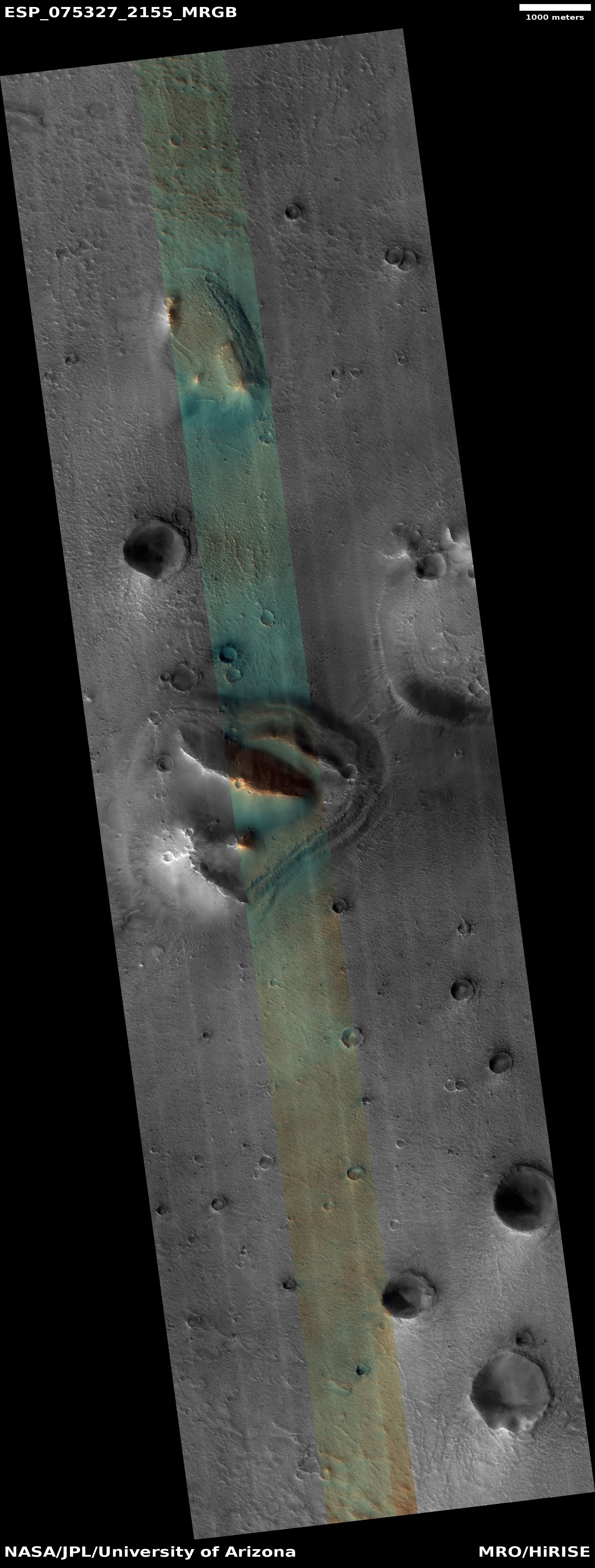
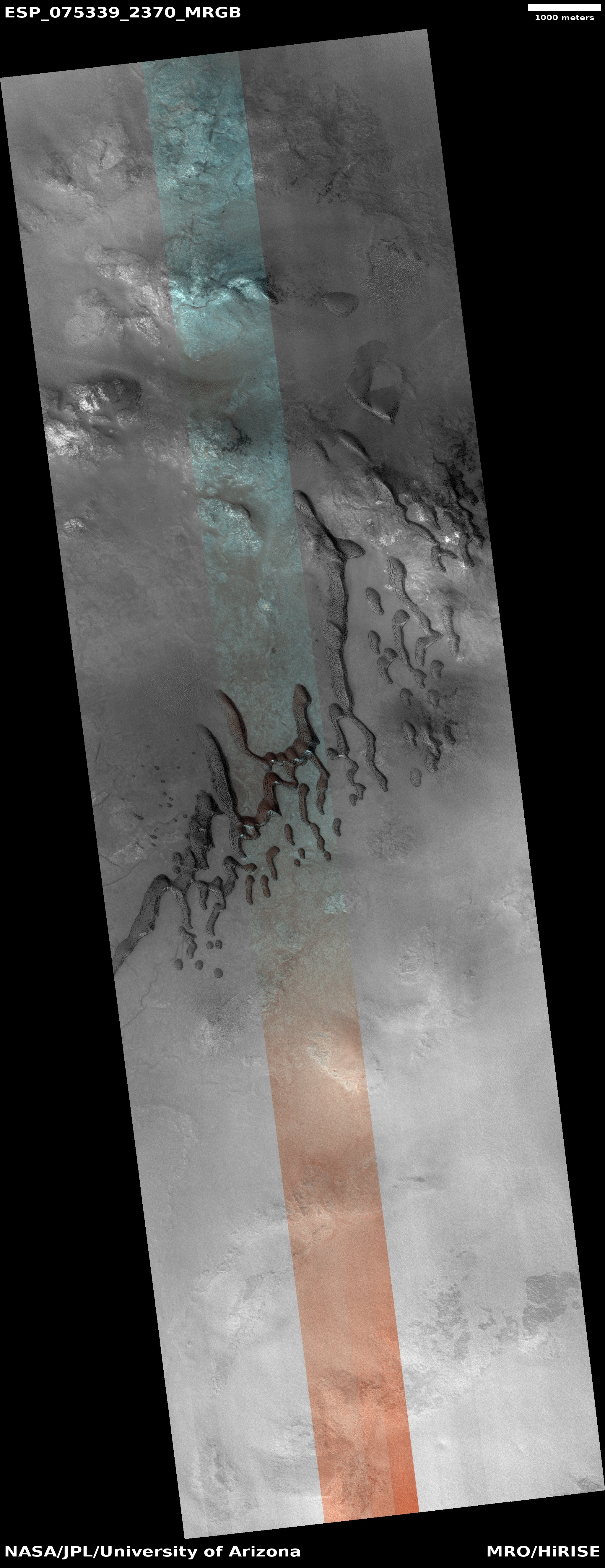
Cool image time! The photo to the right, cropped, reduced, and enhanced to post here, was taken on August 20, 2022 by the high resolution camera on Mars Reconnaissance Orbiter (MRO). It shows a somewhat typical example of the many ice scarps that scientists have identified in MRO pictures.

Though this is not a hard fast rule, most of the ice scarps so far found tend to have the steep cliff on the pole-facing side, with the scarp very slowly retreating towards the equator. In today’s example, the scarp where an ice layer in the cliff wall has been identified is indicated by the white arrow, though three sides of the hollow, on the east, north, and west sides, could all also have exposed ice.

Nor is that the only likely ice at this location at 56 degrees south latitude. The stippled plain surrounding the hollow clearly looks like an eroded ice layer, likely covered with a thin protective coat of dust to protect if from quickly sublimating away. The dark streaks across this surface are likely dust devil tracks.

As documented by the global map below, Mars is like Antarctica, a desert with water ice everywhere.
» Read more

0 comments

Shells of dust surrounding massive binary star

Webb infrared image of dust shells surrounding binary star system
Click for full image.

Cool image time! Using the Webb telescope, astronomers have detected a series of concentric shells surrounding the massive binary star dubbed Wolf-Rayet 140.

The infrared image to the right shows these shells quite clearly. As noted by astronomer Ryan Lau:

“On the night that my team’s Early Release Science observations of the dust-forming massive binary star Wolf-Rayet (WR) 140 were taken, I was puzzled by what I saw in the preview images from the Mid-Infrared Instrument (MIRI). There seemed to be a strange-looking diffraction pattern, and I worried that it was a visual effect created by the stars’ extreme brightness. However, as soon as I downloaded the final data I realized that I was not looking at a diffraction pattern, but instead rings of dust surrounding WR 140 – at least 17 of them.

“I was amazed. Although they resemble rings in the image, the true 3D geometry of those semi-circular features is better described as a shell. The shells of dust are formed each time the stars reach a point in their orbit where they are closest to each other and their stellar winds interact. The even spacing between the shells indicates that dust formation events are occurring like clockwork, once in each eight-year orbit. In this case, the 17 shells can be counted like tree rings, showing more than 130 years of dust formation. Our confidence in this interpretation of the image was strengthened by comparing our findings to the geometric dust models by Yinuo Han, a doctoral student at the University of Cambridge, which showed a near-perfect match to our observations.

Furthermore, the spectroscopy from Webb says these dust shells are carbon-enriched, showing that the dust released by these aged massive stars is a significant source of the carbon in the universe, the fundamental atom needed for life.

5 comments
1 97 98 99 100 101 438