The taffy terrain in Mars’ death valley

Taffy terrain in Hellas Basin on Mars

Cool image time! The picture to the right, rotated, cropped, reduced, and sharpened to post here, was taken on February 21, 2024 by the high resolution camera on Mars Reconnaissance Orbiter (MRO). Labeled “banded terrain and layering,” it actually is a good example of “taffy terrain,” a weird Martian geological formation unique to the Red Planet that scientists as yet don’t quite understand. This 2014 paper only says this:

The apparent sensitivity to local topography and preference for concentrating in localized depressions is compatible with deformation as a viscous fluid. In addition, the bands display clear signs of degradation and slumping at their margins along with a suite of other features that include fractured mounds, polygonal cracks at variable size-scales, and knobby/hummocky textures. Together, these features suggest an ice-rich composition for at least the upper layers of the terrain, which is currently being heavily modified through loss of ice and intense weathering, possibly by wind.

» Read more

0 comments

Mitsubishi joins private consortium building the Starlab commercial space station

The Japanese big space company Mitsubishi has now joined the private consortium building the Starlab commercial space station for NASA, teaming up with Voyager Space and Airbus.

At this moment it appears that Voyager, the lead company in this station, is attempting to capture the international market that up to now has been part of ISS. Airbus gets it direct access to European companies and the Europeans Space Agency (ESA). Mitsubishi now gets it direct access to Japanese government financing.

The other stations being built with NASA financing, Axiom and Orbital Reef, so far seem more focused on getting American business, as is Vast’s Haven-1 station, being built entirely from private funds.

3 comments

Thailand joins China’s partnership to build a lunar base on the Moon

Thailand today signed an agreement with China to become the eighth nation to join its partnership to build its lunar base on the Moon, dubbed the International Lunar Research Station (ILRS).

The partners so far are Azerbaijan, Belarus, Egypt, Pakistan, Russia, South Africa, Thailand, and Venezuela. In addition, another nine academic organizations of one kind or another have signed on. Except for Russia, the partners in China’s program are mostly there for public relations purposes, and will contribute little to the project. And Russia itself will likely not contribute much either, considering its inability to get any major new projects launched for the past two decades.

1 comment

Voyager-1 still out of commission

Though engineers have now confirmed the cause of the computer problem that has prevented Voyager-1 from sending back readable data, a fix has not yet been attempted and the spacecraft remains in safe mode.

In early March, the team issued a “poke” command to prompt the spacecraft to send back a readout of the FDS [Flight Data Subsystem] memory, which includes the computer’s software code as well as variables (values used in the code that can change based on commands or the spacecraft’s status). Using the readout, the team has confirmed that about 3% of the FDS memory has been corrupted, preventing the computer from carrying out normal operations.

The team suspects that a single chip responsible for storing part of the affected portion of the FDS memory isn’t working. Engineers can’t determine with certainty what caused the issue. Two possibilities are that the chip could have been hit by an energetic particle from space or that it simply may have worn out after 46 years.

Although it may take weeks or months, engineers are optimistic they can find a way for the FDS to operate normally without the unusable memory hardware, which would enable Voyager 1 to begin returning science and engineering data again.

Considering that Voyager-1’s power supply will run out sometime in 2026, after almost a half century of operation, the engineers really don’t have that much time to fix the problem and resume science operations.

7 comments

SpaceX launches another 23 Starlink satellites

Like an Energizer bunny: SpaceX last night successfully placed 23 Starlink satellites into orbit, its Falcon 9 rocket lifting off from Cape Canaveral.

The first stage successfully completed its 14th flight, landing on a drone ship in the Atlantic.

The leaders in the 2024 launch race:

34 SpaceX
14 China
5 Russia
4 Rocket Lab

American private enterprise now leads the rest of the world combined 39 to 25, while SpaceX by itself leads the rest of the world, including other American companies, 34 to 30. SpaceX also has another launch scheduled for tonight.

1 comment

Gilmour’s Eris rocket now assembled and ready for launch from Bowen spaceport in Australia

Australian commercial spaceports
Click for original map.

The Austrialia rocket starup Gilmour has now assembled its first Eris rocket in anticipation of its first orbital test launch from that company’s Bowen spaceport on the east coast of Australia.

According to the report at the link, the launch could happen “in the coming weeks,” though no date has been set. Gilmour has already received its spaceport license from the Australian government, but has not yet gotten its launch license from the Australian Space Agency, despite putting in its application two years ago.

It appears there is now a race between this spaceport and the one on the south coast run by Southern Launch to launch first. Both are saying they will launch in mere weeks, but both are also awaiting launch approvals from the Australian Space Agency, which appears to be having difficulties making these first approvals. Either it is dragging its feet, or doesn’t know how to do this yet. Hopefully the bureaucrats will figure out how to say yes to freedom and let these spaceports and companies finally launch, before they run out of cash.

2 comments

NASA picks three commercial companies to build manned lunar rovers

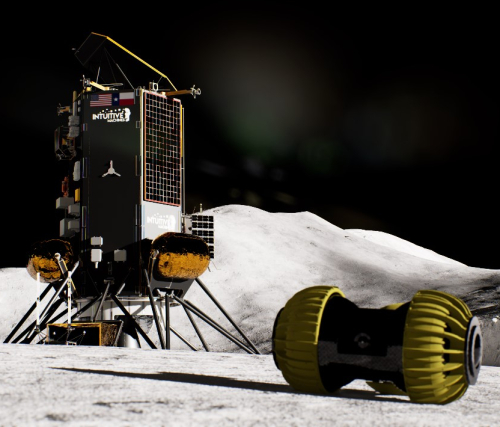
Capitalism in space: NASA yesterday announced that it has picked three commercial companies, Astrolab, Intuitive Machines, and Lunar Outpost, to begin feasibility design work on its new manned lunar rovers, dubbed a Lunar Terrain Vehicle (LTV), for its planned Artemis missions to the Moon.

NASA will acquire the LTV as a service from industry. The indefinite-delivery/indefinite-quantity, milestone-based Lunar Terrain Vehicle Services contract with firm-fixed-price task orders has a combined maximum potential value of $4.6 billion for all awards.

The three companies are actually each a partnership of several American companies, as follows:

  • Astrolab is building its FLEX rover in partnership with Axiom Space, Inc., and Odyssey Space. Its contract is worth up to $1.9 billion.
  • Intuitive Machines is building its RACER rover in partership with AVL, Boeing, Michelin, and Northrop Grumman. This initial award is worth $30 million, but future buys from NASA could exceed $1 billion.
  • Lunar Outpost is building its Lunar Dawn rover in partnership with Lockheed Martin, General Motors, Goodyear, and MDA Space.

All three lead companies are essentially startups that have partnered with older established players, a likely requirement imposed by NASA to give their effort some experienced help. Though this system of dividing up the work between all the players follows the old scheme used by NASA and the established big space companies for decades in order to guarantee every company gets steady work and a continuing cash flow from the government, the difference is that the product will be designed, built, and owned by each partnership, not NASA, allowing each to sell that product to others outside the agency.

If this goes as planned, eventually the government money will become somewhat irrelevant, once a real commercial industry starts functioning in space and on the Moon. That’s what happened in the airplane industry in the 1920s to the 1950s.

8 comments

Engineers confirm IXPE is fixed and resuming science observations

Engineers have now confirmed the software fix they sent to the IXPE space telescope on March 26, 2024 has worked, and have taken the telescope out of safe mode so that it can resume science observations.

The IXPE mission is now observing a new transient X-ray source – Swift J1727.8–161 – a candidate accreting black hole. The source has recently begun producing jets of material moving at a fraction of the speed of light. The IXPE observations will help to understand accretion onto black holes, including potentially revealing how the relativistic jets are formed.

The telescope observes the universe in X-rays, but does so by observing its polarization. This approach provides information not seen in direct observations.

0 comments

Complex ridged terrain in ancient Martian crater

Complex ridges in an ancient Martian crater
Click for original image.

Cool image time! The picture to the right, rotated, cropped, reduced, and enhanced to post here, was taken on January 16, 2024 by the high resolution camera on Mars Reconnaissance Orbiter (MRO). Because an electronic unit for one of this camera’s filters has failed, causing a blank strip in the image center, I have filled in that gap using an MRO context camera image taken October 31, 2015.

The scientists describe this geology as “ridged terrain.” What I see is a surface that was like wet plaster once, and then a giant finger touched it and pulled away quickly, so that as it left some material pulled upward to create random ridges within the depression created by that finger.

These ridges are inside a very very ancient 110-mile-wide crater dubbed Margulis. According to the 2021 poster [pdf] of the scientists who did the first geological mapping of this crater, the crater floor “show remnants of sedimentary materials, suggesting the [crater was] subjected to widespread episodes of resurfacing and denudation.”

Though located in the dry equatorial regions, this ridged terrain suggests it formed suddenly when underground ice sublimated into gas, bursting upward to break the surface when the gas pressure became high enough.
» Read more

0 comments

An abandoned module from one of China’s manned capsules burns up over California

The orbital module of China’s Shenzhou-15 manned capsule, launched with three astronauts in November 2022 and then abandoned in orbit when those astronauts returned to Earth in the spring of 2023, burned up over southern California yesterday.

The fall created a blazing fireball witnessed by people from the Sacramento area all the way down to San Diego, according to the American Meteor Society (AMS). As of Tuesday afternoon, 81 people had reported sightings of the event to the AMS.

It is unlikely, though not impossible, that any pieces hit the ground. The module is considered small enough to be destroyed during descent. Nonetheless, its uncontrolled re-entry highlights China’s general irresponsibility when it comes to space junk. For example, the Russia Soyuz capsule has a similar design, but based on history Russia has for decades routinely controlled the de-orbit of its abandoned orbital module so that it does not come down over land.

3 comments

Technical issues with Lockheed Martin’s Orion capsule to delay next Artemis mission

It appears that technical issues with Lockheed Martin’s Orion capsule are one of the main reasons NASA has had to delay next Artemis mission, the first to put humans inside that capsule and then take them around the Moon.

In January 2024 it was reported that the mission would be delayed from a launch before the end of 2024 until 2025. We now know why:

NASA is working with Orion spacecraft prime contractor Lockheed Martin to resolve a handful of issues that came up late last year during ground testing, forcing the space agency to delay the launch readiness target date for its Artemis II circumlunar mission to September 2025. The Lockheed Martin assembly, test, and launch operations (ATLO) team at Kennedy Space Center (KSC) is reinstalling some electronics and implementing workarounds for others affected by an electrical circuit flaw found in digital motor controllers on the spacecraft.

While a resolution to that issue appears to be getting closer, the Orion program and contractor teams are also working through the corrective actions process for a problem with how the Orion batteries handle the shock of an extreme abort case.

In other words, Lockheed Martin discovered these two electrical issues only last year, after spending almost two decades and more than $15 billion developing Orion.

As I predicted in January, “None of these dates will be met. I predict that further delays will be announced next year and the year after that, pushing all these missions back again, in small increments.” I also predicted that NASA will be lucky to land a human on the Moon by 2030, a mere fifteen years after its original target date of 2015, set by George Bush Jr. in 2004.

In the meantime, expect SpaceX’s Starship to begin regularly commercial and governmental flights to the Moon in the next five years. Long before SLS and Orion put humans on the Moon, Starship will be doing it privately for less cost.

11 comments

White House tasks NASA to create a clock standard for time on the Moon

In a policy announcement yesterday, the White House has directed NASA to establish a coordinated lunar time standard (dubbed LTC) for time on the Moon, similar to Univeral or Greenwich time (UTC) now used on Earth.

A unified time standard—Coordinated Lunar Time (LTC)—will act as the established standard to enable cislunar operations and can be tied to Coordinated Universal Time (UTC), the primary time standard globally used to regulate clocks and time on Earth. This policy directs NASA to work with the Departments of Commerce, Defense, State, and Transportation to deliver a strategy for the implementation of LTC no later than December 31, 2026. NASA will also coordinate with other federal agencies as appropriate and international partners through existing international forums, including Artemis Accords partner nations.

As noted in the full policy statement [pdf]:

Due to general and special relativity, the length of a second defined on Earth will appear distorted to an observer under different gravitational conditions, or to an observer moving at a high relative velocity. For example, to an observer on the Moon, an Earth-based clock will appear to lose on
average 58.7 microseconds per Earth-day with additional periodic variations.

While this difference would be utterly unnoticed by people, the difference will become a problem for GPS systems and other very sensitive systems that depend on precise timing. The new policy will attempt to prevent such issues by getting ahead of the problem. It will also work to coordinate this new lunar universal time with other nations doing lunar exploration.

11 comments
1 248 249 250 251 252 1,327