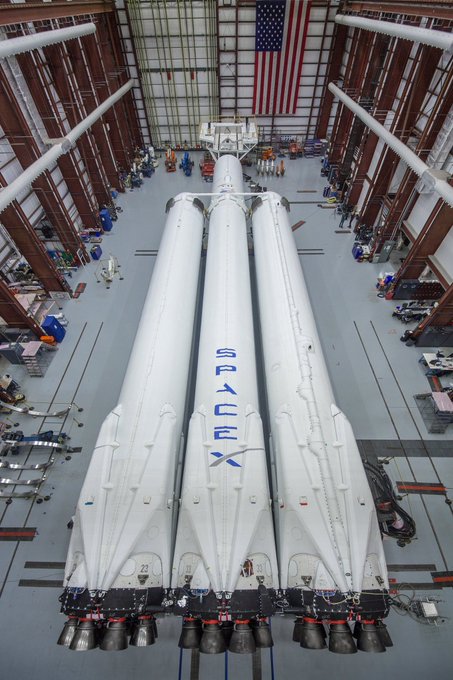
SpaceX aiming to launch 52 times in 2022

According to NASA officials, SpaceX is hoping to complete as many as 52 launches in 2022, a pace of one launch per week.

The impressive figure was given during a virtual meeting of NASA’s Aerospace Safety Advisory Panel, or ASAP, which gives guidance to the space agency on how to maintain safety within its biggest programs. “NASA and SpaceX will have to be watchful during 2022 that they’re not victims of their success,” Sandy Magnus, a former NASA astronaut and member of the panel, said during the meeting. “There’s an ambitious 52-launch manifest for SpaceX over the course of the year. And that’s an incredible pace.”

Based on other sources, I had previously estimated a SpaceX manifest for ’22 to be 40 launches. That this new higher number comes from NASA’s corrupt safety panel, and was touted as a reason to raise questions about SpaceX, makes me suspicious of it.

Still, a launch pace by SpaceX of one launch per week is wholly possible. For one thing, the company needs to get a lot of Starlink satellites into orbit as quickly as possible. With its development of Starship blocked by government interference, it might have decided to up the pace of launches using Falcon 9.

Furthermore, because most of the rocket is reused, SpaceX has a far greater launch capacity. For every Falcon 9 it builds it gets ten or more launches from its first stage. This means SpaceX does not have to build as much to maintain a high launch pace.

As for the safety panel’s fears about such a pace, who cares? That safety panel has been consistently wrong about everything it has said about SpaceX and commercial space now for almost a decade. It is very likely wrong now. In a more rational world, NASA would have shut it down two years ago for doing such a bad job. Sadly, we no longer live in a rational world.

2 comments

Falcon 9 upper stage to impact Moon

A Falcon 9 upper stage launched in February 2015 is apparently now on a course to impact the Moon this coming March.

According to Bill Gray, who writes the widely used Project Pluto software to track near-Earth objects, asteroids, minor planets, and comets, such an impact could come in March.

Earlier this month, Gray put out a call for amateur and professional astronomers to make additional observations of the stage, which appears to be tumbling through space. With this new data, Gray now believes that the Falcon 9’s upper stage will very likely impact the far side of the Moon, near the equator, on March 4.

Grey’s call out for more measurements is because there are uncertainties about this prediction. To prepare for observations of the impact by a variety of lunar orbiters, researchers need better data.

8 comments

NASA: No further Artemis Moon landings for at least two years after first in 2025

The tortoise appears to be dying: NASA today announced that there will be a two-plus year pause of Artemis missions to the lunar surface after it completes its hoped-for first manned Moon landing in 2025.

In presentations at a two-day meeting of the NASA Advisory Council’s Human Exploration and Operations Committee Jan. 18 and 19, agency officials said the Artemis 4 mission, the first after the Artemis 3 mission lands astronauts on the moon, will not attempt a landing itself.

Instead, Artemis 4 will be devoted to assembly of the lunar Gateway. The mission will deliver the I-Hab habitat module, developed by the European Space Agency and the Japanese space agency JAXA, to the Gateway. It will be docked with the first Gateway elements, the Power and Propulsion Element and Habitation and Logistics Outpost, which will launch together on a Falcon Heavy in late 2024 and spend a year spiraling out to the near-rectilinear halo orbit around the moon.

Essentially, the Biden administration appears to be switching back to NASA’s original plans, to require use of the Lunar Gateway station for any future lunar exploration, thus delaying that exploration considerably. Do not expect any of this schedule to take place as promised. The 2025 lunar landing will be delayed, as will all subsequent SLS launches for Artemis. The rocket is simply too complicated and cumbersome to even maintain one launch per year, while inserting Gateway into the mix only slows down lunar exploration even more.

NASA officials also revealed that they are limiting their lunar landing Starship contract with SpaceX to only that single planned ’25 Moon mission. For future manned missions to the Moon the agency will request new bids from the entire industry.

NASA’s Human Landing System (HLS) Option A award to SpaceX last year covers only development of a lander and a single crewed flight on Artemis 3. NASA will acquire future landings through a separate effort, called Lunar Exploration Transportation Services (LETS). The goal of LETS is to select one, and possibly more, companies to provide “sustainable” landing services.

The timing of LETS — a draft request for proposals is scheduled for release this spring — means there will be a gap of a couple years before the first landing service acquired through that program would be ready. “It’ll be about two years from the Option A award to the LETS award before we’ll have this sustainable lander,” Kirasich said. “It’s a different lander with more aggressive requirements than Option A.”

It appears that Jeff Bezos’ political lobbying efforts have paid off, and that NASA is now reopening bidding so that his consortium, led by Blue Origin, can once again compete for that lunar lander contract. Whether the Bezos’ team will be able to propose anything comparable to Starship is however very questionable.

None of this really hurts SpaceX. Its contract with NASA helps them develop a Starship lunar lander. Then, while NASA twiddles its thumbs building Gateway, it will be free to fly its own lunar missions, selling tickets on the open market. I suspect that — should NASA succeed in landing humans in ’25 — the next American manned landing on the Moon will be a bunch of SpaceX customers, not that second Artemis mission sometime in the late 2020s.

SpaceX of course will also be able to bid on that second lunar landing competition. And it will be hard for NASA not to award Starship a further contract, even if others are competing against it. Starship will be operational. The others will merely be proposed.

32 comments

SpaceX’s Starship gets Air Force point-to-point cargo study contract

Capitalism in space: The Air Force Research Laboratory (AFRL) has signed a $102 million five year contract with SpaceX to study the practicality of using its Starship spacecraft as a method for transporting large cargo point-to-point on Earth.

[Program manager Greg] Spanjers said the SpaceX work is focused in four areas: collecting data from commercial orbital launches and landings; exploring cargo bay designs compatible with U.S. Transportation Command containers [TRANSCOM] and support rapid loading and unloading; researching landing systems that can operate on a variety of terrain; and demonstrating the heavy cargo launch and landing process.

The emphasis on landing options and interoperability with TRANSCOM containers and loading processes is an important element of the project, Spanjers noted, because the department’s vision for how the point-to-point capability could be used is broader than just the commercial business case. While companies are primarily interested in delivering cargo to and from established sites, the military wants to deliver supplies and humanitarian aid to locations that may not have spaceports.

This contract is in many ways similar to NASA’s manned Starship lunar lander contract. Both provide SpaceX some cash for developing a different version of Starship, even as the bulk of development money for building Starship comes from the private investment community.

22 comments

SpaceX now blocked from Pakistan; OneWeb signs deal to operate in India

Capitalism in space: Two stories this morning suggest that the competition between the internet satellite constellations Starlink and OneWeb is being partly influenced by local politics, with the influence favoring OneWeb and hindering SpaceX.

First, Pakistan ordered SpaceX to stop taking preorders from its citizens for its Starlink system.

The Pakistan Telecommunication Authority (PTA) said in a Jan. 19 news release that “Starlink has neither applied for nor obtained any license from PTA to operate and provide internet services” in the country. The telecoms regulator advised the general public to refrain from pre-booking the service in Pakistan through Starlink or associated websites.

This order follows a similar decree in India. Like India, SpaceX had apparently not been granted a license or permit to take preorders. SpaceX has now been blocked entirely from the subcontinent by the governments of both countries.

Second, OneWeb and Hughes announced a partnership agreement to distribute its internet service in India.

In the statement, OneWeb’s CEO Neil Masterson said the company would partner with Hughes to “offer high-speed, low-latency satellite broadband solutions and contribute to the Digital India vision”. OneWeb’s constellation, he said, would cover the length and breadth of India, from Ladakh to Kanyakumari and from Gujarat to the Northeast and bring secure solutions to enterprises, governments, telcos, airline companies and maritime customers. “OneWeb will invest in setting up enabling infrastructure such as Gateways and PoPs in India to light up the services,” he added.

According to the announcement, OneWeb intends to start offering its service this year.

OneWeb is half-owned by the Indian-based Bharti group. It seems that this connection with India has greased the bureaucratic wheels in that country for OneWeb, allowing it begin offering its services there. It also appears that this same connection with India is likely one reason both India and Pakistan have put a break on SpaceX’s operations.

1 comment

Flight dates for SpaceX’s next two manned flights to ISS revised

Capitalism in space: A NASA official yesterday announced that the flight dates for SpaceX’s next two manned flights have been firmed up, with the private commercial Axiom AX-1 flight delayed from February 21st to March 31st, followed two weeks later by NASA’s own manned mission on April 15th.

Axiom has also noted that this commercial flight, piloted by a former NASA astronaut and carrying three passengers, will be its only commercial manned flight in ’22.

…Commanded by former NASA astronaut Michael López-Alegría, Ax-1 will only carry private citizens. Each paying $55 million for the privilege, the mission’s three customers are Larry Connor, Mark Pathy, and Eytan Stibbe – all businessmen who’ve respectively amassed multmillion-dollar fortunes in real estate; entertainment and shipping; and military equipment and venture capitalism.

Their Dragon spacecraft will be Resilience, making its third flight.

Axiom’s next private commercial flight has now been delayed until ’23.

0 comments

SpaceX launches another 49 Starlink satellites

Capitalism in space: SpaceX tonight used its Falcon 9 rocket to launch 49 Starlink satellites into orbit.

The first stage successfully landed on a drone ship in the Atlantic Ocean, completing its 10th flight. SpaceX now has three four first stages that have completed at least ten flights. (The correction comes from a comment by one of my readers below.)

The 2022 launch race:

3 SpaceX
1 Virgin Orbit
1 China

7 comments

Philippino presidential candidate meets with SpaceX officials

SpaceX officials have held a virtual meeting with two senators from the Philippines, one of which is running for president, to discuss allowing Starlink service in their country as well as the establishment of a launch site.

TOP executives of SpaceX met with Senators Emmanuel “Manny” Pacquiao and Aquilino “Koko” Pimentel 3rd to discuss the use of low-orbit satellites to provide cheap internet to the Philippines. SpaceX is a space exploration company owned by technology magnate and billionaire Elon Musk.

During the virtual meeting on Saturday, the SpaceX executives also talked about the possibility of setting up a spaceship launch pad in the Philippines.

Pacquiao also proposed projects for Musk’s other companies, Tesla and Boring. He seems enthusiastic about bringing SpaceX to the Philippines. The odds right now of him becoming president however is not great, according to recent polling. This meeting with SpaceX was clearly an effort by him to garner attention and increase his poll numbers.

3 comments

SpaceX launches 105 satellites on its third smallsat launch

Capitalism in space: SpaceX today successfully placed 105 satellites and other spacecraft into orbit using its Falcon 9 rocket.

The first stage successfully landed at Cape Canaveral, completing its 10th flight. The launch itself was SpaceX’s third launch dedicated to smallsats in its effort to compete against the small rockets of Rocket Lab, Virgin Orbit, and Astra for that the smallsat market.

Of those 105 satellites, I actually know the owners of two. First, Joe Latrell, frequent commenter here on BtB, put his first Pocketqube cubesat into orbit, testing a variety of space sensors that could be used to track global water use. Second, Jeremiah Pate’s first Lunarsonde prototype cubesat was launched. If successful, he hopes to launch a constellation of similar cubesats for detecting Earth mineral resources, with six more launches already scheduled in ’22 with SpaceX, Virgin Orbit, Rocket Lab, Northrop Grumman, and Arianespace.

This was SpaceX’s second launch in ’22. At the moment the company is the only entity worldwide to launch anything this year, though Virgin Orbit is targeting its own launch later today.

17 comments

SpaceX pushing to launch 2nd generation Starlink satellites by March

Capitalism in space: In paperwork filed by SpaceX to the FCC, it has announced it is pushing to launch the first second generation Starlink satellites by March, 2022.

While some news reports have suggested that SpaceX intended to launch those upgraded satellites on Starship, this reporting is certainly wrong. As the article at the link correctly notes, SpaceX does not have to state what rocket it plans to use in its paperwork. It could very easily launch these first upgraded satellites on a Falcon 9.

The story however does provide this interesting tidbit about the FCC’s treatment of SpaceX in this licensing process:

SpaceX filed the first unmodified Gen2 Starlink application with the FCC in May 2020, requesting permission to launch an unprecedented 30,000 satellites. While the size of the proposed constellation is extraordinary, the FCC has also been exceptionally slow to process it. Only five months after SpaceX submitted its Starlink Gen2 modification request and nineteen months after its original Gen2 application did the FCC finally accept it for filing, which means that it has taken more than a year and a half to merely start the official review process. [emphasis in original]

In other words, the FCC stalled SpaceX for more than a year and a half. If the DC bureaucracy can play such games with Starlink, this suggests it might very well be doing the same with the approval of the environmental reassessment for SpaceX’s Boca Chica facility, which the FAA has now delayed repeatedly since last year. There are many people in Washington, both in the Biden administration and in the established and permanent bureaucracy, who do not like SpaceX’s success or its independence, and wish to use government power to squelch it. This story provides us some evidence that such misuse of government power in the FAA is very likely occurring.

3 comments

Starlink temporarily backs out of India due to regulatory snafu

Capitalism in space: Starlink in India has stopped taking new preorders and is refunding all previous preorders of its internet service because it had failed to get the proper regulatory permits for selling its service.

India’s Ministry of Communications issued a Nov. 26 statement instructing SpaceX to “refrain from booking/rendering” Starlink services “with immediate effect” because the company did not have a license to operate in the country.

In the days that followed, SpaceX appeared to be still accepting $99 preorder deposits via Starlink’s website for addresses in India.

But the website now tells prospective subscribers: “Starlink is not yet available in your area due to pending regulatory approval. As we receive approvals our coverage area will continue to expand, so please check back for future availability in your area.”

The head of Starlink India also announced his resignation today. It appears he not only did not get the proper permissions, he ignored that November 26 order from the government.

SpaceX apparently is now reviewing the legal situation, which is very unclear and might even block the company from selling its services in India entirely. No timeline is presently known for restarting its operations there.

0 comments
1 103 104 105 106 107 234