
Russia vetos UN resolution put forth by U.S to ban nuclear weapons in space

Russia yesterday vetoed a UN resolution by the U.S and Japan that proposed banning all nuclear weapons as well as “other weapons of mass destruction” in space.

This is all a game by the diplomats and politicians in power on both sides.

U.S. National Security Advisor Jake Sullivan on Wednesday echoed [U.S. ambassador] Thomas-Greenfield, reiterating that “the United States assesses that Russia is developing a new satellite carrying a nuclear device.” If Putin has no intention of deploying nuclear weapons in space, Sullivan said, “Russia would not have vetoed this resolution.”

Russia’s U.N. Ambassador Vassily Nebenzia dismissed the resolution as “absolutely absurd and politicized,” and said it didn’t go far enough in banning all types of weapons in space. Russia and China proposed an amendment to the U.S.-Japan draft that would call on all countries, especially those with major space capabilities, “to prevent for all time the placement of weapons in outer space, and the threat of use of force in outer spaces.”

The vote was 7 countries in favor, 7 against, and one abstention and the amendment was defeated because it failed to get the minimum 9 “yes” votes required for adoption.

So Russia vetos the U.S. resolution, and the U.S. and its allies veto the Russian resolution. In both cases neither side intends to stop work on its space weaponry, nor will either allow any independent inspections of their facilities. Moreover, both resolutions are irrelevant, because these nations are all signatories to the 1967 Outer Space Treaty, which already outlaws the placement of nuclear weapons in space.

As I said, it is all a game, intended not to stop deployment of such weapons but to try to embarrass their opponents.
10 comments

African lawfare to take control of space

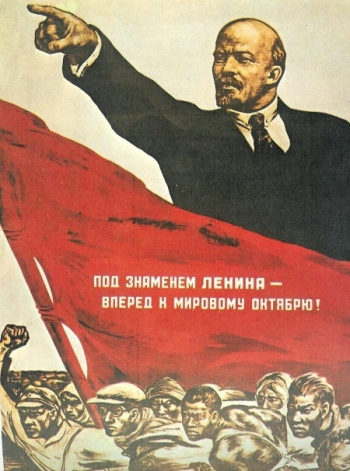
Modern academia: Marching with Lenin!
Modern African academia, proudly marching with Lenin!

It appears that a growing cadre of African lawyers are working within international organizations such as the UN and the International Astronautical Union (IAU) to use the Outer Space Treaty as a wedge to take control of space, wresting it from the hands of private commerical companies.

I make this assessment based upon a long article about this new lawfare published today in Wired, describing the training and political goals of a number of young African layers in the field of international space law.

[S]ome players in the global south are gearing up for the orbital future not just by scrambling to launch satellites, but by building up skills in outer space law—the evolving area of international jurisprudence that introduced the “province of all mankind” concept in the first place.

Though the Outer Space Treaty is still the cornerstone of space law, other international agreements have built up around it over the years—and more still are desperately needed to regulate today’s realities in space. “This is an area of rulemaking where they’re just setting up the rules for the future, so you need to have a perspective now,” explains Timiebi Aganaba, a British-Canadian-Nigerian professor at Arizona State University who has been instrumental in driving African interest in space law. “If the system gets built without you—if you come in later—people will start quoting laws to you.”

In 2011, Aganaba helped organize the first teams of African law students to enter something called the Manfred Lachs Space Law Moot Court Competition. The global tournament, named after an architect of the Outer Space Treaty, uses fictional court cases to train young lawyers how to think through the plausible conflicts that could soon arise beyond the atmosphere—and it is far and away the most important professional conduit into the field of space law. Students who make it to the final round of the competition argue their cases before actual judges from the International Court of Justice—the world’s highest forum for legal disputes between countries. And since 2011, teams from Africa have become a force in the competition. In 2018, South Africa’s University of Pretoria won the international championship.

If Aganaba’s name rings a bell to my readers, it is no surprise. » Read more

9 comments

Belgium signs the Artemis Accords

Belgium yesterday became the 34th nation to sign the American-led Artemis Accords, bi-laterial agreements initially conceived by the Trump administration as a way to get around the legal limitations on private property created by the Outer Space Treaty.

Based on the wording of Belgium’s press release, it appear however that this goal is slowly being watered down by the many nations who have signed:

Belgium’s signature of the Artemis Accords is part of its proactive participation in the work of the United Nations Committee on the Peaceful Uses of Outer Space (UNCOPUOS). As a party to the five United Nations treaties on outer space, Belgium, in close collaboration with other Member States, has launched several actions within the Committee over the past decade to promote the establishment of an international multilateral legal framework for equitable access to and benefits from space resources, as well as for the safe and sustainable use of these resources. [emphasis mine]

The highlighted word, “equitable”, is one of the key words in Critical Race Theory, and when translated into plain English means providing guaranteed benefits for those who feel oppressed, whether or not they deserve it. Note too Belgium’s effort here to get the United Nations involved. By outlawing any nation from claiming territory and establishing its legal framework, the Outer Space Treaty essentially gave that power to the UN. The accords were conceived as a political way of breaking that restriction, shifting power back to the nations who signed. By inserting the UN into the Artemis alliance Belgium is trying to shift power to the UN again. And it appears it is attempting to form its own alliance of the smaller nations within the accords for this purpose.

The full list of signatories to the Accords is as follows: Angola, Argentina, Australia, Bahrain, Belgium, Brazil, Bulgaria, Canada, Columbia, Czech Republic, Ecuador, France, Germany, Iceland, India, Israel, Italy, Japan, Luxembourg, Mexico, the Netherlands, New Zealand, Nigeria, Poland, Romania, Rwanda, Saudi Arabia, Singapore, South Korea, Spain, the United Kingdom, the United Arab Emirates, the Ukraine, and the United States.

The competing alliance of communist nations, led by China, includes only Russia, Venezuala, Pakistan, Belarus, Azerbaijan, and South Africa. That former deep Soviet bloc nations like Bulgaria and Romania, as well as previously very Marxist Angola, went with the west rather than China illustrates the international distrust of China and its authoritarian methods.

0 comments

Israel’s Pearl Harbor

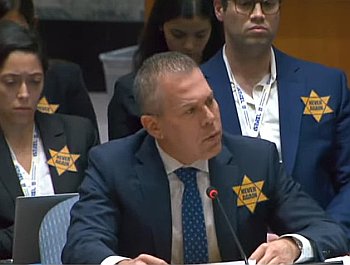
Israel's Israeli ambassador wearing a yellow star
The Israeli UN ambassador and his staff wearing
yellow stars to shame the world’s diplomatic com-
munity for its willingness to appease mass murderers.

For Israel, it is now quite apparent that the mass murder by Hamas of more than a thousand Israeli civilians, including women, children, and babies, was not perceived as just another terrorist attack requiring a measured and surgical response.

No, in this case the entire nation of Israel, from the secular left to religious right, has finally recognized that Hamas had long ago declared war on the Jewish people, and the massacre on October 7th was its way of underlining that state of war.

Israel is now responding in kind, just as the United States did after Pearl Harbor. After that attack on December 7, 1941, American were resolved that they were in a war of survival that could not end until the Axis powers of Germany and Japan were utterly obliterated. There would be no ceasefire or negotiations, as had happened at the end of World War I.

For the Israelis, October 7th is their day of infamy. It is for this reason that the Israeli ambassador put on a yellow star yesterday, similar to the Star of David the Nazis forced Jews to wear, but with the words “Never Again” emblazoned thereon. He then bluntly told the appeasers at the United Nations:
» Read more

18 comments

Russia gets a launch contract!

In what has become a very rare event, Russia’s state-run press today announced that Roscosmos has won a launch contract for its Soyuz-2 rocket from the United Arab Emirates (UAE).

“On June 27th at 3:34 p.m. UAE time [2:34 Moscow time], [UAE’s] MBR Space Centre will launch its maiden mission, PHI-Demo, from Russia’s Vostochny Cosmodrome using the Soyuz-2 rocket as part of the Payload Hosting Initiative,” the media office said in a statement.

The statement says that the initiative, jointly led by MBRSC [UAE’s space agency] and the United Nations Office for Outer Space Affairs (UNOOSA), is aimed at providing space access and hastening the sustainable progression of novel space technologies.

The satellite will be a secondary payload on the launch of a Russian weather satellite.

It seems this UN office wants to help the Russians, and is working to encourage other nations to use its rockets to get into space. Because of Russia’s invasion of the Ukraine, it has lost all of its international launch business. UNOOSA is apparently working to recover Russia some of that business.

The UAE meanwhile appears to be trying to light the candle from both ends, working extensively with NASA and American private companies while also attempting to partner with Russia and China.

0 comments

Trump halts payments to WHO

President Donald Trump today announced that he is halting the U.S. contribution to the World Health Organization (WHO) as a result of its poor response to the Wuhan flu.

Trump declared that the United States would undertake a 60-to-90 day investigation into why the “China-centric” WHO had caused “so much death” by “severely mismanaging and covering up” the coronavirus’ spread, including by making the “disastrous” decision to oppose travel restrictions on China.

The United States is the WHO’s largest single donor, and the State Department had previously planned to provide the agency $893 million in the current two-year funding period. Trump said the United States contributes roughly $400 to $500 million per year to WHO, while China offers only about $40 million. The money saved will go to areas that “most need it,” Trump asserted.

This type of action is what has differentiated Trump from the politicians from either party since Ronald Reagan was president. All the presidents since Reagan would have, at best, called an investigation (fake in truth) and in the end done nothing to change anything. Trump has repeatedly put the hammer down hard on international organizations like WHO that fail to do their job, or act as agents for foreign governments.

That money can certainly be put to better use than giving it to the bureaucrats at the UN, almost all of whom are avowed enemies of the United States and of freedom.

0 comments

500 climate scientists challenge the UN on global warming

On September 23, 2019 letter, five hundred established scientists from across the globe told the United Nations that there is no climate emergency and that it as yet far from certain that human activity is warming the climate.

I should have reported this when it happened, but missed it until today. The letter made six main points:

  • Nature as well as anthropogenic factors cause warming
  • Warming is far slower than predicted
  • Climate policy relies on inadequate models
  • Carbon dioxide is “plant food, the basis of all life on Earth”
  • Global warming has not increased natural disasters
  • Climate policy must respect scientific and economic realities

None of these points is radical or unreasonable. Regular readers of this website will recognize all six, as I have been repeating them all incessantly for almost a decade. They fit into standard scientific practice, which requires solid, reliable, and confirmed data before any theory can be accepted wholesale. None of the models, based on the theory that the rise in carbon dioxide is causing the climate to warm, have worked. As far as we know now, CO2 might have nothing or little to do with climate change. We. just. don’t. know.

Not surprisingly, the letter was immediately attacked by global warming activist Michael Mann (who still tries to pose as a climate scientist though very few buy it). Rather than rationally question these points with data, he simply made an ad hominem attack, calling the letter “craven and stupid” while implying that anyone who signed it was beyond evil.

Worse, the UN itself decided to ignore the letter, instead pushing forward with its global warming agenda designed to destroy capitalism and make us all as poor as the citizens of Venezuela, all in the name of a scientific theory that no one has been able to prove, in any way at all.

23 comments

UN faces financial shortfall

My heart bleeds: The head of the UN today announced that it faces a financial shortfall in October that might force it to cut its bloated budget and reduce the number of posh conferences it holds.

The United Nations (UN) is running a deficit of $230 million, Secretary General Antonio Guterres said on Monday, and may run out of money by the end of October.

In a letter intended for the 37,000 employees at the UN secretariat and obtained by AFP, Guterres said unspecified “additional stop-gap measures” would have to be taken to ensure salaries and entitlements are paid. “Member States have paid only 70 per cent of the total amount needed for our regular budget operations in 2019. This translates into a cash shortage of $230 million at the end of September. We run the risk of depleting our backup liquidity reserves by the end of the month,” he wrote.

To cut costs, Guterres mentioned postponing conferences and meetings and reducing services, while also restricting official travel to only essential activities and taking measures to save energy.

For a short but detailed explanation of the present status of the U.S. policy and politics towards funding the U.N., see this Congressional Research document [pdf]. It appears that the effort by the Trump administration to stop funding certain UN operations, including Palestinian terrorist organizations, might be a major contributing factor to this shortfall.

7 comments

India sides with Israel in UN for the first time

On June 6 the Indian government for the first time voted in support of Israel and its motion against a Palestinian non-governmental organization linked to jihadi terrorist groups.

The vote took place on June 6, just weeks after Prime Minister Narendra Modi and his allies won a two-thirds majority in the Indian general elections. Since Modi took office in May 2014, India has mostly abstained from voting on UN resolutions targeting the Jewish state but has shied away from siding with Israel at the international body.

…By backing Israel at the UN, Prime Minister Modi has finally broken away from the country’s historical voting pattern of siding with the Arab and Muslim countries.

Modi’s landslide election victory probably helped bring about this change of position. I also suspect that Trump’s decision to cut off funds from Hamas and other Palestinian terrorist organizations, while moving the U.S. embassy to Jerusalem, also made it easier for Modi to make this change. Trump has essentially said that the Palestinian emperor has no clothes (ie they are not interested in peace, only killing Jews), and this has allowed many others to chime in as well.

3 comments

Japan quits global whaling regulatory body

Japan yesterday announced that it is quitting the International Whaling Commission, a global whaling regulatory body founded shortly after World War II to regulate commercial whaling that has instead in recent years attempted to ban all commercial whaling, except for favored native tribes in Russia and the Arctic.

The article’s last few paragraphs provide the real political background to this move by Japan:

An IWC-Japan divorce is the culmination of a wide ideological divide at the commission between ardent anti-whaling nations and countries seeking recognition of limited commercial whaling activities as legitimate. The anti-whaling forces have the upper hand, even though IWC’s expansion has seen more pro-whaling countries joining in recent years.

At the Brazil gathering, Japan had attempted to nudge the IWC toward reforms that would have potentially paved the way for a resumption of commercial whaling. The IWC was initially established to regulate whaling but has enforced an outright moratorium on commercial whaling operations since the 1980s in a desperate bid to prevent the extinction of several whale species. Many whale species have since recovered to a degree, but a few are still considered endangered.

Japan’s reform push was easily voted down. Instead, a majority of IWC members voted to have the commission turn its back on commercial whaling for good. That successful resolution also condemned Japan’s scientific whaling practices, widely regarded as a clandestine commercial operation as Japan’s whaling fleet takes hundreds of whales each year, with the meat ending up in grocery stores and restaurants.

IWC also approved subsistence whale hunts for Arctic aboriginal communities.

The large Japanese delegation at Brazil didn’t hide its frustration. The government accuses IWC members of hypocrisy for allowing culture exemptions from the moratorium for Alaskan and Russian native groups, but not for Japan and Scandinavian whaling cultures.

In other words, this commission has become increasingly political. Rather than focusing on protecting whale populations while allowing whaling by all parties, it has decided to pick and choose who can whale, and has decided to ban Japan while giving others the right to whale.

This political bias is not much different than what was seen at the Paris climate accords. Those agreements put odious restrictions on U.S. commercial activity, while putting no restrictions on China and others. It was this political bias, totally divorced from any sincere effort to reduce CO2 emissions, that prompted Trump to exit that agreement.

30 comments

Laid off workers supported by Hamas, take over UN refugee headquarters

Chaos in Gaza: Union workers for the UN Relief and Works Agency (UNRWA) have seized control of its headquarters in protest of lay-offs caused by the withdrawal of financial support by the United States.

The United Nations Relief and Works Agency (UNRWA) announced last month more than 250 staff in Gaza and Judea and Samaria would lose their jobs, after a $300 million cut in annual funding from the United States. The redundancies have prompted daily protests by the agency’s labour union in the enclave, which UNRWA’s Gaza head said have led to security concerns. “They have taken over the compound where my office and other offices are,” said Matthias Schmale.

The agency’s Gaza chief admitted UNRWA does not have full control over the site, in Gaza City, explaining he has not been able to access his own office for more than two weeks. “I am the captain of the ship which has 13,000 sailors on it and they have basically thrown me off the bridge and consigned me to my captain’s quarters,” he told AFP, referring to the number of employees in Gaza.

Schmale accused the labor union of multiple incidents of “threatening and intimidating other fellow Palestinian staff. For me that crosses a red line. … I am very concerned about the safety and security of my Palestinian colleagues,” he added.

It appears the take over is backed by Hamas.

What we are seeing here is the possible collapse of the entire UN/Arab structure that has for decades used the Arab refugees from Israel — and their descendants — as political pawns. Rather than repatriate these people into Egypt or Jordan, both countries as well as the entire Arab world, with the help of the UN and sadly a lot of U.S. money, forced them into refugee camps and thus used them as a hammer against Israel

Without U.S. financial support, however, this ploy cannot work. The protests and violence coming from Gaza in the past year has been a response to this collapse. Hamas has depended on that funding to keep itself in power. Without it, it cannot pay off its supporters.

0 comments

U.S. withdraws from UN Human Rights Council

As long promised if it didn’t reform its anti-U.S. and anti-Israeli biases, the U.S. today officially withdrew from UN Human Rights Council.

I especially like the blunt statement by U.S. UN ambassador Nikki Haley in announcing the withdrawal:

“For too long, [the U.N. Human Rights Council] has been a protector of human rights abusers and a cesspool of political bias,” Ms. Haley said in announcing the move during a joint appearance at the State Department with Mr. Pompeo.

“Regrettably,” she added, “it is now clear that our call for reform was not heeded.”

It appears that this withdrawal means that the council will no longer be getting any U.S. funds.

11 comments

China offers its space station to the UN

The United Nations and China have signed an agreement whereby UN member nations can apply to run experiments on China’s space station, due to become operational in the 2020s.

The UN press release states that it is especially interested in applications from developing nations.

This isn’t a surprise. China is following the approach of the Soviet Union under Leonid Brezhnev during the 1970s and 1980s, using its space station program to generate positive international propaganda. This will also give them an opportunity to obtain technology ideas from other nations.

At the same time, this will force China to become more open with other nations, a side effect of Brezhnev’s space station program that was not expected or even wanted by the Russians at the time.

0 comments

UN agreement reached on space sustainability

In February a UN committee helped negotiate a agreement with 87 nations for establishing rules for space sustainability.

The agreement was reached during a meeting of the United Nations Committee on the Peaceful Uses of Outer Space (COPUOS). COPUOS was created in 1959 as the main UN body to govern the exploration and use of space, and was instrumental in the creation of the five major space treaties. It has been the main multilateral forum where countries meet to discuss space issues and share updates on national activities and practices. As of 2018, those eighty-seven countries are formal members of COPUOS, with Bahrain, Denmark and Norway being the most recent additions. There are also nearly 40 observer organizations, including the Secure World Foundation.

…In 2016, the first set of 12 guidelines were agreed to by a consensus of all the members of COPUOS, and the mandate of the LTS Working Group was extended through 2018. The most recent meeting of STSC in February 2018 saw the LTS Working Group reach consensus on nine more guidelines and the preamble text, bringing the total to 21, as well as agreeing to review their implementation and potentially update them. The 21 guidelines represent countries’ best practices across a broad spectrum of space issues.

Though all of the guidelines essentially confirm policies that these nations have been following, they were reaffirmed by this agreement partly because of the Chinese anti-satellite test in 2007 that produced a lot of space junk.

A review of the guidelines reveals them to be mostly sensible and necessary. The problem is that this process is establishing the precedent that such rule-making should apply to all space activities, and it shall be imposed by UN committees of government bureaucrats here on Earth. For example, the process here appears to be entirely political, and involved none of the actual companies that build and produce rockets and satellites.

At some point in the future, such rule-making should be the responsibility of those who work and and live in space. I predict when that time comes, the UN and the political bureaucracies from these nations will be loath to give up this power. Stay tuned for the eventual rebellion that will follow.

0 comments

Trump administration withholds $65 million from UN PLO agency

The Trump administration today withheld $65 million of a $125 million payment from the UN agency that is supposed to provide aid to Palestinian refugees but has instead been repeatedly found to use it to help the PLO and Hamas in terrorist acts.

In a letter, the State Department notified the U.N. Relief and Works Agency that the U.S. is withholding $65 million of a planned $125 million funding installment. The letter also makes clear that additional U.S. donations will be contingent on major changes by UNRWA, which has been heavily criticized by Israel. “We would like to see some reforms be made,” said State Department spokeswoman Heather Nauert, adding that changes are needed to the way the agency operates and is funded. “This is not aimed at punishing anyone.”

The State Department said it was releasing the rest of the installment — $60 million — to prevent the agency from running out of cash by the end of the month and closing down. The U.S. is UNWRA’s largest donor, supplying nearly 30 percent of its budget. The agency focuses on providing health care, education and social services to Palestinians in the West Bank, Gaza Strip, Jordan, Syria and Lebanon.

Not surprisingly, the PLO is reacting like a five year old, throwing a tantrum, as if it deserves this money no matter what it does.

2 comments

U.S. freezes $125 million grant to UN agency that funds Hamas in Gaza

This is probably related to my previous post: The Trump administration has frozen the payment of a $125 million grant to the UN agency that supposedly does refugee work in Gaza but has been found in the past to help Hamas with its terrorist activities.

The amount frozen is one-third of the annual funding the United States provides the organization, according to the report.

The three diplomats, who asked to remain anonymous because of the political sensitivity of the issue, told Channel 10 the grant had been frozen until the end of the reexamination of U.S. aid to the Palestinians, which began in recent days. According to the diplomats, officials in the administration have informed UN officials in the past two days that President Donald Trump is considering cutting this amount completely and could even increase the cut to $180 million, which would be half the total U.S. funding for UNRWA.

From the article it appears that there are conflicting opinions about this action in the Israeli government.

UNRWA has been caught using its schools for Hamas anti-Semitic propaganda as well a place to store missiles. Let me repeat that: The UN and Hamas think there is nothing wrong with using schools to store weapons.

But hey, let’s give them millions so they won’t get upset at us!

4 comments

Builders of Ghana’s first satellite push for government help

The new colonial movement: The student engineers who built Ghana’s first satellite, GhanaSat-1 and launched in July, are pushing their government to establish the legal framework for future space activities in that country.

Student engineers behind the successful launch of Ghana’s first satellite into orbit have appealed to the government to set up a multi-stakeholder committee to come up with an act, the Ghana outer space act, a key requirement that would enable the country to ratify and sign the United Nations Outer Space Treaty.

They said if the country signed and ratified the treaty, it would give investors the signal and confidence that the country was ready for them to come and establish space science facilities.

The description in the article of what these students want suggests they do not quite understand the ramifications of all the UN space treaties, because it appears they also want Ghana to become signatories to them all. This would be a big mistake. While every country that launches satellites is a signatory to the Outer Space Treaty, very few have signed the Moon Treaty, as its language puts far more serious restrictions on property rights.

0 comments

WHO fakes data to claim weedkiller causes cancer

Par for the course: IARC, the agency of the World Health Organization (WHO) that focuses on cancer research, has apparently faked data so that it could make the claim — in opposition to every other published paper in the world — that a commonly used weedkiller causes cancer.

This detail about the man in charge might explain what happened:

The chairman of the IARC sub-group tasked with reviewing evidence of glyphosate’s effect on laboratory animals was Charles Jameson, an American toxicologist. In testimony as part of personal-injury lawsuits against Monsanto in the United States, Jameson told lawyers for Monsanto he did not know when, why or by whom the edits had been made.

Monsanto is facing multiple legal claims in the U.S. from plaintiffs who allege glyphosate gave them or their loved ones cancer. Jameson is an expert witness for the plaintiffs. He did not respond to questions for this article. [emphasis mine]

If you want to read the whole ugly story, go to the second link above. This report cites numerous examples where IARC clearly fudged their reports to hide the fact that their conclusions were consistently debunked by other research.

11 comments

A modern academic looks at the Outer Space Treaty

Link here. I could also label this another sign of the coming dark age. Consider her proposals:

Space laws need to be updated for our time. Extending the Outer Space Treaty or writing a new one is unlikely to work, as US hesitancy to sign the [Treaty on Prevention of the Placement of Weapons in Outer Space and of the Threat or Use of Force Against Outer Space Objects (PPWT)] shows. ‘Soft law’, driven by need, seems the best option for revising the rules for space operators.

Soft law comprises rules or guidelines that have legal significance but are not binding. It sets standards of conduct for agreeing parties, much like those that protect the environment and endangered species. ‘Rules of the road’ and best practices for space should be developed. These could take a similar form to the navigation guidelines set out in the 1972 Convention on International Regulations for Preventing Collisions at Sea, which govern when one vessel should give way to another, as well as other interactions.

Soft law works when it is in the interest of all parties to abide by it. If countries and companies want to maintain the space environment as a usable domain, then it is in their interests to accommodate a variety of operations. Space is more complex to manage than air, land or sea because of the distance, physics and technology involved. Just as in the cyber domain, technology has preceded regulation, making it difficult to impose after the fact.

The first focus of an analogous set of space guidelines should be environmental protection and debris avoidance, areas that most spacefaring nations agree on. [emphasis mine]

Rather than fix a bad law, the Outer Space Treaty, that is binding on everyone, she proposes the we make the laws “soft,” thus unreliable because everyone can ignore them whenever they want. The result? Utter contempt for the law.

Then she indicates her main interest, which isn’t exploration or the settlement of the solar system, which is the actual interest of the people who are building rockets and spaceships, but “environmental protection.” Above all, we must establish strict regulations that will prevent those pristine lifeless worlds from being damaged by us evil humans!

If anything is a prescription for stunting the growth of space exploration, this is it. Unfortunately, it appears that this prescription is also the dominate intellectual approach of today’s academic community.

7 comments

Senate committee approves funding for UN global warming bureaucracy

Our beloved Democratic-controlled Senate: A Senate committee today rejected Trump’s proposal to cut all UN spending for its global warming bureaucracy, including the IPCC, and re-installed the $10 million budget item.

It is important to note how the vote went:

The amendment passed 16-14. Republican Senators Susan Collins of Maine and Lamar Alexander of Tennessee voted in favor, as did all committee Democrats except for West Virginia’s Joe Manchin.

Essentially, the Senate is now controlled by the Democrats, with the help of a handful of fake Republicans. I should add that the Republican leadership is partly allowing this, by not imposing any party discipline on any of its members.

1 comment
1 2 3 4