Relativity leases manufacturing space from NASA

Capitalism in space: The smallsat company Relativity has leased a large manufacturing space at NASA’s Stennis Space Center in Mississippi where it plans to build its Terran 1 rocket, set for first launch in 2020.

The Stennis center will eventually employ 200 engineers, nearly double the company’s current workforce of 90. The state of Mississippi offered a “significant” incentive package, the company said in a statement. “We’re reducing the human labor component significantly,” said Ellis, a veteran from Jeff Bezos’ space firm Blue Origin, referring to Relativity’s two-story-tall 3D printer arms named Stargate.

Stargate will enable the production of an entire rocket in under 60 days, said Ellis, who is looking to launch nearly two dozen a year in the next five years to prove the company’s production method.

Terran 1’s debut launch is expected in 2020, costing satellite makers $10 million per flight and carrying around 2,755 pounds (1,250 KG) to low earth orbit. That lands the company between U.S.-New Zealand competitor Rocket Lab, whose Electron rocket aims to send nearly 500 pounds to space for $5.7 million, and Cedar Park, Texas-based Firefly Aerospace Inc’s Alpha rocket, which is expected to loft 2,200 pounds (1,000 kg) into low-Earth orbit at a cost of $15 million per flight.

The company has three launch contracts, but they won’t be real until they start launching. If their 3D printing approach works it will cut their costs significantly. Whether it will work or not remains an open question. The 3D printing work I’ve seen with other rockets raises questions about exactly how much of a rocket engine you can make in such a way.

1 comment

Museum decides T-Rex skeleton has no gender

The coming dark age: Officials at the Field Museum in Chicago have decided that since scientists were never able to determine the sex of their most famous T-Rex skeleton, they will now refer to it as if was gender neutral.

According to Arc Digital, “Sue,” Field Museum’s Tyrannosaurus Rex — one of the most complete and largest T-Rex skeletons ever discovered — is working on becoming a “gender neutral” icon by adopting gender-neutral pronouns in her new private exhibit on the museum’s second floor.

Sue is not, in fact, gender neutral or gender fluid. The T-Rex skeleton, discovered in South Dakota in the 1990s, was either male or female. The scientists who discovered Sue believed the skeleton belonged to a female because female T-Rexes are larger than male T-Rexes, and Sue was one of the largest dinosaur skeletons ever found; she’s named “Sue” after Susan Hendrickson, who led the team that unearthed her.

But back in March 2017, Arc Digital reports, the museum decided to have a little fun, and in response to a question lobbed during a Twitter Q&A, Sue claimed that she was “gender neutral” because her sex was unknown, and that she preferred the pronouns they/their/them.

By March 2017, though, Sue, who had graced the museum’s central rotunda for more than a decade, was due to move upstairs to make room for an even larger dinosaur skeleton, and when constructing her pernament home in the museum’s dinosaur exhibit, museum officials adopted Sue’s social media gender-neutral tendencies and made them official. “In her new suite, some of the signage describing the fossil has adopted non-binary pronouns,” Arc Digital says. “One sign does make the distinction between SUE the museum ambassador/Twitter star and the fossil itself, noting that the fossil is properly referred to as ‘it.’ But some of the rest of the signage uses ‘their’ pronouns and seems more interested in teaching museum-goers about the trendy movement for acceptance of non-binary identity than it does about paleontology.”

Our society is truly becoming delusional. This dinosaur was not gender neutral. It goes against every principle of science that a science museum is supposed to be teaching to make believe it is.

Worse, this is a form of political pandering that is disgraceful. It is not the job of the Field Museum to take sides in this sexual political battle. Not only is it inappropriate, it assumes all who enter the museum will agree with them, something that is decidedly a false assumption.

In a sane world I would expect donations to the museum to drop because of this. Unfortunately, I am not convinced we live in a sane world.

4 comments

First confirmed Ebola case in Uganda

Officials have now confirmed the first case of Ebola in Uganda since the present outbreak of the contagious disease in the Congo.

The confirmed case is a 5-year-old child from the Democratic Republic of the Congo who travelled with his family on 9th June 2019. The child and his family entered the country through Bwera Border post and sought medical care at Kagando hospital where health workers identified Ebola as a possible cause of illness. The child was transferred to Bwera Ebola Treatment Unit for management. The confirmation was made today by the Uganda Virus Institute (UVRI). The child is under care and receiving supportive treatment at Bwera ETU, and contacts are being monitored.

The Ministry of Health and WHO have dispatched a Rapid Response Team to Kasese to identify other people who may be at risk, and ensure they are monitored and provided with care if they also become ill. Uganda has previous experience managing Ebola outbreaks. In preparation for a possible imported case during the current outbreak in DRC, Uganda has vaccinated nearly 4700 health workers in 165 health facilities (including in the facility where the child is being cared for); disease monitoring has been intensified; and health workers trained on recognizing symptoms of the disease. Ebola Treatment Units are in place.

In response to this case, the Ministry is intensifying community education, psychosocial support and will undertake vaccination for those who have come into contact with the patient and at-risk health workers who were not previously vaccinated.

There also remain questions about how effective the vaccine is. It seems to work to protect from ebola, but only if you haven’t already become infected. Since the vaccine has not been fully tested, the real scientific questions remain.

2 comments

Leftist college loses big in court for slandering local bakery

Lawfare: A jury has awarded a local bakery $11 million against Oberlin College, a haven for modern leftist fascist thinking, for labeling the bakery racist because they called the police on three shoplifters.

In this case, a wholly innocent 5th-generation bakery was falsely accused of being racist and having a history racial profiling after stopping three black Oberlin College students from shoplifting. The students eventually pleaded guilty, but not before large protests and boycotts intended to destroy the bakery and defame the owners. The jury appears to have accepted that Oberlin College facilitated the wrongful conduct against the bakery.

I should have reported this when it happened last week but better late than never.

The trial is not over. The jury is now considering punitive damages, which could triple the total award.

Meanwhile, enrollment at Oberlin College has plummeted, likely due to its devotion to leftist bigoted agendas rather than educating its students. I hope the college goes out of business.

This legal case is similar to the defamation suits brought by Kentucky teenager Nick Sandman against the Washington Post, CNN, and NBC/MSNBC totaling more than 3/4 of a billion dollars. As in the Oberlin case, the left decided it had the right to slander Sandman, calling him a racist based on no evidence and in fact contrary to the obvious evidence available, merely for the sake of advancing its leftist agenda.

And like this case, I am hopeful the Post, CNN, and NBC/MSNBC will pay heavily. Someone has to make it clear to these people that such behavior is unacceptable in a civilized society, and if it will take lawsuits to do it, so be it.

Update: Oberlin College has asked for a mistrial so that the judgement of the jury would be dismissed.

Why would anyone send their kids to this school?

15 comments

Ghost dunes on Mars

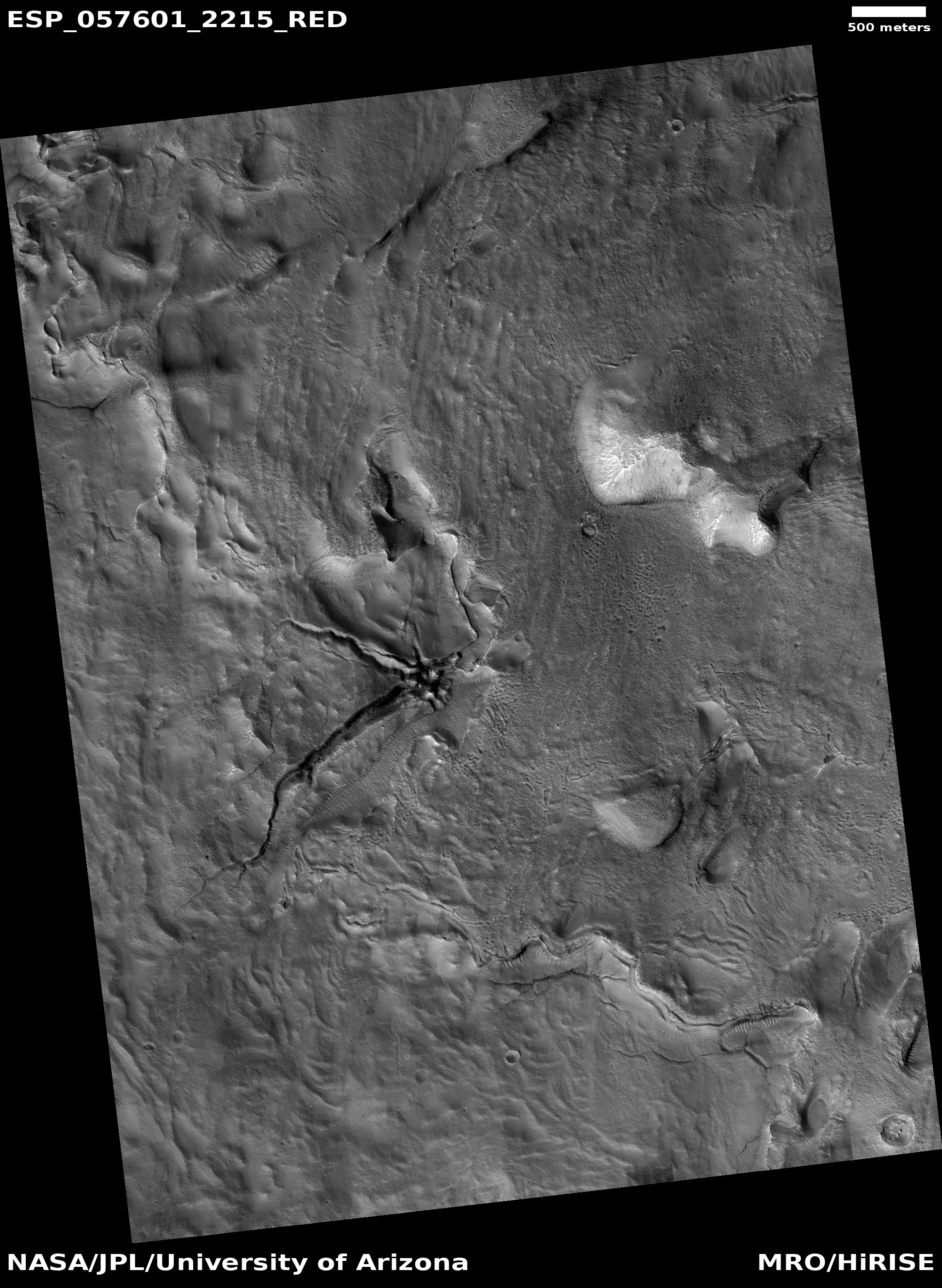
A ghost dune
Click for full image.

Cool image time! The Mars Reconnaissance (MRO) science team today released a captioned image of several ghost dunes on Mars. The image on the right is cropped and reduced to highlight one of those ghosts, which the scientists explain as follows.

Long ago, there were large crescent-shaped (barchan) dunes that moved across this area, and at some point, there was an eruption. The lava flowed out over the plain and around the dunes, but not over them. The lava solidified, but these dunes still stuck up like islands. However, they were still just dunes, and the wind continued to blow. Eventually, the sand piles that were the dunes migrated away, leaving these “footprints” in the lava plain.

The location of these ghost dunes is inside the southeast edge of Hellas Basin, what I call the bottom of Mars.

3 comments

The big water volcano on Ceres

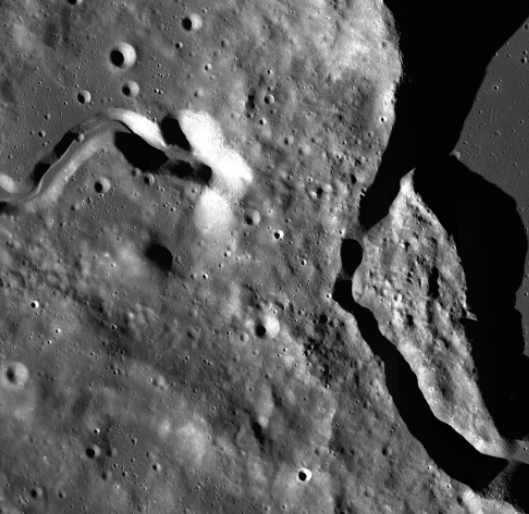
Scientists have proposed a new detailed model to explain the formation of the large mountain Ahuna Mons on the asteroid Ceres.

The new theory doesn’t change the generally accepted idea that this mountain is a ice volcano, formed by the rise of a brine from below. It simply provides some details about the process.

A study involving scientists from the German Aerospace Centre (DLR) has now solved the mystery of how Ahuna Mons, as the mountain is called, was formed, using gravity measurements and investigations of the geometrical form of Ceres. A bubble made of a mixture of salt water, mud and rock rose from within the dwarf planet. The bubble pushed the ice-rich crust upwards, and at a structural weak point the muddy substance, comprising salts and hydrogenated silicates, was pushed to the surface, solidified in the cold of space, in the absence of any atmosphere, and piled up to form a mountain. Ahuna Mons is an enormous mud volcano.

The bubble would be the equivalent of a magma chamber of lava here on Earth.

0 comments

New analysis throws wrench in formation theory of spirals in galaxies

The uncertainty of science: A new analysis of over 6000 galaxies suggests that a long-held model for the formation of spirals in galaxies is wrong.

[Edwin] Hubble’s model soon became the authoritative method of classifying spiral galaxies, and is still used widely in astronomy textbooks to this day. His key observation was that galaxies with larger bulges tended to have more tightly wound spiral arms, lending vital support to the ‘density wave’ model of spiral arm formation.

Now though, in contradiction to Hubble’s model, the new work finds no significant correlation between the sizes of the galaxy bulges and how tightly wound the spirals are. This suggests that most spirals are not static density waves after all.

Essentially, we still have no idea why spirals form in galaxies.

4 comments
1 85 86 87 88 89 156