On the radio

This Sunday, October 11, 2020, from 6:00-8:00 pm (Eastern) I will be on the Task Force Gryphon radio show on Kgra Radio.

The broadcast will be live and they will be taking calls and chat questions. Feel free to call or text in. The conversation should be lively, as the host, who goes by the nom de plume of Commander Cobra, is knowledgeable, an aviation guy, and also a big fan of Behind the Black.

0 comments

More Martian pits!

Pit #1
Click for full image.

Pit #2
Click for full image.

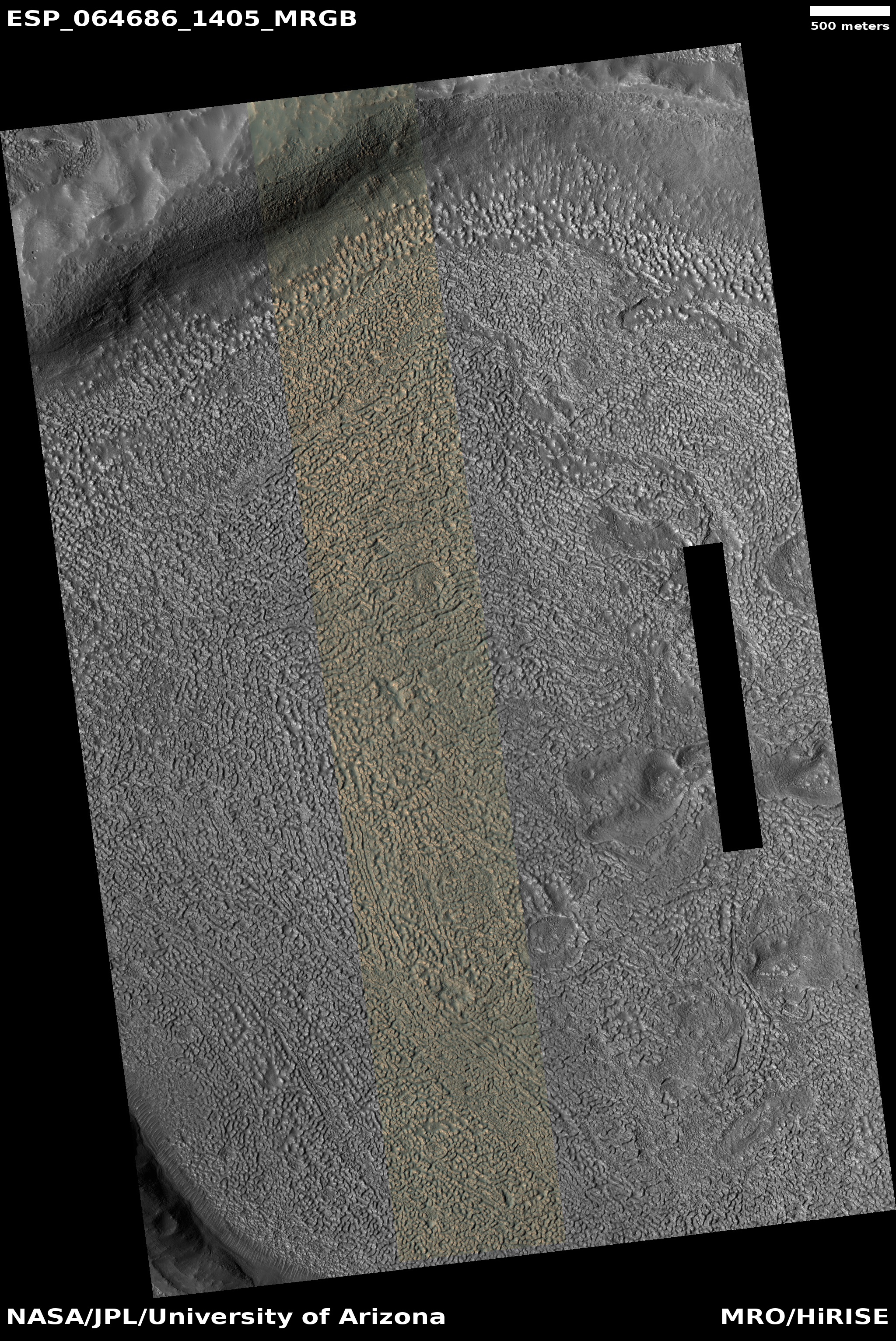
Though the number of new pictures showing pits and possible caves from the high resolution camera on Mars Reconnaissance Orbiter (MRO) has significantly tailed off in the past year, as I noted in my previous post on Martian pits in September, the pictures are still rolling in. This post will highlight five new photos and the pits therein.

The first two, on the right, are both located on the southern flanks of the giant volcano Arsia Mons, where many such pits are found. They were taken respectively on August 16, 2020 and August 27, 2020. The first was a captioned image from MRO’s science team:

In this image, the ceiling of the lava tube collapsed in one spot and made this pit crater. The pit is about 50 meters (150 feet) across, so it’s likely that the underground tube is also at least this big (much bigger than similar caves on the Earth). HiRISE can’t see inside these steep pits because it’s always late afternoon when we pass overhead and the inside is shadowed at that time of day.

What I find most interesting about both images is that the skylights do not occur where you’d expect. In image #1, the meandering rill that suggests an underground lava tube is about 1,000 feet south of the pit. The pit itself seems unrelated to that rill. In image #2, the surface shows no obvious evidence of an underground tube matching the three aligned pits. There is the hint of a narrow depression along the alignment of the three pits, but this could just as easily be evidence of wind-blown dust along that alignment.

In the full image all three pits appear to sit inside a very wide and very shallow northwest-to-southwest depression, but this is hardly certain, and regardless the three pits align in a different direction.

The overview map below provides some context.
» Read more

0 comments

Flying over Jupiter

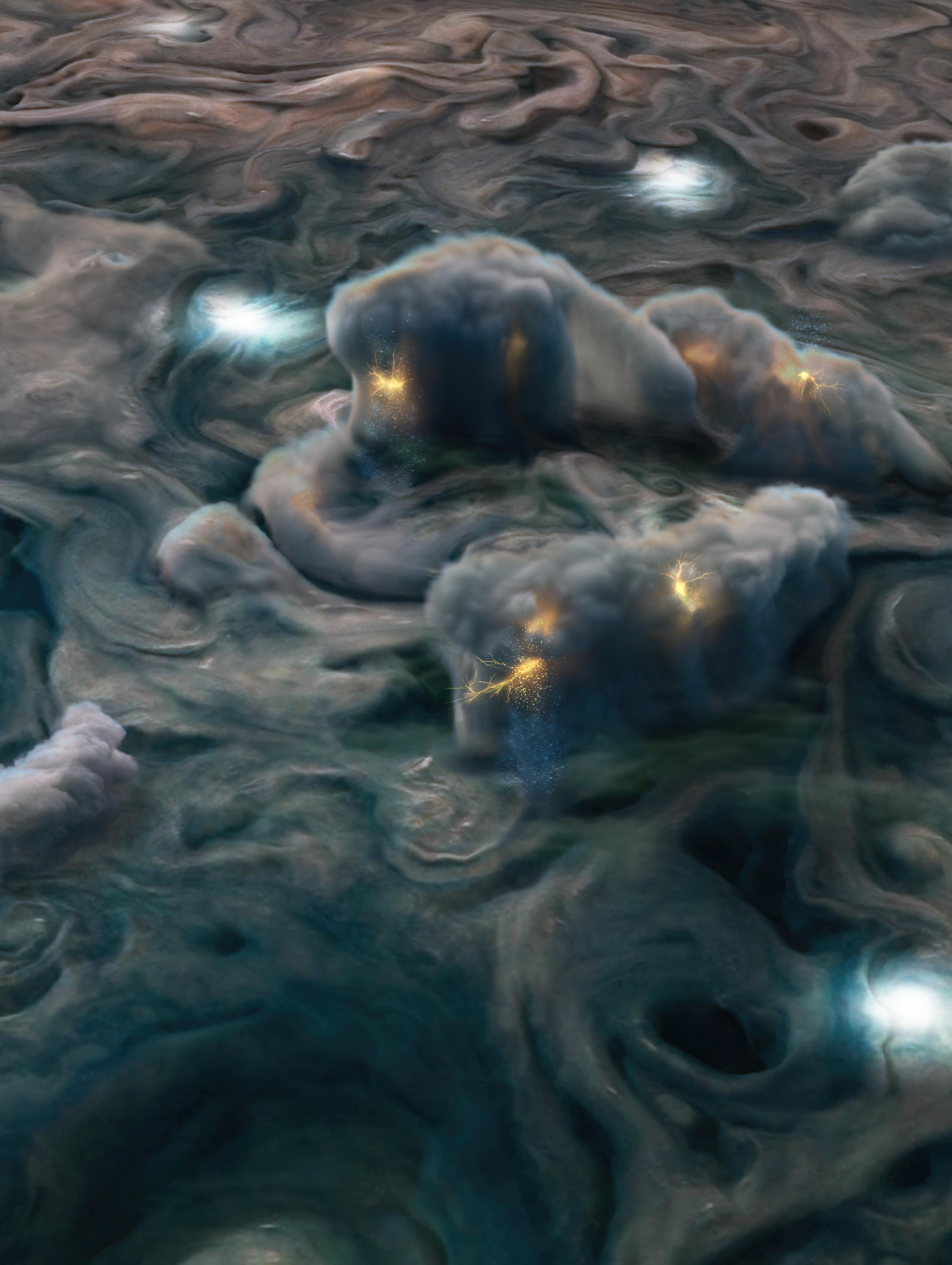
Cool movie time! Using images produced by Juno in orbit around Jupiter, citizen scientist Kevin Gill has produced a very nice movie of the spacecraft’s 27th fly-by on June 2, 2020.

During the closest approach of this pass, the Juno spacecraft came within approximately 2,100 miles (3,400 kilometers) of Jupiter’s cloud tops. At that point, Jupiter’s powerful gravity accelerated the spacecraft to tremendous speed — about 130,000 mph (209,000 kilometers per hour) relative to the planet.

I have embedded the movie below the fold. The choice of a piece of music by Vangellis might seem hokey, but I think in this case it works very nicely. I also was impressed with the addition of some 3D depth near the movie’s beginning.
» Read more

2 comments

More results about Bennu from OSIRIS-REx

Scientists using the OSIRIS-REx spacecraft have now published a special collection of papers outlining some of their discoveries made during that spacecraft’s observations of the asteroid Bennu from February to October 2019.

These papers just make official much of what was revealed during a conference I attended in November 2019. To sum up the papers:

  • Bennu has a lot of carbonates across its surface.
  • Some of that material came from another object that had to have had water.
  • The asteroid’s boulders come in two types, dark-porous and bright-solid, with the latter likely from that water-bearing other asteroid
  • Bennu’s surface is fresh, only recently exposed to space, including the sample site Nightingale.
  • Bennu’s interior has large voids, and its equatorial region is less dense.

The discovery of carbonates, produced from the interaction of water and carbon dioxide, is a big deal. As Dante Lauretta, OSIRIS-REx principal investigator, explained at that November conference, “To me this is one of the most exciting results from the conference.”

These findings have allowed scientists to theorize that Bennu’s parent asteroid likely had an extensive hydrothermal system, where water interacted with and altered the rock on Bennu’s parent body. Although the parent body was destroyed long ago, we’re seeing evidence of what that watery asteroid once looked like here – in its remaining fragments that make up Bennu. Some of these carbonate veins in Bennu’s boulders measure up to a few feet long and several inches thick, validating that an asteroid-scale hydrothermal system of water was present on Bennu’s parent body.

The material could not have been created on Bennu itself, which means it formed on a different object that was large enough and existed long enough to create the veins in these boulders. That material was then flung back into space to settle onto Bennu’s surface.

The freshness of Bennu’s surface is also a big deal, as it means that etither the asteroid is not that old, or that its surface somehow gets plowed over periodically. It also means that when OSIRIS-REx grabs samples at the Nightingale site on October 20th, they will be grabbing material that has not been altered much by the harsh environment of space.

Finally, the data about Bennu’s interior and density is maybe the neatest discovery. As the press release notes,

The reconstructed gravity field shows that the interior of Bennu is not uniform. Instead, there are pockets of higher and lower density material inside the asteroid. It’s as if there is a void at its center, within which you could fit a couple of football fields. In addition, the bulge at Bennu’s equator is under-dense, suggesting that Bennu’s rotation is lofting this material.

Bennu’s very weak gravity makes it a very alien and hard-to-comprehend place. It appears that the gravel in this floating gravel pile is barely held together, some interlocking in a way that leaves many open gaps, with other pieces pulled outward by the spin of the asteroid.

In reading these results, my first impression was an overwhelming sense of time and its inconceivable vastness. Much of Bennu’s most primitive material comes from the early solar system, about six billion years ago. Other material is newer, but required many many millions of years to get created elsewhere, and then somehow end up in space to be captured by this asteroid.

A million years is a very long time. A billion years is a thousand times longer. To conceive such time frames and all that can happen during that time is practically impossible. Bennu has shown us just a hint of how much can happen, some of which we would never have imagined otherwise.

2 comments

Branson picks West Virginia to build test hyperloop underground train

Another Branson scam? Richard Branson’s new big venture to build a hyperloop magnetic underground train to transport cargo and people, dubbed Virgin Hyperloop, has chosen West Virginia as the location to build its first test prototype.

Virgin Hyperloop has picked the U.S. state of West Virginia to host a $500 million certification center and test track for billionaire Richard Branson’s super high-speed travel system, the company told Reuters. The center will be the first U.S. regulatory proving ground for a hyperloop system designed to whisk floating pods packed with passengers and cargo through vacuum tubes at 600 miles (966 kmph) an hour or faster.

Later, Branson announced the decision in a press conference on Thursday, joined virtually by U.S. Transportation Department Secretary Elaine Chao, the state’s Republican governor Jim Justice, and U.S. Senators from West Virginia Shelley Moore Capito, a Republican, and Joe Manchin, a Democrat.

…Construction is slated to begin in 2022 on the site of a former coal mine in Tucker and Grant Counties, West Virginia, with safety certification by 2025 and commercial operations by 2030, the company said.

Forgive me if I think is this nothing but a Branson con-job of the taxpayers and his investors. For example, though the company has raised $400 million of investment capital, much of that came from UAE investors. Considering that Branson took other Arab investors for half a billion on his Virgin Galactic scam, which after fifteen years has never flown an operational flight and will likely never make a dime of profit, I find this investment from the UAE astonishing.

Though the article doesn’t state where the remaining $100 million of cash came from, I suspect it is taxpayer money, from both federal and state coffers.

I am very dubious any of this will ever happen. A decade hence I expect the system will still be in development, with Branson calling for more tax dollars and new investors. Maybe by then he’ll do what he did with Virgin Galactic, go public and he sell his stock for a big profit, leaving others holding the bag.

6 comments

Starship prototype #8 passes tank tests; engine installation next

Capitalism in space: SpaceX’s eighth Starship prototype has passed its tank, thruster, and even fin tests, setting it up for the installation of its three Raptor engines.

Once installed, they will perform several static fire tests, on the launchpad. If those tests are successful, the company will then proceed with a full 50,000 foot test flight. Based on the pace of operations, my guess is that this hop will occur in about two to four weeks.

I’ve embedded one of the videos at the link below the fold, showing a variety of activity at the site.

In other SpaceX news, the Tesla that was put in solar orbit on the first Falcon Heavy test launch has just made its first “fly-by” of Mars, getting to within 5 million miles of the red planet. At that distance the planet really isn’t very close, which is why I put the word fly-by in quotes. That Tesla’s future:

The Roadster will eventually barrel into either Venus or Earth, likely within the next few tens of millions of years, a 2018 orbit-modeling study determined . But the chances of an Earth or Venus impact in the next million years are just 6% and 2.5%, respectively.

» Read more

0 comments

Yodeling!

An evening pause: Hat tip Jim Mallamace, who writes,

If I understood German, I think I would enjoy this performance even more. Angela Wiedl is Bavarian, Melanie Oesch is Swiss, and Herlinde Lindner is Austrian. From what I read in the comments, each singer sings the “Erzherzog Johann Jodler” in her own country’s version of German.

2 comments

Boom unveils its first half-scale prototype commercial supersonic jet

Boom Supersonic, an aviation company that wants to build commercial supersonic passenger jets, has unveiled its first half-scale prototype, dubbed the XB-1, or “Baby Boom”.

They had announced the development of this jet several years ago, and have experienced some delays since. They had hoped to begin commercial operations of their commercial model, dubbed Overture, by ’23, but this remains unclear. Regardless, there does seem interest in this airplane among the commercial carriers, assuming they survive the Wuhan flu panic.

Boom says that the airliner has a projected unit cost of around $200 million each, not including a customer’s desired interior configuration and other unspecified optional extras. This would make it cheaper than many subsonic widebody airliners now on the market, but those aircraft can also carry substantial more passengers. For example, in 2018, Airbus said that the average price of one of its popular A330-200s was approximately $238.5 million, but that aircraft has a maximum seating capacity of 406, nearly four times that of Overture as presently planned. Boeing says that the average price of one of its 767-300ER airliners is around $217.9 million, but again, those planes can seat nearly 300 passengers, depending on the internal configuration.

There has already been not insubstantial interest in the Overture, though, with Boom saying it has commitments to buy up to 76 of the jets from five airlines, including Virgin and Japan Airlines (JAL). Virgin Group has been a major investor in Boom for years now, as well. The Spaceship Company, a Virgin Galactic subsidiary, was previously reported to be preparing to assist in building and testing the airliners.

I will admit, however, that I do not find it encouraging that Virgin Galactic is involved in the plane’s development. In fact, it might even help explain why development was delayed.

0 comments

The idiocy, ignorance, and corruption of California’s Governor Newsom

In the past week the Democratic governor of California, Gavin Newsom, has demonstrated that in his quest to cement the dictatorial powers he gave to himself with the arrival of the Wuhan virus, he really has no interest in any facts or real scientific data.

First, he announced with great fanfare on October 5th that the country and his state were entering a new terrible outbreak of COVID-19. “This is the second wave,” he declared grimly, adding,

“We continue to have a lot to do on COVID-19 transmission,” he said. “You’re starting to see an increase in COVID cases across the country,” the governor observed. “You’re seeing this not just across the country, you’re seeing this across the world.” Newsom then reported that 21 states across the U.S. are seeing increases.

Newsom then made reference to the Spanish flu pandemic that hit America in 1918, noting that “the second wave in 1918 was the most deadly.”

The problem for Newsom however are the facts, as shown in the graph below.
» Read more

9 comments

World’s longest pedestrian suspension bridge to open in ’21

A new tourist attraction, the world’s longest pedestrian suspension bridge, is set to open in Portugal next year.

At this length, the new bridge will be considered the longest pedestrian suspension bridge in the world, beating out the Charles Kuonen Suspension Bridge in Switzerland, which spans 1,621 feet and opened in 2017, according to The Sun. But it isn’t just long, it’s also situated 575 feet above the ground, connecting the Aguieiras Waterfall and Paiva Gorge.

I have embedded below the fold a video showing the bridge under construction. As the article notes, if you are afraid of heights this is not the tourist attraction for you.
» Read more

8 comments

Musk: Starlink about to roll out commercial service

Capitalism in space: With the launch earlier this week of another 60 Starlink satellites, Elon Musk has revealed that they now have enough satellites in orbit to soon begin commercial operations.

After yesterday’s launch of 60 Starlink satellites, SpaceX CEO Elon Musk wrote on Twitter that “[o]nce these satellites reach their target position, we will be able to roll out a fairly wide public beta in northern US & hopefully southern Canada. Other countries to follow as soon as we receive regulatory approval.”

Musk did not say when the satellites will reach their target position. SpaceX has over 700 satellites in orbit after yesterday’s launch.

It will like take a few months to get these satellites into position. Regardless, the speed at which SpaceX operates once again has put them ahead of their competitors. OneWeb, the only other similar constellation with satellites in orbit, was once far ahead of SpaceX but has been stalled as it recovers from bankruptcy. Amazon’s Kuiper satellite constellation is so far only a proposal, and like most everything else the company said it would build, has moved forward with the speed of a glacier.

1 comment
1 40 41 42 43 44 169