InSight shut down temporarily because of lack of power

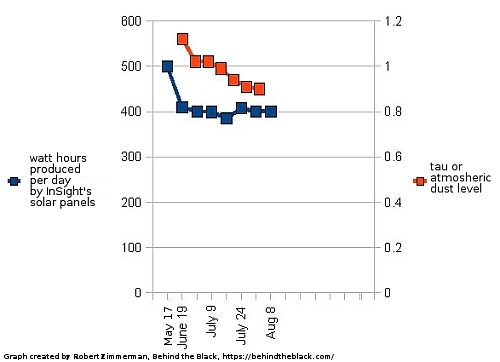
InSight's power levels over recent time

Because a dust storm has caused a further decline in the power being generated by InSight’s solar panels, the science team has decided to put the lander into safe mode for the next two weeks in the hope that the air will then clear, allowing its power levels to rise.

The graph to the right shows that drop. From the press release:

By Monday, Oct. 3, the storm had grown large enough and was lofting so much dust that the thickness of the dusty haze in the Martian atmosphere had increased by nearly 40% around InSight. With less sunlight reaching the lander’s panels, its energy fell from 425 watt-hours per Martian day, or sol, to just 275 watt-hours per sol.

InSight’s seismometer has been operating for about 24 hours every other Martian day. But the drop in solar power does not leave enough energy to completely charge the batteries every sol. At the current rate of discharge, the lander would be able to operate only for several weeks. So to conserve energy, the mission will turn off InSight’s seismometer for the next two weeks.

The real problem however is the dust covering the solar panels. If that dust gets thicker due to this storm, the lander will not recover when they power it up in two weeks. It will still generate electricity at this low number, making future operations likely impossible.

11 comments

Engineers regain full control of CAPSTONE

After a month of careful tests and analysis, engineers today successfully regained full control of the CAPSTONE lunar orbiter, on its way to the Moon.

The most likely cause of the anomaly was identified as a valve related issue on one of the spacecraft’s eight (8) thrusters. The partially open valve resulted in thrust from the associated thruster whenever the propulsion system was pressurized. To attempt a recovery from this condition, the mission team conducted multiple tests on the vehicle and evaluated extensive telemetry and simulation data and then formulated a plan for attempting recovery of the vehicle’s full 3-axis control.

This recovery sequence was uploaded to the spacecraft yesterday (Thursday) and was executed early this morning (Friday 10/7). Initial telemetry and observation data after the recovery attempt points to a successful recovery of the system which has now regained 3-axis attitude control. The updated spacecraft attitude has oriented the spacecraft solar arrays to the Sun and implemented an orientation for the downlink antennas which significantly improves data downlink performance as compared to the pre-recovery attitude.

The spacecraft is not out of the woods yet. The engineers still need to figure out how to do future course corrections with “the possible presence of a valve that remains partially open.”

Nonetheless, that they have successfully regained full control means they have a very good handle on the issue, which bodes well for the lunar orbital insertion maneuver on November 13, 2022.

2 comments

October 7, 2022 Quick space links

Thanks to BtB’s stringer Jay, who trolls Twitter so I don’t have to.


  • UK bureaucracy questions Viasat’s takeover of Inmarsat
  • I covered this in August, but now the UK’s Competition and Markets Authority (CMA) is setting a deadline, October 13, for the companies to explain why their merger won’t destroy Starlink. Otherwise it will initiate a full probe, blocking the merger.

    Typical government stupidity. There is no way this merged company will destroy Starlink. If anything, these companies are merging to survive the competition from Starlink.


1 comment

Thick flow exiting dramatic canyon on Mars

Thick flow into Mamers Valles on Mars
Click for full image.

Cool image time! The photo to the right, cropped and reduced to post here, was taken on July 24, 2022 by the high resolution camera on Mars Reconnaissance Orbiter (MRO). It shows what the scientists label as a “viscous flow” that has apparently carved the wide curving canyon as it slowly flows into open country to the south.

I would estimate the height of that canyon wall to be around 3,000 feet, though this is a very rough guess. I also image a trail switchbacking up the nose of that canyon wall would make for a truly stupendous hiking experience.

The flow filling the canyon floor appears very glacial, which is not surprising as this canyon is at 37 degrees north latitude, in the mid-latitude band where many glacial features are found. The overview map below provides some more detailed context.
» Read more

2 comments

China’s Long March 11 launches from floating sea platform

China today successfully launched two “navigation satellites” from a floating sea platform in the Yellow Sea, using its Long March 11 rocket.

The platform was only about two miles off shore at launch, so the view from the beach drew a large crowd. Video at the first link.

The leaders in the 2022 launch race:

45 SpaceX
42 China
12 Russia
8 Rocket Lab
7 ULA

American private enterprise still leads China 65 to 42 in the national rankings, and the entire globe combined 65 to 62. These numbers will change again later today, with a SpaceX commercial launch scheduled for 4:06 pm (Pacific).

1 comment

Today’s blacklisted American: Black playwright blackballed because he honestly told the story of racism in the Jim Crow south

Carlyle Brown, censored for writing truthfully

The modern dark age: Close-minded students at the black student association at Texas Wesleyan University have forced the cancellation of a play celebrating the civil rights movement in Mississippi in the 1960s — written by black author Carlyle Brown — because it included realistic dialogue of the time, including the word “nigger”.

Students objected to the use of the n-word in a play that tries to capture the environment of hate and racism of the period. Texas Wesleyan’s Black Student Association declared the reference to be harmful and “triggering.” Calling for a boycott, the Association declared that allowing the play to be heard would “further hurt Black students and possibly students from other marginalized communities.”

The Rambler student newspaper reported that school and theater officials killed the production after a 90-minute campus discussion: “The main concern the students voiced was the ‘triggering’ effect of using the racially explicit word, which is repeated 11 separate times throughout the play, and how it can cause trauma to the black students in the audience.”

The play, Down in Mississippi, can be read here [pdf]. From the play’s summary:
» Read more

41 comments

Rocket Lab successfully launches NOAA satellite

Capitalism in space: Rocket Lab today successfully used its Electron rocket to place a NOAA satellite into orbit, designed to gather data from ground-based sensors.

This was the company’s eighth successful launch in 2022, the most it has achieved in any single year. No attempt was made to recover the first stage on this launch.

The leaders in the 2022 launch race:

45 SpaceX
41 China
12 Russia
8 Rocket Lab
7 ULA

American private enterprise now leads China 65 to 41 in the national rankings, and the entire globe combined 65 to 61. The 65 successful launches so far this year is now the second most successful American year in rocketry, exceeded only by the 70 launches in 1966. With almost three months left to go in the year, 2022 looks like it will top that record, by a lot.

SpaceX meanwhile has a launch scheduled for later today, after getting scrubbed yesterday at T-30 seconds because of detected minor helium leak.

1 comment

Endurance docks at ISS

Like clockwork SpaceX’s Endurance capsule successfully docked at ISS yesterday, delivering four astronauts to the station for a six month mission.

The most interesting aspect of this launch and crew is Russian Anna Kikina.

Kikina is the first Russian to fly aboard a U.S. spacecraft in nearly 20 years. She and Rubio were launched under a new agreement between NASA and Roscosmos, the Russian space agency, that ensures at least one astronaut or cosmonaut is always aboard the space station even if a Crew Dragon or Soyuz is forced to depart early, taking its crew with it.

Without the seat-swap arrangement, a medical emergency or some other major problem could leave an all-Russian or all-NASA crew aboard without the expertise to operate the other nation’s systems.

The agreement had been stalled almost entirely by the former head of Roscosmos, Dmitry Rogozin. He is now gone however, sent by Putin to take over the fake occupation government in parts of the Ukraine. It appears his bellicose manner, that caused the loss of a billion dollars in launch contracts with OneWeb, was more than even Putin could handle.

With him gone, the new head of Roscosmos, Yuri Borisov, quickly finalized this astronaut barter deal. He has also publicly acted to try to ease tensions between the U.S. and Russian space agencies.

1 comment

Startup smallsat rocket company signs spaceport deal with Brazil

The new colonial movement: A Canadian startup smallsat rocket company, C6 Launch Systems, has not only signed a spaceport deal with Brazil to build its own launchpad at that country’s Alcantara Space Center, it has also won its first launch customer.

First, the launchpad is for C6’s rocket, which is unnamed and designed to launch cubesats. The company webpage says they are aiming for suborbital flights in 2021 and orbital flights in 2022, but it is unclear if it has launched anything at this point.

Nonetheless, Brazil is very clearly teaming up with C6. The Brazilian air force hired it to build a launch pad, a Brazilian company, Concert Technologies, has awarded it a launch contract.

Concert Technologies S.A. who are developing a new small satellite constellation have signed a a non-exclusive letter of intent to launch three small satellites with C6 Launch. The broad agreement allows for Concert Technologies to schedule more launches to maintain and expand their high-resolution Earth Observation (EO) constellation.

It appears Concert’s satellites will be targeting both the Earth imagery market as well as communications services in the “internet of things.”

1 comment
1 47 48 49 50 51 192