NASA is apparently withdrawing its permit for Starship launches in Florida

We’re here to help you: In requesting public input into SpaceX’s plans to expand operations in Florida to accommodate launches of its Starship/Superheavy rocket, NASA is apparently withdrawing the permit it issued in 2019, allowing for such launches.

While a Final Environmental Assessment for Starship was issued in September 2019, NASA said that communication with SpaceX will be ongoing prior to a future first flight from Florida.

“NASA will review the risks to the area and programs at KSC [Kennedy Space Center] prior to any hazardous work,” Bob Holl told Spectrum News in a statement. “NASA will be involved in the lead-up of activities prior to the first loading and any static fire events of Starship and coordinate impacts across the spaceport.” Holl serves as the chief of the Spaceport Management and Integration Division in the Spaceport Integration and Services Directorate at KSC.

It appears NASA and the federal bureaucracy have decided that a new environmental assessment is necessary for SpaceX’s proposed new operation in Florida. After a 30-day period for public input, ending on July 29th, NASA will issue a new draft environmental assessment by September, which will then be subject to another public comment period. Then, the agency will issue a final decision in November, either declaring the new work causes no further impact or that a new environmental impact statement is required.

If the latter, expect Starship launches at Kennedy to be delayed several years.

This action continues the increased regulatory oversight on new space activities being imposed since the arrival of the Biden administration. The federal government is now apparently trying to set a new policy whereby any new work by a private company on or even near federal land will require its full approval, and even if given that approval will carry with it strict and endless governmental demands, all designed to slow things down.

The political timing of this new action however is significant, since this decision will occur after the November midterms. If control of Congress shifts significantly into Republican hands, as expected, the Biden administration’s new heavy-handed regulatory approach might face some pushback.

19 comments

Russia backs off ’24 ISS exit

Russia has apparently backed off its earlier announcement this week that it is leaving ISS by ’24, instead informing NASA officially that it will stay with the partnership through at least ’28, until it gets its own independent space station in orbit.

All this still remains unclear, and still suggests the Russians are playing a negotiating game in public. Nonetheless, it will be no surprise at all if the Russians remain on the station until its lifespan ends, since it is highly unlikely that it will get its own space station launched in ’28, ’30, or even ’50, based on its past history.

3 comments

Space Perspective unveils design of its Neptune tourist balloon capsule

Space Perspective's Neptune Capsule

Capitalism in space: Space Perspective yesterday unveiled the final design of its Neptune balloon capsule that it hopes to fly tourists to altitudes of almost 20 miles.

The graphic to the right reveals the biggest takeaway from this design: The “splash cone” at the bottom of the capsule tells us that the company intends to land its Florida-launched missions in the ocean, not on land.

An enhanced patent pending splash cone, refined from hundreds of digital iterations, to attenuate splashdown for a gentle and safe landing that improves customer experience and hydrodynamics. With water landings considered by NASA as the low risk way of returning a capsule from space, following the gradual, two-hour descent to Earth and a gentle splash down in the ocean, a Space Perspective crew will retrieve passengers, the capsule, and the SpaceBalloon™ by ship.

The company is presently targeting the end of ’24 for the start of commercial flights. It says it has sold about 900 $125K tickets.

The U.S. now has two balloon companies planning similar near-space missions. World View is planning flights from a variety of locations worldwide for a ticket price of $50K, with the first flights occurring no earlier than ’24.

3 comments

Boeing adds another $93 million charge against earnings for Starliner manned capsule

Capitalism in space: Boeing officials revealed yesterday that they have been forced to add another $93 million charge against earnings for its much delayed Starliner manned capsule the company is building.

This is on top of $410 million in the fourth quarter of 2019 and another $185 million in the third quarter of 2021. All together, Boeing has had to cover $688 million in cost growth.

At the moment the first manned launch is tentatively scheduled to occur before the end of this year, with NASA supposedly announcing a firm date before the end of July. This new charge however suggests that the manned launch will not happen until ’23.

Boeing has not simply lost $688 million. It also has lost potential business because of the delays, both from NASA and private citizens. Instead, that business went to SpaceX.

7 comments

NASA/ESA revise plan to recover Perseverance core samples from Mars

NASA and ESA yesterday announced that the agencies have revised their plan to recover Perseverance core samples from Mars, dropping the launch of a rover to pick up the samples.

Instead, they have decided to use Perseverance to bring the samples to the return vehicle, which will also carry two small helicopters.

In 2030, if all goes as planned, the NASA lander will touch down near where Perseverance is working. The rover will drive over to the lander, and an ESA-built robot arm will extract the tubes one by one and place them inside a spherical container the size of a basketball. In early 2031, a rocket on the lander will loft the container into Mars orbit, where a return craft built by ESA will snare it, enclose it in several layers of shielding for safety, and then head for home. In 2033, a saucer-shaped descent pod will carry the samples down to the Utah desert.

If Perseverance gets into difficulties during its 9-year wait for company, controllers can instruct it to drop its cargo of sample tubes onto the ground, creating a second depot. If that happens, the helicopters come into play: they can fly up to 700 meters, land next to a sample tube—each weighs up to 150 grams—and, with wheels on the bottom their feet, roll over the tube and pick it up with a grabber. On returning to the lander, they will drop the tubes on the ground for the arm to pick up.

The change means that the rover the United Kingdom was planning to build will either be abandoned, or repurposed as a lunar rover.

4 comments

Update on Long March 5B core stage crash prediction

Prediction of Long March 5B crash

The Aerospace Corporation today adjusted its prediction for the uncontrolled crash of the core stage from the Long March 5B rocket that China launched on July 24th.

According to the new prediction, the core stage will return to Earth during a 32 hour period centered on the early morning hours of July 31st above the Middle East.

The map to the right shows this. As you can see, at present the uncertainty of the prediction means the core stage could still crash almost anywhere.

That China has still done nothing to adjust the stage’s orbit now almost certainly confirms it can do nothing. This further confirms that in the year-plus since its last Long March 5B launch in May ’21, it did nothing to fix this fundamental problem. Moreover, this is the rocket’s third launch, all of which involved a core stage crashing uncontrollably. Each launch was thus a direct violation of the Outer Space Treaty, of which China is a signatory.

Another Long March 5B launch is scheduled for later this summer, to launch the last planned module to China’s Tiangong space station. Expect another violation of the treaty then as well.

3 comments

The growing revolt against the bigoted left across the entire education community

A little child shall lead them, by James Johnson
“A little child shall lead them,” painting by James L. Johnson.

For the past year and a half in my daily column “Today’s blacklisted American” I have been documenting the oppressive actions of the intolerant left by noting the numerous times its members have aggressively blacklisted, censored, silenced, and destroyed anyone who stands in their way.

Take some time to glance through that full list. Some of the stories are truly horrifying. such as the time a 9-year-old was denied a kidney transplant because his donor, who also happened to be the child’s father, had not gotten his COVID jab.

Almost all are examples of the routine intolerance of the left. No one is allowed to think differently from them, act differently from them, speak differently from them, and even feel differently from them. If you dare to step out of line, their answer is to smash their boot into your face, as hard as they can. Once, that smashing was metaphoric. Today it has become literal.

Much of this oppression has been centered in the education community. The racist and Marxist ideology of critical race theory had it origins in the black study departments forcibly established in the 1960s in universities after violent protests. From there, these communist bigots spread outward into departments teaching the soft sciences of education, literature, psychology, and social science. They then moved downward into the high schools, and in the past decade into the elementary schools. Only recently they added to their program the queer agenda, aiming at perverting young children in the most vile ways possible.
» Read more

17 comments

A Martian slot canyon!

A Martian slot canyon
For originals go here, here, and here.

Overview map
Click for interactive map.

Cool image time! The mosaic to the right is made up of three images produced by the high resolution camera on the Mars rover Perseverance (found here, here, and here). All three were taken on July 24, 2022 and look north to the nearest cliff face at the head of the large delta that flowed into Jezero Crater some time in the distant past.

The rover was about 80 feet away from the feature when the photo was snapped. Though scale in the photo is not provided, using the scale in the overview map below I would guess this slot canyon is several feet wide, with some spots narrow enough that your body would touch both walls at spots. Its height is likely nor more than 20 feet high, at the very most.

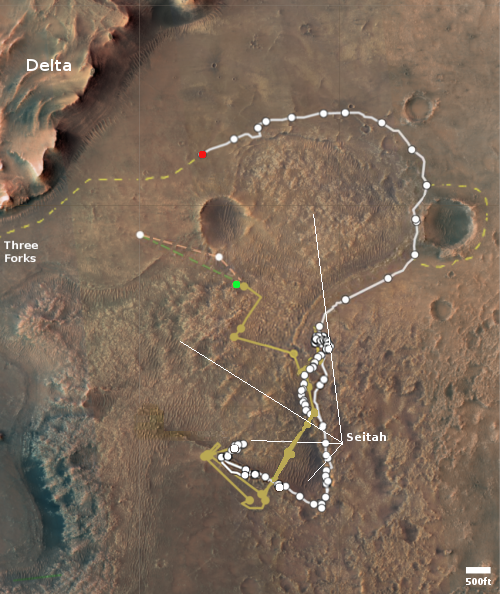
On the overview map, the blue dots mark Perseverance’s location, in both the main map and the inset. The green dot marks where the helicopter Ingenuity presently sits. The red dotted line is my guess as to the future route of the rover up into the delta. The yellow lines indicate the area viewed in the mosaic.

Though hardly as deep as the many slot canyons found in the American southwest, that this slot exists on Mars is quite intriguing. Did it form like those southwestern slots from water flow? Probably not. More likely we are looking at a fracture produced by shifts in the entire delta itself, and then later widened by wind.

That the cliff shows multiple layers suggests the delta was laid down in multiple events, and that the fracture occurred after the delta was emplaced. That the layers on either side of the fracture appear to match up strengthens this conclusion. These layers also suggest that the layering is not simply in a series of small events. The layers are also grouped into larger aggregates, suggesting those larger groupings mark longer epochs, each with its own unique conditions.

3 comments

A crowd of Jupiter hurricanes

Storms on Jupiter
Click for full image.

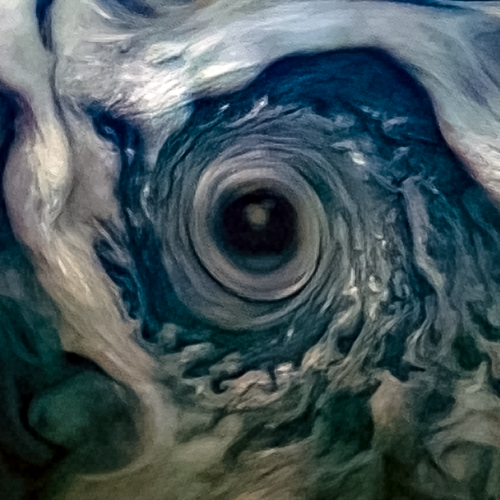
Cool image time! The photo to the right, cropped and reduced to post here, was taken on July 5, 2022 during Juno’s 43rd close fly-by of Jupiter, and was enhanced by citizen scientist Brian Swift. It shows a group of storms, what planetary scientists have labeled “vortices” near Jupiter’s north pole.

These powerful storms can be over 30 miles (50 kilometers) in height and hundreds of miles across. Figuring out how they form is key to understanding Jupiter’s atmosphere, as well as the fluid dynamics and cloud chemistry that create the planet’s other atmospheric features. Scientists are particularly interested in the vortices’ varying shapes, sizes, and colors. For example, cyclones, which spin counter-clockwise in the northern hemisphere and clockwise in the southern, and anti-cyclones, which rotate clockwise in the northern hemisphere and counter-clockwise in the southern hemisphere, exhibit very different colors and shapes.

The image highlights the type of storm Juno scientists are asking the pubic to category in a new citizen scientist project called Jovian Vortex Hunter. You go to its website and go through Juno images, noting and categorizing them. So far more than 2,400 volunteers have marked up more than 375,000 storms.

5 comments

Another Webb galaxy found even closer to the Big Bang

A galaxy formed only 250 million years after the universe formed

Using data from the first Webb deep field, astronomers have identified another galaxy in that image that apparently was able to form less than 250 million years after the the Big Bang, the theorized beginning of the universe.

Like the distant galaxies described last week, it also appears to have the equivalent of a billion Suns of material in the form of stars. The researchers estimate that it might have started star formation as early as 120 million years after the Big Bang, and had certainly done so by 220 million years.

You can read the actual research paper here [pdf]. The image of the galaxy to the right is taken from figure 4 of the paper. From its abstract:

We provide details of the 55 high-redshift galaxy candidates, 44 of which are new, that have enabled this new analysis. Our sample contains 6 galaxies at z≥12, one of which appears to set a new redshift record as an apparently robust galaxy candidate at z≃16.7.

The speed in which this galaxy formed places a great challenge on the Big Bang theory itself. 220 million years is an instant when it comes to galaxy formation, which has been assumed to take far longer. Either galaxy formation is a much faster process than expected, or something is seriously wrong with the timing of the Big Bang theory itself.

7 comments
1 87 88 89 90 91 192