
August 22, 2023 Zimmerman/Space Show podcast
The podcast of my appearance last night on the Space Show with David Livingston is now available. You can download it here.
As always, it was a good discussion about a number of interesting topics.
The podcast of my appearance last night on the Space Show with David Livingston is now available. You can download it here.
As always, it was a good discussion about a number of interesting topics.
The first mission in the Polaris space program of manned flights by billionaire Jared Isaacman, using SpaceX’s manned spacecraft and rockets, has now been delayed until early in 2024.
Isaacman, in the podcast interview, suggested the delays were linked to the development of a new spacesuit required for a spacewalk, the first by a private astronaut mission, planned for Polaris Dawn. “We’ve had a little bit more free time this summer than we probably would have expected,” he said, which he attributed to the timing of spacesuit development and training. That effort “doesn’t always sync up, so we’ve had a little more free time with family and work this summer.”
That new suit, billed as the first new spacesuit developed in the United States in four decades, is critical to future human activities on moon and Mars, he argued. “We’re going to need spacesuits that don’t cost hundreds of millions of dollars in order to do that. We’re pretty excited because the suit that we are testing out, the evolution of it someday could be very well worn by people that are walking on the moon or Mars.”
This mission, dubbed Polaris Dawn, will use a Falcon 9 and one of SpaceX’s fleet of four manned Dragon capsules to spend several days in Earth orbit while conducting that first private spacewalk. Isaacman’s entire Polaris program includes two more manned missions,the second possibly aimed at raising and even doing maintenance on the Hubble Space Telescope, and the third using Starship to go around the Moon.
Isaacman has already flown one private mission in space, in 2021, dubbed Inspiration4. It flew for three days in orbit, carrying four passengers, including Isaacman himself. Since it did not dock with ISS, it was an entirely private manned mission, with no significant government involvement.
In a strange bit of irony, an abandoned payload adapter from a mission launched a decade ago that a European Space Agency (ESA) mission was planning on capturing and de-orbiting has been hit by another piece of space junk, creating additional bits debris around it.
The adapter is a conical-shaped leftover, roughly 250 pounds (113 kg) in mass, from a 2013 Vega launch that sent a small fleet of satellites into orbit. Space tracking systems found new objects nearby the adapter, which ESA learned about on Aug. 10. The objects are likely space debris from a “hypervelocity impact of a small, untracked object” that smacked into the payload adapter, the agency said. We may never know if the crashing object was natural or artificial, given it didn’t appear in tracking systems.
The ESA mission, dubbed Clearspace-1, intends to launch in 2026 and use four grappling arms to grasp the payload adapter, after which both shall be sent to burn up in the atmosphere. Its goal is to demonstrate technology for removing space junk. This event, creating extra debris pieces around the payload adaptor, puts a kink on that mission while also underlining the need for such technology.
Mission engineers now have three years to figure out what, if anything, they need to do to deal with the extra debris. The good news so far is that it appears the payload adapter remains intact, its orbit has not changed, and the surrounding debris appears small enough to pose “negligible” risk.
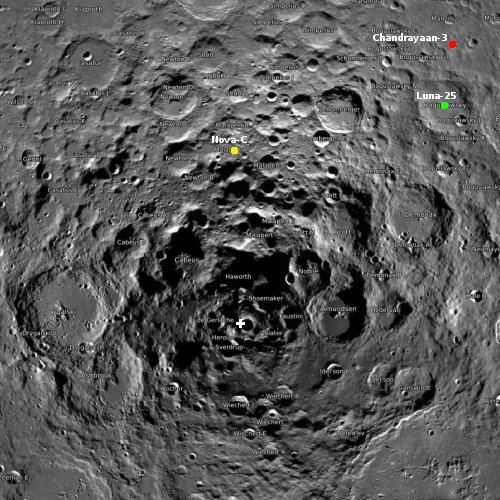
Click for interactive map.
India this morning successfully placed its Vikram lander, carrying its Pragyan rover, on the surface of the Moon in the high southern latitudes.
I have embedded the live stream below, cued to just before landing.
The next challenge is getting Pragyan to roll off Vikram, and spend the next two weeks exploring the nearby terrain. The mission of both it and Vikram is only planned to last through the daylight portion of the 28-day-long lunar day, so it is not expected for either to survive the lunar night. Both will make observations, but the main purpose of this mission has already been accomplished, demonstrating that India has the technological capability to land an unmanned spacecraft on another planet. That the landing was in the high southern latitudes added one extra challenge to the mission.
Embedded below the fold in two parts.
To listen to all of John Batchelor’s podcasts, go here.
» Read more
Russia tonight successfully used its Soyuz-2 rocket to launch a new Progress freighter to ISS, lifting off from its Baikonur spaceport in Kazakhstan.
The leaders in the 2023 launch race:
57 SpaceX
36 China
12 Russia
6 Rocket Lab
6 India
In the national rankings, American private enterprise still leads China in successful launches 65 to 36. It also leads the entire world combined, 65 to 59. SpaceX by itself is still in a neck-in-neck race with the rest of the world (excluding American companies), now trailing 57 to 59 in successful launches.
An evening pause: Some automotive racecar history from before WWII, showing cars then capable of going more than 250 miles per hour.
Hat tip Judd Clark.
Here we go again! When the first panic over COVID arrived in 2020 and government thugs and their leftist minions in the culture began demanding that everyone wear a mask, I wrote the following:
It apparently has not been enough that they have successfully destroyed a thriving economy, put millions out of work, destroyed the airline, entertainment, sports, and restaurant industries, over a disease that, at best is nothing more than a slight blip in the overall death rate, and at worst will be comparable to similar past epidemics that we lived through without government-imposed panic or economic disaster.
No, destroying millions of lives has not been enough. They need to do more. They need to find more ways to squelch our freedom, nullify the Constitution and the Bill of Rights, and, to paraphrase Orwell, stamp a boot down on our faces, forever.
And in this case, they mean to do this, almost literally.
They are now beginning to demand that we wear masks at all times in public, in the mindless and stupid belief that this will somehow stop COVID-19 from spreading.
I also declared unequivocally that I would not wear a mask, “and if you demand it of me you will have a revolution on your hands.”
» Read more
Courtesy of BtB’s stringer Jay.
My heart be still!
Scheduled for August 24, 2023 at 11:30 am New Zealand time, which is equivalent to 7:30 pm (Eastern) on August 23, 2023.
Interesting but also unintentionally hilarious, as the company posted this yesterday, but that assembly line has been shut down for weeks and the company is no longer focused on building rockets.
These images were taken after Vikram separated from its propulsion unit, and demonstrated that it could orient itself accurately and the camera was working.

Click for original image.
Cool image time! The picture to the right, rotated, cropped, reduced, and sharpened to post here, was taken on June 22, 2023 by the high resolution camera on Mars Reconnaissance Orbiter (MRO). It shows what the scientists label as “The tip of Cerberus Fossae,” a thousand-mile-long crack in the surface of Mars formed when the ground was pulled apart by underground forces.
If you look closely at the picture’s right edge, you can see that beyond the end of the fissure it actually continues but appears filled with material. In the full picture this however is the end of the crack. Beyond this point the ground is as smooth and as generally featureless as seen within the picture itself, and as also shown in this MRO context camera view of the same area.
Cerberus Fossae is actually three parallel cracks, with this the northernmost one. The eastern tip of the middle crack was previously highlighted in a cool image in July 2022.
» Read more
A private spaceport proposed for the desert west of Las Vegas has signed a deal with launch startup company to wants to use a 747 to launch reusable rockets.
Robert Lauer, director of Las Vegas Spaceport, announced a partnership with O-G Launch, a company headed by Robert Feierbach. Feierbach’s company aims to be a part of the commercial space industry by launching satellites from recyclable rockets deployed from large jets.
Terms of the partnership were not disclosed, but it is expected that companies seeking to deploy satellites would use O-G Launch aircraft starting from the Las Vegas Spaceport to launch a satellite-bearing rocket from 40,000 feet.
To put it mildly, this project is hardly a spaceport. It is planned as a casino, a resort, and a flight school with a runway. O-G helps give it the appearance of a spaceport by allowing it to claim orbital launches will take place there. Whether O-G ever takes off is another thing entirely. Its presence as part of the project, however, provides great PR for attracting customers to the proposed resort/casino.
Sierra Space announced yesterday that — as part of its private space station module dubbed LIFE — it is partnering with Redwire to install a commercial biotech lab in the module.
The hardware includes equipment that Redwire has previously developed for the International Space Station, such as the Advanced Space Experiment Processor, which hosts biotech experiments. A particular focus will be on crystallization experiments, using the microgravity environment to grow larger crystals that can then be studied to determine their structure for pharmaceutical applications.
The companies did not disclose terms of the contract other than that Redwire will start delivering hardware in the fourth quarter of this year. Gold said that the companies will also partner on business development to identify customers for using the experiment platform.
The target date for the launch of LIFE is presently 2026, though it was not revealed when Redwire’s equipment would be installed.
What struck me about this deal is the shrinking mention of Blue Origin. Originally that company was listed as one of the major players in building this private space station, dubbed Orbital Reef, in which LIFE is only the first module. In the past year however its participation seems less and less significant in every subsequent press release. It appears to still be part of the project, but it is Sierra Space that is leading the effort, and appears to be making things happen.
But then, the track record of Blue Origin is to not make things happen. It could very well be that events are once again overtaking it. Sierra Space can’t wait for Blue Origin to slowly get its act together. It is finding ways to get things done, even if that means Blue Origin gets left behind.
Capitalism in space: In what is a landmark deal indicating the complete shift by the military from building its own satellites to letting private enterprise do it, the Space Development Agency (SDA) of the Space Force yesterday announced it has awarded Lockeheed Martin and Northrop Grumman each a contract to build and operate 36 satellites.
The 72 satellites will make up a portion of SDA’s network known as Tranche 2 Transport Layer. SDA is building a large constellation called the proliferated warfighter space architecture that includes a Transport Layer of interconnected communications satellites and a Tracking Layer of missile-detection and warning sensor satellites. Northrop Grumman’s contract for 36 satellites is worth approximately $733 million. The agreement with Lockheed Martin, also for 36 satellites, is worth $816 million, SDA said.
What makes this contract different than previous military satellite contracts is that the military will do relatively little design. It has released the basic specifications, and is asking private enterprise to do the work for it. It is a customer, not a builder. When the military attempted its own design and construction, the job would take sometimes a decade or more, cost many billions (with cost overruns), and often failed. This new constellation is targeting a 2026 launch, only two years from now.
The constellation will also be more robust than the gold-plated giant satellites the military would build previously. Rather than rely on a single do-it-all satellite which is easy to take out, the constellation has many satellites, and can easily compensate if one or even a few are damaged or destroyed.
This shift was one of the fundamental reasons the military wanted to create a separate Space Force. As part of the Air Force the office politics within that branch of the military had been impossible to make this shift. Too many managers in the Air Force liked building big gold-plated satellites. Once the Space Force took over those managers were taken out of the equation.
Russian engineers have pinpointed the approximate crash site of Luna-25 on the Moon as the 42-mile-wide crater Pontecoulant G, located at about 59 degrees south latitude, 66 east longitude.
Researchers from the Russian Academy of Sciences’ Keldysh Institute of Applied Mathematics have simulated the trajectory of the Luna-25 mission, figuring out where and when it crashed into the moon’s surface, the institute said in a statement on Telegram. “The mathematical modeling of the trajectory of the Luna-25 spacecraft, carried out by experts from the Ballistic Center of the Russian Academy of Sciences’ Keldysh Institute of Applied Mathematics, made it possible to determine the time and place of its collision with the moon,” the statement reads.
According to the institute, the spacecraft fell into the 42-kilometer Pontecoulant G crater in the southern hemisphere of the moon at 2:58 p.m. Moscow time on August 19.
The planned landing site, in Boguslawsky Crater at 73 degrees south latitude and 43 degrees east longitude, was many miles away.
Using a Falcon 9 rocket with a first stage making its 15th flight, SpaceX early this morning launched 21 Starlink satellites, lifting off from Vandenberg in California.
The first stage landed successfully on a drone ship in the Pacific. SpaceX now has two first stages that have flown 16 times, and one that has flown 15 times. Those 47 flights like reduced the launch cost of those launches by about 70%. Since no other rocket company can do this, SpaceX can pocket the profits since it isn’t forced to lower prices as much as it would if it had some real competition.
The leaders in the 2023 launch race:
57 SpaceX
36 China
11 Russia
6 Rocket Lab
6 India
In the national rankings, American private enterprise now leads China in successful launches 65 to 36. It also leads the entire world combined, 65 to 58. SpaceX by itself remains in a neck-in-neck race with the rest of the world (excluding American companies), trailing 57 to 58 in successful launches.
An evening pause: Performed live 1994.
Hat tip Alton Blevins.
I have two long radio appearances tomorrow, for those who prefer the audio format.
First, the second part of the long interview I did with Robert Pratt will be aired on Pratt on Texas at 5pm (Central). You can listen to the live stream here. The topic was blacklisting and the ugly desire of the left in the U.S. to silence debate and squelch its opposition through the use of force.
Second, I will make another appearance on the Space Show with David Livingston. The show will begin at 7 pm (Pacific), and will almost certainly last more than the planned 90 minutes. The live stream can be found here. Please consider calling in with your questions and comments. They are truly appreciated, and help make for a more lively show.
Courtesy of BtB’s stringer Jay.
The launch is scheduled for 6:08 pm (Pacific) on August 23, 2023.
Many of these systems I suspect will be taken over by India’s private commercial space sector as it slowly takes over the space business from ISRO.
This startup is only one example of the India’s commercial space sector that is beginning to pick up steam.
The launch is scheduled for 3:49 am (Eastern) on August 25, 2023. It is the first in SpaceX’s extended contract with NASA, and is likely one that either Boeing would have gotten or would have split with SpaceX if Starliner was flying. No Starliner, and SpaceX gets all the money.
When the table of contents of the most recent issue of the American Geophysical Union’s (AGU) Geophysical Research Letters was released on August 16, 2023, I could not help noticing it contained a string of papers repeatedly showing that the models used to prove the coming fire of global warming continue to remain untrustworthy and unreliable. All of the following papers indicated biases and uncertainties of both climate models as well as the data they used, and each did so in their titles:
All of these papers considered the models valid for future research, and were instead focused on refining and increasing the accuracy of the models. All however showed once again how little we should trust these models.
What makes the publication of these papers significant is that it was the AGU that published them, even though the AGU has a decidedly biased editorial policy in favor of global warming. Despite the AGU’s insistence that “realistic and continually improving computer simulations of the global climate predict that global temperatures will continue to rise as a result of past and future greenhouse gas emissions,” it still cannot avoid publishing papers that repeatedly disprove that conclusion.
» Read more

The assembly sequence for Axiom’s space station while attached to ISS.
Click for original image.
Axiom announced today that in its most recent round of funding it raised an additional $350 million in private investment capital, almost tripling the private capital it has obtained in total.
Axiom Space announced today that it secured $350 million in its Series-C round of growth funding, lifting the total funds raised to over $505 million from investors and achieving more than $2.2 billion in customer contracts.
To date, Aljazira Capital and Boryung Co., Ltd., have anchored the round, paired with support from an array of diverse backers that include deep-tech venture capital funds and strategic brand partners, positioning Axiom Space as second to SpaceX for the most amount of money raised by a private space company in 2023, based on available pitchbook data.
The press release also reaffirms the company’s planned schedule for its space station project, with the first module launching and attaching to ISS in 2026. The graphic shows the assembly sequence, with the rear docking port the one linked to ISS. When assembly reaches the stage of the fourth image it will then be able to separate from ISS and fly independently in 2031. That last number however is one year later than NASA’s previous predictions for the retirement of ISS, suggesting Axiom knows something NASA has not yet told us.
Hat tip to Jay, BtB’s stringer.