April 13, 2026 Quick space links

Courtesy of BtB’s stringer Jay. This post is also an open thread. I welcome my readers to post any comments or additional links relating to any space issues, even if unrelated to the links below.

I have also scheduled it earlier in the day because I am presently asleep, recovering from knee surgery.

11 comments

A pause in posting…

Readers!

Do not expect many posts by me today or for the next few days. I am undergoing knee replacement surgery today, and will not be in shape for any work for at least the next day or so. Depending on my recovery, I could be posting by tomorrow, but don’t bet on it. More likely I will begin to resume work later in the week.

Today’s quick links will go up mid-morning. I have also scheduled evening pauses, so enjoy these. Other than that you will have to wait for my return for much else. I will then make sure to catch up and put up posts covering all the space news that occurred during this pause.

Note that such surgery these days is almost routine, so all should be well. I am hoping it will allow me to once again hike as I have done for my whole life, before the bones in the left knee in November decided to kiss painfully with each bend.

28 comments

Three launches, two by SpaceX and one by China

Falcon 9 landing for its seventh time
Falcon 9 landing for its seventh time on today’s
third launch. See below.

Since last night there were three launches globally, two by SpaceX, and one by China.

First, in the wee hours of the morning SpaceX placed 25 more Starlink satellites into orbit, its Falcon 9 rocket lifting off from Vandenberg Space Force Base in California. The first stage (B1063) completed its 32nd flight, landing on a drone ship in the Pacific. With this flight, 43 days after the stage’s previous flight, it moved into a tie for fourth place in the rankings of the most reused launch vehicle:

39 Discovery space shuttle
34 Falcon 9 booster B1067
33 Atlantis space shuttle
32 Falcon 9 booster B1071
32 Falcon 9 booster B1063
30 Falcon 9 booster B1069
28 Columbia space shuttle
27 Falcon 9 booster B1077
27 Falcon 9 booster B1078

Sources here and here.

Next China launched a classified satellite to test “internet technology”, its Smart Dragon-3 (Jielong-3) rocket lifting off from a sea platform in international waters in the South China Sea. Though China has launched numerous times from this sea platform, previous launches were very close to the shore. This was the first time the platform was moved this far into the ocean.

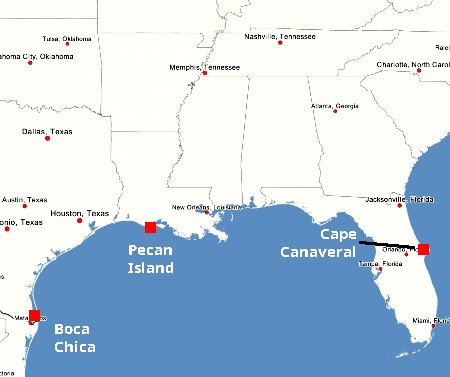
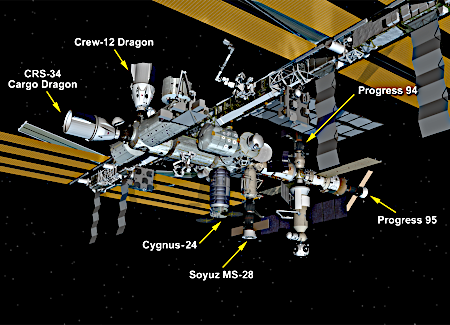
Finally, SpaceX completed its second launch in less than eight hours, sending Northrop Grumman’s Cygnus capsule on its way to ISS with 11,000 pounds of cargo, its Falcon 9 rocket lifting off from Cape Canaveral Space Force Station in Florida. The first stage completed its seventh flight, landing back at Cape Canaveral. Of the two fairings, one was making its first flight, while the other was on its fifth flight.

This was SpaceX’s fourth Cygnus launch for Northrop Grumman. The company originally launched Cygnus on its own Antares rocket, but when that rocket ran out of its Russian first stage engines it was grounded. The company hired Firefly to build a new first stage, but that project remains uncompleted.

Cygnus is scheduled to berth with ISS in two days, on Monday, April 13, at 12:50 pm (Eastern).

The leaders in the 2026 launch race:

44 SpaceX
19 China
5 Rocket Lab
5 Russia

For the third straight year SpaceX continues to lead the entire world combined in total launches, 44 to 34.

28 comments

A military pilot’s perspective on downed pilot rescue in Iran Easter weekend

An evening pause: The details of the amazing search & rescue effort to recover a downed American pilot in Iran last weekend has been covered quite thoroughly in the media, especially the alternative press. This video gives us the compelling perspective of the men and women who made that rescue happen. Even if you oppose Trump’s present actions against Iran, Steeve’s reveals a fundamental aspect of the American way of war that illustrates again the best part of America. The key quote, “Will you be worth the trip?”

Hat tip Mike Nelson.

18 comments

Orion survives re-entry, crew splashes down safe

Orion just after main parachute deployment

Orion successfully survived re-entry tonight with its questionable heat shield, with the capsule splashing down off the coast of California at 8:07 pm (Eastern).

All four astronauts are healthy and safe. As of posting they were still in the capsule, floating on the ocean, with recovery crews on their way to it. [Update: those recovery crews, six boats with more than 40 people, are taking an ungodly amount of time to latch onto the capsule and begin recovery. Over an hour after splashdown the crew is still in the capsule.]

The Artemis-2 mission is now over, though the final condition of that heat shield still needs to be analyzed. In addition, engineers need figure out how to fix a bunch of other issues that took place during the mission:

  • A leak in an internal helium tank on Europe’s service module
  • Communication drop-outs several times
  • the endless issues with Orion’s toilet

There were other minor issues that cropped up repeatedly, none significant but all of which should be fixed. And though it will be helpful to determine how this heat shield performed, it should be noted that the data is essentially irrelevant to future missions. The next mission, Artemis-3, will use a completely different design, and test it for the first time on a manned flight. That flight however will be in Earth orbit, so the stress on the shield will be far less than this return, even with the changed re-entry path.

Though many will call this lunar fly-by “historic,” it will likely be little remembered by future generations. It did little to move the settlement of the solar system forward. No truly useful engineering was tested. The rocket and capsule are engineering dead-ends. Neither will be of much use for establishing colonies on the Moon or Mars, as SLS is still too expensive and too difficult to stack and launch and Orion is too small for any interplanetary missions, being nothing more than an overweight and very expensive ascent/descent capsule.

The only plus of this mission is that it will likely give NASA’s administrator, Jared Isaacman, the political clout to institute major changes in the entire Artemis program, changes that could make the American colonization of the solar system more likely. There are strong indications that he wants to make better use of the private sector.

And that private sector is poised to bypass NASA, regardless of what NASA wants or tries to do, with capabilities far better then anything we have seen since the Apollo program.

56 comments

April 10, 2026 Quick space links

Courtesy of BtB’s stringer Jay. This post is also an open thread. I welcome my readers to post any comments or additional links relating to any space issues, even if unrelated to the links below.

5 comments

Orion’s risky return-to-Earth happens tonight at 8:07 pm (Eastern)

The Earth as seen by the Artemis-2 astronauts, from behind the Moon
The Earth and Moon during the lunar fly-by on April 6, 2026.
Click for original image.

After spending ten days in space, including a swing around the back of the Moon, the four-person Artemis-2 crew is now preparing for its return-to-Earth this evening, splashing down off the Pacific coast near San Diego.

At 10:53 p.m. EDT [last night], the Orion spacecraft ignited its thrusters for 9 seconds, producing an acceleration in velocity of 5.3 feet-per-second and pushing the Artemis II crew toward Earth. The crew is now more than halfway home.

About two hours before the burn, there was an unexpected return link loss of signal during a data rate change affecting the transmission of communications and telemetry from the spacecraft to the ground. Two-way communications were reestablished, and flight controllers resumed preparing for the upcoming burn with the crew shortly after.

…The third return trajectory correction burn is scheduled for April 10 at about 1:53 p.m. ahead of re-entry procedures.

This is I think the second time Orion has had a short loss of communications with ground control. In addition, the crew had to cancel a planned manual piloting demonstration of Orion while it flew past the Moon because of a leak in an internal helium tank, used to maintain pressure in the oxygen tank as the propellant is used. The leak was inside the European-built service module, which will be jettisoned before re-entry and burn up in the atmosphere.

Mission managers say this leak has not impacted any engine burns, but it will require attention before the next flight.

The return to Earth however carries the biggest risk of the entire mission. Orion’s heat shield is questionable. During its first use in the 2022 unmanned Artemis-1 flight around the Moon, it did not behave as expected, with large chunks breaking off instead of thin layers ablating away. Though mission engineers have adjusted the flight path through the atmosphere to mitigate stress, there is great uncertainty about that solution.

I have embedded NASA’s live stream of the return-to-Earth below. It begins at 6:30 pm (Eastern), though the first return event, jettison the service module, doesn’t occur until 7:33 pm (Eastern).
» Read more

21 comments

Amazon to begin commercial availability of Leo internet service in mid-2026

Amazon Leo logo

In an annual letter [pdf] to shareholders, Amazon’s CEO Andy Jassy announced the company plans on inaugurating its Leo internet constellation to customers in “mid-2026,” assuming the company can get a significant more satellites in orbit in the next few months.

Jassy’s wording was interestingly vague, however, suggesting this target date is very uncertain.

Over the last seven years, weโ€™ve built a low Earth orbit satellite network (Amazon Leo) and put more than 200 satellites into space (which is the third-largest low Earth orbit network operating today). With a few thousand more satellites launching in the coming years, the constellation is expanding rapidly.

…While Amazon Leo is officially scheduled to launch in mid-2026, we already have meaningful revenue commitments from enterprises and governments.

To be precise, Amazon presently has launched 241 satellites, out of the 1,616 it needs to launch by July 2026 to meet its FCC license requirement. Because it is not expected to meet that requirement, the company has asked for a time extension, which the FCC is presently considering. The entire first generation constellation is supposed to have 3,232 satellites, so it seems unlikely Amazon will be able to provide internet service by mid-2026, as promised. It won’t have enough coverage with less than a fourth of its constellation in orbit.

0 comments

India conducts another parachute drop test for its Gaganyaan manned capsule

Gaganyaan drop test
Click to watch video of drop test.

India’s space agency ISRO today successfully completed its second helicopter drop test of a dummy capsule, testing the parachute release system that its Gaganyaan manned capsule will use on return to Earth.

In this test, a simulated Crew Module, weighing about 5.7 tonnes, that is equivalent to the mass of the Crew Module in the first uncrewed Gaganyaan mission (G1), was lifted by an Indian Air Force Chinook helicopter to an altitude of about 3km and released over a designated drop zone in sea, near to Sriharikota coast.

Ten parachutes of four types were deployed in a precise sequence during the descent of the Crew Module, gradually reducing the velocity for safe touchdown. Subsequently, the simulated Crew Module was successfully recovered in coordination with Indian Navy. The IADT-02 test validated the parachute-based deceleration systems in the Crew Module.

The manned mission is presently scheduled for early next year, after a series of unmanned orbital test flights are completed in โ€™26. This schedule is significantly later than ISROโ€™s original schedule. When the program was first proposed in 2018, ISRO said the manned mission would happen in 2022.

4 comments

China launches another set of satellites for its Guowang internet constellation

China yesterday successfully completed the 21st launch for its Guowang (Satnet) internet satellite constellation, its Long March 6A rocket lifting off from its Taiyuan spaceport in northeast China.

Though Chinaโ€™s state-run press provided no information on the number of satellites in the payload, all previous launches using the Long March 6A had carried five satellites. If so, that would mean the constellation now has 164 satellites in orbit, out of a planned 13,000. This fits with the information in the article at the link, which states the constellation now has “nearly 170 satellites” in orbit.

China’s state-controlled press also made no mention about where the rocket’s core stage (using very toxic hypergolic fuels) and its four solid-fueled strap-on boosters crashed inside China.

Another launch attempt today by the German rocket startup Isar Aerospace was scrubbed due to “a leak in a composite overwrapped pressure vessel (COPV).” COPV tanks are used inside the main tanks. As the propellant in that main tank is used, the COPV releases helium to maintain the tank’s pressure. No new launch date has been announced.

The leaders in the 2026 launch race:

42 SpaceX
18 China
5 Rocket Lab
4 Russia

For the third straight year SpaceX continues to lead the entire world combined in total launches, 42 to 32. It has another Starlink launch scheduled for this evening.

1 comment
1 21 22 23 24 25 2,927