A hiker’s view from Mount Sharp

A hiker's view of Gale Crater, taken by Curiosity
Click for full image.

A quick cool image! The photo to the right, reduced to post here, was taken yesterday by Curiosity’s left navigation camera. It looks west across the floor of Gale Crater, at the base of a nearby butte.

The crater rim, as seen by the distant mountains, is about 25 miles away. The butte that towers above Curiosity is probably no more than 50 feet high.

Below is a panorama showing the full view to the west, with Navarro Mountain (the nearby 450-foot-high foothill at the base of Mount Sharp) on the left edge. Based on the rover’s planned route, it will travel to the right of the butte rather than climbing up onto the saddle on the left. This will take it to the western side of Navarro Mt, where it will eventually head south into the canyon Gediz Vallis.
» Read more

4 comments

1st water vapor in Ganymede’s atmosphere, detected using data from Hubble

Using Hubble data, astronomers have detected the first evidence of water vapor in the atmosphere of Jupiter’s largest moon, Ganymede.

Though larger than the blistering planet Mercury, the Jovian moon Ganymede is no place to go sunbathing. Located ½-billion miles from the Sun, the water ice on its surface is frozen solid in frigid temperatures as low as minus 300 degrees Fahrenheit. This makes the ice as hard as rock. Still, a rain of charged particles from the Sun is enough to turn the ice into water vapor at high noon on Ganymede.

This is the first time such evidence has been found, courtesy of the Hubble Space Telescope’s spectroscopic observations of aurora on Ganymede spanning two decades. The auroras are used to trace the presence of oxygen, which then is linked to the presence of water molecules sputtering off the surface. Ganymede has a deep ocean located an estimated 100 miles below the surface. That’s too deep for water vapor to be leaking out.

This detection has a margin of uncertainty, but it provides a baseline for the up close observations planned for Europe’s JUICE orbiter, set to launch in ’22 and arrive in Jupiter orbit in ’29. JUICE’s study focus will be the three Galilean moons that appear to have lots of ice, Ganymede, Calisto, and Europa.

0 comments

Russians detach Pirs module in anticipation of Nauka arrival to ISS

With the engine problems of Russia’s new ISS module Nauka apparently resolved sufficiently for its rendezvous and docking expected on on July 29th, Russian astronauts today undocked the 20-year-old Pirs module, which then used its engines so that it safely burned up over the Pacific Ocean.

The article provides a nice history of Pirs, which was originally intended for Russia’s Mir-2 station, never built after the fall of the Soviet Union.

Pirs, meaning “pier,” traces its origins back to the Mir-2 space station — which was itself a Soviet project that’s design began in 1976. Mir-2’s long and troubled history would eventually find it in the early 1990s where major design changes to launch its various modules via the Buran space shuttle were underway.

Following the collapse of the Soviet Union in December 1991, Mir-2 emerged the following year as a four-module station — including a Docking Module, which would become Pirs. In 1993, Mir-2 officially merged with the long-delayed NASA/European/Japanese/Canadian space station Freedom project to become the building blocks of the International Space Station.

The module, which provided the Russian half of ISS needed extra docking ports, was originally expected to be replaced after about five years with a larger module, but this was never built.

15 comments

Deleted

This post incorrectly reported a Chinese launch as occurring today when it had actually occurred (and was reported previously. I have therefore deleted it. Sorry about the error.

The leaders in the 2021 launch thus remain as follows:

23 China
20 SpaceX
12 Russia
3 Northrop Grumman

The U.S. still leads China 29 to 24 in the national rankings.

3 comments

Update on Ingenuity’s 10th flight and Perseverance’s first sample drilling

Ingenuity landing at end of 10th flight

The news coming from the Perseverance and Ingeniuty science teams has been sparse this past weekend, even though Perseverance had begun drilling its first core sample that it will stored for pickup by a later unmanned robot, and Ingenuity had attempted its 10th and most challenging flight yet.

We do have images however, and the two to the right give us hints about what has happened.

First, the top picture on the right was taken by Ingenuity’s navigation camera just prior to landing. The camera looks straight down and is used by the helicopter to adjust its flight. The dark area is the helicopter’s shadow. Based on this picture and the four preceding images (taken over an eleven second period), it appears the helicopter was landing safely. No other images have yet been downloaded, nor has the Ingenuity team announced any results, so we do not yet know if the flight proceeded as planned.

UPDATE: The flight was a success, as per this JPL announcement:

With the #MarsHelicopter’s #flight success today, we crossed its 1-mile total distance flown to date. It targeted an area called “Raised Ridges,” named for its #geographic features. Flight 10 is #Ingenuity’s most complex flight profile yet, with 10 distinct waypoints and a new #record height of 40 feet (12 meters).

Drill and core sample in the ground

The second image, taken by Perseverance’s left navigation camera and cropped and reduced to post here, is more puzzling. It shows what appears to be the core sample still in the ground after drilling. While this could be entirely as planned, it seems very surprising. Most of what I can find online describing the operation for obtaining these samples implies that the robot arm would drill the hole, and then retract the sample immediately to place it in storage. Nothing suggests the arm would be retracted with the sample still in the ground.

I think however the odds of this picture revealing a problem are low. This JPL press release from February 2021 implies vaguely that the core sample will be released in this manner before retraction. After the core sample, with bit, is separated from the arm, the release suggests they will lift the arm away to inspect the drilling process, then return the arm to retract the core sample for storage. This does make some sense, though grabbing that sample again will be quite challenging.

If this was not supposed to happen as described, then there is a problem that must be resolved. I expect more details in the next day or so to clarify this situation.

5 comments

Ingenuity’s next flight set for today

Flight plan for Ingenuity's 10th flight
Click for full image.

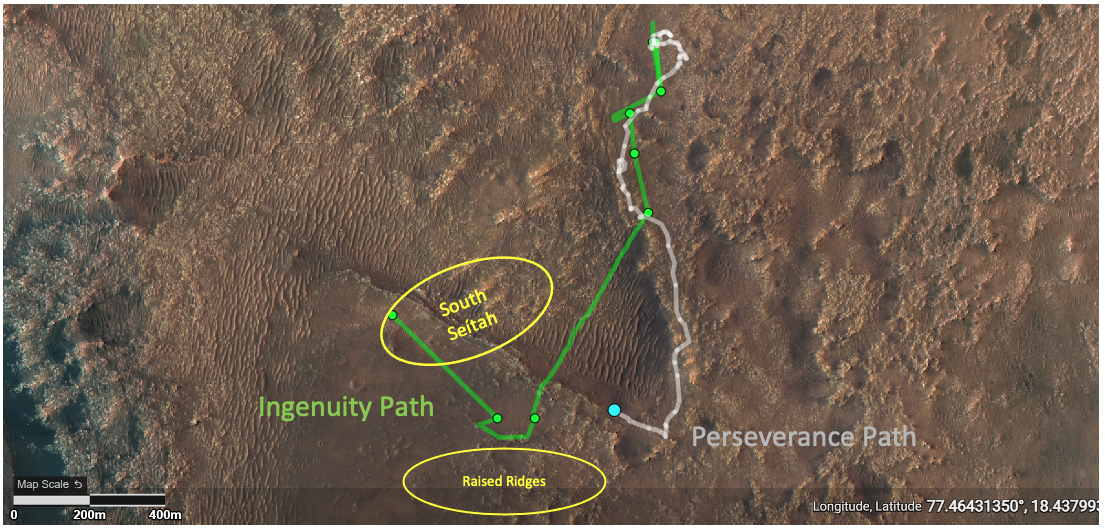
Though circumstances can obviously change, the Ingenuity/Perseverance science teams have scheduled Ingenuity’s 10th Martian flight for sometime later today, with a flight plan, shown to the right, that is even more ambitious.

Flight 10 will allow us to reap the benefits of our previous flight. Scheduled for no earlier than this Saturday (July 24), Flight 10 will target an area called the “Raised Ridges” (RR), named for the geographic features that start approximately 164 feet (50 meters) south-by-southwest of our current location. We will be imaging Raised Ridges because it’s an area that Perseverance scientists find intriguing and are considering visiting sometime in the future.

From navigation and performance perspectives, Flight 10 will be our most complex flight to date, with 10 distinct waypoints and a nominal altitude of 40 feet (12 meters). It begins with Ingenuity taking off from its sixth airfield and climbing to the new record height. It will then head south-by-southwest about 165 feet (50 meters), where upon hitting our second waypoint, take our first Return to Earth (RTE) camera image of the Raised Ridges, looking south. Next, we’ll translate sideways to waypoint 3 and take our next RTE image – again looking south at Raised Ridges.

Imagery experts at JPL hope to combine the overlapping data from these two images to generate one stereo image. Flying farther to the west, we’ll try for another stereo pair of images (waypoints 4 and 5), then head northwest for two more sets of stereo pairs at waypoints 6 and 7 as well as 8 and 9. Then, Ingenuity will turn northeast, landing at its seventh airfield – about 310 feet (95 meters) west of airfield 6. Total time in the air is expected to be about 165 second.

Unlike the previous flights, this one will involve several turns while in the air. The engineers are definitely pushing the envelope with each flight, thus not only gathering scientific data about Jezero Crater but also advancing their engineering knowledge on the art of robotic flying on Mars.

3 comments

The Oort Cloud: what little is known

Link here. This is one of the best articles on the theorized Oort Cloud, in that right off the bat the author recognizes this important fact:

We know so little about it that its very existence is theoretical — the material that makes up this cloud has never been glimpsed by even our most powerful telescopes, except when some of it breaks free.

The cloud’s existence is extrapolated from the arrival of long period comets, and seems to make sense. Yet, without any direct observations it remains a theory only, and an unproven one at that.

4 comments

SpaceX wins contract to launch Europa Clipper to Jupiter

Capitalism in space: NASA today awarded SpaceX a $178 million contract to use its Falcon Heavy rocket to launch Europa Clipper to Jupiter.

If all goes according to plan, Clipper will lift off in October 2024 from NASA’s Kennedy Space Center in Florida and arrive in orbit around Jupiter in April 2030. The probe will then study Europa in depth during nearly 50 close flybys of the moon over the course of about four Earth years, mission team members have said.

The award is not really a surprise. Falcon Heavy is really the only operational rocket with the power capable of launching this mission. Because for years Congress had mandated Europa Clipper be launched on SLS, it was designed with more mass than normal for such planetary missions. Delays in the SLS program however finally forced Congress to relax that mandate, but that left NASA with a payload too heavy for all operational rockets except Falcon Heavy, and even that requires this six year flight, with flybys of the Earth and Mars to get it to Jupiter.

The price for the launch is significantly greater than SpaceX normally charges for its Falcon Heavy, but since it was the only game in town, I suspect SpaceX drove a hard bargain.

10 comments

Ice, lava, quakes, and faults, all in one Martian image

A lot of geology in one picture
Click for full image.

Cool image time! The photo to the right, rotated, cropped, and reduced to post here, was taken by the high resolution camera on Mars Reconnaissance Orbiter (MRO) on April 25, 2021. It grabbed my attention because it possibly captures a whole range of Martian geological processes, all in one place, including evidence of quakes, of lava, of faults, and possibly of glaciers.

First, ignore the black rectangle, which is merely a small section of lost data.

The picture itself shows a wide north-south fissure, as indicated by the distinct western cliff and the fainter and less pronounced eastern cliff. This fissure, likely formed along a fault, was created when the crust was pushed and stretched upward by the pressure of underground volcanic magma, part of the long series of eruptions that formed the many similar and parallel north-south fissures south of the shield volcano Alba Mons.

The overview map below illustrates this fissure’s relationship with Alba Mons.
» Read more

0 comments

Today’s blacklisted American: Democrats introduce Senate bill demanding companies censor social media

Democrats: No soapbox free speech allowed
Democrats: No soapbox allowed! Photo: GeorgeLouis

Blacklists are back and the Democrats got ’em! Two Democrats, Senator Amy Klobuchar (D-Minnesota) and Ben Ray Lujan (D-New Mexico), yesterday proposed a new law that would force social media companies like Google, Facebook, and Twitter to immediately remove any posts on their platforms that includes medical information those Democrats disagree with.

If the companies do not do so, they will be held liable for those posts.

As has become typical of Democrats, they label any information they disagree with as “misinformation.” To make sure their definition is sustained, their bill would have the federal government determine what is correct and not correct. That definition would then be used to justify silencing any other opinions.

Such a law would essentially repeal the First Amendment of the Constitution. Free speech will be banned. Only government-approved speech in connection with health will be allowed. If such a law was upheld by the courts (a very distinct possibility in today’s legal culture), it could quickly be expanded to cover all speech on any subject.

There is some irony in this Democratic Party proposal. » Read more

12 comments

Nauka issues apparently resolved?

According to a press release for Roscosmos, engineers have successfully fired the engines on Russia’s new large module for ISS, dubbed Nauka, and the module is now on course for rendezvous with the space station.

On Thursday, July 22, 2021 the Nauka Multipurpose Module Flight Control Group specialists at Moscow Mission Control Center conducted two correction maneuvers of the module that had launched to the International Space Station the previous day.

The first maneuver took place at 15:07 UTC with the module engines burn for 17.23 seconds giving an impulse of 1 m/sec. The second burn for 250.04 seconds took place at 17:19 UTC with an impulse of 14.59 m/sec.

No details were released explaining why the first course correction engine burn did not happen as scheduled.

UPDATE: I have added a question mark to the headline because there indications from a variety of sources, all unconfirmed, that the problems might still persist. We shall find out in the next two days.

6 comments

Global dust storm on Mars brought on an early spring in southern hemisphere

Scientists analyzing the climate effects from the 2018 global dust storm on Mars have found that while it did little to change the seasons in the northern hemisphere, it caused winter to end early in southern hemisphere.

The team found that the 2018 storm had profoundly different effects in each hemisphere. At the south pole, where the vortex was almost destroyed, temperatures rose and wind speeds fell dramatically. While the vortex may have already been starting to decay due to the onset of spring, the dust storm appears to have had a decisive effect in ending winter early.

The northern polar vortex, by contrast, remained stable and the onset of autumn followed its usual pattern. However, the normally elliptical northern vortex was changed by the storm to become more symmetrical. The researchers link this to the high dust content in the atmosphere suppressing atmospheric waves caused by the extreme topography in the northern hemisphere, which has volcanoes over twice as tall as Mount Everest and craters as deep as terrestrial mountains.

These differences are likely also related to the eccentricity in the Martian orbit around the Sun, which is greater than that of Earth and actually has a direct effect on its seasons. As noted in this recently published paper about the activity scientists have now documented on the Martian surface in the past decade,

Because perihelion (the closest approach to the Sun) currently occurs [during summer in the south], southern hemisphere seasons are more extreme, with a longer winter and shorter, warmer summer

This difference is probably a major factor explaining the different effects of the global dust storm. It also is probably why the Red Planet’s two polar ice caps are so different.

This difference between the two hemispheres will also likely help drive the intitial human settlement on Mars to the north. Not only does the northern hemisphere have the flat lowland plains, making those first difficult landings easier and safer, it has a more benign climate year round.

1 comment

Court rejects Viasat’s effort to stop SpaceX Starlink launches

Capitalism in space? A three-judge panel on July 20, 2021 rejected Viasat’s request for a temporary injunction that would have stopped all SpaceX Starlink launches until Viasat’s lawsuit against that constellation is settled.

While this decision does not settle the lawsuit, it allows SpaceX launches to continue, and likely cause the case to be expedited in the courts. The decision also suggests that the court does not favor Viasat’s claims, which are somewhat dubious on their face, and appear designed merely to shut down a successful competitor through the use of the courts.

Viasat alleged that the FCC did not comply with the National Environmental Policy Act (NEPA) when it approved SpaceX satellite launches because the commission “refused to conduct any environmental assessment.” Viasat told the DC Circuit court that SpaceX launches should be halted because of potential environmental harms when satellites are taken out of orbit; light pollution that alters the night sky; orbital debris; collision risks that may affect Viasat; and because “Viasat will suffer unwarranted competitive injury.”

The FCC by the way disputes Viasat’s claims, and filed its own brief defending SpaceX.

Viasat’s real concern is that its satellite internet service will be considered inferior to SpaceX’s and will thus lose customers to it. Too bad. Competition means you step up your game and do better, not go to court to try to shut down your opposition.

9 comments

Scientists refine Martian interior based on quakes detected by InSight

Martian quake map as seen by InSight

Scientists today published three studies in the journal Science outlining their conclusions about the interior of Mars, based on the quakes that have been detected by InSight since it arrived on Mars in November 2018.

Reporting in a trio of studies published in the July 23rd Science, the Insight science team has now analyzed about 10 marsquakes to make the first direct observations of the structure within another rocky planet. The results — a surprisingly thin crust, an undifferentiated mantle, and a larger-than-expected core — will help determine how Mars formed and evolved.

There results are essentially what was described in April by the InSight science team at the annual 52nd Lunar and Planetary Science Conference (and reported here but no where else), though now more carefully and thoroughly described.

The discovery that the Martian crust is much thinner than expected, either 12 or 24 miles thick, with a core that is still liquid, has ramifications that might help explain both the planet’s formation and its volcanic history and giant volcanoes.

One piece of good engineering news in connection with the lander InSight:

Despite a dust-fueled energy crisis earlier this year, the solar-powered lander has since regained some power-generating capacity. “We are at least safe for this season’s winter and probably far into 2022,” Stähler says.

0 comments

The wind-swept volcanic ash plains of Mars

Overview map

Cool image time! In Mars’ volcano country lies the planet’s largest ash deposit, dubbed the Medusae Fossae Formation. Scientists believe that this gigantic deposit, with a size comparable to the nation of India, was laid down by muliple volcanic eruptions over several billion years and is the source of most of the dust seen on the Red Planet.

The overview map on the right shows the location of this ash deposit on Mars. The white cross indicates the location of today’s cool image, found below.
» Read more

1 comment

Russia’s new module for ISS, Nauka, in trouble after launch

The new big Russian module for ISS, dubbed Nauka and successfully launched yesterday, appears to have a serious engine issue, according to these twitter reports by Anthony Zak of RussianSpaceWeb.com.

From his two tweets:

UPDATE: #Nauka’s main engines (pictured in operation) are currently out of commission. Specialists are troubleshooting the issue and developing a backup rendezvous plan. The module has ~30 stable orbits at current altitude.

…one more thing: at this point, there is no information that Nauka’s tank membranes have leaks in orbit. Those rumors in the Russian press might be a garbled echo of my reporting here ;)->

Nauka’s launch came about fourteen years behind scheduled, delayed by many engineering and quality control problems. Its construction began more than a quarter century ago. If Nauka fails to dock with ISS the Russians will face a disaster to their space program that almost cannot be measured. It will certainly make the Chinese much more reluctant to depend on Russia in their supposed partnership to build a base on the Moon or to work together on China’s space station. It should also make the U.S. far more reluctant to depend on Russia in its Artemis program.

Worse, it is questionable the Russians can get anything built in any reasonable time to replace Nauka. How can anyone expect them to build anything in a reasonable time for either of the U.S. or Chinese interplanetary projects?

14 comments

Today’s blacklisted American: Baltimore’s attorney attempts, and fails, to get FCC to silence and censor local Fox radio station

The Bill of Rights cancelled for conservatives
No first amendment allowed for conservatives,
according to Baltimore’s government attorney.

Blacklists are back and the Democrats got ’em! On May 5, 2021 the office of Baltimore’s state attorney, Democrat Marilyn Mosby, filed a formal complaint with the Federal Communications Commission (FCC) against a local Fox news station, demanding that the FCC censor and shut down the station because it has repeatedly published stories that were critical of Mosby and her policies.

The May 5 complaint, addressed to FCC acting chairwoman Jessica Rosenworcel, accuses WBFF (a.k.a. FOX45 News) — the Baltimore-based Fox-affiliate — of partaking in an “intentional crusade against … Mosby, which given today’s politically charged and divisive environment, is extremely dangerous.” It also details what Mosby’s communications director, Zy Richardson, believes to be a “disconcerting and dangerous pattern: beginning with a slanted, rigged, misleading, or inflammatory headline; followed by conspiracy theory; and supported with guest commentary from disgruntled ex-employees or political opponents that[sic] lend false credibility.”

“The truth of the matter,” Richardson says, “is I am deeply worried that if the WBFF’s coverage is not curtailed and ceased, then someone is going to get hurt. I implore and encourage you … to enlist the full investigative and enforcement powers granted to you by the Federal government to take action against the WBFF as soon as possible.” [emphasis mine]

The blatent oppressive nature of this demand — in utter violation of the first amendment of the Constitution and all that America has stood for during its first two hundred plus years — should be somewhat shocking, but sadly it has become so common from Democratic Party politicians and many of their supporters in the past five years that it hardly made the news when it happened in early May.

Think about it however. » Read more

8 comments
1 546 547 548 549 550 1,761