A fitting memorial

Greeley Haven

Opportunity has settled into its winter haven.

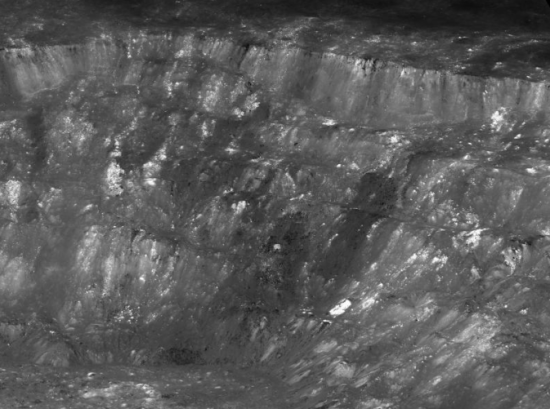
NASA’s Mars Exploration Rover Opportunity will spend the next few months during the coldest part of Martian winter at Greeley Haven, an outcrop of rock on Mars recently named informally to honor Ronald Greeley, Arizona State University Regents’ professor of planetary geology, who died October 27, 2011.

I met and interviewed Greeley a number of times in writing articles for magazines like Sky & Telescope and Astronomy. For years he was a central figure in the field of planetary geology, and his life effort is one of the prime reasons the United States has dominated this field for most of the past half century, with a fleet of planetary missions presently at Mercury, Mars, Jupiter, Saturn, and Pluto, with many more to come.

The article notes that the International Astronomical Union (IAU) has the job of naming objects in space, and could take years to honor Greeley. I say that if these scientists, the true explorers of Mars, want to name something for him, then they should go ahead, and future generations should honor that choice, regardless of what the IAU says.
0 comments

The Sun calms down in December

It’s that time again! As I do every month, it’s time to post Space Weather Prediction Center’s monthly updated graph showing the Sun’s solar cycle sunspot activity. The graph itself can be seen below the fold.

After five months of quickly increasing sunspot activity, the Sun in December finally took a rest, with the sunspot numbers dropping down to almost exactly the solar activity scientists had expected at this time, according to their May 2009 prediction. Interestingly, this might be the first time since I began tracking the solar cycle in 2008 that the prediction actually matched that month’s activity.
» Read more

3 comments

What is this stuff?

What is this stuff?

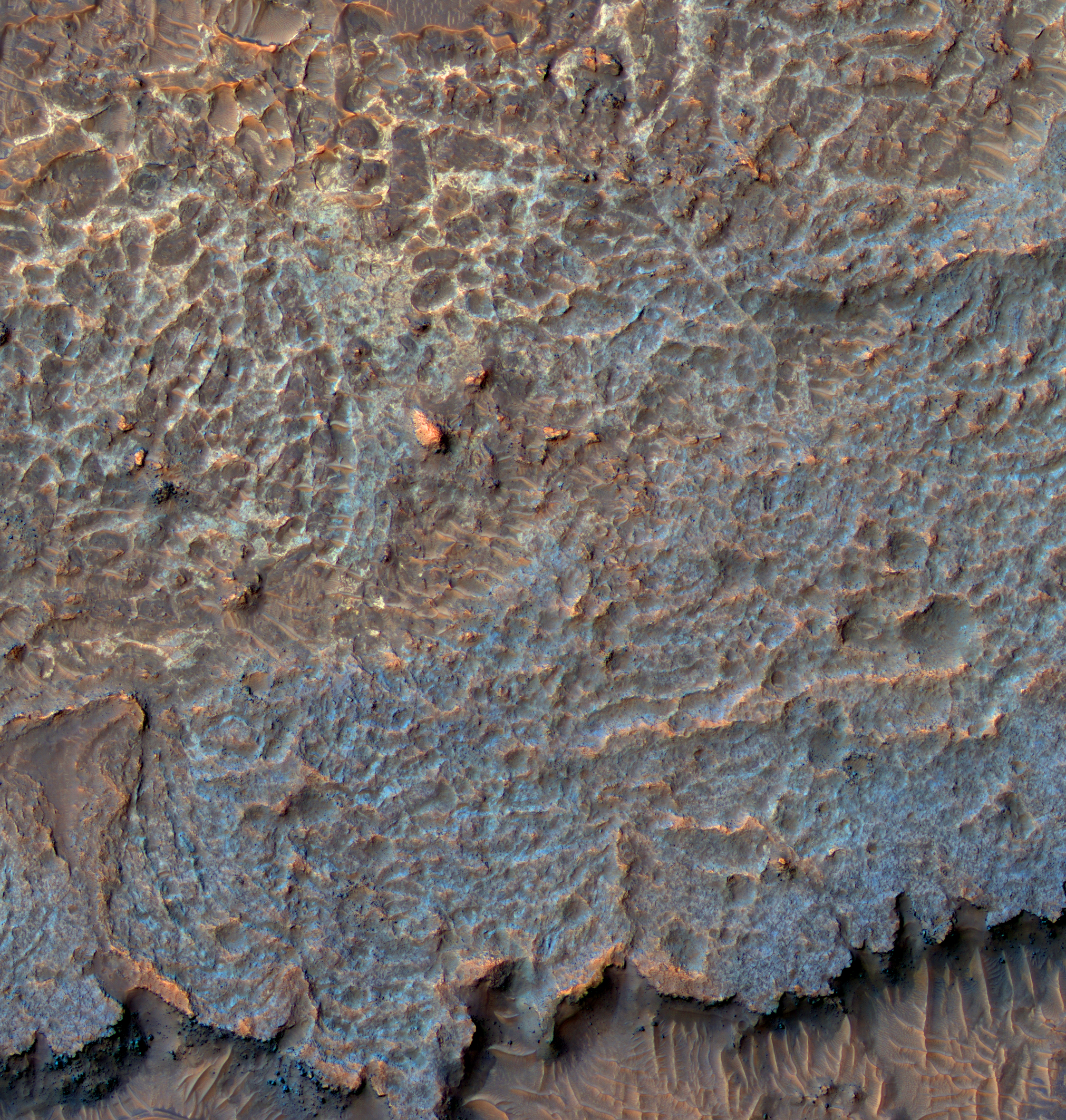
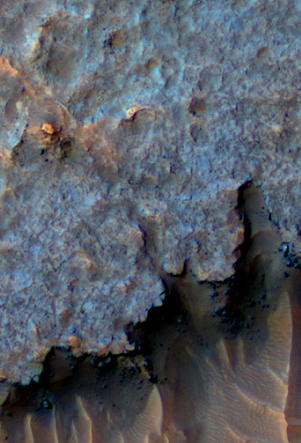
The uncertainty of science: In this week’s release of images from Mars Reconnaissance Orbiter, the science team posted the image on the right and asked, “What is this stuff?”

Here’s a hypothetical geologic history that might explain this scene: layered sediments were deposited by water or airfall (including volcanic pyroclastics). A crudely polygonal patterned ground was created by stresses in the sediments, and groundwater followed the fractures and deposited minerals that cemented the sediments. This was followed by perhaps billions of years of erosion by the wind, leaving the cemented fractures as high-standing ridges.

Of course, this story is almost certainly incomplete if not totally wrong.

Click here to see the close-up subimage from which I cropped the image on the right.

0 comments

Space exploration and the unexpected consequences of government decisions

On Thursday, December 15, 2011, NASA management announced what seemed at first glance to be a very boring managerial decision. Future contracts with any aerospace company to launch astronauts to and from the International Space Station (ISS) will follow the same contractual arrangements used by NASA and SpaceX and Orbital Sciences for supplying cargo to the space station.

As boring that sounds, this is probably the most important decision NASA managers have made since the 1960s. Not only will this contractual approach lower the cost and accelerate the speed of developing a new generation of manned spaceships, it will transfer control of space exploration from NASA — an overweight and bloated government agency — to the free and competitive open market.

To me, however, the decision illustrates a number of unexpected consequences, none of which have been noted by anyone in the discussions that followed NASA’s announcement back in mid-December.
» Read more

6 comments

The new Arctic ozone hole

An interesting and very informative paper was published by the American Geophysical Union this past Saturday, entitled “Arctic winter 2010/2011 at the brink of an ozone hole.” The first paragraph of the introduction essentially summed up the paper’s key points:

Large losses of Arctic stratospheric ozone have been observed during winter 2010/2011, exceeding observed losses during cold winters over the past decades, characterized as the first Arctic Ozone Hole. Although in general Arctic ozone is expected to recover because of the reductions in ozone depleting substances as a result of the Montreal Protocol and its amendments, the observation that apparently the cold Arctic winters in the stratosphere have been getting colder over the past decades raises some concern that Arctic ozone depletion may worsen over the next decades if the cooling trend continues while concentrations of ozone depleting substances remain sufficiently high. [emphasis mine]

Two important take-aways:
» Read more

3 comments

Want to see an asteroid eclipse a star?

transit of Betelgeuse

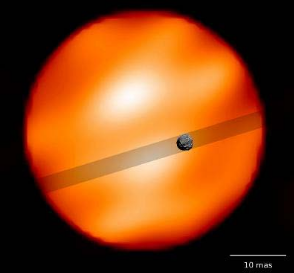
On January 2, 2012, an asteroid is going to transit across the face of Betelgeuse. And if you live in Europe, own a very sensitive telescope, look close and don’t blink, you might be able to see it!

This is all according to a preprint paper published today on the Los Alamos astro-ph preprint website, written by scientist Costantino Sigismondi of the Galileo Ferraris Institute and International Center for Relativistic Astrophysics in Rome. You can download the paper here [pdf].

The transit itself will only last 3.6 seconds, and will only be visible along a narrow swath crossing southern India and moving across the Middle East, through parts of Italy, France, and the southwestern most tips of England and Ireland. A map of this path is below the fold.
» Read more

0 comments

Underground exploring today

No posting today, as I am leaving home at 6:30 am with several cavers for a day trip to a cave in the Chiricahua Mountains in southeast Arizona. The drive one way is about three and a half hours, so doing this as a day trip will likely break what I like to call Zimmerman’s law: “The cave time must exceed the drive time.”

However, when I first visited Tucson last winter and mentioned I might move here, the local cavers asked if I’d be interested in being the cartographer of this particular cave and help them get a project started to survey it. Three previous attempts to survey it were never completed, so no good map exists. And since I have recently completed two significant cave maps of two important West Virginia caves (see monographs 3 and 4 on this page) and am without a map project at the moment, how could I say no? Tomorrow’s trip is my first visit to the cave in preparation for getting the survey project off the ground in January.

Anyway, I will be back late, and will return to the computer on Saturday. For everyone, have a Merry Christmas weekend!

2 comments

Bigotry on campus

The newly named “associate dean for equity and inclusion” at the College of Engineering at the University of California, Berkeley, is promising “disruptive progress” in his effort to increase minorities at the school.

The plan [pdf] includes more money for staffing and facilities for the “equity and inclusion” department, plus more money and power for student organizations. Sadly, this is money and facilities that will no longer be available for actual education or research.
» Read more

0 comments

Global warming is good for you!

Here are two stories that illustrate why we shouldn’t be in a panic over climate change. Though it is important to study the climate and to learn as much as we can about it, it is at this time inappropriate to impose draconian regulations on the world’s populations so that whole economies are destroyed out of fear of climate change. We just don’t know enough about the consequences of climate change. Global warming might even be beneficial!

First, from Nature this story: Global warming wilts malaria. It appears that the assumption that warmer climates would increase malaria epidemics is completely wrong. Instead, warmer temperatures act to hinder the survival of the malaria parasite in mosquitoes.
» Read more

2 comments

A big sideways slip on Mars

Mars Reconnaissance Orbiter today released an image of a really spectacular transform fault on Mars, a spot where the ground cracked and two sections moved sideways to each other. In this case, the sideways movement was about 300 feet. The image is posted below the fold.

Compare that with the Japanese magnitude 9 earthquake on March 11, which only shifted the seabed sideways 165 feet while raising it 33 feet. The quake that moved these two pieces of Martian bedrock sideways must have been quite a ride.
» Read more

1 comment

Ramping way up!

The monthly update of the solar cycle graph produced by NOAA’s Space Weather Prediction Center was released yesterday. I have posted the graph below the fold.

The fast ramp up to solar maximum is continuing. For the fifth month in a row the Sun’s sunspot activity leaped upward. Not only has the sunspot activity once again exceeded the prediction for this particular time period, the activity is shot way above the solar maximum peak predicted for several years hence. This behavior is far different then what we’ve seen during the just completed long and deep solar minimum, when the Sun consistently underperformed the predictions for sunspot activity. Now it appears to be outperforming the predictions.
» Read more

1 comment
1 108 109 110 111 112 139