The cause of white nose, the killer of bats

Scientists today confirmed that the fungus, Geomyces destructans, causes white nose syndrome, the deadly killer that has been wiping out cave-hibernating bats throughout the eastern United States.

A science team led by David Blehert of the National Wildlife Health Center in Madison, Wisconsin captured healthy little brown bats and infected them with the fungus while they were in hibernation, some by direct application and others by putting them in contact with already infected bats. After 102 days, all of the first group had developed white nose on their muzzles and wings, while 16 of 18 of the second group had become infected as well.
» Read more

2 comments

Has dark matter been identified?

From a paper published today on the Los Alamos astro-ph preprint website, scientists suggest that three different physics experiments might have identified dark matter. From the abstract:

Three dark matter direct detection experiments (DAMA/LIBRA, CoGeNT, and CRESST-II) have each reported signals which are not consistent with known backgrounds, but resemble that predicted for a dark matter particle with a mass of roughly ~10 GeV. . . . In this article, we compare the signals of these experiments and discuss whether they can be explained by a single species of dark matter particle, without conflicting with the constraints of other experiments. We find that the spectrum of events reported by CoGeNT and CRESST-II are consistent with each other and with the constraints from CDMS-II, although some tension with xenon-based experiments remains. Similarly, the modulation signals reported by DAMA/LIBRA and CoGeNT appear to be compatible, although the corresponding amplitude of the observed modulations are a factor of at least a few higher than would be naively expected, based on the event spectra reported by CoGeNT and CRESST-II. This apparent discrepancy could potentially be resolved if tidal streams or other non-Maxwellian structures are present in the local distribution of dark matter.

The last sentence above suggests that the differences between the various experiments might be explained by the motion of dark matter itself as it flows through the solar system.

This conclusion is very tentative. The scientists admit that there remain conflicts between the results of the three experiments, and that there also could be explanations other than dark matter for the results. Furthermore, the results of other experiments raise questions about this conclusion.

Nonetheless, it appears that physicists might be closing in on this most ghostlike of all particles in the universe.

0 comments

Elon Musk and the forgotten word

Elon Musk at National Press Club

When Elon Musk gave his speech at the National Press Club on September 29, he was asked one question to which he really did not know the answer. He faked it, but his response illustrated how completely forgotten is one fundamental fact about American society — even though this fact is the very reason the United States became the world’s most wealthy and powerful nation less than two centuries after its founding.

To explain this fundamental fact I think I need to take a step back and talk about the ongoing war taking place right now over how the United States should get its astronauts into space. On one side we have NASA and Congress, who want NASA to build a new heavy-lift rocket to carry its Orion capsule beyond Earth orbit. On the other side we have a host of independent new space companies, all vying for the chance to launch humans and cargo into space for fun and profit.

Which is right? What system should the United State choose?
» Read more

10 comments

Rough Terrain

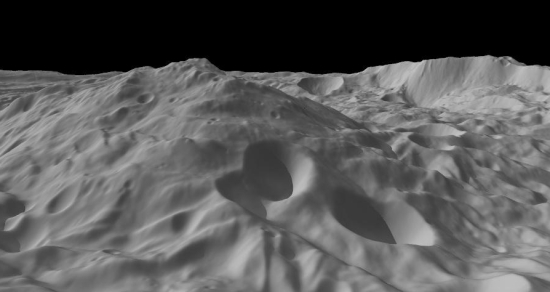
The Dawn scientists have released another spectacular image of the south polar mountain on Vesta whose relative size is three times that of Mount Everest. More information about the image can be found here. From the caption:

The peak of Vesta’s south pole mountain, seen in the center of the image, rises about 13 miles (22 kilometers) above the average height of the surrounding terrain. Another impressive structure is a large scarp, a cliff with a steep slope, on the right side of this image. The scarp bounds part of the south polar depression, and the Dawn team’s scientists believe features around its base are probably the result of landslides.

Mountain on Vesta

It appears the light gravity on Vesta allows for the formation of extreme topology.

0 comments

I am going to the west

I was born and raised in Brooklyn, New York, and thus am undeniably what people call a city boy. Though in my youth my family spent summers in the country near Monticello in upstate New York, I never saw a real mountain. To me, a mountain was the typical rounded wooded hills of the Catskills and Adirondack Mountains.

The first time I traveled west of the Mississippi was when I was 33 years old, in 1986. I and five other caving friends went to New Mexico to attend that year’s annual caving convention. (We spent all of three hours at this week long convention. Instead of sitting in a college classroom listening to cavers talk about caving, we went caving in the Guadalupe Mountains, which to my mind was far more fun.)

When we first arrived in El Paso, we rented a car and started the three hour drive east towards Carlsbad Caverns where we planned to camp and cave for the first few days. At one point during the drive we stopped, just to look at the view. For a born Easterner who was used to hiking in forests where it might take you hours to reach a point where the trees thinned out enough to give you a lookout or vista, the west’s openness was breathtaking. Wherever you looked you could see for fifty to a hundred miles.

As I stood by the side of the road, I noticed something else, but could not put my finger on it at first. Something that was not obvious was different.
» Read more

7 comments

New cave discoveries in the western Caucasus of Russia

From an email sent out by Ukrainian caver Alexander Klimchouk, received today:

Pavel Rudโ€™ko of Krasnoyarsk (Rissia, Siberia) has reported the success of the recent expedition of Krasnoyarsk cavers to the Sarma Cave, Arabika Massif, Western Caucasus. The cave, previously explored by cavers from Krasnoyarsk and Irkutsk to -1570 m, has now been made almost 200 m deeper, to reach depth of -1760m and become the second deepest cave in the world.

The expedition led by Pavel Rudโ€™ko has been carried out between September 1st โ€“ October 7th, 2011. The main branch has been pushed to -1760 m after breaking through a narrow meander at the old bottom. Many side and ascending passages in other parts of the cave have been also explored. The expedition performed systematic temperature measurements, and speleobiological and microbiological sampling.

With its new depth figure, Sarma surpassed the Illjuzia-Mezhonnogo-Snezhnaya system (-1753 m), located in the nearby Bzybsky Massif, and became the second deepest cave in the world, following Krubera Cave (-2191 m) located in the same massif. Thus, the western Caucasus now hosts three deepest caves in the worlds, two of them in Arabika Massif and one in Bzybsky Massif.

Some details of geology, hydrogeology and cave locations of Arabika can be found here. [pdf]

0 comments

The new hockey stick

Steven Hayward at Powerline has noted a new hockey stick graph, produced by scientists and described in detail by the journal Nature. This one is not specifically about climate, but about the reliability of science and the peer-review process itself. To quote the Nature article:

[Retraction] notices [of science papers] are increasing rapidly. In the early 2000s, only about 30 retraction notices appeared annually. This year, the Web of Science is on track to index more than 400 (see ‘Rise of the retractions’) โ€” even though the total number of papers published has risen by only 44% over the past decade.

Below is the graph from the Nature paper. As Hayward says, “Lo and behold, it looks like a hockey stick! (Heh.)”
» Read more

1 comment

The sun’s activity goes boom

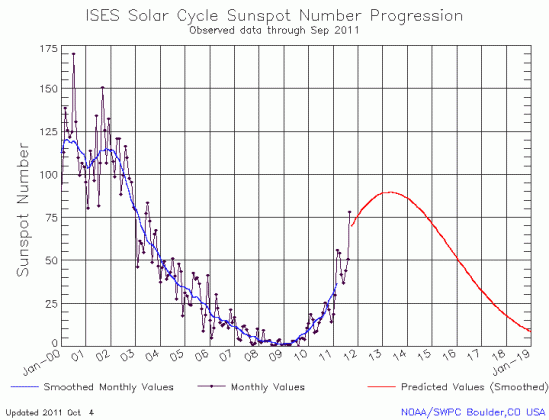
Today NOAA’s Space Weather Prediction Center released its monthly graph of the Sun’s solar cycle sunspot activity. Posted below, it shows the Sun’s activity finally leaping upward in September, after several months of less than expected performance.

It is interesting to see how the sun’s rising sunspot activity for the past year has followed a consistent fluctuating pattern, whereby a sudden monthly jump in sunspots is then followed by several months of decline. If this pattern repeats itself again, we should expect to see the numbers ease off again in October and November.

Regardless, the higher sunspot counts for September are more in line with past predictions. In fact, the solar scientists at the Marshall Space Flight Center have increased their prediction for the time and intensity for the peak of the sun’s maximum. Last month they had called for a peak in May 2013 with a sunspot number of 70. Now, they are predicting the peak will come in April 2013 with a number of 77. They note however that even this higher number will result in the weakest maximum in more than a hundred years.

September sunspot graph

1 comment

The strange hollows on the mountain tops of Mercury

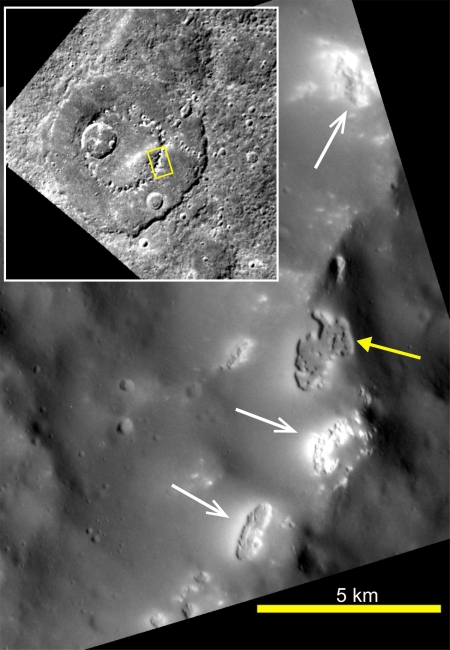
hollows on Mercury

Another spectacular planetary science image, this time from Messenger orbiting Mercury. This close-up image of the hollows of Mercury only illustrates their mystery. The insert shows the context of the close-up image. These irregular sinks are here found on the mountain top ridge of an inner crater rim. Also, some but not all of the hollows have bright interiors.

Scientists have proposed that some form of impact melt process caused these hollows. At impact, the ground literally rippled like water when you toss a stone into a pool. Here, however, the molten ripples quickly froze, creating the inner and outer crater rim rings. To my untrained eye, the hollows look like collapse features where the surface hardened first, then collapsed when the molten inner material drained away as it became solid.

Why some hollows are bright, however, is not yet understood.

0 comments

The red cliffs of Mars

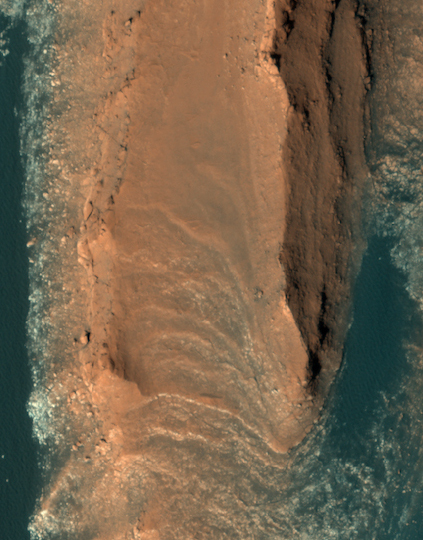
Red cliffs on Mars

Last week the Mars Reconnaissance Orbiter team released this beautiful image of what they call “layered yardangs” on Mars.

What creates these sharp ridges? This layered terrain has been sculpted by the wind. The aligned ridges are called yardangs, which are formed in areas where the dominant erosional force is the wind. Yardangs are also found on Earth, usually in very dry areas.

What I see are majestic red cliffs rising out of a aqua-colored sand desert. What a place to visit!

0 comments

Reality always wins

Elon Musk’s talk yesterday at the National Press Club revealed several interesting things, about SpaceX’s rocket effort, about the state of the American commercial space industry, and about Elon Musk himself.

First, the company’s rocket design effort. Musk centered his talk on SpaceX’s new effort to make its Falcon 9 rocket completely reusable. Though he produced little specific details, and the moderator at the event asked no questions about it, it seems the engineering centers around these three concepts:
» Read more

22 comments

The coming blindness of astronomy

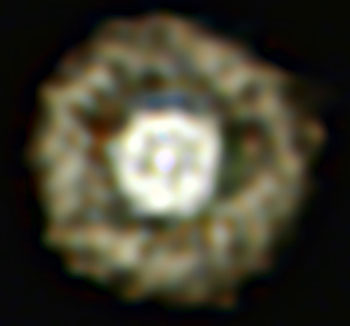
Fried Egg Nebula

The European Southern Observatory today released this infrared image today of what astronomers have named the Fried Egg Nebula. Taken by the Very Large Telescope in Chile, the picture shows the concentric dust shells surrounding a post-red supergiant star, thought to be transitioning to the next stage of stellar evolution called a yellow hypergiant. As the press release explains,

The monster star, known to astronomers as IRAS 17163-3907, has a diameter about a thousand times bigger than our Sun. At a distance of about 13 000 light-years from Earth, it is the closest yellow hypergiant found to date and new observations show it shines some 500 000 times more brightly than the Sun. . . . If the Fried Egg Nebula were placed in the centre of the Solar System the Earth would lie deep within the star itself and the planet Jupiter would be orbiting just above its surface. The much larger surrounding nebula would engulf all the planets and dwarf planets and even some of the comets that orbit far beyond the orbit of Neptune. The outer shell has a radius of 10 000 times the distance from the Earth to the Sun.

Yellow hypergiants are in an extremely active phase of their evolution, undergoing a series of explosive events โ€” this star has ejected four times the mass of the Sun in just a few hundred years. The material flung out during these bursts has formed the extensive double shell of the nebula, which is made of dust rich in silicates and mixed with gas.

According to the science paper [pdf] describing this research, the stage of yellow hypergiants is a preliminary to the star evolving into a luminous blue variable, of which Eta Carinae is the most famous. In this next stage a star is thought to have a good chance of going supernova.

Though this image is truely spectacular, taken by a ground-based telescope of a star 13,000 light years away, what I find most significant about this image is its fuzziness. It reminds me of the kind of images astronomers and the public routinely accepted as the best possible, before the launch of the Hubble Space Telescope.
» Read more

1 comment
1 111 112 113 114 115 139