The Winds of Mars

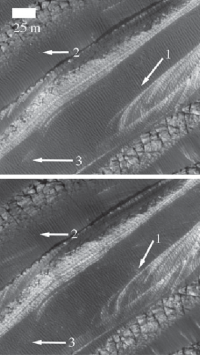
changing martian dunes
Images taken 1363 days apart.

In two different papers published in two different journals in the past month, scientists have concluded that — despite the thinness of the planet’s atmosphere — the dunes and sands of Mars are being continually shaped and changed by its winds. In both papers the data from which this conclusion was drawn came from high resolution images taken by the HiRISE camera on Mars Reconnaissance Orbiter.

What is especially interesting about this conclusion is that the climate models that had been developed for the Martian atmosphere, combined with wind measurements gathered by the various Martian landers, had all suggested that the kind of strong winds necessary to move sand were rare. To quote the abstract of the paper published on Monday in the journal Geology, Bridges, et al,

Prior to Mars Reconnaissance Orbiter data, images of Mars showed no direct evidence for dune and ripple motion. This was consistent with climate models and lander measurements indicating that winds of sufficient intensity to mobilize sand were rare in the low-density atmosphere.

Similarly, the second paper, Silvestro, et al, published on October 22 in Geophysical Research Letters, stated that

results from wind tunnel simulations and atmospheric models show that such strong wind events should be rare in the current Martian atmospheric setting.

Yet, both studies found significant evidence that such winds do occur on Mars, and are moving sand in many different places.
» Read more
1 comment

NASA, the federal budget, and common sense

Let’s be blunt: the federal government is broke. With deficits running in the billions per day, there simply is no spare cash for any program, no matter how important or necessary. Nothing is sacrosanct. Even a proposal to cure cancer should be carefully reviewed before it gets federal funding.

Everything has got to be on the table.

Thus, no one should have been surprised when word leaked two weeks ago that the Office of Management and Budget in the Obama administration was proposing cutting the entire unmanned planetary program at NASA, while simultaneously eviscerating the space agency’s astronomy program. No more missions to Mars. No probes to Europa or Titan. Further and longer delays before the James Webb Space Telescope is completed. And Kepler’s mission to find Earth Like planets orbiting other stars would end mid-mission.

The Obama administration has to find ways to trim the budget, and apparently it is considering eliminating these programs as a way to do it.

Yet, the money spent on space astronomy and planetary research is a pinprick. Considering that the federal government overspends its budget by approximately $3.5 billion per day, and the total amount of money spent on these two science programs equals about $2.4 billion per year, it seems senseless at first to focus on these kinds of cuts. Quite clearly, even eliminating them entirely will not put the federal budget into the black.

Now I am not one to say, “Cut the budget, but please leave my favorite programs alone!” I recognize the serious financial state of the nation, and realize that any budget suggestions I make must include significant total cuts to NASA’s budget.

As a space historian and science journalist who knows a great deal about NASA, however, I also know that there is plenty of room for cuts in NASA’s budget. By picking our priorities carefully at a time when our options are limited, NASA might even be able to accomplish more, not less, with a smaller budget.

Moreover, if I, as a space junky, think it is possible to continue NASA’s most important programs and still trim its budget by 15% to 20%, in real dollars, doesn’t that suggest that the same could be done across the entire federal government?

All it takes is a little knowledge, some common sense, and the courage to say no.
» Read more

1 comment

Violence and hatred in the Occupy “Whatever” movement

These four stories, all in today’s news, all suggest that the heart of the Occupy Wall Street movement is strongly intolerant, filled with angry hatred, and prone to violence. Sadly, they appear to a small subset of a much larger sampling of similar stories.

In Oakland Occupy protesters have withdrawn a resolution to remain peaceful.

A small number of the protesters have openly called for the use of violence as a tactic to get their message out.

In Berkley, dozens of Occupy protesters were arrested yesterday. The cause:

The university reported earlier that an administrator had told the protesters they could stay around the clock for a week, but only if they didn’t pitch tents or use stoves or other items that would suggest people were sleeping there. The protesters voted not to comply with the demand and to go ahead with setting up a tent site they dubbed “Occupy Cal” to protest financial policies they blame for causing deep cuts in higher education spending.

In New York, a man was arrested for assaulting a paramedic and breaking his leg Wednesday night.

And finally, there is this eight minute video, where a Occupy Portland protester curses and threatens a news crew repeatedly until the police finally arrive to escort him away.

2 comments

A fired up Sun

As it does every month, NOAA’s Space Weather Prediction Center today released its monthly update showing the ongoing changes of the Sun’s solar cycle sunspot activity. I have posted the graph below the fold.

For the fourth month in a row the Sun’s sunspot activity has leaped upward. In fact, for the first time since I have been tracking sunspot activity, beginning in 2008, the Sun’s sunspot activity exceeds the predicted activity by a significant amount. Since the end of the previous maximum, the Sun had consistently failed to meet the expectations of solar scientists by producing far fewer sunspots than expected.

In the past few months, however, the Sun has recovered, its activity firing upward, including some of the most active and largest sunspots in years.
» Read more

1 comment

A breathtaking view of the Apollo 15 landing site

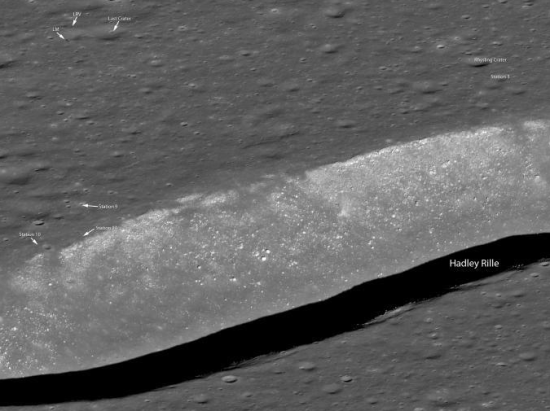
The Lunar Reconnaissance Orbiter team has released a wide angle side view image of the Apollo 15 landing site, showing the lunar module and the areas around Hadley Rille and the Apennine Mountain range that the astronauts explored using their lunar jeep. Below is a cropped close-up, showing the landing site near the top of the image with Hadley Rille near the bottom. Below the fold is a second image showing a wider view that includes the Apennine mountain slope that the astronauts drove their rover up.

Close up of Hadley Rille and Apollo 15 landing site

» Read more

0 comments

Finally some substance in the Presidential campaign

Up until tonight I had not watched any of the Republican Presidential debates. To me, the game show formats of each debate were such that I had no expectation of seeing any substance. Quick one-liners and gotcha attacks — the only thing that generally comes from these formats — can’t tell me anything about the deeper philosophical underpinnings of each candidate. And without that knowledge I can have no idea whether or not the candidates will follow through with what they say they’ll do.

Tonight however I did watch the Herman Cain-Newt Gingrich debate, which CSPAN has made available to watch in its entirety. The format was basically Cain and Gingrich for an hour and a half, answering a variety of questions about the three big entitlement programs, Medicare, Social Security, and Medicaid. Each man could essentially take as much time as he desired to say what he wanted.
» Read more

3 comments

A NASA senior review of all planetary missions?

Here’s a tidbit I just spotted on the EPOXI (formerly Deep Impact) status website, buried in a November 1, 2011 update::

Meanwhile, NASA has decided that there will be a senior review of all operating planetary exploration missions. That will likely include a review of the status of the Deep Impact Flyby spacecraft to determine whether an additional extended mission should be approved. Decisions will not occur until early 2012.

Though Deep Impact is still a functioning spacecraft in orbit around the sun, up until this notice I had not heard of any plans to use it again after its flyby of Comet Hartley-2 in 2010. However, there is no reason its cameras could not be used for astronomy, though unfortunately its high resolution camera has a focus problem which prevents it from taking the sharpest images.

However, the timing of this review of planetary missions, combined with the story last week that the Obama administration might end all funding for future planetary missions, is intriguing. I wonder if they are tied together in some way. That the notice above says the decision will be made in “early 2012” — the moment when the Obama administration will unveil its 2012 federal budget recommendations — strongly suggests that they are linked.

Could that the administration be thinking it can salvage the bad press it will receive for shutting down all future planetary missions by spending a small amount on extending missions already in space? Or is this planetary review another indication that the rumors are true and the administration plans to end the planetary science program entirely?

Unfortunately, I am speculating here, without any real information. Stay tuned to find out.

1 comment

Sailing to Mars

With the end of the Mar500 simulated mission this coming Friday, the Russians are now proposing an eighteen month simulated Mars mission on board the International Space Station.

The Russians have been pushing to do this on ISS for years. Unfortunately, NASA has always resisted.

Yet, as I wrote in Leaving Earth, we will never be able to send humans to any other planets until we have flown at least one simulated mission, in zero gravity in Earth orbit, beforehand. Wernher von Braun pointed out this reality out back in the 1950s, and that reality has not changed in the ensuing half century. Not only will such a mission tell us a great deal about the medical issues of living in weightlessness for years at a time — issues that are far from trivial — it will give us the opportunity to find out the engineering problems of building a vessel capable of keeping humans alive during interplanetary flight, far from Earth.
» Read more

1 comment

The long minimum continues

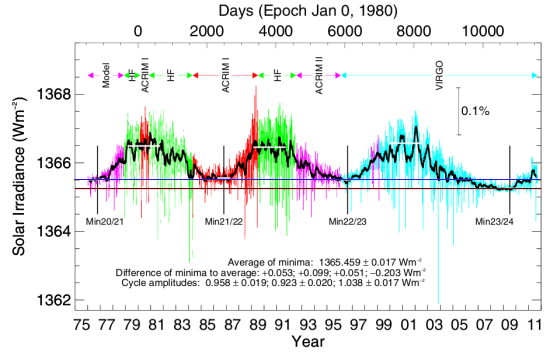
Though it has been very clear for the past few months that the sun has finally transitioned from solar minimum and begun its ramp up to solar maximum, that ramp up has also been very slow and wimpy.

On October 9, 2011 the scientists at Physikalisch- Meteorologisches Observatorium Davos (PMOD) posted an updated summary of the satellite data that has been carefully measuring the variation of the sun’s total solar irradiance since 1978. The graph below, which can be found here [pdf], brings that data up through the present. (I had posted the previous update about a year ago.)

Total solar irradiance

I have added a brown line to illustrate how deep the recently ended solar minimum was, compared to previous minimums. Note also that this most recent minimum would also be far below the minimum prior to 1975. I have also added a blue line to show that the sun has only very recently finally brightened enough to finally exceed the previous minimum. All told, the sun remained dimmer than the previous minimum for over five years!
» Read more

2 comments

Another global warming scientist is accused of hiding the decline

The lead scientist in a recent climate study has been accused of hiding the fact that the global temperature has been flat for more than a dozen years.

The new study, led by Richard Muller, had taken raw land data and re-analyzed it in an attempt to clear up the doubts caused by the climategate scandal. In an announcement last week, Muller claimed that their work had proven that the climate had been warming continuously since 1950.

Now, another climate scientist, Judith Curry, has accused Muller of failing to point out that his same re-analysis had also shown that climate temperatures have been totally flat for the past 13 years, even as carbon dioxide levels in the atmosphere continue to rise. As Curry told the Daily Mail, “This is nowhere near what the climate models were predicting. Whatever it is that’s going on here, it doesn’t look like it’s being dominated by CO2.”

Curry is also accusing Muller of going to the press to spin the results in favor of global warming, before the research was complete.
» Read more

0 comments

Humans do it quickly

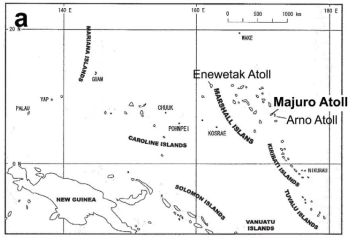
Marshall Islands

A team of scientists from Japan have found evidence that the human settlement of the Marshall Islands in the central Pacific Ocean occurred almost immediately after those islands emerged from beneath the sea. Though it had been previously believed that a thousand years had to pass until these newly emerged islands had developed sufficient vegetation for humans to occupy them, the evidence from this study shows that humans not only showed up almost immediately, they acted to vegetate the island themselves in order to make it habitable.

The scientists drilled four cores just off the western shore of Laura Island, the largest island of Majuro Atoll, as well as thirteen trenches on that same island, in order to determine when the island first emerged from under the sea. They also excavated a well-preserved bank at the center of Laura Island to study the human occupation of the island.

What they found was that the Atoll emerged from underwater approximately 2000 years ago, triggered by a fall in sea level. More surprising, the first evidence of human settlement appeared to occur at almost the same time.
» Read more

2 comments

Catching an avalanche on Mars, as it happens

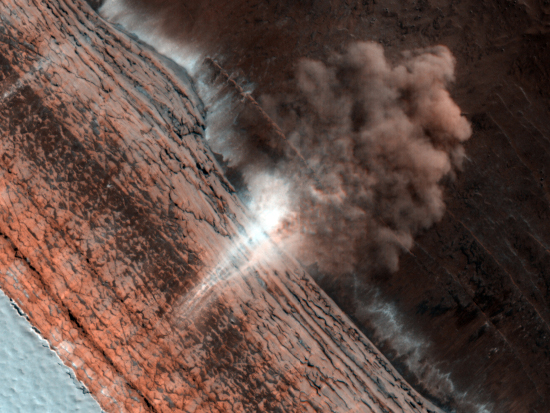
The Mars Reconnaissance Orbiter team today released this really cool image from Mars, showing an avalanche near the North Pole, in progress. The image looks directly down the cliff face from above. At the base of the cliff we can see the dust cloud from the crash of material billowing out away from the scarp.

What impresses me most about this image is that it was taken by an orbiting spacecraft approximately 200 miles above the planet’s surface, moving at thousands of miles an hour. Yet, the camera not only had the resolution to see the cloud of dust, it could snap the image fast enough to capture the actual fall of material (the white wisps down the side of the cliff that are reminiscent of a waterfall).

Also intriguing is the visible steep face of the cliff face itself. I know a lot of rock climbers who would love to literally get their hands (and chocks) on that rock face. And in Mars’s one-third gravity, rock climbing would surely be different.

avalanche on Mars

1 comment
1 110 111 112 113 114 139