Faster than light?

Can neutrinos travel faster than light? After three years of gathering data, an experiment at CERN says they do, though by only a tiny amount.

[Physicist Antonio] Ereditato says that he is confident enough in the new result to make it public. The researchers claim to have measured the 730-kilometre trip between CERN and its detector to within 20 centimetres. They can measure the time of the trip to within 10 nanoseconds, and they have seen the effect in more than 16,000 events measured over the past two years. Given all this, they believe the result has a significance of six-sigma β€” the physicists’ way of saying it is certainly correct.

You can download and read a preprint of their paper here.

What I find intriguing about this result, other than its exciting groundbreaking possibilities, is how it illustrates sharply the contrast between normal and healthy science, and the sad and sick state of the field of climate science.
» Read more
2 comments

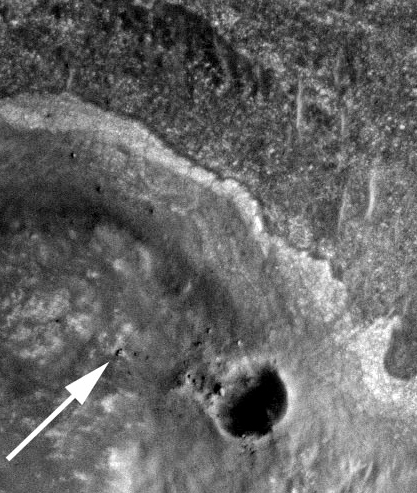
The rover Opportunity as seen from Mars orbit

Opportunity on Endeavour Crater rim

The image to the right was taken by Mars Reconnaissance Orbiter, with the white arrow showing the Mars rover Opportunity perched on the rim of Endeavour Crater.

The rover’s scientists hope that the rocks found on the crater rim, dredged up from deep below when the crater impact occurred, will be the oldest rocks so far touched on the Martian surface, and thus give them a peek at ancient Martian geology.

0 comments

Video from Dawn

NASA has released an update summarizing what scientists have found since Dawn went into orbit around Vesta in July. The video below, compiled from images Dawn has taken, gives a nice visual overview. The most interesting big feature, understated by the video, is the series of grooves that appear to encircle the asteroid’s equator. To my eye it almost looks like Vesta was once two asteroids that got merged into one, with these grooves indicating the weld point.

The direct link to the video can be found here.

Embedded video from

NASA Jet Propulsion Laboratory California Institute of Technology

1 comment

Another look at the cost of building NASA’s heavy lift rocket

Clark Lindsey takes another look at the cost for building the Congressionally-mandated heavy lift rocket, what NASA calls the Space Launch System and I call the program-formerly-called-Constellation. Key quote:

Finally, I’ll point out that there was certainly nothing on Wednesday that refuted the findings in the Booz Allen study that NASA’s estimates beyond the 3-5 year time frame are fraught with great uncertainty. Hutchison and Nelson claimed last week that since the near term estimates were reliable, there’s no reason to delay getting the program underway. That’s the sort of good governance that explains why programs often explode “unexpectedly” in cost after 3-5 years…

In other words, this is what government insiders call a “buy-in.” Offer low-ball budget numbers to get the project off the ground, then when the project is partly finished and the much higher real costs become evident, Congress will be forced to pay for it. Not only has this been routine practice in Washington for decades, I can instantly cite two projects that prove it:
» Read more

2 comments

More bad budget reporting

Once again a journalist as well as a science journal are spinning budget numbers to hide the fact that the present Congress is not imposing draconian cuts to science. If anything, they are not cutting enough, considering the dire state of the federal deficit.

First there is the headline, from Science: Senate Panel Cuts NSF Budget by $162 Million. Then there is the article’s text, by Jeffrey Mervis, which not only reaffirms the cuts described in the headline but adds that “the equivalent House of Representatives panel approved a bill that would hold NSF’s budget steady next year at $6.86 billion.” Mervis then underlines how terrible he thinks these budget numbers are by quoting Senator Barbara Mikulski (D-Maryland): “We’ve gone beyond frugality and are into austerity.”

This reporting is shameful. Not only is Mikulski full of crap, Mervis’s description of the budget numbers is misleading if not downright wrong. Here are the final budget numbers for the NSF since 2007, in billions of dollars (sources: Science, the American Geological Institute, and The Scientist):
» Read more

1 comment

NASA to unveil its heavy-lift rocket design

Two stories, one from AP and the other from Florida Today, say that NASA will announce today the design of its heavy-lift rocket, mandated by Congress and estimated to cost around $35 billion. Here is NASA’s press release. To me, this is the key quote (from AP):

NASA figures it will be building and launching about one rocket a year for about 15 years or more in the 2020s and 2030s, according to senior administration officials who spoke on the condition of anonymity because the announcement was not yet made. The idea is to launch its first unmanned test flight in 2017 with the first crew flying in 2021 and astronauts heading to a nearby asteroid in 2025, the officials said. From there, NASA hopes to send the rocket and astronauts to Mars β€” at first just to circle, but then later landing on the Red Planet β€” in the 2030s. [emphasis mine]

In other words, after spending $1.7 on the National Space Plane, $1.2 billion on the X-33, $1 billion on the X-34, $800 million on the Space Launch Initiative, and finally, almost $10 billion on Constellation, none of which ever flew, NASA is now going to spend another $35 billion on a new rocket that won’t fly for at least another decade.

To be really blunt, this new rocket, like all its predecessors, will never fly either. It costs too much, will take too long to build, and will certainly be canceled by a future administration before it is finished. It is therefore a complete waste of money, and any Congress that approves it will demonstrate how utterly insincere they are about controlling spending.

A clarification: Some of the $35 billion mentioned above has already been spent for the Orion capsule. This however still does not change any of my conclusions.

8 comments

Brooklyn goes Republican

At just after midnight tonight AP named the Republican, Bob Turner, the winner of the special Congressional election in Brooklyn/Queens. At that time Turner was winning 53% to 47%, with 73% of the precinct reporting.

In looking at the results as well as the district map itself, I find myself more than astonished. The Republican Bob Turner got seventy percent of the Brooklyn vote (as of 12:05 am).
» Read more

2 comments

NASA and ATK sign new launch development agreement

At a press conference today, NASA and ATK announced a new launch development agreement, running through March 2012, to help develop ATK’s Liberty solid rocket into a launch vehicle that could bring both cargo and crews to ISS.

The agreement provides ATK no funds, but is designed to give ATK as much support from NASA as possible in developing Liberty, tested fired last week for only the third time. If this initial agreement goes well, it will position ATK to compete for the next round of development subsidizes.

According to ATK, they think they could launch by 2015, and are hoping to provide a rocket capable of flying the spacecraft and freighters of Boeing, Sierra Nevada, Blue Origin, and even SpaceX (should Falcon 9 have problems and they need a rocket to launch Dragon).
» Read more

6 comments

A day to express the value of justice

Updated and bumped: I wrote the following last year on September 11. Sadly, nothing has changed since then. President Obama is still trying to sell the idea that this day should be used as a day of service, something that misses the point so completely as to almost be despicable.

So, I think it is worth repeating what I wrote on September 11, 2010:

The President has asked us to consider today “a national day of service and remembrance”. Though the sentiment seems reasonable, I must respectively disagree.

September 11 should not be turned into a day to celebrate volunteerism or service or American charity. Though these values are profound, important, and an expression of much of what makes our nation great, they are not why we remember September 11.

We remember the evil acts commited on September 11, 2001 in order to remind us that there is evil in the world.

We remember these evil acts so that we will have the strength to fight that evil, with every fiber of our being.

We remember those who died in order to prevent future attacks and further deaths.

We remember so that no one can ever try to make believe these events did not happen.

We remember so that no one can spread the lie that the perpetrators were something other than what they were: Men who had decided to kill in the name of Islam, based on what they believed their religion taught them.

And finally, and most important, we remember the horrible events of September 11, 2001 so that those innocent murdered souls — whose only crime that day was going to work — will not have died in vain.

4 comments

Unknown objects in space

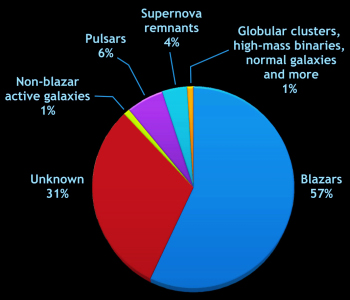
Fermi list of object types

NASA’s Fermi Gamma-Ray Telescope today released an updated catalog of the last two years of its survey of the sky at high energy emissions. All told, there are 1873 objects in the catalog, more than half of which are supermassive black holes at the center of distant galaxies. You can see this all-sky map below the fold.

Many of the objects are quite familiar, such as the Crab Nebula, the remnant of a supernova that exploded a little less than a thousand years ago.

For decades, most astronomers regarded the Crab Nebula as the steadiest beacon at X-ray energies. But data from several orbiting instruments — including Fermi’s Gamma-ray Burst Monitor — now show unexpected variations. Astronomers have shown that since 2008, the nebula has faded by 7 percent at high energies, a reduction likely tied to the environment around its central neutron star.

Since 2007, Fermi and the Italian Space Agency’s AGILE satellite have detected several short-lived gamma-ray flares at energies hundreds of times higher than the nebula’s observed X-ray variations. In April, the satellites detected two of the most powerful yet recorded. To account for these “superflares,” scientists say that electrons near the pulsar must be accelerated to energies a thousand trillion times greater than that of visible light — and far beyond what can be achieved by the Large Hadron Collider near Geneva, Switzerland, now the most powerful particle accelerator on Earth.

What I, and many astronomers, find even most interesting about this catalog, however, is the large number of completely mysterious objects scattered across the sky, objects that emit powerful gamma rays but are not visible in any other wavelengths. All told, these unidentified objects comprise almost one third of the entire catalog.
» Read more

2 comments

The sun’s weak maximum continues

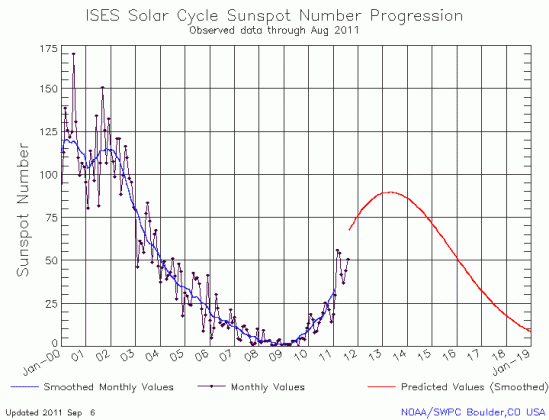
The monthly graph from NOAA’s Space Weather Prediction Center of the Sun’s solar cycle sunspot activity is out and I have posted it below. Though activity increased for the second month in a row, the totals are still below the activity levels of March and April 2011.

I am beginning to think that I sound like a broken record. This monthly graph once again suggests that the next solar maximum will be weak, possibly weaker than the most up-to-date predictions for the next solar maximum. And even if that prediction is correct, the data continues to point towards a quieter Sun, with the likelihood of a long period of no sunspots beginning in the next decade.

Based on past history, the consequences of a long Maunder-type minimum, where there are no sunspots for decades, should be very profound. Every time the Sun has gone this quiet in the past, the Earth’s climate has cooled. Furthermore, new results just released add weight to this conclusion. A less active Sun allows more intergalactic cosmic rays to hit the atmosphere, and the CLOUD experiment at CERN strongly suggests that the higher rate of cosmic rays could in turn increase the atmosphere’s cloudiness, thereby reflecting more light and energy and making the Earth colder.

The sunspot graph for August 2011

0 comments
1 112 113 114 115 116 139