The dangerous environment of space

A just released report from the National Academies, Preparing for the High Frontier: the role and training of NASA astronauts in the post-space shuttle era, describes the challenges that NASA faces in staffing its astronaut corps in the coming years. More important, however, is some new information buried in the report about the hazards of long term exposure to weightlessness.

For example, it seems a significant number of astronauts have come back from spending months at ISS with serious vision problems, caused by a newly discovered condition dubbed papilledema, the swelling of the optic disk.
» Read more

1 comment

Sticker shock over Congressionally designed rocket

The Obama administration has discovered that the cost to build the program-formerly-called-Constellation, required by Congress, is going to be far more than they can stomach.

White House budget officials increasingly are concerned that some of NASA’s manned-exploration plans may be unaffordable, especially as the space agency weighs options that would raise the cost by billions of dollars by speeding up the development of rockets and spacecraft, according to people familiar with the issue.

The cost concerns are coming to a head, these people said, as the White House Office of Management and Budget ratchets up questions about NASA’s proposed program in light of the current emphasis on deficit reduction.

None of this surprises me.
» Read more

4 comments

Don’t you dare touch my space junk!

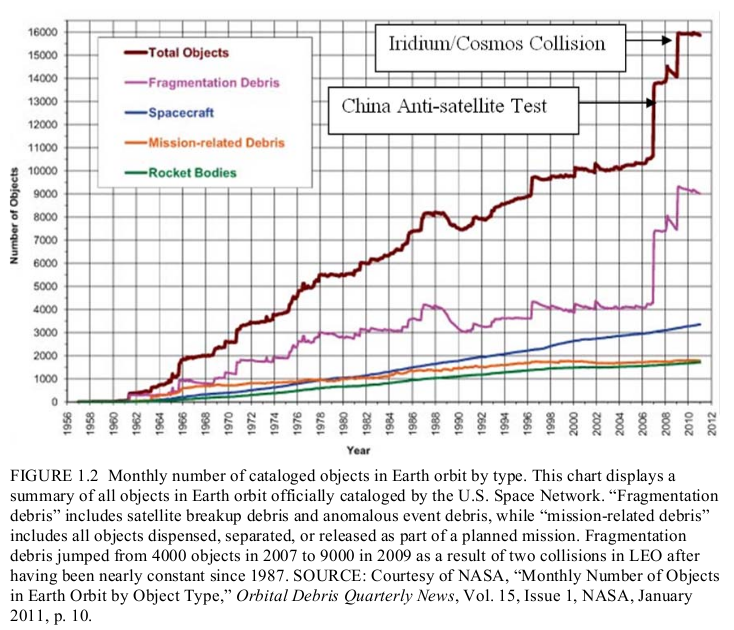
cataloged objects in orbit

A just released National Research Council report on space junk, Limiting Future Collision Risk to Spacecraft: an assessment of NASA’s meteoroid and orbital debris programs, describes in great and worthwhile detail the increasing problem of orbital debris as well as the technical and budgetary problems that exist for removing it. It is especially worth reading for the stories, such as when a Colorado hiker heard a high-pitched sound and then found a still warm thirty-inch diameter sphere in a foot deep crater. The object turned out to be a titanium tank from a Russian upper stage rocket, launched two months earlier.

What I want to focus on here, however, is one issue the report discusses that, as far as I can tell, has generally been missed. Worse, this issue — somewhat ridiculous when you think about a little — will make removing most of the space junk in Earth orbit far more complicated than ever imagined by engineers.

Simply put, under already agreed-to international treaties, no nation can salvage or collect any debris placed in orbit by another nation. To do so will violate international law, and almost certainly cause an international incident. To quote the report:
» Read more

5 comments

The Hubble Space Telescope: Movie camera!

Using Hubble Space Telescope images taken over a 14 year period, a team of astronomers led by Patrick Hartigan of Rice University have produced six very short time-lapse movies, showing the changes that have occurred to a variety of interstellar jets and bow shocks over time. The one below is my favorite. They are all worth looking at, as they illustrate forcefully how the changeless heavens are not so changeless.

0 comments

Al Gore and the silencing of debate

Yesterday I posted a link to a story about Al Gore claiming that any expression of skepticism about global warming is to him no different than racism. Here again is what Gore said,

โ€œThere came a time when friends or people you work with or people you were in clubs with โ€” youโ€™re much younger than me so you didnโ€™t have to go through this personally โ€” but there came a time when racist comments would come up in the course of the conversation and in years past they were just natural. Then there came a time when people would say, โ€˜Hey, man why do you talk that way, I mean that is wrong. I donโ€™t go for that so donโ€™t talk that way around me. I just donโ€™t believe that.โ€™ That happened in millions of conversations and slowly the conversation was won. We have to win the conversation on climate.โ€

More than at any other time, Gore here has very successfully illustrated the differences between how climate skeptics debate the scientific questions of climate change versus how global warming advocates do it.
» Read more

6 comments

Hunkering down during the hurricane

Update: We lost power at around 12:30 am, and as of mid-morning Sunday the power was still not back. Thus, my posting will be light today. At the moment we are out at a local restaurant that has power (and food!), so I am using my laptop to post.

As I sit here waiting for Hurricane Irene to speed past Washington, DC, leaving behind a lot of water, some fallen trees, and the likelihood of a power outage, I thought I’d mention that I will be doing a special 30 minute appearance tonight on the nationally syndicated John Batchelor radio show at 9 pm (Eastern). Should be fun, with New York City shut down and me possibly doing the interview in the dark, with no power.

Update and bumped. The hurricane where I live here in the DC area has so far been quite mild, with only a few short bursts of heavy rain and hardly any wind. However, John Batchelor had so much fun with our discussion at 9 pm that I am coming back for another half hour at 11:30 pm (Eastern).

One more note: I consider the decision of Mayor Bloomberg in New York to shut down the subway and buses for the weekend to be downright madness. The subway should run until the last minute, in case people need to leave. Closing it so the government employees can get out is like a captain deserting his ship ahead of the passengers.

Unfortunately, this kind of political overreaction is what you get when you cede too much power to politicians. They have to act, if only to appear as they are doing something.

3 comments

Sponge in space

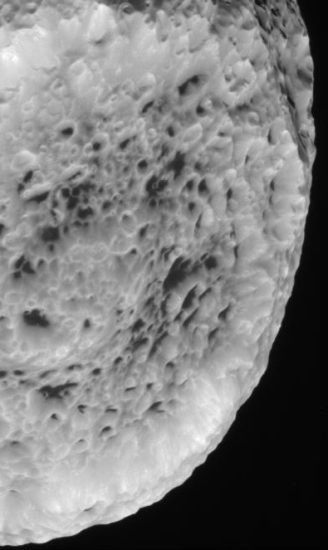
Hyperion

On August 25 Cassini did a close fly-by of the small Saturn moon Hyperion, getting as close as 15,500 miles. The mission has just released images from that fly-by.

Looks like a sponge, doesn’t it? This moon is small, only 168 miles across, which makes it about half the size of the asteroid Vesta that Dawn is presently orbiting. Why it is so peppered with craters is of course the big science question. I would guess this has something to do with the environment around Saturn, with its rings and the innumerable particles that come from it. Yet, other moons of Saturn are not as crater-filled, so there is obviously more to this than meets the eye.

This fly-by was the second closest of Hyperion that Cassini has done, the first passing over the the moon’s surface by only 310 miles. Because the irregularly-shaped moon’s rotation is more like a chaotic tumble, scientists could not predict what part of the surface they would see. To their luck the new images captured new territory.

Another fly-by is scheduled in only three weeks, on September 16, 2011. This time, however, the spacecraft won’t get as close, passing at a distance of about 36,000 miles.

2 comments

When dust, pebbles, rocks, and boulders act like liquid

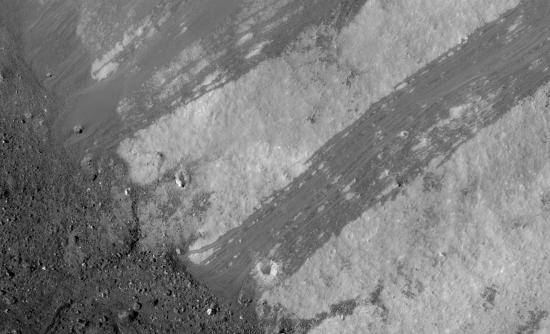
The science team of Lunar Reconnaissance Orbiter released an intriguing picture yesterday of what scientists call a granular flow down the side of a five mile wide crater on the far side of the moon. Looking at the image, one would swear that the darker material flowing down the slope of the crater rim is a lava flow frozen in place.

lunar granular flow

However, according to the scientists, that is not what it is. Instead, this is merely debris left behind from an avalanche.
» Read more

0 comments

Capturing an asteroid into Earth orbit

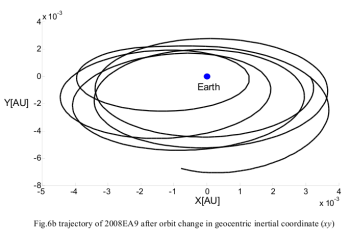
orbital path after asteroid capture

Want to mine an asteroid? Rather than travel to it with all their mining equipment, three Chinese scientists have proposed a better way. In a paper published today on the Los Alamos astro-ph preprint website, they have calculated the energy required to shift the orbits of the six thousand near-Earth asteroids and place them in Earth orbit for later mining. Of these, they found 46 asteroids that had the potential for such an operation, and two likely candidates for a space mission. One 30-foot-wide asteroid, 2008EA9, will actually be in the right place for this technique in 2049. As they write,

It can be seen that the velocity increment of the 2008EA9 is relatively small (-1.00km/s) and it will very close approach [approximately 645,000 miles] to the Earth in [February] 2049. Moreover the size of the NEO 2008EA9 is very small so that the capturing of it is relatively easy.

The real problem, of course, is adding that small “velocity increment” to the asteroid.
» Read more

4 comments

Earthquake in Virginia

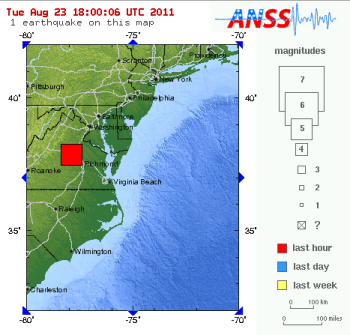
Quake map

A 5.9 magnitude earthquake hit Virginia at about 1:51 pm (Eastern).

I am in Maryland, just outside the beltway, and felt something like an earthquake about five minutes ago. The house started to shake, then settled, then shook again. Quite startling. I opened the front door the same time a neighbor did. She had felt the same thing.

The above quake was more than 90 miles away. I wonder how bad it is there, considering the eastern U.S. rarely experiences quakes and has made no preparations for such a thing.

For updates:
» Read more

47 comments

Another Al Gore doomsday prediction bites the dust

In a new paper published yesterday, climate scientists described a newly discovered deep, cold current flowing off Iceland’s coast that appears to make the ocean conveyor belt that warms the northern Atlantic less sensitive to climate change than previously thought.

In other words, another one of Al Gore’s doomsday predictions has proven false.

More significantly, scientists now have no understanding why the ocean conveyor belt shut down during past ice ages, as their most favored theory now appears insufficient.
» Read more

1 comment
1 113 114 115 116 117 139