Solar ramp down jumps slightly

My original post about NOAA’s October update to its monthly tracking of the Sun’s sunspot cycle contained an incorrect graph. For reasons I do not understand, the first graph they posted did not include the data for September, thus creating for me the illusion that little had changed in September. I am now posting the correct graph here, below the fold, with annotations to give it context.

In September numbers showed a slight jump in sunspot activity, though once again nothing so significant as to change the overall trends. Moreover, the correction doesn’t change what I wrote previously in any way: the rate of decline seems to have transitioned down from the 2009 prediction (red curve) to the 2007 weak prediction (lower green curve). This doesn’t real mean much, as the sunspot number can still vary up and down considerable before we reach solar minimum in two or three years.

» Read more

0 comments

Back from a weekend underground

Bob Zimmerman underground

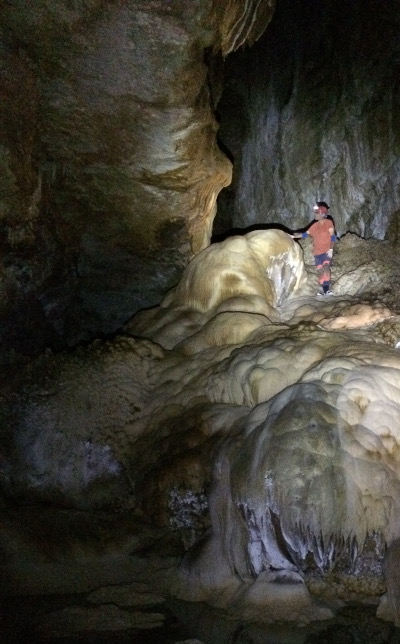
The picture on the right will explain why I have been silent posting since Friday. I have just returned with five friends from three days of caving in New Mexico, doing some wild caving plus my first visit to Carlsbad Caverns since 1992, guided by a local caver who has been helping me with my cave survey project in Arizona.

New Mexico probably has the largest concentration of truly large and spectacularly decorated caves in the entire world. I’ve caved there previously, but this was my first trip driving from Arizona. We went to two wild caves, one of which I had never visited before and a second that I had seen during my 1992 trip. The picture shows me in the latter, standing above a large clear pool near the back of the cave with some giant flowstone speleothems all around me.

The new cave contained a room dubbed Speleogasm, because every formation there, of which there are too many to count, is completely festooned with helectites and sodastraws in a mad protrusion that no geologist can as yet explain. Nor is there any way to describe it adequately or photograph it successfully. To witness it you need to go, requiring the specialized caving skills that include the techniques and equipment required to rappel and climb a 40 foot rope.

As always, the advantages of learning how to do this successfully is the reward of seeing things that few ever see. It is why engineers and scientists strive so hard to get planetary probes to distant planets. And why humans want to travel to the planets. For me, getting inside a remote and beautifully decorated cave will just have to do.

1 comment

How the Republican Party might break-up

Devin Nunes (R-California), a establishment Republican supporting Kevin McCarthy (R-California) for House Speaker, said today that any Republicans who don’t vote for McCarthy should be kicked out of the party.

Nunes is talking about the final House-wide vote for Speaker. First the Republicans vote in private among themselves, picking their nominee. McCarthy is expected to easily win that vote. Then the entire House votes. Some conservatives are threatening to not vote for McCarthy in that House-wide vote in order to extract greater influence over the entire party. Nunes wants them ejected from the party if they do that.

I have also read another story, the link to which I can’t find now, where establishment Republicans want to codify what Nunes is saying, so that any Republican who voted against McCarthy in the final vote would be kicked out of the party. If this happens, then we might very well see the Republican Party split, something that I increasingly see as a possibility. Right now the party is trying to be too big a tent, including conservatives and many moderate Democrats who find the modern Democratic Party unacceptable. (This is one reason why the Republican presidential field is so large.)

Should the party split, we might also eventually see the withering away of the Democratic Party, which today is very corrupt and far too leftwing for most Americans. If the Republicans split into conservative and moderate wings, many of those disenchanted Democrats would move to the moderate Republican faction. The result would be to cut off the corrupt modern Democratic Party from the reins of power.

I am of course being hopeful and naively optimistic. A more likely scenario would be for the Republican Party to split in such a way that the unified Democrats, still corrupt, would take over.

2 comments

Guess where?

Pluto lake

I found the image on the right while trolling about on the various raw image sites for NASA’s planetary missions. No press release yet, and maybe there never will be one. I do know the scientists involved in this particular mission are right now drooling over the details available in the full resolution image, which I have cropped and reduced to fit on the right. Take a look and you will drool as well.

Want to know where this is? I bet you have already guessed, but if you need help, click on the “read more” link below, where I have also added some comments.
» Read more

0 comments

Decline to solar minimum

Last week NOAA posted its monthly update of the solar cycle, showing the Sun’s sunspot activity in August. As I have done every month since 2010, I am posting it here, below the fold, with annotations to give it context.

The sunspot count continued its decline, though dropping only a small amount. Regardless, the decline continues at a rate far faster than predicted or is usual during the ramp down from solar maximum. If this rate of decline should continue, we will reach solar minimum sometime late in 2017, two years earlier than predicted (as indicated by the red curve).

» Read more

3 comments

The terrible political consequences of Iran deal to the Democratic Party

Several stories in the news today outline for me the terrible political consequences faced by the Democratic Party by their support for the nuclear deal with Iran:

This quote from the middle article however highlights how bad the consequences for the Democrats will be:

if Obama is left with a deal that is opposed by a majority of either the Senate or the House, the Democrats will be stuck with it. They will then be on the defensive with every hostile move Iran makes with the $150 billion the mullahs are going to get.

Like Obamacare, only Democrats are going to support this Iran deal. They will own it entirely. Thus, the first time Iran does something to violate the treaty or to use the $50 billion or more of cash they will get for signing the deal to promote terrorist attacks, it will be Democrats and only Democrats who will share the blame.

Yet, like Obamacare, the Democratic Party seems oblivious to these political risks. Come hell or high water, they are, as described in the first story, working as hard as they can to get the votes to sustain an Obama veto and make this deal law.

As much as I want these Democrats kicked out of office, I think having the Iran deal approved will be worse for the nation and the world. It will immediately dump billions of dollars into the hands of Iran’s radical terrorist leaders, surely resulting in more violence against many innocents across the globe. And it will announce to the world our willingness to allow Iran to develop nuclear weapons, which will almost certainly instigate a nuclear arms race in the Middle East and probably prompt Israel to attack Iran, possibly with its own nuclear weapons.

None of this is good. Better that the Democrats should save themselves the political cost and oppose this horrible deal.

Unfortunately, I am not hopeful. The track record of today’s Democratic Party is that of a group of people willing to put ideology ahead of everything, even if it means they will lose elections like crazy afterward. I see nothing to make me think they will do different here.

Our only option afterward then will be to throw them out of office. I pray that come 2016, the election results will make the Republican landslides of 2010 and 2014 look like mild rebukes in comparison.

15 comments

The wild Martian terrain

Yardangs on Mars

This week’s image release from the high resolution camera on Mars Reconnaissance Orbiter illustrate well the wild and mysterious geology of the Martian surface. I include cropped sections from two images here, just to give you a taste. Go to the link to do your own exploring.

The image to the right is a cropped and scaled down version of the original image, so the details are not easily seen. Make sure you look at the original. The strange yardang ridges, all aligned alike, rise up out of a relatively smooth plain.

Yardangs are formed when a surface that is composed of materials of differing strengths (i.e., of both harder and softer materials) is shaped by the abrasive action of sand and dust carried by the wind. In this case, and given the proximity of the Apollonaris Patera volcanic center, we think that these wind-carved deposits are comprised of volcanic ash and pyroclastics that erupted from Apollonaris when it was last active in the not-too-distant geologic past. Over time, the softer materials (likely volcanic ash) were eroded away, leaving behind the harder materials in the form of elongated ridges that are parallel to the direction of the prevailing wind. The end result is a stunning, out-of-this-world display of yardangs, sculpted with the artistic chisel of the Martian wind.

That’s the theory, anyway. The actual geological process that formed these ridges is probably a lot more complicated.

The image below the fold illustrates the on-going surface activity on Mars.
» Read more

0 comments

Ten years after the Russians did it, NASA finally produces lettuce in space

Lots of news stories today about yesterday’s lettuce feast on ISS, where a Japanese and two NASA astronauts chowed down on lettuce grown in a NASA-built space greenhouse, ten years after the Russians did it with the American-built and still working LADA greenhouse.

Almost all the stories below, however, fail to note that earlier effort, and instead make the false claim that this NASA experiment is the first to grow lettuce in space.

Only the last article, written at an alternative space news website normally focused on the collection of space memorabilia, gets it right, noting that the Russians did it more than a decade ago and have since then been regularly growing lettuce, peas, and radishes on ISS — and eating them. (They also link to the 2003 Air & Space article I wrote on this very subject.)

Meanwhile, take a scan of all the important mainstream news outlets above, none of whom did the slightest bit of research or fact-checking so they could find out that NASA’s experiment now is not the first, and in fact is more than a decade behind an earlier co-operative effort between the Russians and Utah State University.

This should make you wonder if maybe their other news research is as sloppy.

6 comments

Big fire in the mountains above Tucson

At sunset tonight I went out into my back patio to enjoy the evening air and noticed smoke trailing off from the mountains on the opposite side of the valley. Taking a closer look with binoculars I discovered a major forest fire blazing on the front range of the Santa Catalina mountains, about a thousand feet above the city.

To give the layout, our home is on the west side of town, on a hill that overlooks the city. The Santa Catalina Mountains border the north side of Tucson, about ten miles away. (Below the fold is a short video showing the mountains and the smoke, taken today from the west side on one of the overpasses above the interstate, slightly south of my home. The video shows a view similar to what I can see.)

The fire, dubbed the Finger Rock fire after the canyon in which it started, was originally ignited by lightning last week, smoldered for a week, then re-ignited today and is spreading fast. While Diane and I watched this evening we saw the flames leap across from Pontatoc Ridge to the opposite wall of the adjacent valley, Ventana Canyon, which Diane and I last hiked in 2013. I saw flames that were easily 100 feet high.

We have hiked on Pontatoc Ridge. That trail is certainly badly damaged or destroyed. The lowest parts of the fire now appear to be burning at about 500 feet above the nearest homes in the foothills below. When it jumped into Ventana Canyon it appears to move uphill, so at the moment no one’s home is threatened. This is a very very rugged area. It will be difficult for fire crews to get there, no less work to control the blaze.

As the evening progressed and darkness set in the extent of the fire became easier to see, as the flames now stood out in the darkness through the smoke. Though the Forest Service seems sanguine about it, this is not a trivial fire. It threatens the entire front range of the Santa Catalinas, which is one of Tucson’s major recreation areas. Worse, it is close enough to the city that it poses a threat to the homes in the foothills.

Stay tuned for updates.

» Read more

1 comment

The sunspot decline continues

On Monday NOAA posted its monthly update of the solar cycle, showing the Sun’s sunspot activity in July. As I have done every month since 2010, I am posting it here, below the fold, with annotations to give it context.

Sunspot counts continue to decline at a rate faster than predicted or is usual during ramp down from solar maximum. Normally the ramp down is slow and steady. This time it has so far been more precipitous. While the 2009 prediction of the solar science community (indicated by the red curve) suggests minimum will occur sometime after 2020, the actual counts suggest it will occur much sooner.

» Read more

7 comments

Orion might not be ready for 2018 test flight

Government in action! Last week NASA admitted that the Orion capsule and its service module might not be ready for its 2018 test flight.

Bill Gerstenmaier, head of NASA’s human spaceflight directorate, told members of the [NASA Advisory Council’s human exploration] subcommittee the Orion capsule’s European-made service module, which is being developed by Airbus Defense and Space, will probably be the last piece of the critical test flight to be ready for launch.

NASA and ESA officials, together with contractors from Orion-builder Lockheed Martin and Airbus, have discussed shipping the Orion service module from Europe to NASA’s Kennedy Space Center in Florida before it is finished. European engineers could travel to the Florida spaceport to complete construction of the service module before its integration with the Orion crew capsule, which is to be assembled by Lockheed Martin at KSC’s Armstrong Operations and Checkout Building.

Engineers plan to introduce changes to the Orion crew module after a successful orbital test flight in December 2014. The upgrades include a switch from a monolithic heat shield made of ablative Avcoat material to blocks of Avcoat, a change intended to improve the manufacturability of the thermal protection system. [emphasis mine]

I have highlighted the last paragraph above because it is written to give the false impression that the decision to change the heat shield resulted from the December 2014 test flight. The truth is that NASA had already decided to change heat shields before the test flight. Why NASA engineers are still “planning” to introduce these changes illustrates why government operations are absurdly wasteful.

Orion was first proposed by President George Bush in 2004. The first Orion contract was awarded in 2006. It is now a decade later, and NASA is suddenly warning us that they might not get a single capsule and service module built by 2018, 12 years after construction began. During that time they have spent approximately a billion dollars per year on Orion. For what?

Kennedy proposed going to the Moon in 1961. Eight years later Americans were walking there. Pearl Harbor was attacked on December 7, 1941. The U.S. completed the total defeat of Germany, Italy, and Japan in slightly more than three years, by the spring of 1945.

Today’s NASA however can’t get a single capsule and service module built in 12 years. The contrast is striking. Anyone with the slightest bit of common sense would say that with a track record like this, this program should be shut down now.

8 comments

Counting bats on a Saturday evening

While most normal people spend their Saturday evenings going out to dinner followed by either a movie or a show, I spent this past Saturday doing something entirely different: counting bats!

There is a local cave here in the Tucson area that is a maternity colony for one species of bats. During the summer the females gather here to gossip and then give birth to their babies, after which they move on until next year. Because of a desire to help these bats, a few years ago the managers of the cave decided to close it during the summer months. This way humans wouldn’t be there to disturb the mothers during their labor.

The managers also decided to do regular bat counts of the bats leaving the cave each evening to feed, in order to get an estimate of the population size. To everyone’s delight they found the numbers rising year-to-year, following the summer closure. The total population of bats isn’t actually going up, but it appears that bats are finding this cave to be a good place to give birth, so more and more of them are making it their summer residence.

In the end the situation will contribute to an actual rise in population, as providing the maternity colony a safe haven will allow for more successful births and more babies.

In the past three years the bat count numbers over each summer would exhibit a typical bell curve, going up and then declining as the summer progressed, with the largest numbers ranging between 75 to 150 each night. However, last year there was one evening in which no bats left the cave. The bat biologist leading the bat count, Sandy Wolf, has theorized that this might be because the mothers are synchronizing their labor so that everyone gives birth at the same time and, because of that, on that night no one exits for feeding.. She knows that some species do this, but for this particular species such behavior has never been documented.

Anyway, she decided to find out. This has required that someone be at the entrance counting the bats at least every other evening. (In past years the counts were only done about once a week.) This has required more help, and thus Sandy has called for volunteers to do the work.

And that is how I and fellow caver Jerry Isaman ended up hiking up the hill to the cave with digital camera, infrared lights, and monitor this past Saturday.

» Read more

2 comments

Worlds without end

Last week’s fly-by of Pluto by New Horizons illustrated forcefully once again the power of exploration on the human mind, and how that exploration always carries surprises that delight and invigorate us.

First of all, the images from that fly-by demonstrated clearly that the decision by the International Astronomical Union (IAU) to declare Pluto a non-planet was very much premature. Even project scientist Alan Stern himself enthusiastically noted at the start of Friday press conference that Pluto-Charon was a “double planet system”.

The IAU definition itself was faulty and difficult to apply. The clause that required a planet to have “cleared the neighborhood around its orbit” made little sense in the real universe, as even the Earth has not successfully cleared its orbit after several billion years. Was the IAU suggesting the Earth was not a planet?

New Horizons’s discovery last week that even a small object like Pluto, orbiting the Sun on its own with no gas giant nearby to provide tidal heating, can still exhibit significant and on-going geological activity, shows that our understanding of what defines a planet is at this time quite limited. We simply don’t know enough about planetary evolution and formation to definitively define the term. Nor do we have enough knowledge to determine if Pluto falls into that category, though the data strongly suggests that it does.

Are planets made up of only gas giants, rocky terrestrial planets like the Earth, and dwarf planets like Ceres and Pluto? Or are there numerous other as yet unknown categories?
» Read more

2 comments

The government-run Russian space program trims its budget

In the heat of competition: Even as the Russians consolidate their entire aerospace industry into a single entity run by the government, the government has revealed that — due to the country’s recent economic troubles — the budget for space will have to be trimmed.

I found the juxtaposition of these two stories today quite revealing, and illustrates to me the fundamental problem with the Russian Soviet-style government-run approach. Under the competitive, capitalist system that the U.S. is finally beginning to adopt for its space program, when the economy forces budget cuts, competition naturally requires the different companies in the industry to lower costs and innovate. If they don’t, their competitors will get the business. This in turn keeps the industry vibrant, and actually acts to end the tough economic times.

In the Soviet-style system, there is no incentive to compete or innovate. There is only one company, no competition, and everything is decided by a single leadership on top. The government can demand innovation by command from above, but this is not the most effective way to make it happen. Some will obey the commands and try harder. Most however will simply hunker down during hard times, taking fewer risks to cover their asses so they won’t be a target for those budget cuts.

Moreover, with a single government entity running everything, if the economy goes sour the budget must be cut to the entire industry. And since the cuts are determined by a handful of powerful government officials at the top, using money they obtained by coercion (tax-dollars) and not from customers who voluntarily purchased the product, they have no guidance on what parts of the industry to cut. They are just as likely cut the best because it involves too much risk, or because their buddies in a poorly run agency bribed them more.

Capitalism, however, provides competing independent companies, some of which are going to have their own sources of income that might flow independent of a shrinking economy. And it is quality that determines who lives and who dies, not corrupt and powerful government officials. The better companies gain customers, while the less efficient companies naturally fall by the wayside. Thus, during hard economic times competitive capitalism actually works to increase an industry’s efficiency while simultaneously helping to reinvigorate the industry.

This all suggests to me once again that while the consolidation in Russia of its aerospace industry might provide them a short-term burst of success, in the long run they will find it difficult to keep up with America’s private companies.

0 comments

A new double dynamo theory to explain the Sun’s solar cycle

A team of solar scientists have proposed a new theory that they think explains the ebb and flow of the Sun’s eleven year solar cycle, and if right can explain the periodic occurrence of grand minimums where there are essentially no sunspots for decades, such as the Maunder Minimum in the 1600s.

The theory proposes that the Sun has two different dynamos that produce different magnetic waves in its interior. Like waves that can either cancel each other out or combine for more power, these two dynamos do the same over time and thus effect the Sun’s sunspot/solar cycle.

“We found magnetic wave components appearing in pairs, originating in two different layers in the Sun’s interior. They both have a frequency of approximately 11 years, although this frequency is slightly different, and they are offset in time. Over the cycle, the waves fluctuate between the northern and southern hemispheres of the Sun. Combining both waves together and comparing to real data for the current solar cycle, we found that our predictions showed an accuracy of 97%,” said Zharkova.

Zharkova and her colleagues derived their model using a technique called ‘principal component analysis’ of the magnetic field observations from the Wilcox Solar Observatory in California. They examined three solar cycles-worth of magnetic field activity, covering the period from 1976-2008. In addition, they compared their predictions to average sunspot numbers, another strong marker of solar activity. All the predictions and observations were closely matched.

Looking ahead to the next solar cycles, the model predicts that the pair of waves become increasingly offset during Cycle 25, which peaks in 2022. During Cycle 26, which covers the decade from 2030-2040, the two waves will become exactly out of synch and this will cause a significant reduction in solar activity.

“In cycle 26, the two waves exactly mirror each other – peaking at the same time but in opposite hemispheres of the Sun. Their interaction will be disruptive, or they will nearly cancel each other. We predict that this will lead to the properties of a ‘Maunder minimum’,” said Zharkova. “Effectively, when the waves are approximately in phase, they can show strong interaction, or resonance, and we have strong solar activity. When they are out of phase, we have solar minimums. When there is full phase separation, we have the conditions last seen during the Maunder minimum, 370 years ago.”

And on this same subject, last week NOAA posted its monthly update of the solar cycle, showing the Sun’s sunspot activity in June. As I have done every month since 2010, I am posting it here, below the fold, with annotations to give it context.
» Read more

4 comments

What we will and will not see during the Pluto fly-by

Pluto's two hemispheres

The images above, released today by the New Horizons’ science team, provide the best global view so far of Pluto’s two hemispheres. I have cropped and rearranged the original to focus on Pluto.

The images illustrate some basic new knowledge about the planet. For one, scientists have now identified the planet’s poles, based upon its rotation. While scientists had had a very rough vague idea of Pluto’s rotation and inclination beforehand, they have now pinned it down pretty precisely.

The images also show the planet’s most striking and unique features, though not with enough resolution to tell us what they are.

New color images from NASA’s New Horizons spacecraft show two very different faces of the mysterious dwarf planet, one with a series of intriguing spots along the equator that are evenly spaced. Each of the spots is about 300 miles in diameter, with a surface area that’s roughly the size of the state of Missouri.

Scientists have yet to see anything quite like the dark spots; their presence has piqued the interest of the New Horizons science team, due to the remarkable consistency in their spacing and size. While the origin of the spots is a mystery for now, the answer may be revealed as the spacecraft continues its approach to the mysterious dwarf planet. “It’s a real puzzle—we don’t know what the spots are, and we can’t wait to find out,” said New Horizons principal investigator Alan Stern of the Southwest Research Institute, Boulder. “Also puzzling is the longstanding and dramatic difference in the colors and appearance of Pluto compared to its darker and grayer moon Charon.”

This image release also shows us what we will and will not see during the fly-by. The image on the left is the “encounter hemisphere.” This is the hemisphere that will be in view during New Horizons’ July 14 fly-by. We shall get very nice high resolutions of much of this hemisphere.

The other hemisphere, however, will not be facing us during the fly-by. Unless that can get some high resolution images before it rotates out of view, the row of large dark spots at the equator will remain a mystery.

The images also suggest that, because of Pluto’s tilt, much of the southern hemisphere is not going to be seen at all. It will remain an additional mystery for the many decades that are going to pass before another spacecraft finally returns to this distant place.

6 comments

The negative, depressing mainstream press

Sunday’s Falcon 9 failure has given us a great opportunity to learn something about the mainstream press and the elite culture that dominates it. As expected, while the space-oriented press focused on what happened and what will be done to fix the problem, almost every mainstream press outlet immediately concluded that the failure was a disaster that could and (with some outlets) should ring the death knell for private space. Here are just a few examples:

I could go on. Notice that these are almost all mainstream news sources. The few that specialize in science reporting, such as Scientific American, New Scientist, and National Geographic, also tend to push the left wing science agenda.

If you can force yourself to read these articles, as I have, you will find yourself inundated with negativity, pessimism, and a can’t-do attitude. Moreover, many of these articles seem expressly designed to encourage the public and politicians to withdraw their support for space exploration. For example, the Scientific American article, in outlining the history of recent ISS cargo failures, includes this quote:

Public support for the private space industry also took a blow last October (just three days after the Orbital Sciences ATK mishap) when Virgin Galactic’s suborbital space plane SpaceShipTwo crashed during a test flight, killing one of its pilots. [emphasis mine]

Does Scientific American provide us any evidence that public support had dropped after these failures? No. In fact, there is absolutely no evidence that support dropped, and if anything, based on the budget increases over the years for commercial space (despite Congressional efforts to trim that budget), support has continued to grow through thick and thin.

No, Scientific American inserted this statement because they want support to drop, and have tailored their article to help make that a self-fulfilling prophecy. The negativity of all these other articles suggest that their writers and outlets feel the same. Life is hard! Bad things can happen! Better that we stick our head in the sand and hide from the evil thunder gods rather than look up to try to figure out what thunder is!

For myself, I do not find the Falcon 9 failure this past weekend depressing in the slightest. This is a company and a rocket that hadn’t even existed a little more than decade ago, and in that short time they have revolutionized the rocket industry. Rockets fail. This is no surprise. Their track record, however, tells us that they will figure out what went wrong and start flying again, as soon as they can.

What I do find depressing is the failure culture of today’s modern intellectual society. It is one reason I do not depend on them for news, and in general try to depend on them for as little as possible for anything else.

18 comments

Falcon 9 explodes two minutes into launch

Today’s Falcon 9 rocket launch of a Dragon freighter to ISS ended in failure slightly past 2 minutes after lift-off when the upper stage exploded.

My first thought about this failure is the supply problems it causes at ISS. The Progress failure in April strained the supply lines, making this Dragon flight somewhat critical.

In a presentation to a committee of the NASA Advisory Council here April 9, NASA officials said that food supplies on the ISS would reach a threshold called “reserve level” on July 24, and go to zero by Sept. 5. That assumed that the station received no more supplies beyond a SpaceX Dragon cargo mission launched to the station in April.

The other major limiting consumable is a solid waste container known by the Russian acronym KTO. Without additional cargo missions beyond the Dragon flight, KTO supplies would reach the reserve level July 20 and be exhausted on Sept. 2. Other consumables, including water, would not reach reserve levels until later in the year or early 2016.

In other words, some of the station’s toilets are going to begin to overflow without more supplies. It is possible however that this problem will be alleviated by the planned July 3 launch of the next Progress, especially since NASA officials claimed just prior to the launch failure today that ISS had enough supplies to last through October.

As for the launch failure, I expect that SpaceX will quickly pinpoint the problem and schedule another launch. I have embedded video of the launch below the fold. Prior to the explosion of the first stage all looks completely normal. In fact, immediately before the failure the announcer notes this fact, making what happens next especially shocking.

Update: I have corrected the first paragraph, correcting it from “first stage” to “upper stage.”
» Read more

14 comments

Some stories of hate

This morning civilized people the world over were greeted with several stories of hate and violence, where the perpetrators attempted to kill large numbers of people, merely because of their race or religion.

The first — and the one that our bankrupt mainstream media will spend all of its time reporting — occurred in Charleston, where a hate-filled racist killed nine black church-goers during a prayer session.

This was an evil act, committed by an evil and sick man. No sane or civilized person on the left or right condones it.

Two other stories, both reported in the Israeli news outlet The Jewish Press, described two attacks in the Middle East, one on a Jewish religious site and the other on a Christian religious site.

Both of these Middle Eastern attacks are as evil as the massacre in Charleston. Both expressed the same mass hatred of a group of people, this time based on religion rather than race. And as in Charleston, no sane or civilized person on the left or right should condone them.

Sadly, I expect America’s modern leftwing intellectual class, represented by our mainstream media, to focus entirely on the first, not only condemning the murderous attack in Charleston but to use that act as an excuse to attack all conservatives, essentially repeating the crime by expressing a mass hatred of an entire group of people, this time because of their political beliefs.

The Middle East violence will meanwhile be ignored. In fact, if you dig hard enough, you will likely be able to find examples in the left wing press where these acts are condoned.

In a sense, the reactions of people to these violent evil events provide us a litmus test for hate. They will reveal who is civilized and who is not. Those who are civilized will condemn them all, and will not spend any time trying to assign the act to their political opponents. Those who are not will try to make political points and will try to assign blame in all the wrong places.

Watch and listen. If you pay close attention over the next few days, and keep a clear mind, you will be able to learn a lot.

4 comments

Finding caves on Mars

A new study of pits on Mars has isolated one particular type of pit that has all the features of an Earth-like cave entrance, with a large number located in the regions around the giant volcanoes where evidence of past glacier activity has been found. From the abstract:

These Atypical Pit Craters (APCs) generally have sharp and distinct rims, vertical or overhanging walls that extend down to their floors, surface diameters of ~50–350 m, and high depth to diameter (d/D) ratios that are usually greater than 0.3 (which is an upper range value for impacts and bowl-shaped pit craters) and can exceed values of 1.8. Observations by the Mars Odyssey Thermal Emission Imaging System (THEMIS) show that APC floor temperatures are warmer at night and fluctuate with much lower diurnal amplitudes than nearby surfaces or adjacent bowl-shaped pit craters.

In other words, these pits are deeper with steeper and overhanging walls that suggest underlying passages. They also maintain warmer temperatures at night with their day/night temperatures changing far less than the surface, similar to caves on Earth where the cave temperature remains the same year-round.

The study’s most important finding, from my perspective, was the location of these pit craters.
» Read more

3 comments
1 51 52 53 54 55 84