Ramp down to solar minimum continues

On Sunday NOAA posted its monthly update of the solar cycle, showing the Sun’s sunspot activity in May. As I have done since 2010, I am posting it here, with annotations to give it context.
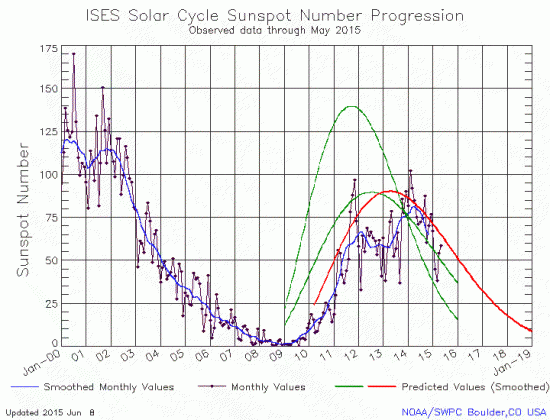
May 2015 Solar Cycle graph

The graph above has been modified to show the predictions of the solar science community. The green curves show the community’s two original predictions from April 2007, with half the scientists predicting a very strong maximum and half predicting a weak one. The red curve is their revised May 2009 prediction.

Sunspot activity once again increased in May, though it continues to remain below the 2009 prediction of activity. Though it is still early in the ramp down, a look at the present pattern suggests that (as I also noted last month) sunspot activity is declining much faster than normal. In the past, the ramp down after solar maximum was long and drawn out, while ramp up was much faster. This ramp down seems much more precipitous than past solar cycles.

I should add that in early April Sunspot Index and Long-term Solar Observations (SILSO) had declared that the peak of the solar maximum had occurred in April 2014, and that they could now sum up the overall weakness of this maximum.

Cycle 24 proves to be 30% weaker than the previous solar cycle, which reached 119.7 in July 2000, and thus belongs to the category of moderate cycles, like cycles 12 to 15, which were the norm in the late 19th and early 20th century. Compared to strong cycles, such cycles typically feature a broader maximum, with a 3-year plateau on top of which two or more surges of activity can produce sharp peaks of similar height.

I had missed this announcement when it was first posted. It is worth noting however, especially since their discussion in April is interesting to read in the context of what has happened since.

1 comment

Same-sex science paper retracted

Politics corrupts science, again: The journal Science has retracted a paper that had claimed opinions on homosexual marriage could be changed quickly during a short conversation.

As noted in the journal’s retraction statement:

The reasons for retracting the paper are as follows: (i) Survey incentives were misrepresented. To encourage participation in the survey, respondents were claimed to have been given cash payments to enroll, to refer family and friends, and to complete multiple surveys. In correspondence received from Michael J. LaCour’s attorney, he confirmed that no such payments were made. (ii) The statement on sponsorship was false. In the Report, LaCour acknowledged funding from the Williams Institute, the Ford Foundation, and the Evelyn and Walter Haas Jr. Fund. Per correspondence from LaCour’s attorney, this statement was not true.

In addition to these known problems, independent researchers have noted certain statistical irregularities in the responses. LaCour has not produced the original survey data from which someone else could independently confirm the validity of the reported findings. [emphasis mine]

LaCour was the paper’s lead author. That he cannot provide the original data immediately discredits the work. It also discredits his only co-author, Donald Green of Columbia University, who apparently put his name on the paper without ever looking at the original data as well. When the above fraud was exposed, Green quickly called for the paper’s retraction, but I wonder how it was possible he allowed it to be published in the first place. Could it have been that he supports the idea of same-sex marriage, and wanted science to contribute its support as well, regardless of the facts?

Not being able to provide the original data is the same problem that Phil Jones of the Climate Research Unit had. Jones’ work documenting the global temperature for the past century has been the main source used by the entire climate field for decades, and when he couldn’t provide his original data, saying it was lost, his work should have received the same treatment as LaCour above — immediate retraction. Instead, Science protected him, as did the entire climate community.

Their willingness to cover-up Jones’ bad science is now coming back to bite them, with more examples of sloppy work getting into publication. Jones showed that it was all right to fake his results. LaCour decided to try it as well, and Green saw no reason to challenge the dishonesty. The result? Fake science done for the sake of homosexual politics.

The big difference now, however, is the willingness of Science to quickly retract the piece. It appears we are making some progress in re-establishing the rules of science to research and publication.

A minor side note: The author of the story above is John Bohannon, the same guy who just proved you can write a fake paper and get journalists to report it.

1 comment

Corruption in the Russian space industry

A slew of stories in the Russian press today illustrate again the deeply ingrained problems that country has, both in corruption and in its ability to produce a quality product.

The last story describes the overall scale of the corruption, which is not confined just to the space sector, but can be found in many industries. The aerospace industry just happens to be the most visible outside Russia, and thus the most embarrassing. Yet,
» Read more

1 comment

The liberal bias of pollsters

In a strained attempt to explain the failure of pollsters to predict the election results yesterday in Great Britain, pollsters and pundits seem unable to see the elephant in the room that explains their problems.

And what is that elephant? Take a look at this list of bad polling predictions provided by Nate Silver, the mainstream media’s big polling guru because he correctly predicted both Obama victories:

  • The final polls showed a close result in the Scottish independence referendum, with the “no” side projected to win by just 2 to 3 percentage points. In fact, “no” won by almost 11 percentage points.
  • Although polls correctly implied that Republicans were favored to win the Senate in the 2014 U.S. midterms, they nevertheless significantlyunderestimated the GOP’s performance. Republicans’ margins over Democrats were about 4 points better than the polls in the average Senate race.
  • Pre-election polls badly underestimated Likud’s performance in the Israeli legislative elections earlier this year, projecting the party to about 22 seats in the Knesset when it in fact won 30. (Exit polls on election night weren’t very good either.)

Does anyone notice a trend? I could also reference other elections that pollsters badly predicted, such as the Sandinista defeat in Nicaragua in 1994, the Republican victory in 1994, Bush’s victory over Kerry in 2004 and practically every vote for or against the European Union. And there are others. For a bunch of so-called intellectuals who claim to be experts in predicting human behavior, they seem very oblivious to the obvious.
» Read more

3 comments

Freedom speaks: An interview with Pamela Geller

Muhammad bomb cartoon

Link here. As she bluntly notes right at the start of the interview:

We incited no one. We didn’t call for violence, justify violence, or approve of violence. The people who were inciting were the ones saying that we should be killed for exhibiting Muhammad cartoons. There is no automatic or unavoidable response to being insulted. No one is forced to kill for being insulted. Those who choose to do so are responsible for their actions. No one else is.

When asked about the criticism that pundits and reporters on both the left and the right have been leveling at her for provoking the attacks, she was equally blunt, though she saved her harshest criticism for the quislings on the right.

This is the problem with the conservatives. This is why we can never nominate qualified, brave, true conservative candidates. The conservative movement has trimmed to accommodate the leftist media so much that they’ve trimmed themselves out of principle. They attack me because they’re desperately afraid that the leftist media will smear them by association with me. It is an act of sheer cowardice.

It has been disgusting these last few days watching the so-called intellectuals of our society, including many reporters who should know better, rush over themselves to blame Pamela Geller and the victims in this Islamic terrorist attack, merely because they exercised their first amendment rights.

The Islamic State has not only claimed credit for the attack, it says it plans to do more, targeting people in as many as 15 states, with Geller as one of those named to its kill list.

And we should blame Geller for the violence? How divorced from reality has our society’s intellectual class become?

14 comments

The Sun drifts downward

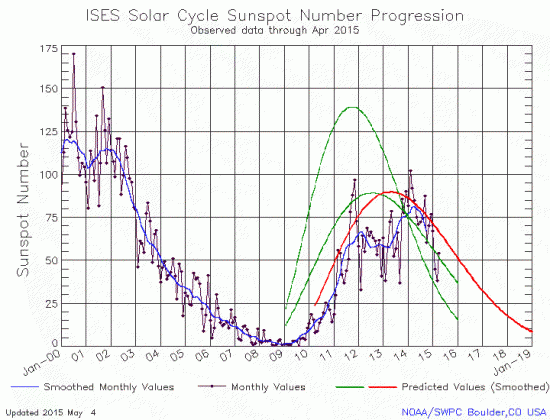
NOAA today posted its monthly update of the solar cycle, showing the Sun’s sunspot activity in April. As always, I am posting it here, with annotations to give it context, as I have done since 2010.

April 2015 Solar Cycle graph

The graph above has been modified to show the predictions of the solar science community. The green curves show the community’s two original predictions from April 2007, with half the scientists predicting a very strong maximum and half predicting a weak one. The red curve is their revised May 2009 prediction.

Though sunspot activity increased in April, it remained well below the predicted numbers from the 2009 prediction, as has sunspot activity generally done for this entire solar cycle.

Note that if you extrapolate the red curve of the 2009 prediction down to its end you find that the solar minimum was predicted to occur sometime after 2020. Based on the rate of activity we have seen for the past year, it is very possible that the minimum will occur sooner, and will likely last longer.

But then again, the sun does what the sun wants to do. We don’t exactly understand the root causes of the solar cycle, and can only watch it unfold time after time as we try to peel back its mysteries.

1 comment

New Shepard makes its first test flight

New Shepard launch

The competition heats up: Blue Origin completed on Wednesday its first test flight of its reusable suborbital spacecraft, New Shepard.

After reaching an altitude of 307,000 feet, or 58 miles, the capsule successfully separated from its first stage, what they call the propulsion module, and safely parachuted back to Earth. The first stage, designed to also be recoverable, was not recovered successfully. According to Jeff Bezos’s explanation, they “lost pressure in our hydraulic system” and that they were trying to land it vertically, like SpaceX’s Falcon 9 first stage.

The cropped image on the right of the full resolution image, gives us a close-up of the capsule and propulsion module. The small fins on the propulsion module suggest the capability for a vertical landing, but it is unclear from the image whether the module has legs, though other images and videos strongly suggest there are legs on this module.

The flight itself, getting above 50 miles, reached space according to most definitions. In fact, Blue Origin with this flight has accomplished what Virgin Galactic has been promising to do for more than a decade, a suborbital test flight of its spacecraft. Blue Origin’s flight was unmanned, but it demonstrated that their design works. They will of course have to re-fly the capsule as well as land that first stage successfully to prove the design’s re-usability, but this flight shows that they are off to a very good start. And their webpage clearly shows that they are almost ready to start selling tickets for suborbital flights.

The most significant success of this launch, however, is the performance of the BE-3 rocket engine. Blue Origin has convinced ULA to hire it to build the engines for its new Vulcan rocket. This success justifies that decision.

I have embedded their videos of the full flight below the fold.
» Read more

3 comments

The building rage is not just against Democrats

People who read my website only intermittently might get the impression that I am partisan and specifically hostile to the Democratic Party. This is false. I am an equal opportunity opponent to anyone that likes oppression and the use of government to impose it.

Some stories today, describing the actions or opinions of some of the so-called conservative or moderate leaders of both the Republican and Democratic parties, illustrate clearly that we still need a major house-cleaning in Congress if we are to get this out-of-control monster under control:
» Read more

2 comments

Why SpaceX’s first stage failure is really a magnificent success

Yesterday SpaceX attempted for the second time to land the first stage of its Falcon 9 rocket on an unmanned barge in the Atlantic. They failed, spectacularly.

I however consider this attempt to be a magnificent success. I also think they could fail at achieving this vertical landing for the next twenty launches and still those failures would each be a magnificent success.

Why? How can an engineering failure like this really be considered an achievement? It is very simple. Even if SpaceX continues to fail in its effort to recover its Falcon 9 first stage and reuse it, the possibility that they might succeed — demonstrated time after time by the company with each launch — has struck terror in the hearts of every other aerospace launch company. Each landing attempt shows SpaceX’s commitment to lowering launch costs while developing cutting edge engineering capabilities. Each attempt shows the world that they are the world’s leading launch company.

The result? Every other launch company in the world, both old and new, are scrambling desperately to lower their own costs as well as improve their own engineering.
» Read more

35 comments

The hidden glaciers of Mars

The glaciers belts of Mars

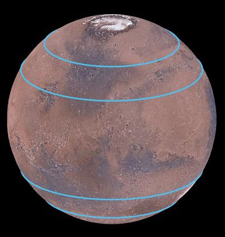
Scientists, using computer models and radar data obtained in orbit, have detected large belts of glaciers in Mars’ upper middle latitudes, buried beneath a layer of dust.

Several satellites orbit Mars and on satellite images, researchers have been able to observe the shape of glaciers just below the surface. For a long time scientists did not know if the ice was made of frozen water (H2O) or of carbon dioxide (CO2) or whether it was mud.

Using radar measurements from the NASA satellite, Mars Reconnaissance Orbiter, researchers have been able to determine that is water ice. But how thick was the ice and do they resemble glaciers on Earth? A group of researchers at the Niels Bohr Institute have now calculated this using radar observations combined with ice flow modelling.

The press release has one typo that is important. The belts appear to be located between 30-50 degrees latitude, not 300-500 (the degree sign became a 0 by mistake).

It is important to recognize the uncertainty of this discovery. Orbital images have seen features that suggest glaciers. The evidence that it is water-ice and that the water-ice is still largely present comes from the computer models. Computer models are notorious for seeing things that end up not being there.

Nonetheless, this result is important. It is further strong evidence that Mars still contains a lot of water locked in its immediate subsurface, where future colonists can mine it and use it to survive and build their homes.

2 comments

The sunspot crash continues

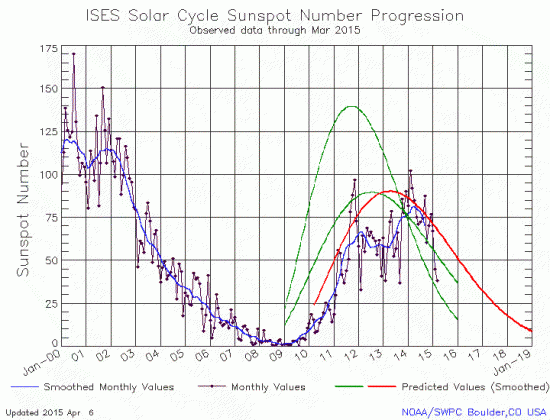
On Sunday NOAA posted its monthly update of the solar cycle, showing the Sun’s sunspot activity in March. I am posting it here, with annotations to give it context, as I have done since 2010.

March 2015 Solar Cycle graph

The graph above has been modified to show the predictions of the solar science community. The green curves show the community’s two original predictions from April 2007, with half the scientists predicting a very strong maximum and half predicting a weak one. The red curve is their revised May 2009 prediction.

In February the Sun’s sunspot activity plunged, dropping way below the prediction of the solar science community. In March that plunge continued. Even though activity had seemed to track that prediction through most of 2014, the overall levels were always less than the prediction. The sunspot numbers for the past two months have simply made this fact obvious once again, dropping to levels almost as low as those last seen in 2011, before the onset of the solar maximum.

That the ramp down at this time is so precipitous is especially intriguing, as historically the ramp down from previous solar maximums has been slow and steady. It is once again evidence that the Sun is doing things that solar scientists have never yet had the opportunity to observe.

5 comments

A photo tour of Vandenberg Air Force Base

Yesterday, as part of my visit to Vandenberg Air Force Base to give a space history lecture to the local section of the American Institute of Aeronautics and Astronautics, I was given a short tour of these west coast launch facilities. While Kennedy is used for launches that circle the equator, Vandenberg, with its southern-facing coast, launches rockets that head south over the ocean for a polar orbit.

We only had time to go inside one launchpad, where unfortunately I was not permitted to take pictures. However, the images I did get will give you a reasonable sense of the layout for this spaceport, which is increasingly becoming a spaceport for private launch companies like ULA and SpaceX. Though the bulk of business for both companies here might be military and government payloads, the future is still going to include a lot of private payloads. The images also help to highlight the differences between these two companies, as well as some past history, as one of these launchpads was once intended for the space shuttle, though never used for that purpose.
» Read more

7 comments

Whose side is Obama on?

I ask this frightening question because it is becoming increasingly clear that Obama’s loyalties do not seem to be firmly lodged on the side of western civilization, the United States, or even our allies in the Middle East, both Jewish and Muslim.

To give you an idea, here is a small selection of links:

The last is interesting in that it includes these comments by Obama:

In a Nowruz (Persian New Year) video address, Obama said that a “reasonable nuclear deal… can help open the door to a brighter future for you, the Iranian people. I believe that our nations have a historic opportunity to resolve this issue peacefully — an opportunity we should not miss,” added Obama.

The collection above is only a sampling in the past week. It ignores past stories, such as Obama’s snub of the Charlie Hebdo demonstrations in France, for example.

I repeat: Whose side is Obama on? The evidence sure is mounting that he is not allied with the United States.

11 comments

Feel the middle-class rage

While this story is about the testimony of a mother before the Arkansas State Board of Education, objecting to Common Core standards and demanding that they be changed or abandoned, I think its most important take-away is watching the intelligent and thoughtful anger she expresses.

I have included the video of her testimony below the fold. Anyone who thinks the tea party movement is dead needs to watch this video to find out how wrong they are. This woman speaking as a representative of over a thousand parents and teachers, all of whom object to Common Core, the federally-imposed education standards. She also reveals the increasing level of rage and anger that is percolating in the general public over the incompetent and destructive dictates that are being imposed on them by bureaucrats in Washington.

The Republican leadership in the House and Senate might think they were elected to keep the government open, but this woman’s testimony tells me that the mid-term elections were a demand by the public for the Republicans to shut it down.

And they better do it soon, because the rage is continuing to build. If our elected officials don’t respond to it soon the very system of democracy on which our society was built — founded on the principle that government is the servant to the people — is going to become very seriously threatened.

» Read more

3 comments

Sunspots crash in February


NOAA today posted its monthly update of the solar cycle, showing the sunspot activity for the Sun in February. As I have done monthly for the past five years, I am posting it here below the fold, with annotations to give it context.

In the past two months I have noted how the ramp down from solar maximum has closely tracked the 2009 prediction of the solar scientist community (indicated by the red curve).

In February, however, that close tracking ended, with sunspots plunging far below the prediction. Note also that sunspot activity in March has also been weak.

» Read more

2 comments

Russians confirm plan to leave ISS in 2024

The competition heats up: Russian space managers have confirmed that they have endorsed a plan to leave ISS in 2024, when they will assemble their own space station using new modules as well as a significant number of the modules attached to ISS.

On February 24, 2015, the Scientific and Technical Council, NTS, at Roskosmos, the main planning body at the agency led by a newly appointed chairman and the former head of the agency Yuri Koptev, formally endorsed the Russian participation in the ISS program until 2024. It would be followed by the separation of Russia’s newest modules from the ISS to form the new national space station. As previously reported on this site, the initial configuration of the station would include the Multi-purpose Module, MLM, the Node Module, UM, and the Science and Power Module, NEM. Notably, the original Russian ISS component — the Zvezda Service Module, SM — was not included in the plan, thus ensuring that its propulsion capabilities would be available for deorbiting of the outpost at the end of its operational life.

Whether ISS will be functional with just the Russian Zvezda module is not clear. NASA engineers now have about a decade to figure this out and to fix it.

In general the break up of the partnership running ISS will be good for space exploration. The competition between nations will spur development and innovation. It will also free each nation from the shackles of the partnership. The Russians in particular have wanted to utilize ISS for more daring and longer expeditions to research interplanetary travel, and were stymied by NASA’s bureaucracy. Once they start doing this sort of thing on their own station NASA will feel obliged to follow.

Obviously, competition between nations carries risk. As long as there is some agreed to framework for claiming territory on other planets (something that the U.N. treaty does not allow), the nations will be able to compete peacefully. Without that framework, however, will leave room for disagreement and conflict.

It is thus essential that the space-faring nations sit down and work out this framework, and do it as soon as possible before each nation has vested interests in space that are already in conflict with each other. Above all, this new framework has got to abandon the U.N. space treaty with its rules that forbid the claiming and controlling of territory by nations in space. Those rules were never realistic, and literally guarantee that nations will eventually end up at war with each other as they fight to determine who owns what in space.

6 comments

Watching politics eat away at climate science

Two stories today today illustrate how the field of climate science is being destroyed by politics.

In the first, a leading climate skeptic chortles over the resignation of Rajendra Pachauri, the man who has headed the IPCC since 2002, who has stepped down because of allegations of sexual harassment by an employee at the institute he heads in New Delhi. In the second, Willie Wei-Hock Soon, a scientist who has published numerous peer-reviewed papers raising questions about global warming science, is attacked for not fully disclosing the sources of his income.

In both cases, the two sides in the global warming debate are using these allegations as ammunition to attack the believability of each side’s stance on the scientific question of global warming. And in both cases, the stories raise literally no questions about the science itself that each man advocated.

I admit that I have attacked Pachauri numerous times in the past, but each time it was because he demonstrated outright ignorance of the field of climate science or had been caught making significant scientific errors. His resignation here however has nothing to do with the science published in IPCC reports, and should not be used as fodder to criticize the theory of human-caused global warming.

Similarly, none of the articles in the mainstream science press about the allegations against Soon have raised a single question about his actual results. All they have done is attack him for not revealing all of his funding sources. His research itself still appears valid. That the largest science journals, Science and Nature, have published articles attacking Soon, with the Smithsonian now piling on as well, without presenting any evidence that he had falsified any of his work, illustrates how corrupt this field has become. The science for these major science journals no longer matters. All that matters is destroying someone who was apparently successful in bursting the balloon on some global warming science.

Until everyone stops playing this game and focuses instead on the data itself and what that data is really telling us, we will get no closer to truly understanding the climate of the Earth. And tragically, I see far too little effort in the climate field to do this.

7 comments

Sunspot activity tracks prediction

On Monday NOAA posted its monthly update of the solar cycle, showing the sunspot activity for the Sun in January. As I do every month, I am posting it here below the fold, with annotations to give it context.

As I have noted previously, the ramp down from solar maximum continues to track the 2009 prediction of the solar scientist community (indicated by the red curve) quite closely. As NOAA also notes,

While awaiting final confirmation, all evidence points to the most recent solar maximum having peaked at 82 in April, 2014. This was within the expected range for the peak, but occurred significantly later than predicted.

Since their graph doesn’t show the entire curves for their predictions, the above statement seems reasonable. However, looking at the graph with those curves inserted (see my annotated graph below the fold), it becomes clear that not only did the peak occur much later than predicted, the maximum’s overall activity was also generally less than predicted.
» Read more

0 comments

“Oh, she’s going down.”

Rand Paul today became the fourth senator to announce his opposition to Loretta Lynch, Barack Obama’s nominee for attorney general.

Earlier Wednesday, in his office in the Russell Senate Office Building on Capitol Hill, Breitbart News watched as the senator’s legal and press team briefed him final time before the interview. Sergio Gor, Paul’s communications director, his press secretary Eleanor May and attorney Brian Darling were all present.

Paul asked the team about Sen. Ted Cruz’s (R-TX) question during Lynch’s Senate Judiciary Committee confirmation hearing about whether she’d oppose using a drone to kill an American citizen on American soil.

When Paul heard about her non-answer—she wouldn’t commit that the federal government does not have such authority—he was incredulous. Furthermore, Paul was appalled that Lynch came out in favor of President Barack Obama’s executive amnesty and the use of asset forfeiture—where the federal government seizes people’s property sometimes with flimsy reasoning, something even the Obama administration has offered slight opposition to—and then told his office staff he’s going to oppose her and aim to derail her nomination chances. “Oh, she’s going down,” Paul said to the room.

The video of Lynch’s non-answer to Cruz’s question is quite shocking. I dare you to watch it and tell me afterward that this administration and Democratic Party is not a threat to your freedom and rights.

Whether the Republicans in the Senate will have the courage to stand up to this threat, however, remains a very big unknown. That four senators have announced their opposition so early is a good sign, but we shall see.

1 comment

Roscomos puts the squeeze on Ukraine

Two more stories this week provide additional evidence that Roscosmos, the new Russian government-run space corporation that controls Russia’s entire space industry, intends to eliminate its dependence on any foreign contributions, even if that contribution comes from the former Soviet province of Ukraine.

In the first story, Roscosmos ends the commercial use of the Dnepr anti-ballistic missile, built originally in the Ukraine. In the second story Roscosmos makes it very clear that it will focus on using its Russia-made Angara rocket rather than depend on the Ukrainian Zenit, even though Zenit is what the Roscosmos-owned Sea Launch platform was designed to use and Angara is far from operational.

The main result of these decisions will be the bankrupt many Ukrainian space companies. Whether it will bring more business to Angara, however, remains to be seen. Angara has only had one orbital launch, and has hardly tested its many different configurations. At this stage it is highly unlikely that the commercial customers who have depended on Dnepr and Zenit will flock to it, especially since they now have other competitive options available in the west.

3 comments
1 52 53 54 55 56 84