The ever-receding Space Launch System

Today a story at Space News reveals that NASA has decided to forgo construction of a second mobile launcher for its Space Launch System (SLS). Instead, they will modify the one they have.

The mobile launch platform, originally built for the Constellation Program and currently being modified to support the SLS, will be used for one launch of the initial Block 1 version of the SLS, designated Exploration Mission (EM) 1. That platform will then have to be modified to accommodate the taller Block 1B version that will be used on second and subsequent SLS missions.

Agency officials said late last year they were considering starting work on a second mobile launch platform designed from the beginning to accommodate the Block 1B version of the SLS. They argued that doing so could shorten the gap of at least 33 months between the first and second SLS missions caused in part by the modification work to the existing platform.

The first mobile launcher was built and modified for an estimated $300 to $500 million. NASA obviously has decided that the politics of building a second won’t fly. The cost is too great, as would be the political embarrassment of admitting they spent about a half a billion for a launcher they will only use once. (That this mobile launcher is leaning we will leave aside for the moment.)

What this does however is push back the first manned SLS/Orion launch. At present, the first unmanned mission is likely to go in June 2020 (though don’t be surprised if that date sees further delays). If it takes 33 months after that launch to reconfigure the launcher for the first manned mission, that manned mission cannot occur any sooner than April 2023. That second launch however is planned to be the first to use SLS’s new upper stage. To put humans on it untested seems foolish, doesn’t it? NASA is going to have to fly an extra mission to test that upper stage, which is going to add further delays to the schedule.

In November I predicted that the first manned SLS/Orion mission would not happen before 2025. At the time it was assumed that the second flight of SLS would have to launch the unmanned Europa Clipper mission, in order to test that upper stage. Now however it appears that the Trump administration wants to shift Europa Clipper to a commercial launch vehicle, probably Falcon Heavy.

This means that either astronauts will be flying on an untested SLS upper stage, or NASA will have to add a test launch in April 2023, followed some time thereafter by that manned mission. Since NASA does not at present have a budget for a third mission, I am not sure what is going to happen here.

What I do know is that SLS is certain to get delayed again. By 2025 we will have paid close to $50 billion for SLS and Orion, and the best we can hope for is a single manned mission. And that one mission will have taken 21 years to go from concept to launch.

This is not how you explore the solar system. With a schedule like this, all SLS and Orion are doing is distributing pork to congressional districts and to the big space companies (Boeing and Lockheed Martin) that are building both. Establishing the United States as a viable space-faring nation is the last thing these players have in mind.

18 comments

Tiny crowded Israel

Journeying through northern Israel

Much of the world’s political troubles are centered on the question of Israel in the middle of the Middle East. In both the Arab world as well as in some western intellectual circles, there are whole campaigns to make it go away (some peaceful, some genocidal). Politicians, pundits, and intellectuals argue incessantly about the rights of the Palestinians and the Jews, the best solution of achieving peace, and even the question of whether the Jews who have immigrated there have a right to stay.

I have just returned from spending two weeks in Israel, a trip I do somewhat regularly to see family. Each of these visits has given me an on-the-ground close-up look at the situation there, something that is difficult to get from the typically shallow media coverage of the region. And from each of these visits comes at least one essay, something I think is required because of Israel’s significance in much of the world’s political turmoil.

This year, we took a three day sightseeing trip to northern Israel, to visit some Roman ruins, the Sea of Galilee, and an incredible nature preserve that is the springtime home for thousands upon thousands of migrating birds. This excursion thus made this particular Israel visit far different from my half dozen or so previous trips, in that it was the first time I spent a considerable time in Israel proper. All my previous trips visiting family had me spend almost all my time going from one West Bank settlement to another. (That experience resulted in a series of essays on what those settlements are really like, which not surprisingly has no resemblance to their portrayal in the western press. My previous essay, A look at some Israeli West Bank settlements, provides a good summary, but it also provides links to all the previous essays, which are definitely worth the time to read if you want to find out what it is really like in the West Bank. I will give you one clue that might shock you: Hitchhiking is one of the most popular ways to get around.)

Anyway, this three-day trip allowed me to get my first look at Israel itself. The map above shows our route, as indicated by the dotted red line. The numbered Xs were our stops, of which I will discuss below.
» Read more

6 comments

Robert Mueller’s political document

Numerous pundits have commented in great detail and with far greater expertise than I on the indictments (pdf) last week issued by Special Counsel Robert Mueller against thirteen Russians for wire and bank fraud, identity theft, and conspiracy to defraud the United States. (See here and here for two thoughtful conservative takes.)

As an American who cares about our democracy, however, I decided it was essential I read the indictment myself to form my own opinion about it. I advise every American to do the same, using the first link above to download it. My own personal take-aways are as follows:

1. It is a very good thing that Mueller indicted these Russians. Based on the evidence summarized by the indictment, they clearly committed crimes against Americans and the U.S. government. Moreover, those crimes were committed with the intent by foreigners to interfere with our political process, something we must never allow if at all possible, and punish if we can.

2. Still, I am very curious to learn how Mueller’s team obtained the evidence in these indictments. Reading the document suggests that they must have either had extensive wiretaps, or inside information. Unfortunately, as it is very unlikely that any of these Russians will ever go to trial (having apparently all fled back to Russia long before the indictment was announced), this is information we are likely never to get.

I am therefore also very puzzled by the timing of the indictment. Wouldn’t it have made more sense to issue it as soon as possible, and in a way that might have allowed the authorities to detain these individuals so they might be put on trial? Instead, the slow timing seems almost intended to allow them to escape, and thus prevent an actual trial from ever occurring. I wonder why, though I have my suspicions.

3. Despite the correctness of and the need for these indictments, Mueller’s indictment is first and foremost a political document. If you read it, it is quite obvious that its purpose was not to bring these Russians to justice, but to imply that Russia was working with Trump to get him elected, even though a careful analysis of everything the Russians did shows that this is not the case.

Why do I say this? The indictment spends numerous pages describing in incredible detail every single pro-Trump action taken by these Russians, from organizing social media campaigns to anti-Clinton protests to pro-Trump rallies, while providing only one or two very short summaries of the anti-Trump actions they took, thus giving the impression if you do not read the indictment closely that they were essentially a Trump operation. This however is false. Not only does the indictment lack any evidence of any links between the Russians and the Trump campaign, the details indicate strongly the non-partisan nature of the Russian strategy. While prior to the election it appears they favored Trump, once he was the candidate they shifted tactics to attack both him and Clinton. The goal was not so much to get Trump elected but to cause the most negative disruption to the American election process as possible. The indictment itself admits this, though almost as an aside. The first paragraph quote below shows the Russian strategy before Trump is the candidate, with the second showing their strategy afterward.
» Read more

18 comments

Massive flow on Mars

Massive flow on Mars

Cool image time! The image on the right, cropped to post here, comes from a Mars Reconnaissance Orbiter image that shows a massive relatively recent and dark slope streak that emanates out from a single point on the surface. (Note that the release at this link rotates the image so that north points down. I have rotated back so that north points up.)

Streaks form on slopes when dust cascades downhill. The dark streak is an area of less dust compared to the brighter and reddish surroundings. What triggers these avalanches is not known, but might be related to sudden warming of the surface.

These streaks are often diverted by the terrain they flow down. This one has split into many smaller streaks where it encountered minor obstacles. These streaks fade away over decades as more dust slowly settles out of the Martian sky.

Point of origin for flow

Location of flow, west of Olympus Mons

The MRO release focuses on the fingerlike breakup of the flow as it descends into sand-dune filled plain. What is more interesting to me is the terrain where this flow originated. A close-up of that area from the full image, shown on the right, reveals a feature that could be a wash running in line with the flow’s origin, and leading uphill to a dark feature that is a likely a cliff face. (The light in this image is coming from the southeast.)

This location, at 15.2N latitude, 214.9E longitude and shown by the small cross in the image on the right and captured from this page, is west of Olympus Mons, the largest volcano on Mars. This suggests to me that the originating feature might be an outlet from a lava tube, from which water suddenly seeped out to produce this massive slope streak. A look at the mesa from which this flow came, cropped from the full image and posted below the fold, shows numerous similar slope streaks of varying ages flowing out of this mesa, with some very faint because they occurred farther in the past. Some are even within the bowl at the top of the mesa.

Whether these come from lava tubes is definitely unclear, and I suspect I will be told by geologists not likely. The seeps however do suggest strongly that this mesa might be a very good location for future colonists to look for underground water ice. Since clouds form on the western slopes of Arsia Mons, the southernmost of the three giant volcanoes to the east of Olympus Mons, and that past glacial activity has been documented there, I wonder if some of these same conditions might also exist here, on the nearby terrain west of Olympus Mons.
» Read more

4 comments

Mars rover update: February 8, 2018

Summary: Curiosity remains on Vera Rubin Ridge, though it has begun moving toward the point where it will move down off the ridge. Opportunity remains in Perseverance Valley, though it has finally taken the north fork down.

Before providing today’s update, I have decided it is time to provide links to all previous updates, in chronological order. This will allow my new readers to catch up and have a better understanding of where each rover is, where each is heading, and what fascinating things they have seen in the past year and a half.

These updates began when I decided to figure out the overall context of Curiosity’s travels, which resulted in my March 2016 post, Pinpointing Curiosity’s location in Gale Crater. Then, when Curiosity started to travel through the fascinating and rough Murray Buttes terrain in the summer of 2016, I stated to post regular updates. To understand the press releases from NASA on the rover’s discoveries it is really necessary to understand the larger picture, which is what these updates provide. Soon, I added Opportunity to the updates, with the larger context of its recent travels along the rim of Endeavour Crater explained in my May 15, 2017 rover update.

Now to talk about the most recent news from both rovers!
» Read more

1 comment

Falcon Heavy reactions post launch

I could provide links to probably a hundred articles, but most simply say the same things, while generally being awed and excited. The handful below sum things up well, plus provide some additional details:

The first two stories provide a good overview of the excitement caused by the launch. The third story, about California’s tax on rocket launches, is really an op-ed opposing the tax. (I don’t expect that state’s leftist legislature to cancel it.) The third story also outlines what happened, but provides this significant quote from Musk, illustrating starkly how revolutionary this rocket is:

Musk said he personally inspected the landed boosters, adding that SpaceX could even reuse them if it wanted. Even after seeing the results of the launch, Musk said he was having difficulty comprehending the magnitude of the flight, saying it was surreal for him to see such success.

“It can launch things direct to Pluto and beyond. Don’t even need gravity assist or anything,” Musk said. “You can go back to the moon.”

He estimated the total SpaceX investment was over $500 million dollars to develop Falcon Heavy. Musk noted those funds were “all internal,” and not from taxpayers or fundraising.

In other words, the taxpayer now has available, at no development cost, the heavy-lift rocket that NASA has been trying and failing to build for tens of billions since 2004.

Finally, the last story isn’t really about Falcon Heavy, but about how SpaceX is in the driver’s seat in the prices it charges. The company is saving quite a lot by reusing its first stage boosters. For the first initial launches reusing these boosters they offered discounts to get customers to use them. Now they no longer have to, because their normal prices beat everyone else anyway. They can pocket the extra profits.

And all this has happened because of freedom, competition, and the vision of one man. Musk deserves all the accolades he is receiving today.

14 comments

Falcon Heavy launch a success!

Capitalism in space: SpaceX has just successfully launched its Falcon Heavy into space.

The key to this launch was to get the three first stage boosters to all work in unison, and for the two side boosters to successfully separate. All worked.

As I write this we are waiting for the two side boosters on their way back to land, and the central core heading back to land at sea.

The two side boosters landed like synchronized swimmers. The core stage barge landing remains unconfirmed. Update: SpaceX has confirmed that the core stage failed to land correctly, crashing into the ocean.

Two Falcon Heavy boosters landing simultanously

Even so, the upper stage and its payload are in orbit. They will fire its engines in about a half hour, and then again in six hours to put the Tesla into solar orbit. Update: The first firing occurred as scheduled, and Musk has now confirmed that the final burn has placed the Tesla in a solar orbit that reaches out into the asteroid belt.

SpaceX has now started a live stream from the Tesla, showing its mannequin dubbed “Starman” sitting in the driver’s seat.

Even if the core stage failed to land successfully, and even if the upper stage fails to send the Tesla towards Mars, this launch is an unqualified success. SpaceX has demonstrated that the Falcon Heavy works. It is now the most powerful rocket in operation, and only matched or beaten in capability by the Saturn 5, Energia, and the Space Shuttle, none of which exist any longer.

The 2018 launch standings:

6 China
3 SpaceX
2 ULA
2 Japan

33 comments

Polar bears are starving! (NOT)

Fake science: Two articles yesterday from the so-called science journals Nature and Science today illustrate once again how pervasive the corruption in the climate field has now spread to almost anything that relates to climate.

Both articles refer to a paper published this week in Science, though the Nature article is far more detailed and longer. Researchers had tracked 9 polar bears during the spring months in three separate years, and had found that 5 of them had lost weight during this time period. From the Nature article:

Polar bear calorie use in spring

On average, the bears needed nearly 12,325 kilocalories per day — 1.6 times more energy than previously thought. To meet such energy demands, a female bear on the spring sea ice should eat either one adult or 19 newborn ringed seals every 10 to 12 days, the scientists concluded.

But nearly half of the bears didn’t catch enough food — and were forced to fast or scavenge carcasses. These animals lost 10% of their body mass over about 10 days. “That’s dramatic,” says physiologist John Whiteman at the University of New Mexico in Albuquerque. It’s as if a person weighing 80 kilograms shed 8 kilograms in just over a week, he says.

Catching enough to eat isn’t the only challenge polar bears face. As rising temperatures thin the sea ice, wind and currents make it drift faster on the ocean surface. “Think about a treadmill,” says Merav Ben-David, a wildlife ecologist at the University of Wyoming in Laramie. If the sea ice moves faster under their paws, polar bears have to walk faster — or for longer — to remain in the same spot3, which forces them to expend more energy, she says. [emphasis mine]

Oh my god! The polar bears are dying! And global warming is killing them!

What a joke. A quick look at the graph above, captured from the Science video, reveals that what the researchers really found is that four bears lost weight, four bears gained weight, and one stayed about the same. The bears studied weren’t “starving,” they represented what looks like an ordinary cross-section of population.

Moreover, this study is incredibly uncertain in that it only studied 9 bears, and only during the spring months during three years. What happens during the rest of the year? What would happen if they studied a larger population? While the data here teaches us something about the polar bear’s diet, calorie intake and calorie requirements, it is absolutely insufficient to provide any conclusions about the future of the bear population.

Worse, while both articles were quick to mention the threat from global warming, neither mentioned that the polar bear population continues to thrive, and has been doing so for the past decade, with no declines in almost all Arctic regions.

Further compounding the bad reporting here, while both articles repeated their religious belief in global warming and the impending disappearance of the Arctic icecap, there remains zero evidence in all data gathered of the ice pack by satellites and ground research that the icecap is shrinking significantly. In fact, while it had shown a steady decline through the first decade of the 21st century, in the past few years there has been a marked recovery. While these scientists might want the ice cap to disappear for political reasons, it simply isn’t doing so.

This is junk journalism and fake science. In fact, it is downright pitiful. That the reporting at such important science journals as these has become so slipshod speaks badly for the future of science in general.

58 comments

Weird Martian geology: Kaiser Crater

Kaiser Crater bedrock

Cool image time! This week JPL’s image site highlighted a picture taken by Mars Odyssey of the floor and dunes inside Kaiser Crater, located to the west of Helles basin in an area dubbed the Noachis Region.

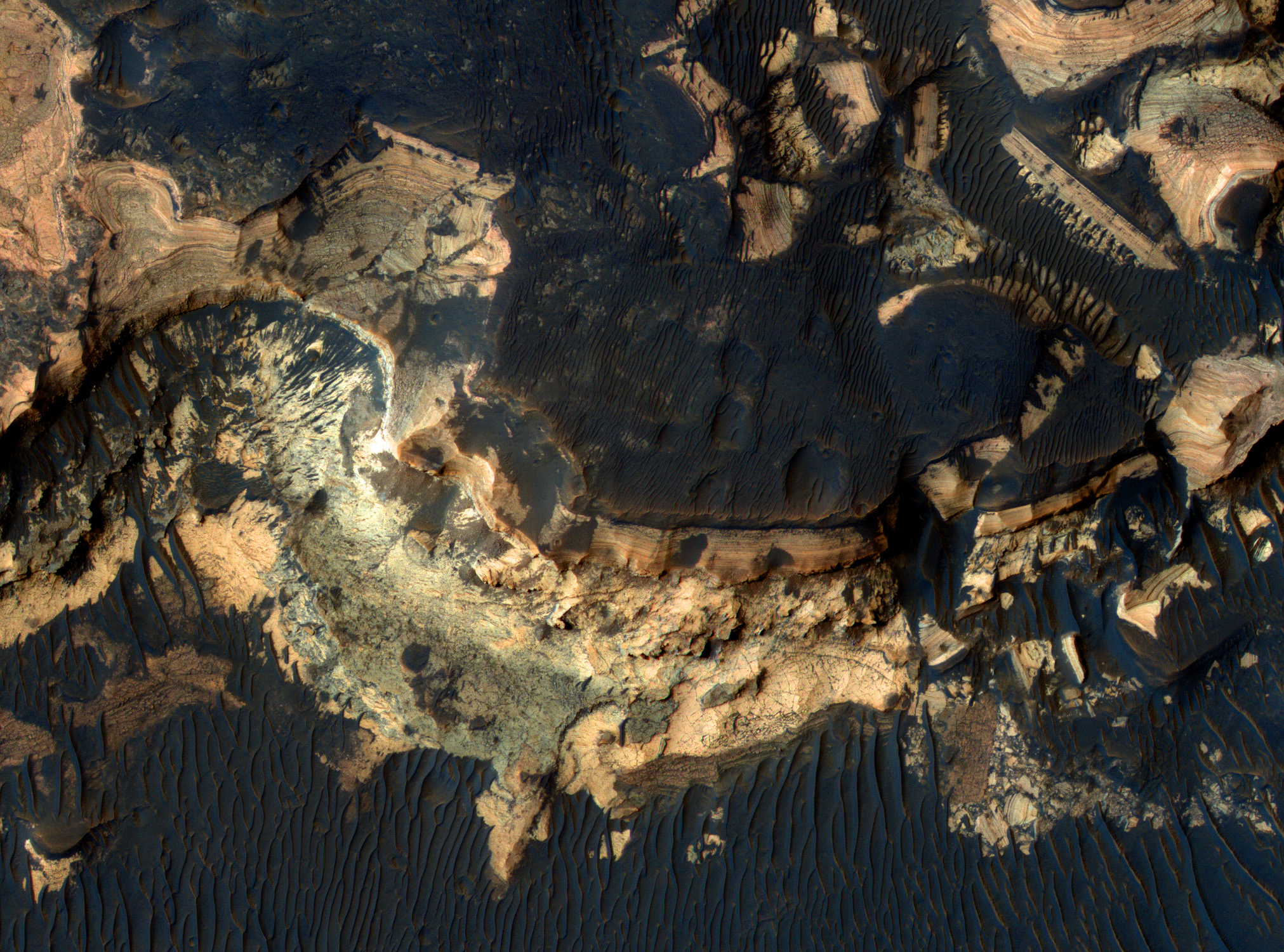
To my eye, the Mars Odyssey picture was interesting, but not worth a post here on Behind the Black. However, I decided to take a look at what HiRise, the high resolution camera of Mars Reconnaissance Orbiter (MRO), had taken of the same area, just out of curiosity. A search at the master HiRise image site at the same latitude and longitude (-45 latitude, 180 longitude) showed that HiRise had imaged a part of the same area, but at much higher resolution.

When I zoomed in on this hi resolution image I came across some interesting and weird geology, cropped to show here on the right. Now this, I thought, is worth posting. Notice how the dark tracks, caused by dust devils, leave no tracks as they cut across the brighter areas. Obviously, these bright areas have no dust or sand, and are likely solid bedrock of some kind. The depressions might be craters, but they also might not. The raised area around the depressions might have been caused by the impact, or it might have been caused by some internal geological process that caused the depression while also raising the surrounding bulge. Since then the wind has been steadily depositing sand in the depressions, causing it to get trapped there.

7 comments

NASA’ safety panel illustrates the impossibility of exploration by NASA

Last week NASA’s Aerospace Safety Advisory Panel (ASAP) issued its 2017 report [pdf], detailing the areas it has concerns for human safety in all of NASA’s programs. Not surprisingly, the report raised big issues about SpaceX, suggesting its manned launch schedule was questionable and that there were great risks using the Falcon 9 rocket as presently designed.

ASAP was especially concerned with the issues with the Falcon 9 COPV helium tanks and how they were connected with the September 2016 launchpad explosion, as well as SpaceX’s approach to fueling the rocket. Below is a screen capture of the report’s pertinent section on this.

ASAP SpaceX concerns

The report complements NASA and SpaceX for looking at a new design for the COPV helium tanks, but also appears quite willing to force endless delays in order to make sure the issue here is completely understood, even though this is likely impossible for years more.

ASAP also raises once again its reservations about SpaceX’s method of fueling the Falcon 9, which would have them fill the tanks after the astronauts are on board so that the fuel can be kept cold and dense to maximize performance. This issue I find very silly. The present accepted approach is to fill the tanks, then board the astronauts. SpaceX wants to board the astronauts, then fill the tanks. Either way, the astronauts will be in a rocket with tons of volatile fuel and oxidizer. I really do not see why it makes that much of a difference, especially with SpaceX building a successful track record using its approach with each successful commercial launch. They did 18 last year alone.

Below the fold is a screen capture of the report’s entire summary, with some sections highlighted by me.
» Read more

32 comments

Mars rover update: January 16, 2018

Summary: Both rovers have moved little in the past month, Opportunity because it is in a good science location and because it must save energy during the winter and Curiosity because it is in a geological location so good the scientists appear to almost be going ga-ga over it.

Curiosity

null

For the overall context of Curiosity’s travels, see Pinpointing Curiosity’s location in Gale Crater.

In the month since my December 18 update, Curiosity has continued to head south rather than east as originally planned (as indicated by the dotted yellow line in the traverse map to the right). Moreover, the rover has not moved very much, because the science team has decided that there is just too much significant geology in this area on Vera Rubin Ridge, also part of a geological unit they have dubbed the Hematite Unit.

Right now the rover is located at an area they call “Region e,” one of the three patches I have also indicated on the image to the right. From the second update below:

This location is a slight depression with exposed fractured bedrock that appears more “blue” from orbit than the surrounding region. In addition, the orbital evidence and observations from the ground suggest that this location is similar to “Region 10” that we visited just last week, which was shown to have some pretty spectacular small-scale features that were of particular interest to many on the science team. As a result, the team was very excited to reach “Region e” and begin our scientific investigation!

The last few updates on the Curiosity mission update page indicate the excitement the geologists have for this site:
» Read more

3 comments

The known ice cliffs on Mars

Last week there was a big NASA story about the discovery of eight locations on Mars where the evidence strongly suggests that these spots have cliff faces with exposed layers of water ice.

The press release however did not provide an overview about where those eight locations were. Only two locations were given, one for a scarp in Milankovič Crater in the northern hemisphere, and one in an area called Promethei Terra, located in the remote cratered highlands in the southern high-mid-latitudes.

The location of known ice scarps on Mars

After much digging (and some assistance from John Batchelor) I was finally able to obtain the latitudes and longitudes of all 8 locations. All but the scarp in Milankovič Crater crater (shown by the white dot north of Olympus Mons) are located in the white rectangular box shown to the south and east of Hellas Basin, the area with Mars’ lowest elevation. This part of Mars is not well imaged with the high resolution camera on Mars Reconnaissance Orbiter (indicated by the fewer number of red squares in the image), mostly because it appears relatively boring from a distance. Nothing appears to be there for hundreds and hundreds of miles except craters, sand, and sand dunes..

The discovery of these scarps in this area however changes the picture. It suggests that cratered highlands that surround Hellas Basin, including those close to the planet’s equator, could contain similar buried layers of ice. More research is necessary to pin down more locations, especially those closer to the equator where conditions might be more hospitable for a colony.

Moreover, educated readers of Behind the Black have previously noted that because of Hellas Basin’s low elevation the air pressure there is thicker, and therefore the location has some advantages as a potential colony location. These ice scarps raise the value of Hellas Basin considerably, as they suggest that such layers could easily be exposed as you descend into Hellas Basin. If such layers are exposed on the northern flanks of the basin, they would be at latitudes of around 25 to 30 degrees south, a much more friendly latitude for settlement.

2 comments
1 72 73 74 75 76 139