The federal government’s blank check

Three articles this morning about actions taken by Congress in connection with the budgets for NASA and NOAA illustrate the bankrupt nature of our federal government.

The first story describes how several legislators from the House Appropriations Committee have inserted amendments into their budget bill that will restore a $10 million NASA climate monitoring program that the Trump administration had shut down.

The second story describes how that same budget bill generously funds both NASA and NOAA at levels far above their own requests.
» Read more

3 comments

Chaos on Mars

chaos terrain

Cool image time! The image on the right, cropped and reduced in resolution to post here, shows an area on Mars that geologists have dubbed “Chaos Terrain.” If you click on the image you can see the full image, which also includes several canyons oriented in what seem to be random directions.

I first heard this geological term for regions on Mars shortly after the first orbital missions circling Mars began taking images back in the 1970s. It applied to places where the terrain was hummocky, a crazy collection of hills forming no pattern at all. Earth does not really have such terrain.

The close-up to the right also shows that at least one of these hills is fractured, made up of several large pieces that have separated over time.

This image was part of the May 2nd image release from the high resolution camera on Mars Reconnaissance Orbiter. What makes it interesting is its location on Mars. The image below shows that location, indicated by a white cross.
» Read more

3 comments

Craters, cones, pits, amid endless plains

Pits, cones, and craters

Cool image time! Buried in the catalog of recent high resolution images from Mars Reconnaissance Orbiter are places on Mars that are inexplicable and fascinating, while also indicative of its vastness. The image on the right, reduced in resolution and cropped to post here, shows us one such place. If you click on the image you can see the full image at high resolution.

The archive posting of this image is titled “Cones near Pits.” As you can see, to the north and east of the pits are some mesas (why they call them cones I do not know).

The pits are unusual, and appear to be some form of collapse. In the larger image several additional mesas can be seen at farther distances, but most of the overall terrain is remarkably flat and featureless, except for numerous small craters that appear either partly buried by dust or significantly eroded.

I am not going to guess at the geology that caused the pits and mesas. What I do want to focus on is the vastness of Mars. This location is on the southern edge of Utopia Basin, the second deepest basin on Mars. It is part of the planet’s endless northern plains, an immense region covering almost half the planet that tends to be at a lower elevation, is relatively smooth, and is thought by some scientists to be evidence of what was once an intermittent ocean. The global map of Mars below indicates the location of the above image with a black cross.
» Read more

16 comments

Sunspot update for April 2018: Heading into solar minimum

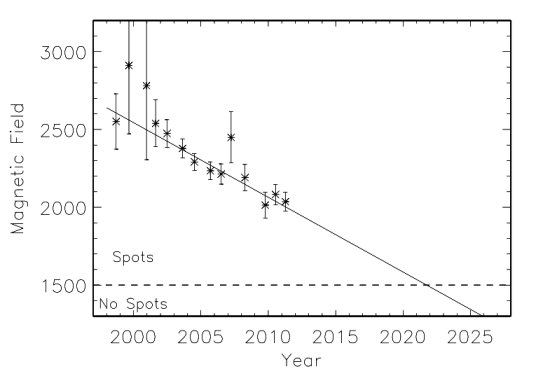
On Sunday NOAA posted its monthly update of the solar cycle, covering sunspot activity for April 2018. Below is my annotated version of that graph.

While there was an uptick in sunspots in April, compared to the almost complete inactivity in March (the least active month for sunspots in a decade), the uptick did little to change the general trend. Sunspot activity is now comparable to what we saw in early 2008 (as indicated by the yellow line). This was just before the arrival of the previous solar minimum, which happened to also be one of the longest and deepest on record.

» Read more

1 comment

Volcano or Impact?

Elliptical crater with flow features

Cool image time! Yesterday the Mars Reconnaissance Orbiter (MRO) team released its monthly image dump of more than 500 new photographs, taken by the spacecraft’s high resolution camera. As I have started to do in the past few months, I am reviewing this collection and plan to post a few of the more interesting images over the next month. On the right is the first of this series. I have cropped and reduced the resolution to show here, but you can see the full resolution version if you click on the image.

The MRO team labels this image an “elliptical crater with flow features.” The first impression one gets from the image is that the impact that caused the crater came from the side and hit the ground obliquely, creating the crater’s oval shape and the lava-type flow features in the crater’s floor.

As is almost always the case with Martian geology, beware of first impressions. You need to give any feature both a more detailed look as well as a broader view to have any chance at understanding its context and geology.
» Read more

4 comments

Alien world

Meridiani Planum
So what is it we are looking at in the image above? I have reduced the resolution slightly to fit it here, but you can see the full resolution image by clicking on the picture.

Is it a marble or granite kitchen counter? Nah, the surface is too rough.

Maybe it’s a modern abstract painting that we can find hanging in the Museum of Modern Art in New York. Nah, it has too much style and depth. Abstract art is much more shallow and empty of content.

Could it be a close-up of a just-opened container of berry-vanilla ice cream, the different flavors swirling and intertwined to enhance the eating experience? No, somehow it looks too gritty for ice cream.
» Read more

7 comments

Mars rover update: April 27, 2018

Summary: Curiosity’s exploration of Vera Rubin Ridge is extended, while an attempt by Opportunity to climb back up Perseverance Valley to reach an interesting rock outcrop fails.

For a list of past updates beginning in July 2016, see my February 8, 2018 update.

Curiosity

Curiosity's traverse map, Sol 2030

For the overall context of Curiosity’s travels, see Pinpointing Curiosity’s location in Gale Crater.

Since my March 21, 2018 update, it has become apparent that the Curiosity science team has decided to extend the rover’s research on Vera Rubin Ridge far beyond their original plans. They have continued their travels to the northeast well past the original nominal route off the ridge, as indicated by the dotted red line on the traverse map above. Along the way they stopped to inspect a wide variety of geology, and have now moved to the north and have actually begun descending off the ridge, but in a direction that takes the rover away from Mount Sharp and its original route. As noted in their April 25 update,
» Read more

1 comment

Zooming in on a Martian surprise

Global map of Mars

Let’s take a journey. Above is a global map of Mars, showing its largest and well known geological features. While far smaller than Earth, its lack of oceans means that Mars’ actual dry surface has about the same square footage as the continents of Earth. It is a vast place. Getting a close look at every spot is going to take many decades of work, and probably won’t be finished until humans are actually walking its surface.

Let’s pick a spot, zoom in and find out what’s there.
» Read more

5 comments

More hatred and bigotry from the left

It has become quite depressing to repeatedly document the numerous daily examples of leftist hatred and bigotry that now populate American intellectual and political culture. It must be done, however, so below are a few more recent examples from the past month, categorized appropriately. A quick scan of the stories will illustrate to anyone how bankrupt our modern intellectual and political culture has become. Worse, it appears with time that the levels of emotional hate and bigotry are only growing.

First the bigotry:

I could list more, but these are enough. They illustrate the bigoted focus of the left. To them, everything is race or ethnicity. You cannot accomplish anything as an individual if you are a minority, and all your failures can be blamed on the evils of the white race. More important, it is their right to oppress whites, merely because they perceive that some white cultures in the past were oppressive. Under this mentality, we shall soon see the return of segregation (as indicated by at least two stories above) and racial discrimination. And it won’t matter that this time it will be whites who are oppressed instead of blacks. It will still be evil, because it will be based not on the content of each individual’s character but on the color of their skin.

Next the hate:
» Read more

17 comments

How I spent my Saturday: Removing graffiti in a cave

Yesterday was another of my many cave adventures, but different than most. Instead of exploring and mapping newly discovered or out-of-the-way remote cave passages, I participated in a project of the Central Arizona Grotto (a chapter of the National Speleological Society and located in Phoenix) to remove years of graffiti from Peppersauce Cave. You can see pictures of yesterday’s effort here, published by the Arizona Star.

You won’t see any pictures of me. The younger cavers were far more photogenic.

Peppersauce has become what cavers call a “sacrificial cave.” It is open and ungated, relatively easy to traverse, and very well known throughout the state. Thus, many inexperienced people go there to see it, most of whom know little about caving, the ethics of protecting them, or the proper techniques for caving safely. Yesterday, while we were working to either sand-blast, chemically remove, or grind away old spray-paint (some of which was sadly obscene), I must have seen between 150 to 200 people go by. At least two thirds of them were not wearing helmets. Many clearly had never been in a cave before. Some were not wearing headlamps, carrying flashlights instead (which makes climbing harder because you don’t have use of both hands and can easily lose your light). A few even came in with no lights, depending instead on the lights their companions carried.

Because of this heavy traffic, Peppersauce has been badly trashed. On visits by experienced cavers we routinely carry out bags of trash, only to find that trash reappearing, sometime in mere hours. The walls of the cave had been covered with graffiti, some many layers deep.

Ray Keeler of Central Arizona Grotto (CAG) has organized several projects in the past to remove this graffitti over the past two decades. The effort he is leading this year is the third, and has the help of cavers from grottos throughout the state. This was the fourth clean-up weekend, and the first that I was able to attend (having missed the first three due to scheduling conflicts).

I’ve done similar things before, but never on this scale. It was quite educational using the solvent to remove some graffiti, but unfortunately many types of paint are completely resistant to removal by either sand-blasting or solvent. After awhile I got discouraged doing solvent work. Too often nothing got removed. In the afternoon I switched to our last technique, grinding, and was far more gratified with the results. The grinder, which we do not use on formations, removes only the slightest layer of material, and thus does little damage. It however is very effective in removing all paint, no matter how resistant.

The cave is now about two thirds cleaned. We are racing to finish the rest before the summer, because a typically insane reason forced upon us by the government. You see, according to a law passed by Congress, graffiti that is more than fifty years old is considered historical, and cannot be removed without a great deal of paperwork and complex bureaucracy. Spray paint was invented in the late 1960s (about fifty years ago), and so some of this ugly graffiti, no matter how obscene, is going to be protected by our government beginning later this year. Our goal is to get it removed beforehand, so that the cave can be returned to a more natural state, for future visitors to experience.

19 comments

The first sunspots of the next solar cycle

In linking to my sunspot update this week, there has been a lot of speculation at the climate website WattsUpWithThat that the next solar cycle has begun.

Our resident solar physicist, Dr. Leif Svalgaard commented and provided a link to something reported by his colleagues, something that likely would not have been possible without the fantastic solar observations of NASA’s Solar Dynamic Observeratory (SDO). He said: “Cycle 25 has already begun. It looks to me that SC25 will be a bit stronger than SC24, so probably no Grand Minimum this time.” It seems a small sunspot has been observed, that has the opposite polarity of cycle 24 sunspots. [emphasis in original]

The speculation at WattsUpWithThat, which suggested that this sunspot was the first such sunspot this cycle, was not quite accurate however. This sunspot with an opposite polarity, which decayed so quickly that it did not rate getting a sunspot number, was not the first. This week the Solar-Terrestrial Centre of Excellence, a Belgian organization focused on space-solar science, published this very good article discussing not only this sunspot but two others, one of which occurred more than a year ago.
» Read more

4 comments

A Martian snake of collapsed hills

A Martian snake of collapsed hills

Close-up of collapsed hills

Time to once again delve into this month’s release of high resolution images from Mars Reconnaissance Orbiter. The image above, cropped, rotated, and reduced in resolution to post here, shows a string of strange mounds or hills, each with similar collapse features on their tops. If you click on the picture, you can see the full resolution image, rotated properly with north up. You can also go to the MRO post, which provides some additional information.

The white box indicates the location of the cropped close-up, at full resolution, to the right. This area is typical across the entire snake-like ridge. You have these mounds or hills, each with chaotic depressions at their tops. The depressions suggest that this ridge follows an underground void, like a lava tube. The ridge-like nature of the line of hills also suggest that this tube has been exposed by erosion over time, with the surrounding terrain more easily blown or washed away while the more resistant ridge remains.

At the same time, the line of hills is baffling. Why would a lava tube expand periodically to form something that looks like a string of pearls?

The location of this snaking ridge provides some additional context.
» Read more

8 comments
1 70 71 72 73 74 139