Mars rover update: November 16, 2017

Summary: Curiosity does drill tests, crosses Vera Rubin Ridge. Opportunity finds evidence of either ice or wind scouring on rocks in Perseverance Valley.

Curiosity

For the overall context of Curiosity’s travels, see Pinpointing Curiosity’s location in Gale Crater.

Curiosity looks up Vera Rubin Ridge, Sol 1850

Since my last update on September 6, Curiosity has continued its travels up and across Vera Rubin Ridge, a geological bedding plain dubbed the Hematite Unit. The panorama above, created by reader Phil Veerkamp, shows the view looking up the ridge slope. If you click on it you can see the full resolution image, with lots of interesting geological details.

The panorama below, also created by Veerkamp, shows the view on Sol 1866, two weeks later, as the slope begins to flatten out and the distant foothills of Mount Sharp become visible. (If you click on the image you can see a very slightly reduced version of the full resolution panorama.) This image also shows the next change in geology. From orbit the Hematite Unit darkens suddenly at its higher altitudes, and Curiosity at this point was approaching that transition. The rover is now, on Sol 1876, sitting on that boundary, where they will spend a few days making observations before moving on.

Curiosity on the Hematite Unit, Sol 1866

null

The image on the right shows Curiosity’s approximate position, about halfway across the Hematite Unit and with the rover’s approximate future route indicated, as shown in this October 3, 2016 press release.

In the two months since my last rover update the Curiosity engineering team has spent a lot of time imaging and studying the Hematite Unit. They have also spent a considerable amount of time doing new tests on the rover’s drill in an effort to get around its stuck feed mechanism in order to drill again. Only yesterday they took another series of close-up images of the drill in this continuing effort.

As indicated by the October 3 2016 press release, the rover still has a good way to go before it begins entering the distant canyons and large foothills. While they should leave the Hematite Unit and enter the Clay Unit beyond in only a few more months, I expect it will be at least a year before they pass through the Clay Unit and reach the much more spectacular Sulfate Unit, where the rover will explore at least one deep canyon as well as a recurring dark feature on a slope that scientists think might be a water seep.

Opportunity

For the context of Opportunity’s recent travels along the rim of Endeavour Crater, see my May 15, 2017 rover update.
» Read more

0 comments

Exploring one of Mars’ giant volcanoes

Master index

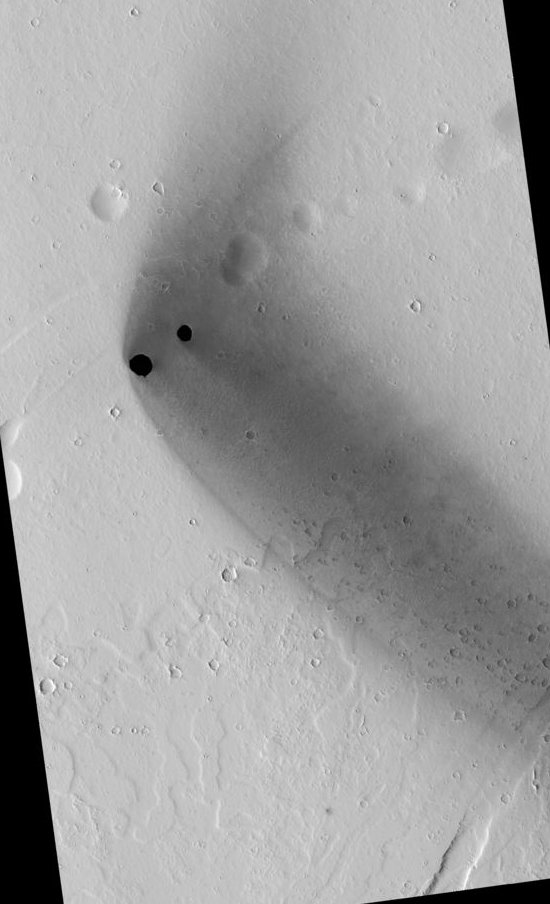
For the past two weeks JPL’s image site has been releasing a string of images taken by Mars Odyssey of the smallest of Mars’ four giant volcanoes.

Pavonis Mons is one of the three aligned Tharsis Volcanoes. The four Tharsis volcanoes are Ascreaus Mons, Pavonis Mons, Arsia Mons, and Olympus Mars. All four are shield type volcanoes. Shield volcanoes are formed by lava flows originating near or at the summit, building up layers upon layers of lava. The Hawaiian islands on Earth are shield volcanoes. The three aligned volcanoes are located along a topographic rise in the Tharsis region. Along this trend there are increased tectonic features and additional lava flows. Pavonis Mons is the smallest of the four volcanoes, rising 14km above the mean Mars surface level with a width of 375km. It has a complex summit caldera, with the smallest caldera deeper than the larger caldera. Like most shield volcanoes the surface has a low profile. In the case of Pavonis Mons the average slope is only 4 degrees.

The image on the right is the context image, annotated by me to show where all these images were taken. The images can accessed individually below.

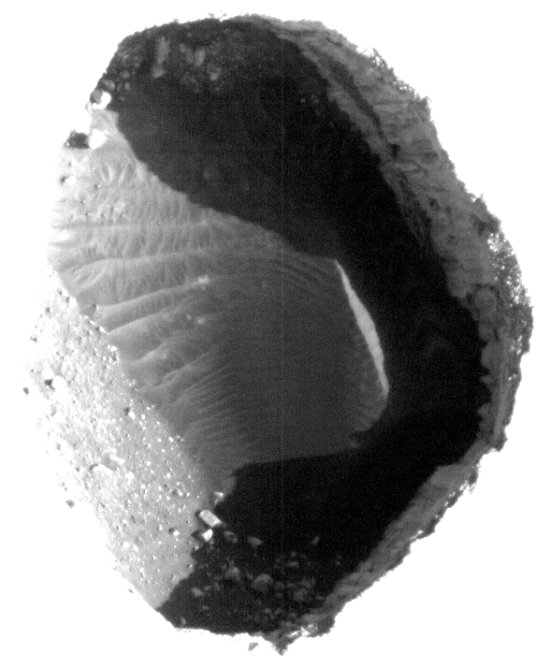
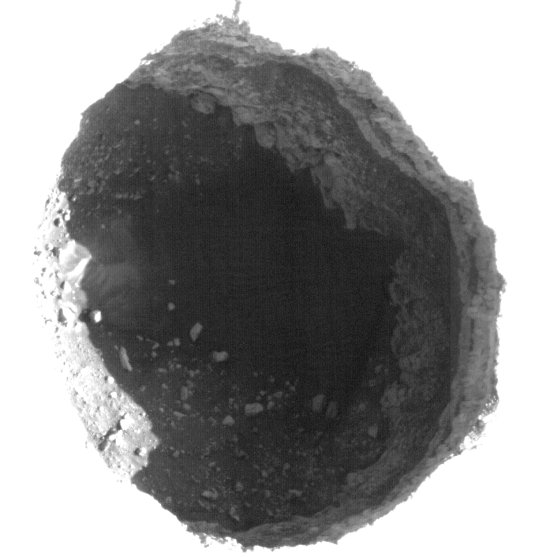
Each of these images has some interesting geological features, such as collapses, lava tubes, faults, and flow features. Meanwhile, the central calderas are remarkable smooth, with only a few craters indicating their relatively young age.

The most fascinating geological fact gleaned from these images is that they reveal a larger geological trend that runs through all of the three aligned giant volcanoes to the east of Olympus Mons.

The linear and sinuous features mark the locations of lava tubes and graben that occur on both sides of the volcano along a regional trend that passes thru Pavonis Mons, Ascreaus Mons (to the north), and Arsia Mons (to the south).

This trend probably also indicates the fundamental geology that caused all three volcanoes to align as they have.

Arsia Mons is of particular interest in that water clouds form periodically above its western slope, where there is also evidence of past glaciation. Scientists strongly suspect that there is a lot of water ice trapped underground here, possibly inside the many lava tubes that meander down its slopes. These facts also suggest that this might be one of the first places humans go to live, when they finally go to live on Mars.

27 comments

I am looking for a library to donate my space history files

I am in the process of updating my will, and in the process I am searching for a library or university or archive that would be an appropriate place to leave my space history archives, collected during the past two and a half decades. This archive includes recordings of numerous interviews with Russian and American astronauts and engineers as well as numerous scientists. It also documents quite thoroughly the first half century of the space age.

I had considered giving this archive to the four year university here in Tucson, but it appears they really don’t want it. My last conversation with the head of their special collections was quite hostile, making me wonder if he might have glanced at my webpage and was triggered by it.

If someone has a suggestion, please comment here or email me. My main desire is that this collection should stay intact. I also desire that whichever university or library accepts it also agree to this clause:

It is my request however that these space materials, which cover the history of the first half century of space exploration by someone who witnessed it and thus will be of special interest to future residents not living on Earth, shall be transferred to the first university established on a world other than Earth that is willing to cover the cost for that transfer. Should such transfer occur, the [Earth-bound university/archive] will have the right to retain copies of all materials.

18 comments

The first meeting of the National Space Council

The first meeting of the National Space Council just wrapped up. You can see highlights here. I have several thoughts.

The entire event was very carefully staged, with the planned outcomes determined beforehand. The three panels of speakers were organized to match up with the three main actions the council intended to pursue, with the questions from the various high level Trump cabinet members clearly arranged to line up with each panel. Moreover, the fact that all these panel members were there and participating in this staged event suggests that Trump himself is directly interested, and insisted they do so.

The first action was a decision to rework the country’s overall space policy, including its future goals for exploring the solar system. This action item was linked with statements by officials from Lockheed Martin, Boeing, and Orbital ATK, and was clearly intended to placate their desire to keep what they all called “sustained” and “reliable” funding. It was also clearly linked to Pence’s opening remarks, which insisted that the U.S. should return to the Moon, permanently, and use that as a jumping off point for exploring Mars and the rest of the solar system.

The second action was a commitment to review, in the next 45 days, the entire regulatory bureaucracy that private companies must face. This was linked to the testimony from officials from SpaceX, Blue Origin, and Sierra Nevada.

The third action was a focus on the military and national security aspects of space, focused on the development of a “space strategic framework” that will apparently link the military needs with the growing commercial space industry. This framework has been under development for several months. The council actually spent the most time questioning the national security witnesses on this issue. This focus also aligns with the main interest in space held by Trump’s nominee for NASA administrator, Congressman Jim Bridenstine (R-Oklahoma). Interestingly, Bridenstine was in the audience, but was given no speaking opportunity, unlike the NASA acting administrator, Robert Lightfoot, who Pence specifically provided a moment to speak.

Overall, this meeting indicates that the Trump administration is likely not going to do much to drain the swamp that presently dominates our space effort. Trump’s interest in reducing regulation remains strong, but it also appears he and his administration is also strongly committed to continuing the crony capitalism that is wasting literally billions of dollars in space and helping to put the nation into unrecoverable debt.

5 comments

Hate from the left

The last few days have been a horror show of hate. While most decent people were appalled by the murderous attack in Las Vegas and horrified by the evil of the man who did it, it appears the thing that offended the left most of all was not the murderer, but the guns he used and the nerve of conservatives and Republicans to defend the 2nd amendment of the Constitution in defying their non-stop efforts to repeal it. That outrage against conservatives often bordered on insane and outright hate, completely divorced from facts or reality.

This list of stories is only a small sampling. The hateful attacks the past few days on conservatives and anyone connected with Trump and the Republican Party by Democrats and leftists have been non-stop and repeatedly vicious.

The last story above however reveals clearly where these attacks are going. The left, and the Democratic Party that supports the left’s ideology, wants to end freedom and obtain unrivaled and unopposed power. Anything that stands in their way must be destroyed, including the Bill of Rights. Moore’s proposal to repeal the 2nd amendment is not the only proposal put forth by Democrats in recent years trying to repeal parts of the Bill of Rights. For example, in June Democratic Congressmen held a sit-in in the House, protesting the due process clause in the 5th amendment. Then, in 2014 the Democrats proposed repealing the 1st amendment. We already know that the left has worked tirelessly for the past century to make the 9th and 10th amendments moot so the federal government will rule over areas of law that were reserved to the states, or the people.

That’s 5 of the Bill of Right’s 10 amendments that leftists and the Democratic Party oppose. If I was dig a bit deeper I am sure I can find examples where they have worked to repeal the other five as well.

I want make it clear where this Democratic Party and its supporters in academia and Hollywood now stands. They hate all opposition, and want to repeal the constitutional protections created to protect ordinary people from tyranny. If you stand for freedom, you cannot stand with them.

And if you don’t believe me, watch this video and the hate coming from this woman against someone who was merely wearing a “Make America Great Again” hat. She steals it, then says his free speech and property rights should be suspended, merely because she hates him. Others might say it is because she disagrees with him, but what I see is unbridled hate, pure and vicious.

We need to recognize this hate for what it is. It is what caused so many liberals in the past two days to attack conservatives, not the murderer who killed dozens in Las Vegas. And it is this kind of hate that always leads to oppression, mass murder, and tyranny.

42 comments

Pioneer

Pioneer

I am today announcing the publication of Pioneer, a science fiction book I first wrote back in 1982 that has languished in my files now for more than three decades. As I note in the introduction,

It was never published because at the time I could not find an agent to market it to book publishers, and was then too naive and shy to attempt to do such things myself.

In viewing several recent science fiction movies, however, I was motivated to pull the final draft of Pioneer from my files, wondering if it might be marketable. I hadn’t read it in decades, and had literally forgotten the story. I started reading expecting a typical first novel, somewhat incoherent and emotionally immature.

Instead I was quite surprised and enthralled. I couldn’t put the book down. Moreover, I was astonished at the coherence of the story and characters. “This is a good book!” I exclaimed to my wife Diane. Nor am I bragging when I say this, since the person who wrote it is someone from many decades ago and who essentially no longer exists.

Thus, I decided it was time to get Pioneer published, especially since this is now a very easy thing to do, no longer requiring either an agent or a book publisher.

The press release announcing the book’s publication provides the story’s premise:
» Read more

20 comments

Space hype versus reality

Three stories today illustrate the importance of maintaining some skepticism when reading the claims of rocket companies.

I could probably also include the story earlier today about the model rocket test launch that was hyped absurdly by the company and the British newspapers that reported it.

The first story reports the comments of a local politician claiming that SpaceX will be launching from its Boca Chica Texas spaceport by the end of 2018. Interesting, but I’d rather go by what the company itself says, and what SpaceX CEO Gwynne Shotwell says today is “Our Texas site still doing landscaping, could be avail in ~ 2 yrs; no rush given our capacity at two Fla pads.”

In other words, the local official’s prediction was a bit overstated, and therefore should not be taken too seriously.

The second story however can be taken a bit more seriously, since it is a report from an actual company official, Clay Mowry, Blue Origin’s vice president of sales, marketing and customer experience. He explains that they hope to resume New Shepard suborbital test flights before the end of the year, with manned test flights occurring in 2018. However, he says little about why there was such a long gap in New Shepard launches after they completed their last test flight in October 2016. At that time they said they would be doing more test flights in early 2017, but by the spring of 2017 had back tracked.

The claim that they might be flying again before the end of the year, however, still carries weight, in that it matches earlier statements. In other words, Blue Origin has been very careful not to make promises it cannot meet. In rocket science this care cannot always be met, but they clearly have tried hard. This is why I take Mowry’s statement that they hope to fly humans on New Shepard in 2018 with some trust.

The third story is a perfect example of how a company loses trust. Virgin Orbit is part of the Virgin set of companies run by Richard Branson, and used to be part of Virgin Galactic. Branson and Virgin Galactic have been making promises now for more than a decade, none of which have born fruit. This unreliability has made me very skeptical about anything they say, which is also why I do not report their claims much anymore. When they actually fly something I will write about it.

For awhile I thought Virgin Orbit was a different bird, as the executives there have been more careful, only making cautious promises and then more or less fulfilling them. The story above however gives me pause. Even as they admit they have had to delay their test program their president still insists that they will be able to ramp up to two launches per month by 2020. Considering the fact that no single private company has yet managed to do such a thing, in the more than half century since the beginnings of the space age, I think it is a little dangerous for this guy to make this claim, even before the company has even launched its first rocket. Virgin Orbit might do it, but such wild claims make me very suspicious of them.

And then there was today’s earlier story about Starchaser Industries. They launch a model rocket 4000 feet in the air, and from this they claim that they will be putting humans on a suborbital rocket in only two years. If you believe that, I have a bridge in Brooklyn I can sell you, cheap.

The bottom line here is to use some common sense and thoughtful judgment in reading stories about future space achievements. The first three stories above are actually all well written, well researched, and very careful in how they report their stories. It however is not necessarily their job to tell you whether the claims are trustworthy, especially if the claims seem reasonable based upon the available information. The last however is an example of bad journalism, rewriting a press release without doing any research at all.

In all cases, it is important to distinguish between stories about what is going to happen versus what is happening. I always prefer the latter, since a real achievement will always trump a mere prediction. And when it comes to the space industry and rocket science, predictions surely must take a back seat to reality.

3 comments

Cassini says goodbye to Saturn

Saturn, October 2016

Cool image time! The picture above, reduced in resolution to show here, was taken in October 2016 during one of Cassini’s last distant orbits that gave it a global view of Saturn and its rings. Since it began its dives close to the gas giant such views have not been possible.

The mission ends this coming Saturday with a dive into Saturn. It was launched in October 1997, and after a seven year journey has spent the last thirteen years in orbit around the planet, providing us the first long term glimpse of a gas giant as its seasons evolved.

Cassini has been orbiting Saturn for nearly a half of a Saturnian year but that journey is nearing its end. This extended stay has permitted observations of the long-term variability of the planet, moons, rings, and magnetosphere, observations not possible from short, fly-by style missions.

When the spacecraft arrived at Saturn in 2004, the planet’s northern hemisphere, seen here at top, was in darkness, just beginning to emerge from winter (see Cassini’s Holiday Greetings​). Now at journey’s end, the entire north pole is bathed in the continuous sunlight of summer.

The spacecraft was also able to observe the seasonal changes that occurred to Titan. It also studied the plumes coming from the tiger stripe cracks on Enceladus, shown below the fold in a movie created by Cassini over a 14 hour time period in August 2017.

I expect that scientists will be exploring Cassini’s data archive for decades, finding many things not noticed in their initial viewing. Unfortunately, we will not have another spacecraft taking new pictures in orbit around Saturn to compare with Cassini’s past images for many decades to come. On Saturday, we go blind.
» Read more

5 comments

Mars rover update: September 6, 2017

Summary: Curiosity ascends up steepest part of Vera Rubin Ridge, getting just below the ridgetop, while Opportunity inspects its footprint in Perseverance Valley.

Curiosity

For the overall context of Curiosity’s travels, see Pinpointing Curiosity’s location in Gale Crater.

Curiosity panorama, Sol 1807

Curiosity's location, Sol 1802

Since my last update on August 11, Curiosity has been slowly working its way along the base of Vera Rubin Ridge, and up its slope. Today’s update from the science team describes how the rover is now on the steepest part of that slope, which is also just below the ridgetop. The panorama above looks east at the ridge, at the sand-duned foothills in the Murray Formation that Curiosity has been traversing since March 2016, and the crater plains beyond.

The image on the right shows Curiosity’s approximate position, with the point of view of the panorama indicated. The image also shows their planned upcoming route across the Hematite Unit. As they note in their update:

Curiosity now has great, unobstructed views across the lowlands of Gale crater to the rear of the rover. The view is improving as the air becomes clearer heading into the colder seasons. The first image link below shows a Navcam view into the distance past a cliff face just to the left of the rover. The image is tilted due to the to the unusually high 15.5 degree tilt of the rover as it climbs the ridge. Part of Mount Sharp is in the background. The second link shows an image looking ahead, where we see much more rock and less soil. The foreground shows that some of the pebbles are relatively well rounded. The rock face up ahead is smooth, which will mean easier driving.

That report I think is somewhat optimistic.
» Read more

0 comments

Global warming and Glacier National Park

One of the main activities for almost everyone visiting Glacier National Park is to drive across the park on Going-to-the-Sun Road, which crosses the mountains and probably has some of the most spectacular scenery of any road in the United States. During our visit this week we entered the park from the west side, spent several days there hiking trails, then took this road across to the east side, where we did more hiking.

The highest point on Going-to-the-Sun Road is Logan Pass. The park service has built a visitor center there, where everyone stops to do a short hike and admire the views. The trail head for the more challenging Highline Trail, which we did soon after arrival, is also here.

Outside the Logan Pass visitor center are a variety of displays. One focused on the changing environment at Glacier, and not surprisingly, it made a point of talking about the documented shrinkage of the glaciers during the past century. Below is an image of the pertinent quote from that display:

Display outside Logan Pass visiter center

When I saw this I was quite amused. The glaciers in the park are expected to be gone in only three more years, by 2020? Not a chance. I thought, they are going to have to change this sign soon. In fact, based on my experience with past failed global warming predictions, I was actually surprised they had let this display stay there this long, and hadn’t already made it vanish to be replaced with a new doomsday prediction that was far enough in the future that they could use if for awhile to generate new fear (and funding) before it too turned out to be wrong.

Anyway, in driving east and down from Logan Point, Diane and I eventually reached the east entrance to the park, where there was another visitor center. Like Logan Pass, this center also had a collection of outdoor displays, with one display once again focused on the park’s changing environment. Below is the pertinent quote from that display:
» Read more

9 comments

The Eclipse

The eclipse approaching totality

Just arrived at Glacier, where the internet access is bad, and there is no cell service. Thus, this might be my last post for the week. I will try to post in the evening, but this is a vacation, so it will not be my first priority. If I could do it in my room that would okay, but I have to go down to the lobby of the Lake McDonald Lodge.

Anyway the image to the right was taken by me by holding my hand filter out at arm’s length, blocking the sun, and snapping a picture with my camera. It came out far better than I expected, as you can actually see the sun in the filter, partly blocked.

Totality was amazing. I was amazed by two things. First, how quiet it became. There were about hundred people scattered about the hotel lawn, with dogs and kids playing around. The hotel manager’s husband set up speakers for music and to make announcements, but when totality arrived he played nothing. People stopped talking. A hush fell over everything. Moreover, I think we somehow imagine a subconscious roar from the full sun. Covered as it was, with its soft corona gleaming gently around it, it suddenly seemed still.

Secondly, the amazing unlikeliness of the Moon being at just the right distance and size to periodically cause this event seemed almost miraculous. Watching it happen drove this point home to me. And since eclipses themselves have been a critical event in the intellectual development of humanity, helping to drive learning and our understanding of the universe, it truly makes me wonder at the majesty of it. I do not believe in any particular religion or their rituals (though I consider the Bible, the Old Testament especially, to be a very good manual for creating a good life and society), but I do not deny the existence of a higher power. Something made this place, and set it up in this wonderous way. Today’s eclipse only served to demonstrate this fact to me again.

Posting will be light for the rest of the week. If I get a chance I will add some more pictures to this post tomorrow.
» Read more

17 comments

A celebration of hate and ignorance

The last few days have not been good ones for American free speech and freedom. Not only have we seen violence perpetrated to silence the free expression of dissent, we have seen an effort after the fact to use that violence as a club for destroying any opposition to the liberal and leftist dogma that dominates the American political and academic community.

The following links will provide a nice overview of how our cultural elites, especially on the left, have responded to this weekend’s terrible events in Charlottesville, Virginia, where one person was killed and almost twenty injured when a car rammed into a crowd of competing racist demonstrators.

That is how our elites responded, not with conciliatory remarks aimed at bringing people together, but with anger and hate, hate of Trump, hate of the Republican Party, hate of the NRA, hate of whites, hate for anyone that dared disagree with their leftist agenda. Then, when Trump issued a statement condemning all violence in the name of bigotry, the response was equally hateful:
» Read more

36 comments
1 74 75 76 77 78 139