Obama allies himself with Islam radicals

The side that President Barack Obama takes in the worldwide conflict between fundamentalist (and violent) Islam and western Judeo-Christian civilization can be seen I think by three stories this past week:

In the first case Obama chose to hurriedly change his plans so he could attend the funeral of the Saudi king. He did not consider attending or sending an important representative to the demonstrations in France condemning the Charlie Hebdo murders. Nor did he consider attending or sending an important representative to the ceremonies commemorating the 70th anniversary of the liberation of Auschwitz.

In the second case Obama has made his dislike for Netanyahu and Israel quite clear, almost to the point of performing childish tantrums. Yet, Israel is our ally. It is also the only real democracy in the Middle East that actually attempts to defend western values.

In the third case, Obama has his administration meet with Muslim Brotherhood leaders to coordinate an effort to remove Egypt’s President Abdel Fattah al-Sisi, even though al-Sisi is one of the few in the Islamic world demanding that Islam reform itself away from violence.

So, what side do you think Barack Obama is on? Who do you really think he wants to win this war?

11 comments

Got $500? You too can get a scientific paper published!

A Harvard scientist used a random text generator to create a fake science paper entitled “Cuckoo for Cocoa Puffs?” and was able to get it accepted at 17 journals. [Note: the link includes an auto-download of the pdf of the scientist’s fake paper.]

Shrime decided to see how easy it would be to publish an article. So he made one up. Like, he literally made one up. He did it using www.randomtextgenerator.com. The article is entitled “Cuckoo for Cocoa Puffs?” and its authors are the venerable Pinkerton A. LeBrain and Orson Welles. The subtitle reads: “The surgical and neoplastic role of cacao extract in breakfast cereals.” Shrime submitted it to 37 journals over two weeks and, so far, 17 of them have accepted it. (They have not “published” it, but say they will as soon as Shrime pays the $500. This is often referred to as a “processing fee.” Shrime has no plans to pay them.) Several have already typeset it and given him reviews, as you can see at the end of this article. One publication says his methods are “novel and innovative”!. But when Shrime looked up the physical locations of these publications, he discovered that many had very suspicious addresses; one was actually inside a strip club.

Essentially, these fake journals are scams to get $500 from scientists, generally from third world countries who can’t get their papers published in the bigger first world journals. (What does that tell us about those bigger first world journals?)

The best line of the article however was this: “Many of these publications sound legitimate. To someone who is not well-versed in a particular subfield of medicine—a journalist, for instance—it would be easy to mistake them for valid sources.” [emphasis mine] It seems to me that if you are a journalist writing about a particular field, you should be reasonably educated on that field and be able to spot a fake journal. I certainly can. That it is assumed that mainstream journalists who report on medicine cannot speaks volumes about the quality of the field.

1 comment

Ocean science deals with limited budgets

A National Research Council report has outlined a range of budget cuts in the field of ocean science, including significant cuts to infrastructure expenses, in order to focus the available funds more wisely.

Faced with rising costs of going to sea, the ocean-sciences division of the US National Science Foundation (NSF) should immediately slash what it spends on marine hardware, says a new report. It suggests making the biggest cut to the flagship US$386-million Ocean Observatories Initiative (OOI), which after years of construction is just months away from being finished.

The report, released on 23 January by the US National Research Council, is likely to guide US oceanography for years to come. It is the first formal attempt to address what many researchers have grumbled about for years — that basic ocean science at the NSF is losing out to the rising costs of infrastructure.

This report and the response of the ocean science community illustrates a pattern going on throughout the sciences. For years, their budgets had been rising so fast that they really didn’t know what to do with the money. (I know they would disagree with me.) This resulted in some laziness in how they spent it, including a great deal of feather-bedding and pork.

Now that budgets have frozen and are no longer growing, and in many cases shrinking back to more affordable levels, they need to figure out what is essential and what is not. This report is part of that effort.

I am seeing this same process happening in other fields as well. Santa, in the form of unlimited federal spending, has gone home, and is unexpected to return for quite some time.

1 comment

Why I ignored Obama’s State of the Union speech

Space.com has provided a detailed look, with reactions, of President Obama’s prominent mention of space exploration in his State of the Union speech this week.

I didn’t even watch the speech, nor read it, nor really care much at all about what he said. It is garbage, political propaganda that has nothing to do with getting us into space. The speech’s only real purpose is to puff up Barack Obama and his political allies.

The article above mentions Obama’s April 2010 space speech. What I wrote about that 2010 speech in 2010 focused on this promise by Obama:

[A]s stated in the speech’s fact sheet, that he “will commit to making a specific decision in 2015 on the development of a new heavy-lift rocket architecture.” Somehow this commitment was supposed to convince us that, despite his cancellation of the Constellation program (which already has had six years of development under its belt), his willingness to postpone making a decision for five years more would somehow accelerate the program.

How stupid does Obama really think people are? [emphasis in original]

Five years later, does anyone remember this promise? And is Obama making this decision now, as promised? No to both. The only reason he is building SLS is because Congress required him to. And the purpose of that rocket program isn’t to build a rocket, but to pour ungodly amounts of money into congressional districts.

To me, the real news this week was the big money private enterprise is beginning to pour into real development in space. That will get us to the planets, not the egotistical blathering of politicians.

9 comments

The sunspot cycle update for December

The monthly update by NOAA of the solar cycle, showing the sunspot activity for the Sun in December, was released this past weekend. As I do every month, I am posting it here, below the fold, with annotations to give it context.

Even though sunspot activity in December increased, the slow ramp down to solar minimum continues to track the 2009 prediction of the solar scientist community. The overall intensity of the solar maximum prior to 2014 was considerable less than this prediction, but the numbers throughout 2014 matched that prediction remarkably well.
» Read more

0 comments

Do not submit!

Mohammed Bomb cartoon

The cartoon on the right prompted the first Islamic riots. More recent ones in the French magazine Charlie Hebdo apparently prompted today’s violent murders.

The goal of these Islamic acts of violence: To stop people from criticizing Islam.

My goal in publishing this cartoon: To defy these thugs and to encourage people to criticize Islam. In the past two decades we have seen nothing but violence, terrorism, death, and destruction from this Arabic religion, fed by hatred and bigotry of Jews and Christians. It is time to say so, bluntly.

If Muslims wish this criticism to stop, they need to do something about it themselves, as the President of Egypt has, instead of demanding others to shut up.

1 comment

A new Russian heavy lift rocket amid Russian budget woes

The competition heats up: Even as Russia today successfully placed a commercial satellite in orbit on the 400th successful Proton rocket launch, Russian sources indicate that — despite budget woes fueled by the drop in oil prices — Russia is moving ahead with the design and construction of a heavy-lift rocket capable of competing with NASA’s Space Launch System (SLS).

From the last link above:

By 2013, Roskosmos drafted a very preliminary roadmap toward the development of heavy and super-heavy launch vehicles. Not surprisingly, it matched closely the strategy that NASA had followed since 2011 within the Space Launch System, SLS, project.

…As the American SLS project, Russian super-heavy launcher plans envisioned building a rocket with a payload of 80-85 tons in the first phase of the program. A pair of such rockets would be enough to mount a lunar expedition. In the second phase of development, the rocket would be upgraded to carry unprecedented 130-180 tons of payload in order to support, permanent lunar bases, missions to asteroids and expeditions to Mars.

As much as I remain a skeptic of SLS, it has apparently struck so much competitive fear in the Russian leadership that they are now willing to try to copy it. Much like the 1980s, when the Soviet rulers bankrupted their nation trying to duplicate American projects like the Strategic Defense Initiative and the Space Shuttle, Putin is now repeating that error all over again. His country has experienced almost a quarter-century of strong economic growth since the fall of communism because, during that time, they focused on capitalism, private enterprise, freedom, and a bottom-up economic structure. Now, they are beginning to abandon that approach and return to the top-down, centralized system of government planning.

As it did in previous century, it will bankrupt them again in this century. Though the Russian government is denying the reports that they are going to trim their space budget, their government’s budget is going to suffer from the drop in the price of oil. Something will have to give.

Update: This review of a book about modern Russia is definitely pertinent: The Land of Magical Thinking: Inside Putin’s Russia

2 comments

Solar maximum ramp down continues

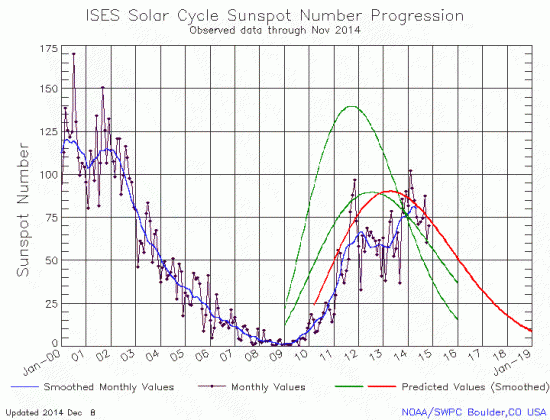
The monthly update by NOAA of the solar cycle, showing the sunspot activity for the Sun in November, was released on December 8, just before NOAA completely revamped its website. As I have been doing every month for the past four years, I am posting it here, with annotations to give it context.

As noted in previous months, the 2009 prediction of the solar scientist community is looking better and better with time. Though there was an increase in sunspot activity in November, the overall trend continues downward very close to that prediction, though at levels that have generally been less than predicted.

November 2014 Solar Cycle graph

The graph above has been modified to show the predictions of the solar science community. The green curves show the community’s two original predictions from April 2007, with half the scientists predicting a very strong maximum and half predicting a weak one. The red curve is their revised May 2009 prediction.

Future updates will depend on whether NOAA continues to track sunspots using these same standards. After much searching I was finally able to locate the graph above at this link, suggesting that at least for now, they are holding to these standards. I note however that the links to the 2007 and the 2009 solar cycle predictions have vanished down the memory hole. Fortunately, I still have this data, and can continue to annotate the graphs to compare prediction with actual data.

That they might have removed these predictions from their webpage however is a shame. I have emailed them to ask them about this and will let you know what I learn.

3 comments

Book news!

Two book items which I think my readers will be interested in:

First, my publisher of the ebook edition of Genesis: the Story of Apollo 8 has asked me to ask my readers to please post book reviews of the book on amazon.com. Presently the book has 47 reviews. If it gets three more, we will be eligible for a number of additional Kindle promotions.

So, whether you liked the book or not, please go to its webpage on amazon and give it a review. Your support will be very much appreciated.

Note also that the sale on amazon continues until the end of December. Until then, you can get the ebook edition of Genesis the Story of Apollo 8 for only $2.99!

Second, I have just published a new book, though on a topic that has nothing to do with space. Circuit Hikes of Southern Arizona was written during my spare time during the past two years while Diane and I explored the many beautiful trails out here in Tucson. Though there are many good Arizona hiking guidebooks, I noticed a lack of guidebooks describing loop trails. Since that is what we were doing anyway, I figured why not assemble my knowledge into a new guidebook and use the opportunity to learn about the modern world of both ebook and print self-publishing.

The print edition of Circuit Hikes is available directly from me here for $15, including shipping. The ebook can be purchased here (directly from me) or from amazon, barnes & noble, and all your normal ebook venders for $10.

This post will remain at the top of the webpage for the next twenty-four hours.

0 comments

Orion launch on Thursday given go-ahead

The Thursday test launch of an Orion capsule has been given the go-ahead.

Many of the news reports this week about this test flight have referred to Orion as “the spacecraft that will take humans to Mars.” I must note again that this is hogwash. No humans will ever go to Mars using Orion. It is too small and does not have the capacity to keep humans healthy and alive for the year-plus-long flight time necessary to get to and from Mars.

The most Orion can ever be is the ascent and descent module for a much larger interplanetary space vessel, used just for getting humans up and down from the surface of the Earth. The spacecraft that will really take people to Mars will have to be something more akin to Mir or ISS, a large assembly of modules put together in low Earth orbit.

One other tidbit everyone should know about tomorrow’s test flight: Though it is being touted as a test of Orion’s heat shield, the company that makes this heat shield has already abandoned this design, so the test itself is for a heat shield that will never be launched again on another Orion capsule. In addition, the flight won’t test the rocket to be used, as the SLS rocket isn’t ready. Nor will it test the capsule’s life support systems, which are not on board.

Which immediately raises the question: Why in hell is NASA even bothering with this test flight?

Sadly, I can answer that question. This is all public relations, an effort to lobby for funding. That’s it.

0 comments

Cygnus on Falcon 9?

The heat of competition: Industry rumors now suggest that Orbital Sciences’s first choice for launching its next ISS freighter Cygnus is SpaceX’s Falcon 9.

The articles offers this explanation for why Orbital is favoring its chief competitor:

While flying on a competitor’s launch vehicle might be viewed as awkward, the decision could boil down to one simple determining factor – cost. It has been estimated that a flight on a F9 would set a customer back $62 million. By comparison, United Launch Alliance’s (ULA ) Atlas V 401 launch vehicle, a booster with similar capabilities to the F9, costs an estimated $100 million per mission. Moreover, SpaceX has a proven track record with the Falcon 9.

All true, but I can think of two more reasons SpaceX is the top choice.
» Read more

3 comments
1 89 90 91 92 93 139