NASA awards company contract to develop new advanced solar panels

NASA has awarded the solar panel company Solestial its second development contract, with both contracts worth more than one million dollars, to develop new advanced solar panels for use on future commercial space stations.

The 18-month SBIR Phase II contract will provide funds to support development of next generation, 50-kilowatt (kW) class solar array wings. Solestial’s silicon solar blanket technology will allow for arrays larger than any ever built, while also maintaining lower mass and competitive efficiency. The array will be developed in collaboration with Opterus Research & Development, who will develop a low-cost, novel deployment system for Solestial’s ultrathin, flexible, silicon solar blankets.

These blankets will be an upgrade from the new panels presently being deployed on ISS, that unroll like a blanket rather than unfold like hard panels. The design is lighter weight, easier to deploy, and cheaper. It will thus become a valuable product that every private space station will want to buy.

1 comment

Federal judge throws out Justice’s discrimination lawsuit against SpaceX

A federal judge in Texas yesterday dismissed the Biden Justice Department lawsuit against SpaceX that accused the company of discrimination for not hiring illegal immigrants.

A federal judge in Texas on Wednesday halted the Justice Department’s case, after the company called it “factually and legally insupportable.” Musk has argued that SpaceX was barred from hiring foreign nationals because of restrictions placed on sharing of information related to rocket technology.

The Justice Department had been investigating SpaceX’s hiring practices since 2020 after receiving a complaint from a person who claimed he was turned down for a job after revealing during an interview that he wasn’t a US citizen or a lawful permanent resident.

At the present Biden’s Justice department has not responded to this decision. The lawsuit might have been idiotic on its face, but its deeper intention was simply to harass SpaceX and Elon Musk — now considered an enemy to Democratic Party rule — and in that it has so far succeeded. Appealing this decision will continue that harassment, even if it is patently obvious that the suit has no merits at all.

10 comments

Firefly wins Australian payload for its second Blue Ghost lunar lander mission

Firefly yesterday announced that the Australian commercial company, Fleet Space Technologies, will fly its seismometer on Firefly’s second Blue Ghost lunar lander mission, planned to land on the far side of the Moon in 2026.

Fleet Space’s SPIDER payload is part of the Australian Space Agency’s Moon to Mars initiative that’s aligned with NASA’s Artemis program to support future habitation on the Moon. Upon deployment of the payload, Firefly’s Blue Ghost lunar lander will provide ongoing power and communications, enabling SPIDER to capture seismic data from the lunar surface for up to 14 days. This data will offer insights into the geological properties of the lunar subsurface and its mineral profile, such as water ice, that can support lunar infrastructure and further regolith exploration.

The mission also has payloads from NASA and the European Space Agency. Note that all three governments are buying the lunar landing services from this private company, rather than build the lander themselves.

0 comments

Next X-37B launch now scheduled for early December on SpaceX’s Falcon Heavy

The next X-37B launch has now been scheduled for a December 7, 2023 launch, and will be sent into orbit for the first time on SpaceX’s Falcon Heavy rocket.

The mission, designated USSF-52, will conduct a wide range of tests, including operating the reusable spaceplane in new orbital regimes, experimenting with space domain awareness technologies, and investigating the radiation effects on materials provided by NASA, the Space Force said in a statement Nov. 8. “We are excited to expand the envelope of the reusable X-37B’s capabilities,” said Lt. Col. Joseph Fritschen, the X-37B program director. The NASA experiment onboard, known as Seeds-2, will expose plant seeds to the harsh radiation environment of long-duration spaceflight.

SpaceX was awarded a $130 million contract in June 2018 to launch USSF-52. The mission was originally scheduled to launch in 2021 and has been delayed by payload and range availability.

The use of the Falcon Heavy suggests the payloads on this next flight are heavier and require that rocket’s extra boost. This will be the seventh X-37B flight of the Space Force’s fleet of two reusable mini-shuttles, beginning in 2010. The previous mission lasted 908 days in orbit, and landed one year ago in November.

5 comments

Japanese billionaire finally concedes his Starship Moon mission won’t happen in 2023

Japanese billionaire Yusaku Maezawa finally admitted publicly today that his manned Moon mission using SpaceX’s Starship/Superheavy rocket won’t happen in 2023 as first announced in 2018.

The most significant part of the announcement? “”We’re not sure when the flight will be,” Maezawa noted on X. Though SpaceX and several news sources claim that federal approval for the next test launch could occur as soon mid-November, Maezawa — as one of SpaceX’s most important customers — might have more detailed non-public information about that approval process.

Even if that second flight get approved and flies in November, it does not mean Maezawa’s manned mission will soon follow. SpaceX will certainly not be ready for manned Starship launches following this test. It will likely require at least a few more unmanned test launches, with each likely delayed months by the same federal bureaucracy that delayed the second test launch by months.

Unless something significant changes in how the federal government is regulating SpaceX at Boca Chica, the first manned flight of Starship is likely years away, no sooner than 2025, but more likely 2026 or 2027.

3 comments

Rocket Lab schedules next launch, plans 22 launches in 2024

Rocket Lab has completed its investigation into a September 2023 launch failure and has now scheduled its next Electron launch for the end of November.

More significant, it says it has 22 booked launches scheduled for 2024, a pace that would more than double its previous annual record of 9 launches in 2022.

In its third quarterly report it also revealed that it lost just over $40 million in that quarter, more than last year’s third quarter by 17%. The September launch failure impacted those numbers, though the company’s revenue in the third quarter still grew by 7% from the previous year.

To achieve 22 launches next year will require the company to launch twice a month. With three launchpads (two in New Zealand and one in the U.S.) this is possible, but challenging. Of those launches, nine will attempt to recover and reuse the first stage, and two will not be orbital but suborbital hypersonic tests for the military.

0 comments

November 8, 2023 Quick space links

Courtesy of BtB’s stringer Jay.


2 comments

Strange meandering ridge amidst Martian glaciers

Overview map

Strange meandering ridge in glacier country

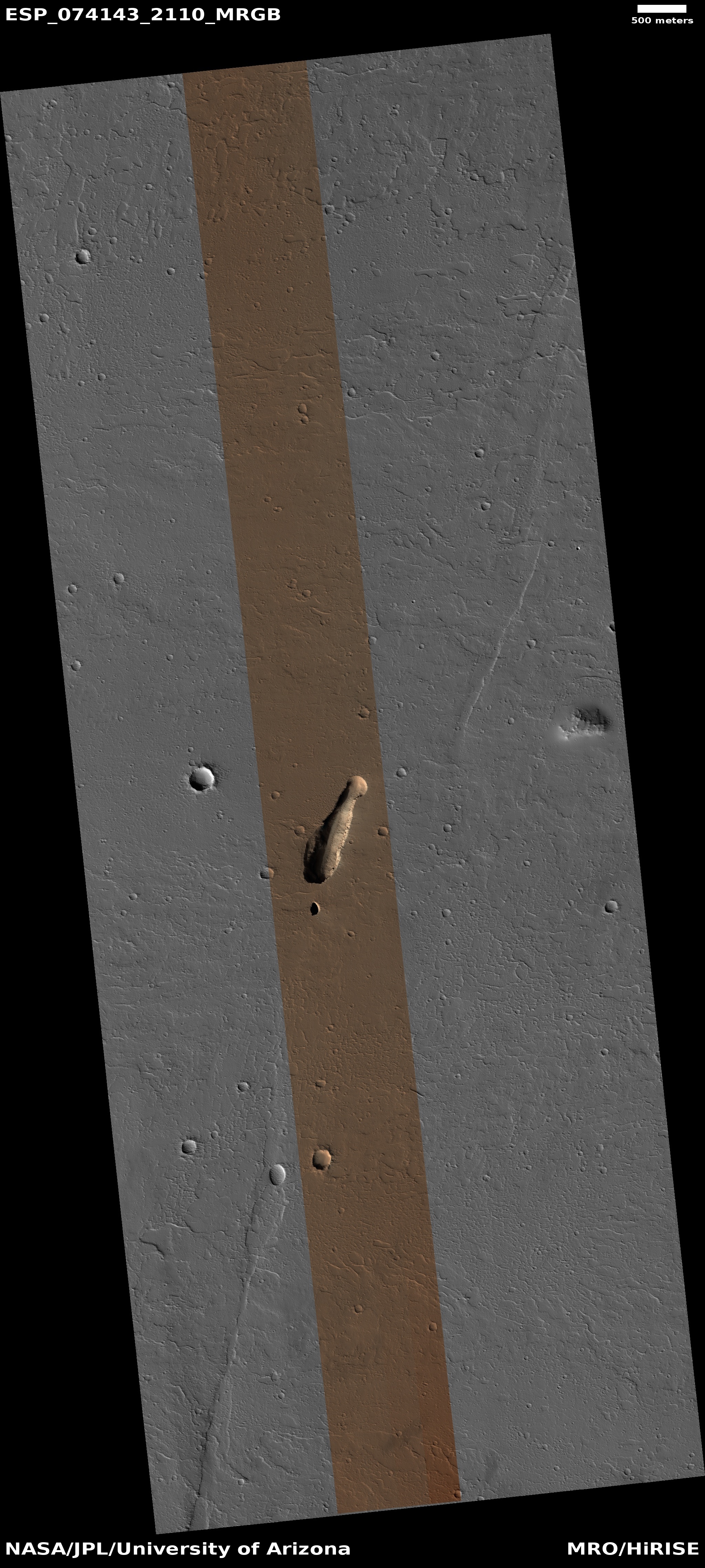
Cool image time! The picture to the right, cropped, reduced, and sharpened to post here, was taken on June 21, 2023 by the high resolution camera on Mars Reconnaissence Orbiter (MRO). Its focus is the meandering ridge in the center of the picture, which the scientists intentially describe vaguely as a “ridged flow-like feature”.

The elevation difference between the high and low points within the picture is about 500 feet, though most of that slope occurs in the lighter terrain on the right. The darker area where the ridge is located has no clear elevation trend, though there are hints of depressions and rises within it.

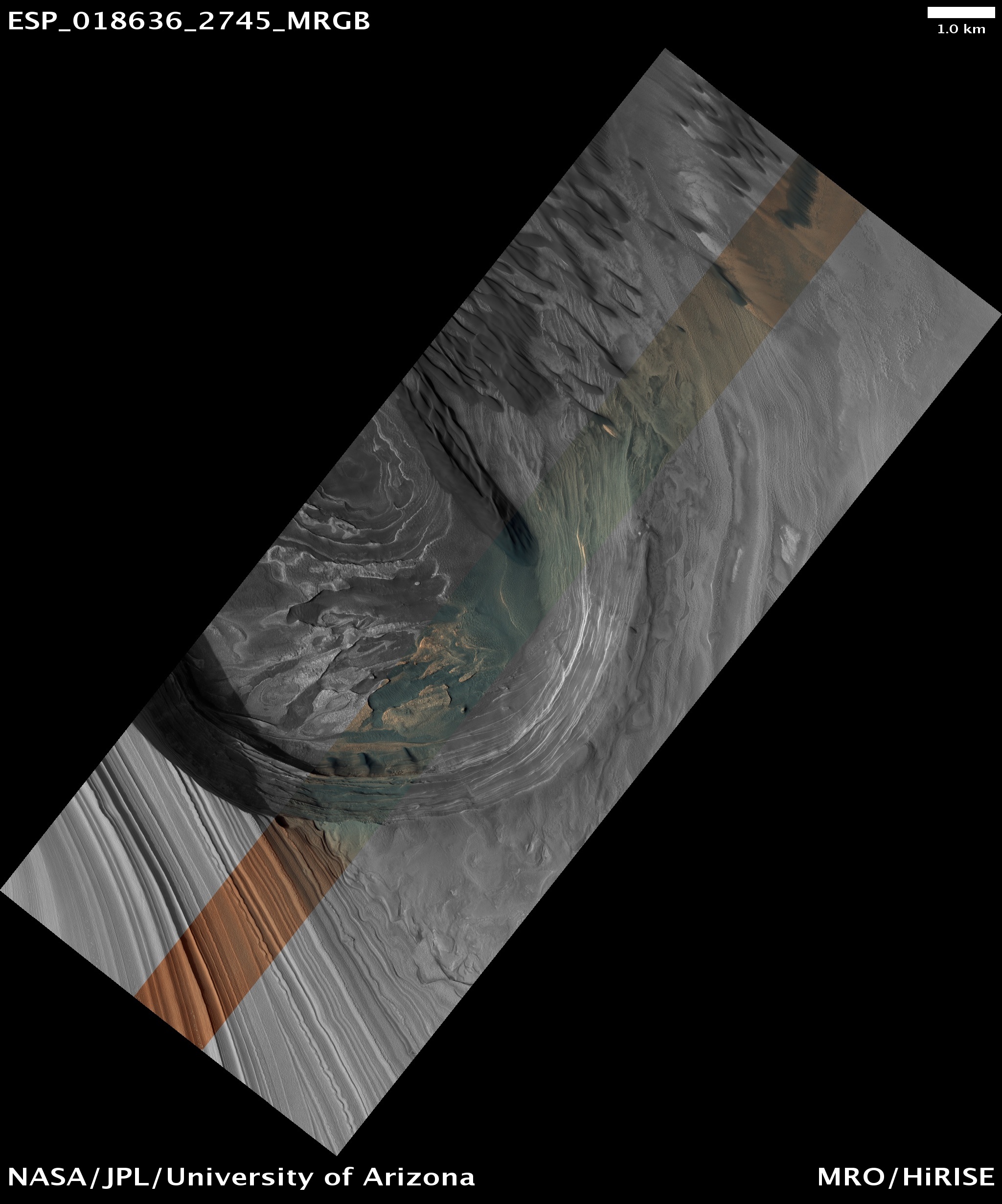
The yellow dot on the overview map above marks this location, deep within the chaos terrain dubbed Deuteronilus Mensae, on the western end of the 2,000 long northern mid-latitude strip I dub glacier country, because practially every image from there shows glacial features.

To underline this fact, the red and white dots mark previous cool images from 2020 and 2021, with the first showing an eroded glacier and the second glacial ice sheets.

The mesa to the east of this picture rises more than 6,000 feet to its peak, as indicated by the black dot. This is also the highest point for this entire grouping of mesas. All are surrounded by a single large apron of material, likely a mixture of alluvial fill and ice.

What however caused the narrow ridge in the picture above? Is it ice or bedrock? If ice why is it so different than the glacial material that seems to surround it? If bedrock, it suggests it is instead an ancient inverted channel created when that ridge was a canyon through which ice or water flowed, compacting the canyon floor. When the terrain around it eroded away it was more resistent and became a ridge instead.

I have no answer. The colors suggest the ridge is rock, not ice, but that is not conclusive.

0 comments

FCC raises questions about SpaceX’s application to link cell phones to Starlink

The FCC has responded to SpaceX’s application to link cell phones to Starlink with a set of questions, mostly centered on finding out whether the company’s system might interfere with other communications systems.

“This analysis should take into account the worst case scenario of all satellites transmitting at the same time, including different power levels required for rain fade and cloud cover as well as clear sky conditions over a particular area of coverage,” the FCC wrote.

In addition, the same analysis should look at the “possibility of loss of service by other authorized satellite and terrestrial operators in that area,” the Commission added. Another request asks SpaceX to provide “a map with projected beam coverage” for the US, showing the maximum and typical power levels of the satellite cellular service. The FCC also wants to know how the company can shut down the cellular Starlink system in the event interference arises over certain geographic areas.

The FCC’s concerns appear reasonable, but no one should dismiss the possibility that politics are involved as well. The Biden administration, which now has a majority of appointees on the FCC, has made it clear it opposes almost everything Elon Musk is doing.

7 comments

Virgin Galactic trims staff and spending

Despite having completed its fifth commercial suborbital flight on November 2, 2023, Virgin Galactic announced yesterday that it is laying off staff and cutting spending.

The number of people laid off was not revealed. Supposedly the company has done this as part of its effort to develop an upgraded version of SpaceShipTwo.

The company reported having $980 million of cash and equivalents on hand at the end of the second quarter this year, when it reported a net loss of $134.4 million. The company has not disclosed its estimated costs for development of the Delta vehicles, but said it expected those vehicles to enter service in 2026. The company expects only limited revenue from VSS Unity, which is able to fly monthly carrying up to four customers at a time.

I instead suspect that demand for suborbital flights is dwindling because of the competition from orbital operations. Had this company started flying a decade ago, as promised numerous times by Richard Branson, it would have been ahead of the curve. It didn’t and thus missed the boat.

2 comments
1 377 378 379 380 381 2,411