
Johnny Winter – Be Careful With A Fool
An evening pause: Performed live 1970. Tommy Shannon is on bass and Uncle John Turner is on drums.
Hat tip Judd Clark.
An evening pause: Performed live 1970. Tommy Shannon is on bass and Uncle John Turner is on drums.
Hat tip Judd Clark.
Embedded below the fold in two parts.
To listen to all of John Batchelor’s podcasts, go here.
» Read more

On Christmas Eve 1968 three Americans became the first humans to visit another world. What they did to celebrate was unexpected and profound, and will be remembered throughout all human history. Genesis: the Story of Apollo 8, Robert Zimmerman's classic history of humanity's first journey to another world, tells that story, and it is now available as both an ebook and an audiobook, both with a foreword by Valerie Anders and a new introduction by Robert Zimmerman.
The print edition can be purchased at Amazon or any other book seller. If you want an autographed copy the price is $60 for the hardback and $45 for the paperback, plus $8 shipping for each. Go here for purchasing details. The ebook is available everywhere for $5.99 (before discount) at amazon, or direct from my ebook publisher, ebookit. If you buy it from ebookit you don't support the big tech companies and the author gets a bigger cut much sooner.
"Not simply about one mission, [Genesis] is also the history of America's quest for the moon... Zimmerman has done a masterful job of tying disparate events together into a solid account of one of America's greatest human triumphs."--San Antonio Express-News
China’s three-stage Long March 4C rocket today (early morning on September 7th in China) successfully placed a classified remote sensing satellite into orbit, lifting off from China’s Jiuquan spaceport in the Gobi Desert.
This launch occurred prior to Japan’s H-2A launch, but I am only catching up with it now. As always, China’s state run press released little information, including where the first and second stages crashed inside China. All three stages of the Long March 4C use very toxic hypergolic fuels, so if those stages landed near habitable areas, there will be significant risk to bystanders.
The leaders in the 2023 launch race:
62 SpaceX
40 China
12 Russia
7 Rocket Lab
7 India
In the national rankings, American private enterprise still leads China in successful launches 71 to 40. It also still leads the entire world combined, 71 to 65, while SpaceX by itself now trails the rest of the world (excluding American companies) only 62 to 65.
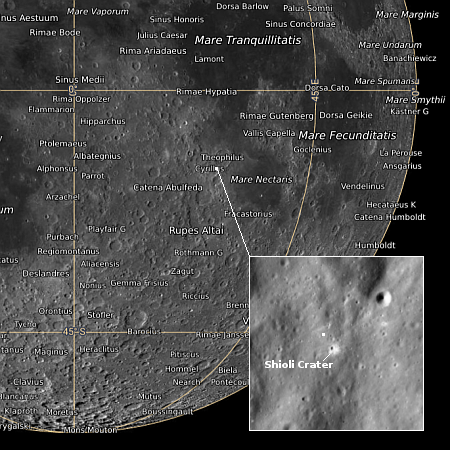
Map showing SLIM landing zone on the Moon.
Click for interactive map.
Japan today (September 7th in Japan) successfully used its H-2A rocket to place both the XRISM X-ray space telescope and SLIM lunar lander into orbit.
As of posting XRISM has been successfully deployed. SLIM has not, as it needs to wait until after a second burn of the rocket’s upper stage about 40 minutes later. The map to the right shows SLIM’s landing target on the Moon, where it will attempt a precision landing within a zone about 300 feet across.
This was Japan’s second launch this year, so it does not get included in the leader board for the 2023 launch race:
62 SpaceX
39 China
12 Russia
7 Rocket Lab
7 India
In the national rankings, American private enterprise still leads China in successful launches 71 to 39. It also still leads the entire world combined, 71 to 64, while SpaceX by itself now trails the rest of the world (excluding American companies) only 62 to 64.

Now available in hardback and paperback as well as ebook!
From the press release: In this ground-breaking new history of early America, historian Robert Zimmerman not only exposes the lie behind The New York Times 1619 Project that falsely claims slavery is central to the history of the United States, he also provides profound lessons about the nature of human societies, lessons important for Americans today as well as for all future settlers on Mars and elsewhere in space.
“Zimmerman’s ground-breaking history provides every future generation the basic framework for establishing new societies on other worlds. We would be wise to heed what he says.” —Robert Zubrin, founder of the Mars Society.
All editions are available at Amazon, Barnes & Noble, and all book vendors, with the ebook priced at $5.99 before discount. All editions can also be purchased direct from the ebook publisher, ebookit, in which case you don't support the big tech companies and the author gets a bigger cut much sooner.
Autographed printed copies are also available at discount directly from the author (hardback $29.95; paperback $14.95; Shipping cost for either: $6.00). Just send an email to zimmerman @ nasw dot org.
Courtesy of BtB’s stringer Jay.
The problem so far isn’t that SpaceX has switched its live streams to X. The problem is that the company is so far not providing any links on its webpage to the live streams, which makes it difficult to find them and watch.
This was the test that it was unable to complete in both July and August. Testing to continue, including a full 8-minute firing to simulate a full launch, with a final announcement on an actual launch date to be made in October.
The launch is scheduled for 7:42 pm (Eastern) today, or 8:42 am in Japan on September 7th. Live stream is here.
No details were released, which is not surprising as Kuiper has yet to launch even one of its 3,200 satellites. I doubt Vodafone committed any money. I also doubt it agreed to restrict itself from making deals with others, such as Starlink.

Anthony Fauci: Washington’s liar-in-chief
Two stories in the past week got some notice in the conservative press as it reported on the increasing ramp up of fear-mongering about a new COVID epidemic (coincidently timed to arrive just before the 2024 election) by politicians, health officials, and the mainstream press.
The first story produced a lot of coverage because it involved the embarrassing appearance of Anthony Fauci on CNN, who when challenged directly on the recent research that has found masks accomplish nothing (which by the way simply confirms decades of earlier research that told us the same thing) still claimed that masks worked, and that this evidence should be ignored. You can watch Fauci’s moment of tragic black comedy here. His key response is at best incoherent, and at worst an utter lie and a denial of plain facts.
“Yes, but there are other studies, Michael, that show at an individual level, for individual, when you’re talking about the effect on the epidemic or the pandemic as a whole, the data are less strong. But when you talk about as an individual basis of someone protecting themselves or protecting themselves from spreading it to others, there’s no doubt that there are many studies that show that there is an advantage. When you took it at the broad population level like the Cochrane study, the data are less firm with regard to the effect on the overall pandemic. But we’re not talking about that, we’re talking about an individual’s effect on their own safety. That’s a bit different than the broad population level.”
Fauci refers to the “many studies” proving his position, but of course he can’t name them because they don’t exist. Even during the worst of the Wuhan panic the few studies that came out claiming some efficacy of masks were all found to be weak or flawed or downright fraudulent. He also makes the patently stupid claim that masks still work on an individual level, even though he admits the evidence for more than a century shows they don’t work at all.
This is what Michael Cantrell at PJMedia had to say about Fauci’s rationalizations:
» Read more

Leaving Earth: Space Stations, Rival Superpowers, and the Quest for Interplanetary Travel, can be purchased as an ebook everywhere for only $3.99 (before discount) at amazon, Barnes & Noble, all ebook vendors, or direct from my ebook publisher, ebookit.
If you buy it from ebookit you don't support the big oppressive tech companies and I get a bigger cut much sooner.
"Leaving Earth is one of the best and certainly the most comprehensive summary of our drive into space that I have ever read. It will be invaluable to future scholars because it will tell them how the next chapter of human history opened." -- Arthur C. Clarke

Glacier country on Mars

Click for original image.
Cool image time! The picture to the right, cropped, reduced, and sharpened to post here, was taken on June 19, 2023 by the high resolution camera on Mars Reconnaissance Orbiter (MRO).
The scientists simply labeled this “Deposit Layers,” but that description hardly covers the incredibly diverse and puzzling features within the picture. We see layers, swirls, and radiating groves, all suggesting glacial features. We see mesas apparently covered with ice, and a flat surrounding lower plain that appears to be also ice but acting more like an ocean or sea. If there is any visible bedrock at this location it is difficult to determine.
The dominance of ice features is not surprising however, considering the location. The red dot on the overview map above marks this location, in a large 80-by-56-mile-wide basin inside the 2,000-mile-long northern mid-latitude strip I dub glacier country, because almost every image from MRO shows distinct glacial features. This particular basin is considered part of the segmented and indistinct canyon dubbed Mamers Valles, that winds its way through this glacier country of chaos terrain to eventually drain into the northern lowland plains.
From a geologist’s perspective, however, the layers are the most significant feature in the picture, as those layers mark the innumerable climate cycles that have apparently shaped the Martian surface. Mapping those layers will likely involve decades of work, but when largely completed we shall have a very precise history of the red planet’s geological history, going back several billion years.

Elon Musk yesterday tweeted a short video showing Starship prototype #25 as it was stacked on top of Superheavy prototype #9, stating that both were now ready for their orbital test launch, the second attempt by SpaceX to launch this new rocket.
The image to the right is a screen capture from that movie, showing the full rocket ready to go. When it will go however remains a complete unknown, as Musk himself noted in the tweet: “Starship is ready to launch, awaiting FAA license approval.”
In May I predicted that though Musk predicted at that time that SpaceX would be ready to do this launch in August, it would not happen then or likely for months afterward, because the FAA under the Biden administration is slow-walking all launch approvals for SpaceX, as I showed in detail in a later June essay.
It is now September. SpaceX didn’t meet Musk’s original August ready date for launch, but it only missed that target by about five days. And as I predicted, the FAA has also not yet approved the launch license.
» Read more
Firefly today announced that the satellite company L3Harris has awarded it a three-launch contract as part of Space Force’s quick response satellite launch program.
Firefly will provide rapid launch capabilities for L3Harris to achieve direct access to low Earth orbit at a lower cost and support the responsive space needs of the U.S. government. The three missions will launch from Firefly’s SLC-2 launch site at the Vandenberg Space Force Base.
The missions are scheduled for 2026, which makes sense as Firefly has yet to make its Alpha rocket operational. It has attempted two launches, the first a failure and the second reaching orbit but at an altitude lower than planned. Its third attempt, also a rapid response launch for the Space Force, was officially declared ready for launch within 60 hours, anytime within the next six months when the Space Force demands it.
A side note: It has seemed to me that in 2023 the launch of new American rockets by launch startups has slowed considerably. Why this is occurring is likely the result of many factors. First, two companies (Astra and Relativity) have abandoned their first iteration of their rocket, and appear unready to launch again for several years, if ever. Second, we may be seeing evidence of the heavier regulatory fist under the Biden administration, making it more difficult for new rockets to get launch license approval.
Third, it appears investor enthusiasm for this new industry has cooled, partly because of the first two reasons above as well as the poor stock trends of the new rocket companies that went public.
It is also possible the slowdown is simply the normal fluctuation one sees in any new industry with a relatively small number of players. This could simply be a pause as they gear up for a string of new launches next year.
Only time will answer this question. Stay tuned.
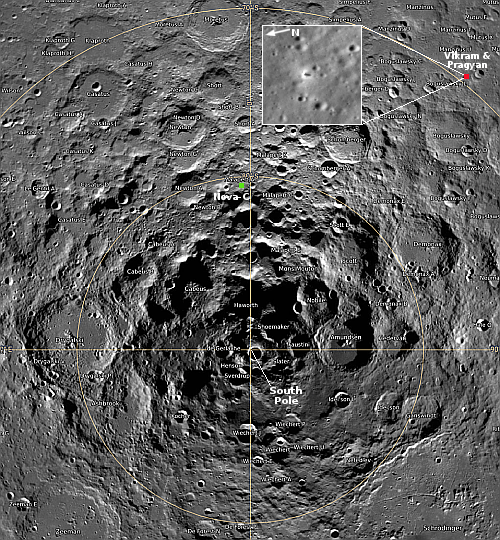
Click for interactive map. To see the original
image, go here.
The science team for Lunar Reconnaissance Orbiter (LRO) yesterday released an oblique image taken of India’s Vikram lander, on August 27, 2023, four days after the lander touched down about 370 miles from the south pole.
The LROC (short for LRO Camera) acquired an oblique view (42-degree slew angle) of the lander. … The bright halo around the vehicle resulted from the rocket plume interacting with the fine-grained regolith (soil).
That image is shown in the inset to the right. I have cropped it to focus on Vikram itself, which is in the center of the inset, with its shadow to its right, the opposite of all the surrounding craters. Pragyan is in this image, but neither it nor its tracks appear visible. The rover had moved west from the lander, which would be downward to the line of three craters near the bottom of the inset. To get a better sense of Pragyan route, compare this image with the map India’s space agency ISRO released on September 2nd.
An evening pause: Hat tip Doug Johnson.
Courtesy of BtB’s stringer Jay, who also provided me the link to the Chinese launch posted earlier.
The theory, MOND, was first proposed in the 1990s, but because of the desire to squelch and suppress any skepticism of the Big Bang, it has been routinely been ignored by all press services and poo-poohed by cosmologists. I tried several times to propose articles about it when I still wrote for magazines, and was consistently shot down. It could be it is finally getting more play because of the data from Webb.
If you want to listen to the entire briefing, go here. This delay means Ariane-6 is only four years behind schedule, and that Europe will be without a large launch rocket for at least one year.
Not only do few proposed Russian space projects ever happen, those that do take decades to get built, and sadly too many fail once launched. The last Phobos mission, Phobos-Grunt, never got out of Earth orbit, crashing to Earth shortly after launch in 2012. Russia announced a replacement mission shortly thereafter, with a target launch date of 2018. No launch ever occurred. This new proposal is likely not to fly for decades yet, if ever.

John Littell, persecuted
for being a thoughtful doctor
They’re coming for you next: When the American Board of Family Medicine (ABFM) stripped Florida doctor John Littell of his medical license in March 2023 because he had publicly advocated the use of ivermectin to treat COVID patients while questioning many of the government health policies being imposed during the epidemic, he immediate appealed.
I reported on ABFM’s attempt to blacklist Littell back in April, shortly after it took action against him. At the time it appeared the ABFM’s actions were prompted because he had spoken publicly about his successful use of ivermectin at a hospital board meeting, a meeting from which he was evicted.
Interviews with Littell went viral after he gave a speech at the Sarasota Memorial Hospital Board meeting last month in support of using Ivermectin to treat Covid and was subsequently removed by police after approaching a sympathetic board member. Since the video’s release Littell has amassed a large Twitter following and even appeared on Dr. Drew’s TV show to talk about what happened.
ABFM then sent him a letter “saying he’d been de-certified for ‘spreading false, inaccurate, and misleading materials about COVID-19, COVID-19 vaccination, and treatment and mitigation of the virus.'”
Finally in response to Littell’s appeal in July ABFM decided to reinstate his license, but it also declared the license was retroactively de-certified for the previous three months, even though he had still being seeing patients because his license was supposed to be still active pending appeal.
» Read more

The Chinese pseudo-company Galactic Energy today used its Ceres-1 rocket to launch four satellites from an offshore launchpad located a few miles off the coast of Shandong Province in the Yellow Sea.
For the third straight time the government-run state press made no mention of this pseudo-company in reporting the launch. Instead, it was achieved by “China”, which is true since the company isn’t really private. It is a fake company created using investment capital and aimed at making money winning contracts, but everything it does is supervised by the communist government, which can take over operations and control of the rocket at any time. That the state-run press is no longer touting the private company suggests to me that the communists are greedily eyeing its success, and are thinking about stepping in to take over.
The leaders in the 2023 launch race:
62 SpaceX
39 China
12 Russia
7 Rocket Lab
7 India
In the national rankings, American private enterprise still leads China in successful launches 71 to 39. It also still leads the entire world combined, 71 to 63, while SpaceX by itself now trails the rest of the world (excluding American companies) only 62 to 63.
Note: the world this year has so far achieved 134 successful launches, which only two years ago was a new record for the most global launches in a single year, breaking the previous record from 1966. Last year the world smashed that record, achieving 179 launches. It appears the world this year will smash last year’s record.

Click for original image.
Cool image time! The picture to the right, cropped, reduced, and sharpened to post here, was taken on February 1, 2023 by the high resolution camera on Mars Reconnaissance Orbiter (MRO). It shows what the camera team labels “Circular Mounds Surrounded by Moats,” which when all the known data is considered are probably caused by a spray of small meteorites landing on a field of ice.
Why ice? The location is at 37 degrees south latitude, in the cratered southern highlands of Mars, where many images show glacial-type features inside many craters. In fact, all the nearby craters at this location appear to have such features, suggesting the presence of near-surface ice trapped in these craters.
The picture actually looks at the floor of another such crater, with the mounds in the image’s upper left the crater’s indistinct central peaks. Though only 8.5 miles wide, the crater is deep, with interior walls that quickly rise 2,800 feet to the rim. That depth further suggests ice, as any snow that fell here in the far past could easily become trapped, inside what could be thought of a cold trap.
» Read more

Modern science
The refusal by many in the scientific community to deny there is any uncertainty of science has been best illustrated for decades by the cosmologists who have put together the framework of the standard model for the creation of the universe, centered on the Big Bang, and their pitchmen in the mainstream press. Since the 1960s any skepticism of this model was generally treated as equivalent to believing in UFO’s, aliens, and the Face on Mars.
Thus, astronomers and astrophysicists did what necessary to protect their careers. Even if they had great doubts about the standard model and the Big Bang, they generally kept their mouths shut, saying nothing. Meanwhile, our increasingly corrupt press pushed this one explanation for the formation of the universe, treating the cosmologists who pushed it as Gods whose every word was equivalent of an oracle that must never be questioned.
This past weekend the New York Times suddenly admitted to the uncertainty surrounding the Big Bang, and for possibly the first time in decades allowed two scientists to write an op-ed that carefully outlined the problems with the standard model and the Big Bang theory, problems that have existed and been growing since the 1990s but have been poo-pooed as inconsequential and easily solved. Data from the Webb Space Telescope however has made that poo-pooing more and more difficult, as astrophysicists Adam Frank and Marcelo Gleiser make clear:
» Read more
The Japanese government is now in the process of reworking the law that governs its space agency JAXA, in that this law has up to now forbidden it from using any of its budget to directly fund the work of any private companies.
According to sources, the government plans to add a provision to the JAXA Law — the basis for establishing JAXA — to set up a fund to provide long-term, large-scale financial support to the private and academic sectors, and to submit a draft revision at an extraordinary Diet session this autumn.
In the past, JAXA has put money into two private companies out of its own income earned from intellectual property and other sources, and the investment per company was limited to several tens of millions of yen. In March, the Liberal Democratic Party proposed that a fund of ¥1 trillion be established over 10 years.
It appears this limitation might explain why Japan trails so badly in the aerospace sector. JAXA has been forbidden to award contracts to private companies. It has been required by law to do all the work itself.
I suspect one of the two private companies it has sent money to was Mitsubishi, which in turn been a major contractor in building JAXA’s H-2A and new H-3 rockets. The system however has not resulted in rockets that are competitive and inexpensive, which is why Japan has garnered little market share.
If the revision in the law allows JAXA to award development contracts to private companies as they develop their own rockets and spacecraft, owned not by JAXA but by them, then we may see a change.
An evening pause: This was I think the song that made her career. Its shallow environmentalism, from the still naive 1960s, seems appropriate today on Labor Day.
Hat tip Judd Clark.

Click for original image.
Cool image time! The picture to the right, cropped, reduced, and sharpened to post here, was taken on June 8, 2023 by the high resolution camera on Mars Reconnaissance Orbiter (MRO). It shows some of the more unusual terrain found at the higher latitudes in the Martian northern lowland plains.
How do we explain this strange landscape? Based on what little we presently know about Mars, at 40 degrees north latitude this bubbly-looking surface probably indicates the presence of a lot of near-surface ice that at some time in the past was heated for some reason and thus bubbled upward to form these mounds. Think of tomato soup simmering.
Unlike simmering tomato soup, this terrain is solid and no longer bubbling. We are looking at a soup that has frozen even as it bubbled. The process could have been like an ice volcano, the ice turning to thick slurry that froze quickly, like lava. Or it could have happened fast, and then froze to remain unchanging in the eons since.
» Read more

Marilyn Lovell, holding son Jeffrey, watches Apollo 8 lift-off on
December 21, 1968 with daughters Susan, right, and Barbara, left
On August 27, 2023, Marilyn Lovell passed away at the age of 93 in Lake Forest, Illinois, where she and her astronaut husband had lived since he had retired from NASA following his last space mission, Apollo 13.
Jim Lovell of course is the famous one. In the 1960s space race he was the leading space cadet, spending more time in space than any other person, with flights on Gemini 7 (the longest mission yet), Gemini 12 (proved it was possible to do work on a spacewalk), Apollo 8 (first mission ever to another planet), and Apollo 13, which was supposed to be Lovell’s crowning achievement, a walk on the Moon. Unfortunately an explosion in the Apollo service module on the journey out to the Moon forced the crew to use its Lunar Module as a lifeboat so that the three astronauts could get back home safely. That failure meant Lovell would never step on the Moon, despite a life dedicated to taking the first tentative steps in the exploration and the eventual settlement of the solar system by the human race.
It could however be argued that none of that laudable career would have happened had he not had Marilyn Lovell for a wife.
» Read more
