
Linda Ronstadt – Desperado
An evening pause: Hat tip Dan Morris.
An evening pause: Hat tip Dan Morris.
Capitalism in space: An explosion last week during a static fire test of the upper stage engine of ABL Space’s RS1 rocket test explosion will delay that rocket’s first launch by three months, according to company officials.
The incident took place in the seventh in a series of hot-fire tests of the stage in Mojave. The overall test campaign started in December with a series of fill-and-drain, cold flow and ignition tests, followed by the hot-fire tests. Piemont said that, at the time of the anomaly, at least five more tests were planned before the company completed the test campaign.
That upper stage was being tested ahead of the first RS1 launch from Kodiak Island, Alaska. “After some final engine design changes were identified last summer, we set an aggressive schedule to try to launch by the end of 2021,” Piemont said. “Our schedule slipped a bit in past few months, but our programs were converging towards a launch from Kodiak in February.”
It now appears the RS1 will not launch any earlier than May.

On Christmas Eve 1968 three Americans became the first humans to visit another world. What they did to celebrate was unexpected and profound, and will be remembered throughout all human history. Genesis: the Story of Apollo 8, Robert Zimmerman's classic history of humanity's first journey to another world, tells that story, and it is now available as both an ebook and an audiobook, both with a foreword by Valerie Anders and a new introduction by Robert Zimmerman.
The print edition can be purchased at Amazon or any other book seller. If you want an autographed copy the price is $60 for the hardback and $45 for the paperback, plus $8 shipping for each. Go here for purchasing details. The ebook is available everywhere for $5.99 (before discount) at amazon, or direct from my ebook publisher, ebookit. If you buy it from ebookit you don't support the big tech companies and the author gets a bigger cut much sooner.
"Not simply about one mission, [Genesis] is also the history of America's quest for the moon... Zimmerman has done a masterful job of tying disparate events together into a solid account of one of America's greatest human triumphs."--San Antonio Express-News
Do not comply: A large group of highly qualified doctors and nurses, almost all of whom have been blacklisted, fired, suspended, or prevented from treating patients simply because either they opposed the COVID shot mandates or wished to treat their patients as they saw fit, testified on January 24, 2022 in Congress, describing in horrible detail the many times they were forced to watch as their patients died because their hospitals had forbidden them from providing the treatments they knew would work.
Below is a 38 minute-long video showing the most dramatic testimony during the five hour hearing. If you want to watch the full hearing, go here.
» Read more

Click for full image.
Using orbital data from Mars Reconnaissance Orbiter (MRO), scientists have found salt deposits on Mars where nearby crater counts suggest that the salt water that once held these deposits could have evaporated away as recently as 2.3 billion years ago.
Using [MRO’s] cameras to create digital elevation maps, Leask and Ehlmann found that many of the salts were in depressions – once home to shallow ponds – on gently sloping volcanic plains. The scientists also found winding, dry channels nearby – former streams that once fed surface runoff (from the occasional melting of ice or permafrost) into these ponds. Crater counting and evidence of salts on top of volcanic terrain allowed them to date the deposits.
Past data has suggested that if liquid surface water had existed on Mars, it was gone by three billion years ago.
You can read the scientists’ research paper here.. The maps to the right, figure two from the paper, shows the locations of discovered salt deposits, almost all of which are in the Martian southern cratered highlands of Mars.
Is there uncertainty in these results? My regular readers know that the answer is of course yes. The biggest problem for these Mars researchers is that, despite the surface evidence that liquid water should have once flowed on the surface of Mars, no scientist has yet come up with a satisfactory model of Mars’ past climate that would have made that possible. The planet was either too cold or had too thin an atmosphere, based on other data. And getting it warmer or with a thicker atmosphere involves inventing any number of scenarios that are all questionable, based on what is presently known.
There is also the increasing evidence that glaciers of ice, not water, might have carved those winding, dry channels. If so, many of the assumptions that liquid water existed might simply be wrong, or incomplete. The scientists who wrote this report recognize this importance of ice on Mars, and note in their abstract that
…we think that the water source came from surface runoff, rather than deep groundwater welling up to the surface. The small amounts of water required are most likely from occasional melting of ice.
As always, more data is needed, with the most useful data that will clarify these conclusions being that gathered by future colonists on the surface of Mars itself.

Now available in hardback and paperback as well as ebook!
From the press release: In this ground-breaking new history of early America, historian Robert Zimmerman not only exposes the lie behind The New York Times 1619 Project that falsely claims slavery is central to the history of the United States, he also provides profound lessons about the nature of human societies, lessons important for Americans today as well as for all future settlers on Mars and elsewhere in space.
“Zimmerman’s ground-breaking history provides every future generation the basic framework for establishing new societies on other worlds. We would be wise to heed what he says.” —Robert Zubrin, founder of the Mars Society.
All editions are available at Amazon, Barnes & Noble, and all book vendors, with the ebook priced at $5.99 before discount. All editions can also be purchased direct from the ebook publisher, ebookit, in which case you don't support the big tech companies and the author gets a bigger cut much sooner.
Autographed printed copies are also available at discount directly from the author (hardback $29.95; paperback $14.95; Shipping cost for either: $6.00). Just send an email to zimmerman @ nasw dot org.
The new colonial movement: The Russia design bureau that is building Luna-25, Russia’s first unmanned lunar lander since the 1970s, has announced that it is targeting July 23, 2022 for launch.
The lunar mission will be launched atop a Soyuz-2.1b carrier rocket with a Fregat booster from the Vostochny spaceport in the Russian Far East. Under the lunar project, the Luna-25 automatic station will be launched for studies in the area of the lunar south pole. The lander is set to touch down in the area of the Boguslawsky crater.
Boguslawsky crater is about 125 miles from the nearest known permanently shadowed craters, and about 250 miles north of the south pole. It is thus not landing in what is presently thought to be the most valuable real estate on the Moon because of the possible presence of water ice, though there might be other resources at Boguslawsky that interest the Russians.
Engineers in French Guiana are now preparing all the components of the first Vega-C rocket, built by the Italian company Avio, for its first launch in April.
Vega-C is an upgraded version of the Vega rocket and is currently set to launch no earlier than April 2022. The rocket will feature improved first and second stage solid rocket motors, an upgraded liquid-fueled AVUM+ upper stage, and usher in an era of propulsion system commonality between the Vega and Ariane rocket lines.
At the moment they are modifying the Vega launchpad and building a new mission control center. Once completed in March they will stack the rocket.
Vega-C, like its predecessor, is powered by solid rockets, which Avio believes can be competitive with reusable rockets, at least for the next decade or so. Arianespace also hopes to lower costs by using the exact same solid rocket boosters on both Vega-C and its new Ariane 6 rocket. Vega-C’s first stage, using a P120C solid rocket motor, is also used as side boosters on Ariane 6.
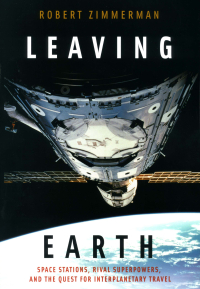
Leaving Earth: Space Stations, Rival Superpowers, and the Quest for Interplanetary Travel, can be purchased as an ebook everywhere for only $3.99 (before discount) at amazon, Barnes & Noble, all ebook vendors, or direct from my ebook publisher, ebookit.
If you buy it from ebookit you don't support the big oppressive tech companies and I get a bigger cut much sooner.
"Leaving Earth is one of the best and certainly the most comprehensive summary of our drive into space that I have ever read. It will be invaluable to future scholars because it will tell them how the next chapter of human history opened." -- Arthur C. Clarke
China has apparently used a space junk removal robot to tug a defunct Chinese satellite out of geosynchronous orbit, thus opening that slot for future satellites.
Ground tracking by ExoAnalytic Solutions found that the robot, dubbed SJ-21, apparently docked with the defunct satellite on January 22nd. Since then:
In an email to Breaking Defense this afternoon, Flewelling [of ExoAnalytic] said the latest tracking data gathered earlier today from ExoAnalytic’s telescopes show the SJ-21 separating from the Compass G2, leaving the latter in the eccentric “super-graveyard drift orbit.” SJ-21 now has moved back to a near-GEO orbit.
The orbit places the defunct satellite in an orbit above the geosynchronous orbit satellites use, but in an orbit that is not typical.
This work is comparable to what the Japanese/American company Astroscale is presently testing in low Earth orbit, though it appears far more sophisticated. In fact, based on what SJ-21 has done so far, it appears China is far ahead of everyone else in developing in-orbit robotic servicing capabilities.
Embedded below the fold in two parts.
To listen to all of John Batchelor’s podcasts, well worth your time, go here.
» Read more
An evening pause: A nice rendition, with appropriate visuals, of a 1930s song. It also happens to be John Batchelor’s theme song.
Hat tip Charlie Tutino.
Capitalism in space: Astroscale has halted an ambitious demonstration in-orbit of its magnetic capture technology when its engineers detected “anomalous spacecraft conditions.”
The demo involved a client satellite (posing as space junk) and a separate robot. Both were equipped with Astroscale’s magnetic capture device. A test in August had successfully separated the two units by a small distance, and then demonstrated that the magnetic capture device could grab the client satellite.
In the on-going but paused demo the robot was to separate, fly a distance away, and then use its autonomous programming to rendezvous with the client and then recapture it again. It successfully separated but that’s when the anomalies were detected. Engineers are now reviewing the data to see if they correct these issues and then proceed with the rest of the demo.
If successful Astroscale would demonstrate that their magnetic capture system works, thus giving them a strong selling point to have satellite companies buy it and install it on their satellites. Then, when the satellite was no longer needed Astroscale could send a robot up, capture it, and then de-orbit it safely.
Capitalism in space: The Sultanate of Oman has finalized an agreement to have the Polish company SatRevolution build its first probe to go beyond Earth orbit and have Virgin Orbit launch it.
The target beyond Earth and the missions specific goals has not yet been determined, though the goal is to launch it before the end of ’24.
This agreement is in a addition to an earlier agreement by the same entities to build and launch Oman’s first satellite, set to launch from an airport runway in Cornwall, Great Britain, sometime later this year.
What this agreement tells us that there is money to be made building spacecraft and launching them. Oman wants to have its own space program, like its neighbor the United Arab Emirates (UAE), but like the UAE it does not have the aerospace industry to make that possible. The solution? Hire the skillsets of private companies, in this case from the U.S. and Poland.
Capitalism in space: Stratolaunch today announced [pdf] that is has been awarded by the Air Force contract to study whether its Roc aircraft carrier and Talon-A research craft will be useful in test hypersonic weapons and spacecraft.
Stratolaunch, LLC is pleased to announce a research contract with the U.S. Air Force Research Laboratory (AFRL).
Stratolaunch, under partnership with Booz Allen Hamilton, is on contract with AFRL to examine and assess the feasibility of hypersonic flight tests of a wide range of Air Force experiments and payloads on a frequent and routine basis.
Stratolaunch supports national security objectives for hypersonic offensive and defensive weapons development through the design, manufacture, and operation of a fleet of reusable hypersonic aerospace vehicles air-launched from its globally deployable carrier aircraft, Roc. The company plans to augment existing Department of Defense flight test resources through affordable, commercially contracted, rapid-turnaround hypersonic flight testing for the Department of Defense and its prime contractor partners.
This contract is not to do actual tests, but to study whether Stratolaunch’s equipment can make hypersonic tests easier, cheaper, and more frequent, as the company promises.
The Space Telescope Science Institute, which operates both the Hubble Space Telescope and the James Webb Space Telescope, today released a wonderful short video summarizing in images the decades of knowledge that Hubble has gleaned of the massive star Eta Carinae.
I have embedded that video below the fold. What makes Eta Carinae special is that when Hubble was pointed at it shortly after the first repair mission in 1993, that photo proved without a doubt that the telescope’s vision had been fixed. More important, the photo proved that Hubble was going to routinely show us things never before seen. In this case, we got our first sharp and unambiguous view of a massive star exploding.
» Read more
Since the arrival of the Wuhan panic in March 2020 my family doctor, Robert Lending, has been sending his patients a weekly update on what he knows about COVID and its risks to them and to others.
From the beginning he has maintained in these updates a neutral attitude, focusing entirely on facts and data. He has kept his opinions out of his updates, and has generally taken on faith much of the data released by official government agencies.
Nearly two years later, and 88 updates, Lending’s patience has finally worn thin. His 89th and most recent update, released yesterday, was quite blunt. As he told me when he gave me permission to reprint it in full,
I am getting sick of it all so I am starting to opinionate more.
Below the fold is that most recent update. I have edited out Lending’s references to his patients and regular practice, focusing instead on his analysis, based on his detailed long term review of the literature coming from science journals and government agencies. I have highlighted his most pertinent conclusions.
My readers are free to take whatever conclusions they wish from what he writes. My conclusion is that his analysis proves that everything I have written about the Wuhan virus since the beginning of 2020 has turned out to be essentially correct. This virus was never the threat it was ginned up to be, and was instead merely a political tool of fear to increase the power of those in government while oppressing everyone else.
Dr. Lending’s analysis — and his permission to me to republish it — indicates that I am no longer the only person willing to say so, publicly.
» Read more

Mike Lindell and My Pillow, cancelled
The new dark age of silencing: Because Mike Lindell, owner of My Pillow, is very vocal and active in promoting his pro-Trump and conservative beliefs, his bank has suddenly decided he must be blackballed, and is demanding he close all his accounts with it.
The bank, Minnesota Bank & Trust and Heartland Financial, explained in a phone conversation with Lindell that they were doing this out of fear.
The [controller for Lindell’s companies] asked in the call why the bank, a subsidiary of Heartland Financial, is associated with “someone who could be in the news.”
“Not that the FBI is even sniffing and looking, but what if somebody came and said, ‘Do you know what? We are going to subpoena all of his account records, and this and that. And then all of a sudden we make the news,” the [bank] executive said.
“So it’s more of a reputation risk,” he said.
The Federal Trade Commission has sued to block Lockheed Martin’s purchase for $4.4 billion the rocket engine company Aerojet Rocketdyne.
The FTC apparently believes that the acquisition would give Lockheed Martin an unfair competitive advantage. It could refuse to sell Aerojet’s engines to the competitors who depend on them. It also would be able to obtain some of its competitors’ proprietary information through Aerojet.
This quote from the article however explains this action more accurately:
Over the past year, Lockheed Martin has argued that the merger should follow the same template as Northrop Grumman’s acquisition in 2018 of solid rocket motors manufacturer Orbital ATK. The Northrop-Orbital deal was approved by regulators on condition that the company agreed to supply motors to its competitors.
“The FTC during the Biden administration has taken a different view on market concentration and vertical integration than the last one, which approved the Northrop Grumman-Orbital ATK deal,” noted industry analyst Byron Callan, of Capital Alpha Partners. [emphasis mine]
This appears to be more evidence that Democratic Party control of the White House is resulting in more regulation and greater interference in the private sector. In this particular case that interference might very well cause Aerojet Rocketdyne to shut down entirely, since its customer base has been disappearing. It isn’t garnering any new customers because its rocket engines cost too much. Folded into Lockheed Martin the company might be reshaped and become productive and competitive again. Unfortunately, the Biden administration thinks it knows better, and might prevent that from happening.
Capitalism in space: The German rocket startup company Isar Aerospace has won the first place $11.3 million prize in the European Innovation Council Horizon Prize in the category of low-cost rockets.
Isar was one of three finalists for the prize announced earlier this month by the European Commission, along with another German small launch vehicle developer, Rocket Factory Augsburg, and Spanish company Payload Aerospace, which is working on a reusable small launcher. Those three came from an initial pool or more than 15 applicants, Breton said at a ceremony during the conference to announce the winner.
Isar hopes to launch its rocket, called Spectrum, late this year.
Whether this contest marks the beginning of an open and competitive launch industry in Europe remains unclear. Apparently the EU is thinking of creating what it calls the “European Space Launcher Alliance,” which — from the vague descriptions of it as well as the reservations expressed by Isar officials — might force independent companies to cater their actions to the needs of the larger rocket companies, like Airbus and ArianeGroup. This quote suggests the thinking of those larger companies:
“We understand how important it is for Europe to grab and keep leadership,” said Morena Bernardini, vice president of strategy at ArianeGroup. “This is possible only if industry is pushing in one direction.” [emphasis mine]
If I was a new startup, the highlighted words from this powerful established big space company would worry me enormously. Who decides what that “one direction” is? And what if different companies want to approach rocketry differently?
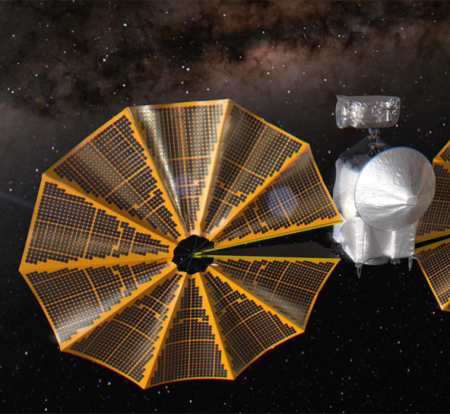
According to the principal scientist for the Lucy asteroid mission, engineers think they have identified what caused one of Lucy’s two fanlike solar arrays to fail to deploy completely.
The +Y array, rather than unfurling a full 360 degrees, instead went 347 degrees. In that configuration, the spacecraft is still generating more than 90% of its expected power. “Power is not an issue for the spacecraft, nor will it be through the entire mission if we have to fly it like it is.”
The arrays unfurl when a motor pulls on a lanyard, swinging one end of the array around and into place. Levison said that the most likely reason the array did not latch is that, for some reason, there was a loss of tension in the lanyard during deployment. That caused it to fall off a spool and wrap around the motor shaft. About 75 centimeters of lanyard remains to be pulled in.
It appears they in April will turn on the array’s motor to try to pull the lanyard in that last little bit. If that doesn’t work, they will then simply leave things as they are, as it appears the array is open enough to give them sufficient power for their mission.
There are risks to that course, however. Because the array is not latched open, it could begin to close, and thus result in less power to the spacecraft. Furthermore, its unlatched state appears to make some planned engine burns too risky.
China today used its Long March 4C rocket to launch a new Earth observation satellite into orbit.
No word on whether the first stage had parachutes or grid fins to control is crash landing in the Chinese interior.
The 2022 launch race:
3 SpaceX
2 China
1 Virgin Orbit
1 ULA
With less than a week before the start of the Kickstarter campaign on February 1, 2022 to raise at least $73,000 to pay for producing the video game Pioneer 2140CC (based on my science fiction book, Pioneer), Aaron Jenkin, the game’s producer, tonight sent out an update to the subscribers of the Kickstarter newsletter.
Besides describing the growing interest from our potential audience as well as his recent successes at marketing, Aaron’s the big announcement was the release of the game’s trailer, embedded below:
I was personally quite impressed with this trailer, which Aaron tells me he created himself. It captures perfectly what I tried to say in the book, and does so while adding intelligently the necessary game elements that any video game must have. Pioneer is about the human spirit, faced with the actual dangers that future space explorers will face, not the typical science fiction faux aliens or artificial cartoon character conflicts that are all too common in many sci-fi movies. Space is deadly and alien, and it will be the noblest achievement of humanity to make it possible for humans to live and work there.
If you are interested in supporting the game (as well as buying it when it is published), go to PioneerSpaceGame.com and subscribe to the newsletter for future updates counting down to the February 1st launch.
You might also want to read Pioneer first. It won’t necessarily help you play the game, but it will put you in the right mindset.