
July 7, 2021 Zimmerman/Batchelor podcast
Embedded below the fold in two parts.
» Read more
Embedded below the fold in two parts.
» Read more
An evening pause: I first posted this as a pause back in 2012. Time to post it again, as I empathize with Wainwright even more now than then.
We all travel a path in life. Once Americans celebrated those who chose an independent and unique path. That no longer appears true, not that it would make any difference to Wainwright, or to me. For some, to chose a unique path and be true to yourself is the only option.

On Christmas Eve 1968 three Americans became the first humans to visit another world. What they did to celebrate was unexpected and profound, and will be remembered throughout all human history. Genesis: the Story of Apollo 8, Robert Zimmerman's classic history of humanity's first journey to another world, tells that story, and it is now available as both an ebook and an audiobook, both with a foreword by Valerie Anders and a new introduction by Robert Zimmerman.
The print edition can be purchased at Amazon or any other book seller. If you want an autographed copy the price is $60 for the hardback and $45 for the paperback, plus $8 shipping for each. Go here for purchasing details. The ebook is available everywhere for $5.99 (before discount) at amazon, or direct from my ebook publisher, ebookit. If you buy it from ebookit you don't support the big tech companies and the author gets a bigger cut much sooner.
"Not simply about one mission, [Genesis] is also the history of America's quest for the moon... Zimmerman has done a masterful job of tying disparate events together into a solid account of one of America's greatest human triumphs."--San Antonio Express-News
Good news! Federal government data for the 2020-2021 school year shows a steep drop in enrollment in public schools, with the biggest declines in the youngest grades.
While overall the drop was only 3%, the drop was stunning from parents enrolling their children for the first time.
Even more stark is the drop in enrollment among younger students. Preschool enrollment fell by 22%, and preschool and kindergarten enrollment combined dropped 13%.
The drop is even more significant in that it is really the first such decline in decades.
It appears that almost one in four parents have decided that public schools are not a good place for their little ones. Foolish mask mandates, absurd social distancing rules, and leftist propaganda promoting bigotry and sexual perversity are not what they want for their kids.
In a sane world, we would quickly see a reduction in the budgets for these public schools. Sadly this is not likely. Too many local politicians are under the thumb of the teacher unions, and serve them, not their constituents.
In the end however these budgets must be cut, if not entirely zeroed out. As long as the money keeps flowing to these corrupt institutions, they will have power and will use it for bad ends.
Let me add one more point: Considering the horrible state of the public schools, their mistreatment of children in connection with COVID, their failure to teach anything well in the past few decades, their new endorsement of racial bigotry and hatred, and their increasing partnership with radical sexual perversity, I must ask: Why on Earth are 78% of parents still sending their kids there?

Cool image time! The photo to the right, rotated and cropped to post here, was taken by the high resolution camera on Mars Reconnaissance Orbiter (MRO) on April 27, 2021. It shows a strange scattering of dunes on a flat plain. The red at the top of each dune probably indicates exposed dust and sand. The white fringe is likely either water frost or the leftover mantle of dry ice that is deposited in the polar regions each winter down to 60 degrees latitude, and disappears with the coming of spring, sublimating back into carbon dioxide gas.
There are a lot of puzzles here. The overview map below provides some context, but only some.
» Read more

Now available in hardback and paperback as well as ebook!
From the press release: In this ground-breaking new history of early America, historian Robert Zimmerman not only exposes the lie behind The New York Times 1619 Project that falsely claims slavery is central to the history of the United States, he also provides profound lessons about the nature of human societies, lessons important for Americans today as well as for all future settlers on Mars and elsewhere in space.
“Zimmerman’s ground-breaking history provides every future generation the basic framework for establishing new societies on other worlds. We would be wise to heed what he says.” —Robert Zubrin, founder of the Mars Society.
All editions are available at Amazon, Barnes & Noble, and all book vendors, with the ebook priced at $5.99 before discount. All editions can also be purchased direct from the ebook publisher, ebookit, in which case you don't support the big tech companies and the author gets a bigger cut much sooner.
Autographed printed copies are also available at discount directly from the author (hardback $29.95; paperback $14.95; Shipping cost for either: $6.00). Just send an email to zimmerman @ nasw dot org.
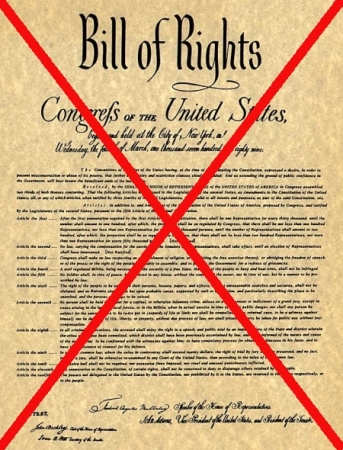
No first amendment permitted at Northwestern
University, if the students have their say.
Blacklists are back and the students at Northwestern U have got ’em! The student government at Northwestern University in Illinois recently passed a resolution demanding that the school’s board of trustees remove trustee J. Landis Martin from the presidential search committee because he had the gall to donate to Trump’s presidential campaign.
On June 2, student government members approved a resolution to remove J. Landis Martin, Chairman for the Northwestern University’s Board of Trustees, from the Presidential Search Committee, which is reported to be choosing the next Northwestern University President within the next year, according to the Daily Northwestern.
Outlined in the “Resolution for the Recusal of J. Landis Martin from the Presidential Search Committee” are the reasons the student government voted 17-1 to dismiss Martin on June 2nd.
The resolution lists that that “Northwestern University students are a diverse population that identify with many of the groups that Donald Trump harmed during his campaign and presidency,” and also “the conservative political ideology of Donald Trump, including those that support him, do not align with the views of the average Northwestern undergraduate.” [emphasis mine]
In other words, these students will not tolerate on their campus anyone who expresses an opinion they disagree with. There will be no free speech, no open discourse, and no debate. Agree with them, or you will be silenced, blackballed, and removed.
» Read more
Capitalism in space? An article today in Space News, “NOAA to take first step toward a small satellite constellation”, describes at great length NOAA’s recent effort to rethink how it builds its weather satellites, shifting from large and expensive single satellites launched years apart to constellations of smallsats that provide more redundancy and are cheaper and easier to replace.
What the article misses, as does NOAA apparently, is that this shift should not be designed by NOAA at all. During the Trump administration there was pressure on this agency to do what NASA had, stop designing and building its satellites but instead become a customer that hires private satellite companies to do it instead.
Not much came of that pressure. NOAA hired one private company to study the idea of building a private satellite to observe the Sun. It also awarded three companies experimental contracts to provide NOAA weather data from already orbiting smallsats.
That was it. NOAA made no other attempts to encourage private companies to design and build weather satellites for it, even as it struggled to get its own satellites off the ground. The second new GOES satellite in a constellation of four for providing global weather coverage failed almost immediately after launch in 2018. Overall, that constellation is expected to cost $11 billion, $4 billion more than initially budgeted. And it is years behind schedule.
What the article above suggests is that, with the Trump administration gone, NOAA has now abandoned the effort to transition to privately-built weather satellites. Instead the article describes at great length the effort by NOAA to redesign its satellites from big, rare, and costly to small, frequent, and cheap.
This effort will fail. Government agencies like NOAA are incapable of accomplishing such a task. They do not think in terms of profit, and keeping costs down to maximize those profits. Instead, such government institutions see high costs as beneficial, as they pump more money into their operations.
Until elected officials force NOAA to change, it will not, and its weather satellites will continue to be late, expensive, and untrustworthy. Sadly, the elected officials we have today, especially in the Biden administration, are not going to do that. They are as satisfied with the present situation as NOAA is.
Leaving Earth: Space Stations, Rival Superpowers, and the Quest for Interplanetary Travel, can be purchased as an ebook everywhere for only $3.99 (before discount) at amazon, Barnes & Noble, all ebook vendors, or direct from my ebook publisher, ebookit.
If you buy it from ebookit you don't support the big oppressive tech companies and I get a bigger cut much sooner.
"Leaving Earth is one of the best and certainly the most comprehensive summary of our drive into space that I have ever read. It will be invaluable to future scholars because it will tell them how the next chapter of human history opened." -- Arthur C. Clarke
Capitalism in space: One of SpaceX’s two drone ships used by its Falcon 9 first stages for ocean landings has arrived in California in preparation for frequent Starlink launches from Vandenberg Space Force Base.
The journey began on the East Coast two weeks ago and included passage through the Panama Canal. Once the drone ship gets offloaded, it will be based at Pier T, where it be part of recovery operations for the Starlink landings that potentially could occur in late July or early August.
These California launches will allow SpaceX to increase the global coverage of its Starlink constellation. It will also allow the company to begin frequent launches from both coasts.
Using a Long March 3C rocket China today successfully launched a communications satellite for use by its manned space missions and its space station, similar to the TDRS satellites used by NASA for similar purposes.
This satellite is the fifth such satellite launched, and is likely intended to enhance communications between the ground and China’s new space station.
No word on where the first stage crashed, or whether it landed near habitable areas.
The leaders in the 2021 launch race:
21 China
20 SpaceX
11 Russia
3 Northrop Grumman
The U.S. still leads China 29 to 21 in the national rankings.
An evening pause: A nice cover of the Brandi Carlile song.

Reporting daily the modern witch hunt against freedom and
independent thought.
It is just about six months since I decided to do a daily column entitled “Today’s Blacklisted American.” In that time I have documented more than 120 examples where one group of Americans thought it okay and proper to destroy the livelihood and freedom of other Americans, all because the latter said something the former did not like.
The link will take you to the full list of columns since mid-January. After six months I think it is time to assess what these columns have revealed. And that revelation is quite ugly.
» Read more
An evening pause: Much of the math goes over my head, but the story is still fascinating in showing how you can discover what later seems obvious, merely by keeping an open mind while endlessly and repetitively asking the next question.
Hat tip Mike Nelson.

Click for full image.
Today’s cool image, shown in a rotated, cropped, and reduced version to the right, gives us a close-up look at one of the giant scallops found in the high mid-latitudes of the northern lowland plains of Mars, specifically in Utopia Basin north of the landing sites of both Perseverance and Zhurong. In fact, this particular image is only a few miles north of one of my previous cool images, Giant scallops on Mars, posted in December 2019.
The image was taken on February 3, 2021 by the high resolution camera on Mars Reconnaissance Orbiter (MRO). While such scallops are not unusual in the mid-latitudes, their formation process is not well understood. As I noted in the 2019 post, ” scientists believe [pdf] the formation process is related to the sublimation of underground ice.”
According to [one hypothesis] scallop formation should be ongoing at the present time. Sublimation of interstitial ice could induce a collapse of material, initially as a small pit, then growing [away from the equator] because of greater solar heating on [that] side. Nearby scallops would coalesce together as can be seen to have occurred.
This hypothesis is not proven, and today’s cool image raises questions about it. Though the bright material at its center suggests exposed ice, supporting the idea that sublimation of ice near the surface created the scallop, the scallop scarps seem more extended and distinct to the south, not the north as this hypothesis proposes. Sunlight should hit the northern scarps more, which suggests they should retreat more instead of the southern scarp.
The overview map below provides the context.
» Read more
Doesn’t exist at the professional baseball games.
This seems especially appropriate during the July 4th weekend: Major League Baseball (MLB) — joining Disney, Sea World, and Sesame Street — has officially banned Dion Cini from all baseball stadiums, simply because he routinely came to games and displayed a “Trump Won Save America” banner.
Cini’s Twitter profile describes him as “Guerilla Marketeer, Political Consultant, Founder of OperationFlagDrop & ‘Professional Provocateur.’”
He has skated with his flag on Wollman Ice Rink, where he was physically assaulted, even though the Trump organization operated Wollman Rink. Cini also unfurled what is rumored to be the world’s largest Trump flag on the front of Trump Tower in Manhattan in March of this year. Cini even dropped a “Trump Pride” flag one day after the end of Pride Month.
Cini has now been banned by MLB stadiums and Disney parks, Sea World, and Sesame Street. As per his Twitter account, he has no plans of stopping the flag drops.
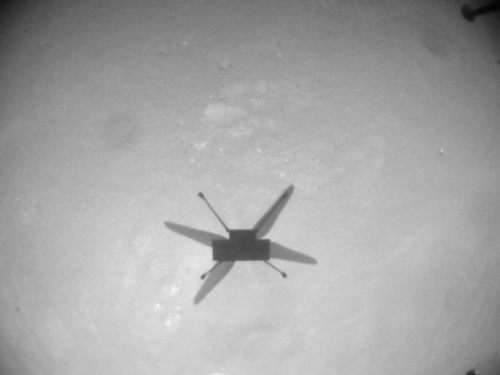
Ingenuity has apparently completed its 9th flight on Mars, its most challenging yet attempted. Based on the six images so far released from that flight, all taking during its landing, it appears the flight was successful. Or at least, the helicopter landed without incident or damage.
The photo to the right was the last picture taken just before touch down. From the caption:
NASA’s Ingenuity Mars Helicopter acquired this image using its navigation camera. This camera is mounted in the helicopter’s fuselage and pointed directly downward to track the ground during flight.
The dark shadow of the helicopter is clearly visible. If you want to see the entire sequence of six images, go to the Ingenuity raw image website and pick the “latest images” filter in the right column. At present it shows this sequence, though I am certain as the day passes images from the entire flight will start appearing.
As noted at the first link above, the flight was to be more than twice as long as any previous flight while flying over the roughest terrain. There was the real risk that its software would become confused by that terrain.
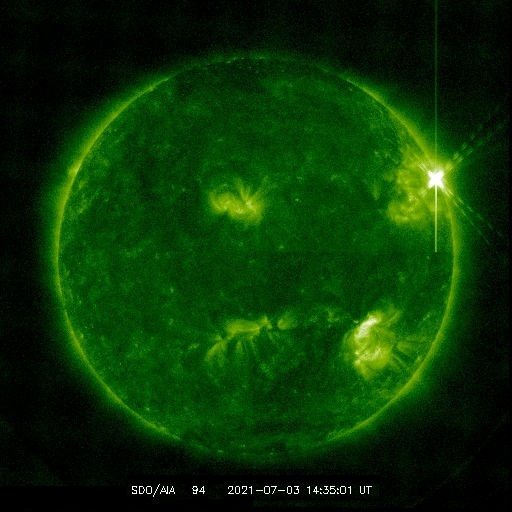
On July 3, 2021 the Sun emitted the first X-class solar flare of the rising present solar maximum, the first such flare since September 2017 during the previous maximum.
This flare is classified as an X1.5-class flare. X-class denotes the most intense flares, while the number provides more information about its strength. An X2 is twice as intense as an X1, an X3 is three times as intense, etc.
The image to the right was taken by the orbiting Solar Dynamics Observatory (SDO), designed to monitor the Sun continuously and catch such events.
More information here. The flare caused some disturbances to various radio instruments, though nothing that resulted in any serious consequences.
What the flare did demonstrate is that the Sun is definitely ramping up to solar maximum. In fact, the Sun has not been blank, with no sunspots on its facing hemisphere, since May 6th, the longest such stretch since the last solar maximum.
China yesterday successfully launched a new weather satellite using its Long March 4C rocket.
Launched from one of China’s three interior spaceports, the first stage crashed somewhere within China. No word on whether it came down near inhabited areas.
The leaders in the 2021 launch race:
20 SpaceX
20 China
11 Russia
3 Northrop Grumman
The U.S. still leads China 29 to 20 in the national rankings.
This past weekend NOAA released its monthly update of its graph showing the Sun’s sunspot activity, with the new update covering the period through the end of June 2021. As I have done since I began this website eleven years ago, I post that monthly graph below, annotated to show the previous solar cycle predictions and thus provide context.
In June the hot streak of sunspot activity exceeding the prediction of NOAA’s solar science panel continued, with activity rising again after a tiny dip in May. Except for two months, since 2019 the number of sunspots each month has consistently exceeded the prediction. Furthermore, the ramp up of activity has been faster than expected.
» Read more

Click for full image.
The engineers running the Mars helicopter Ingenuity revealed today that they will be attempting their most ambitious flight for the helicopter’s ninth flight, presently scheduled for no earlier than July 4th.
I have annotated the map to the right to show Ingenuity’s present position and its approximate landing area.
Without question this flight will be the riskiest taken by Ingenuity so far, more than doubling the flight distance achieved on any previous flight. More important, it will be flying over terrain far rougher than it was initially designed for.
» Read more
During a parachute drop test in late June, following a redesign of the parachute with U.S. help, engineers for the ExoMars Rosalind Franklin Mars rover found the chute still experienced problems that tore it during deployment.
They actually performed two drop tests, a day apart, using two different parachutes, with the first test apparently going off without a hitch. However, according to the press release:
“The performance of the second main parachute was not perfect but much improved thanks to the adjustments made to the bag and canopy. After a smooth extraction from the bag, we experienced an unexpected detachment of the pilot chute during final inflation. This likely means that the main parachute canopy suffered extra pressure in certain parts. This created a tear that was contained by a Kevlar reinforcement ring. Despite that, it fulfilled its expected deceleration and the descent module was recovered in good state.”
I have embedded below the fold the only video released by the European Space Agency. It is not clear whether this is from the first or second test. Near the end it appears that the pilot chute above the main chute might be separated, but the video ends before that can be confirmed.
Though ESA has apparently improved the chute’s performance significantly since its earlier failures that contributed to the delay of ExoMars from last year to 2022, they still haven’t gotten the chute completely right. Fortunately they still have time to get it fixed before that ’22 launch.
» Read more
China today launched five military surveillance satellites using its Long March 2D rocket.
The rocket’s first stage crashed into “the extreme eastern Shaanxi Province, ” according to the article. No word on whether it landed near habitable areas.
The leaders in the 2021 launch race:
20 SpaceX
19 China
11 Russia
3 Northrop Grumman
The U.S. leads China 29 to 19 in the national rankings.