Celestron to modify commercial amateur telescope for space use

Capitalism in space: Amateur telescope manufacturer Celestron has signed a deal to adapt one of its more expensive ground-based telescopes for use in space.

Trans Astronautica Corp. announced an agreement Sept. 27 with telescope manufacturer Celestron to develop a space-qualified version of the company’s Rowe-Ackermann Schmidt Astrograph (RASA) ground-based telescope. “We’ve been using Celestron’s RASA telescopes in our space domain awareness and asteroid prospecting systems, and we found them to be very affordable, high-quality optical systems,” Joel Sercel, TransAstra founder and CEO, told SpaceNews. “We looked at the designs and we realized it would not be that hard to adapt them for space use.”

Over the next year, TransAstra plans to modify the RASA telescope design and substitute materials to produce a telescope that can withstand radiation exposure, temperature swings, and the vibration and shock loads of space launch.

TransAstra provides tracking data on space junk to both the commercial and defense industry. It also has a new deal to use its telescopes to provide schools use of these telescopes for educational purposes. The goal is to put this capability into orbit.

The future ramifications however are profound. Once Celestron has a commercial relatively inexpensive telescope capable of operating in space (or on the Moon), it will not take long before customers begin lining up eager to buy and launch it. Think about it: though there will be engineering issues to overcome, the cost of placing one of these telescopes on one of the new commercial lunar landers for operation on the Moon will not be far beyond the budgets of many amateur astronomers, some of whom spend hundreds of thousands of dollars on their own ground-based observatories.

9 comments

Genesis cover

On Christmas Eve 1968 three Americans became the first humans to visit another world. What they did to celebrate was unexpected and profound, and will be remembered throughout all human history. Genesis: the Story of Apollo 8, Robert Zimmerman's classic history of humanity's first journey to another world, tells that story, and it is now available as both an ebook and an audiobook, both with a foreword by Valerie Anders and a new introduction by Robert Zimmerman.

The print edition can be purchased at Amazon or any other book seller. If you want an autographed copy the price is $60 for the hardback and $45 for the paperback, plus $8 shipping for each. Go here for purchasing details. The ebook is available everywhere for $5.99 (before discount) at amazon, or direct from my ebook publisher, ebookit. If you buy it from ebookit you don't support the big tech companies and the author gets a bigger cut much sooner.


The audiobook is also available at all these vendors, and is also free with a 30-day trial membership to Audible.
 

"Not simply about one mission, [Genesis] is also the history of America's quest for the moon... Zimmerman has done a masterful job of tying disparate events together into a solid account of one of America's greatest human triumphs."--San Antonio Express-News

September 27, 2022 Quick space links

Courtesy of BtB’s stringer Jay, who trolls Twitter so I don’t have to.

I will believe it when it actually happens.

Just a cool image.

More specifically, the “Crimean Federal District which will include Crimea and the occupied territories of Donbass, Zaporozhye and Kherson regions.” If so, Rogozin’s head is essentially being put on the block. Ukrainian partisan forces have been very successful at killing such leaders.

I guess this is a reward by Putin for Rogozin’s skill at losing Russia billions in commercial satellite sales.

3 comments

More glaciers in Mars’ glacier country

Overview map

glacial layering in Clasia Vallis
Click for full image.

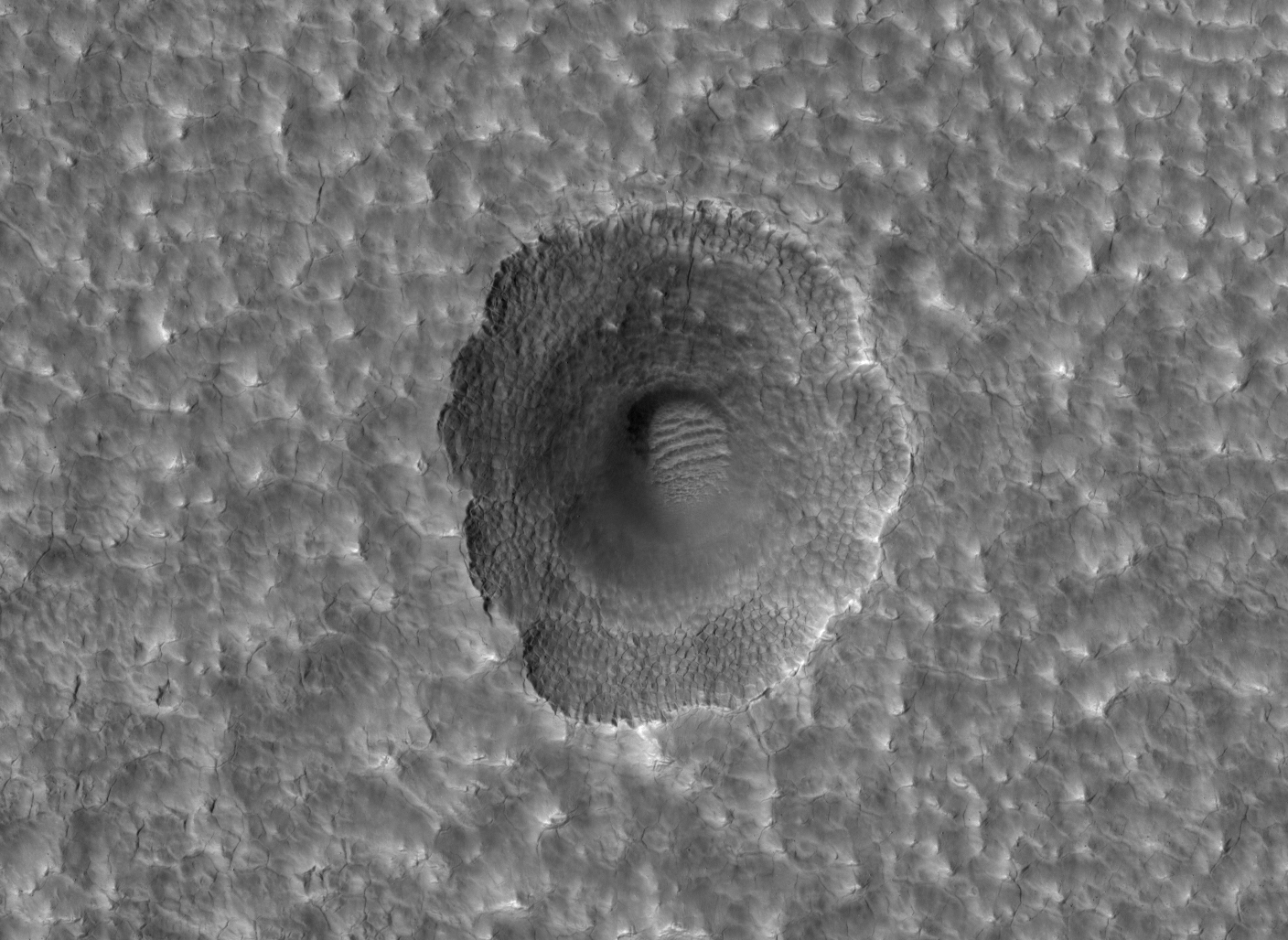
Cool image time! The photo to the right, rotated, cropped, and reduced to post here, was taken on June 18, 2022 by the high resolution camera on Mars Reconnaissance Orbiter (MRO). It shows what appear to be layered glacial features on the floor of what at first glance appears to be a crater.

It is not a crater however. The depression in the lower right of this image is the rim and floor of a 77-mile-long meandering canyon on Mars dubbed Clasia Vallis. The red cross in the overview map above marks its location, at 34 degrees north latitude. This channel drains downward from the southern cratered highlands into the 2,000-mile-long mid-latitude strip of mensae terrain that I dub glacier country because almost every hi-res image from this region shows glacial features.

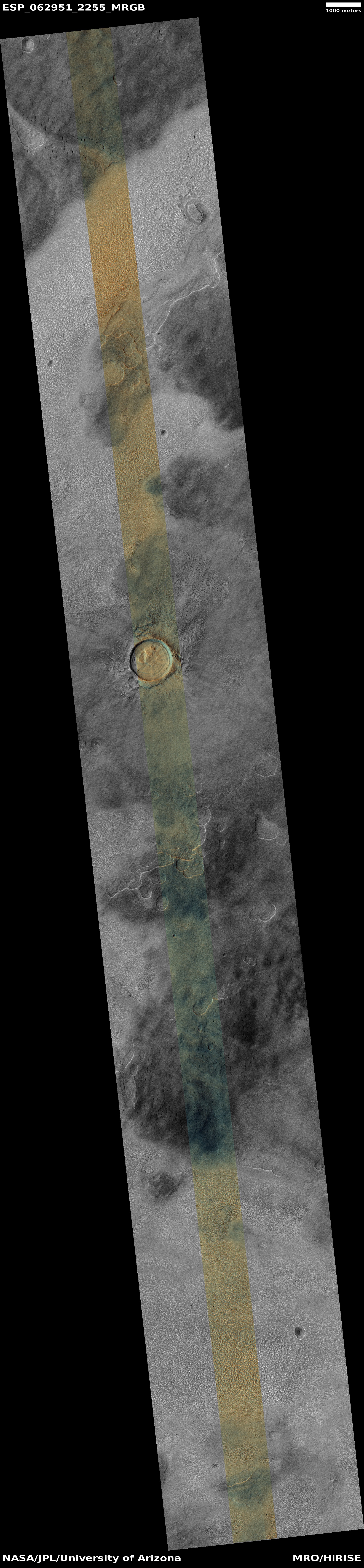
Below is a wider view of Clasia Vallis, taken by the context camera on MRO on March 19, 2014.
» Read more

0 comments

Conscious Choice cover

Now available in hardback and paperback as well as ebook!

From the press release: In this ground-breaking new history of early America, historian Robert Zimmerman not only exposes the lie behind The New York Times 1619 Project that falsely claims slavery is central to the history of the United States, he also provides profound lessons about the nature of human societies, lessons important for Americans today as well as for all future settlers on Mars and elsewhere in space.

 
Conscious Choice: The origins of slavery in America and why it matters today and for our future in outer space, is a riveting page-turning story that documents how slavery slowly became pervasive in the southern British colonies of North America, colonies founded by a people and culture that not only did not allow slavery but in every way were hostile to the practice.  
Conscious Choice does more however. In telling the tragic history of the Virginia colony and the rise of slavery there, Zimmerman lays out the proper path for creating healthy societies in places like the Moon and Mars.


“Zimmerman’s ground-breaking history provides every future generation the basic framework for establishing new societies on other worlds. We would be wise to heed what he says.” —Robert Zubrin, founder of the Mars Society.


All editions are available at Amazon, Barnes & Noble, and all book vendors, with the ebook priced at $5.99 before discount. All editions can also be purchased direct from the ebook publisher, ebookit, in which case you don't support the big tech companies and the author gets a bigger cut much sooner.


Autographed printed copies are also available at discount directly from the author (hardback $29.95; paperback $14.95; Shipping cost for either: $6.00). Just send an email to zimmerman @ nasw dot org.

Today’s blacklisted American: Arrested in 2020 for letting her kids play in park, a mom is still being prosecuted by Idaho Republicans

Sarah Brady: targeted by both establishment parties for defending her freedom
Sarah Brady: targeted by both establishment parties
for defending her freedom

Persecution is now cool! In 2020, during the worst of the Wuhan panic, Sarah Brady was part of a gathering of parents and children in a public playground in Meridian, Idaho, a playground that the local mayor, Lauren McLean (Democrat), had closed in her panicked fear of COVID. Her irrational ban said that no outdoor equipment or playground equipment could be touched, though people could still gather in the parks.

When police officers demanded Brady and the others leave the park, Brady challenged them, questioning the absurdity of the closure. She was then arrested, and charged with misdemeanor that could result in six months in jail and a $1,000 fine.

“I feel like I was singled out because I was the only person that was arrested,” Brady said. “I wasn’t the only person standing on the bark [the playground surface]. I definitely wasn’t playing on the playground equipment. I wasn’t swinging, never touched them. But yeah, I do feel like I was singled out and maybe it was because I asked too many questions.”

Two years later, this absurd persecution of Brady continues. The Republican state attorney general, Lawrence Wasden, has refused to drop the charges, and is instead pursuing them.
» Read more

8 comments

First ground-based telescope view of DART impact on Dimorphus

LICIACube Explorer image of DART impact

We now have the first ground-based images of the DART impact on the 525-foot-wide asteroid Dimorphus yesterday, captured by the Hawaiian telescope ATLAS.

You need to watch the video of the full sequence of images, available here, to get a true sense of the impact. The cloud of material quickly expands to about twice the asteroid’s size, then dissipates away, with the remaining asteroid now appearing larger (?). That larger size could be caused by a remaining cloud of material that still needs to settle back to the surface.

More images have been released by a Chinese telescope. Also, the first images from the Italian cubesat LICIACube Explorer, flying in parallel with DART, have been released. I have posted one to the right. The large blob near the center is the parent half-mile-wide asteroid, Didymos. Dimorphus is buried in the debris cloud above and slightly to the right.

Hat tip stringer Jay for the links to these images.

1 comment

Leaving Earth cover

Leaving Earth: Space Stations, Rival Superpowers, and the Quest for Interplanetary Travel, can be purchased as an ebook everywhere for only $3.99 (before discount) at amazon, Barnes & Noble, all ebook vendors, or direct from my ebook publisher, ebookit.

If you buy it from ebookit you don't support the big oppressive tech companies and I get a bigger cut much sooner.


Winner of the 2003 Eugene M. Emme Award of the American Astronautical Society.

 
"Leaving Earth is one of the best and certainly the most comprehensive summary of our drive into space that I have ever read. It will be invaluable to future scholars because it will tell them how the next chapter of human history opened." -- Arthur C. Clarke

Radar data from Zhurong finds no ice to a depth of 260 feet

Zhurong's ground-penetrating radar data

Overview map

Chinese scientists today finally published their results from the ground-penetrating radar instrument on their Mars rover Zhurong, revealing that to a depth of 260 feet (80 meters), it detected no clear signal of water ice.

Figure 2 of their paper, posted above, summarizes their results. It shows the radar profile to 328 feet (100 meters) depth along Zhurong’s route, as shown in the map to the right, with the last bit of its recent travels ending somewhere in the blue circle. From the paper:

Our low-frequency radar imaging profile shows radar signals within the depth range of 0–80 m (Fig. 2a), precluding the existence of a water-rich layer within this depth range as the existence of water would strongly attenuate the radar signals and diminish the visibility of deeper reflections. The estimated low (less than 9) dielectric permittivity (Fig. 2c) further supports the absence of a water-rich layer as water-bearing materials typically have high (greater than 15) dielectric permittivity.

We further tested this assessment with thermal considerations by conducting a heat conduction simulation based on available thermal parameters estimated from previous studies (Methods). Our thermal simulation results … show that the Zhurong landing area has an annual average temperature of around 220K in the RoPeR detection depth range, which is much lower than the freezing point of pure water (273K), and also lower than the eutectic temperatures of typical sulfate and carbonate brines, but slightly above those of perchlorate brine systems. This observation suggests that the shallow subsurface of the Zhurong landing area could not stably contain liquid water nor sulfate or carbonate brines, consistent with the radar imaging result.

The data suggests that below the surface topsoil layer, the regolith, there are two distinct layers of material that the scientists interpret as possible evidence of past catastrophic floods. That conclusion however is very very uncertain. The main take-away is that in the northern lowland plains of Utopia Planitia at 25 degrees north latitude, where Zhurong landed, Mars is definitely a dry desert, with no water close to the surface.

This data also suggests that if you establish a colony anywhere in Mars’ dry equatorial regions within 30 degrees latitude of the equator, you will likely have to travel north or south a considerable distance to get to easily accessible ice. The global map of Mars below shows the regions where ice is most evident, north and south of 30 degrees latitude.
» Read more

2 comments

Two Chinese launches: Long March 2D and Long March 6 put satellites into orbit

China successfully completed two launches in the past twelve hours, placing four satellites into orbit in total.

First, in the evening of September 26th, a Long March 2D rocket launched a “remote sensing” satellite into orbit. This was then followed in the morning of September 27th with the launch of a Long March 6 rocket, putting three “experimental” Earth observation satellites into orbit. We know nothing more about any of these satellites.

The article at the link lists a third launch, of a Kuaizhou-1A rocket, but I have already reported that.

The leaders in the 2022 launch race:

43 SpaceX
41 China
12 Russia
7 Rocket Lab
6 ULA

American private enterprise still leads China 60 to 41 in the national rankings. Against the entire world combined, the U.S. now trails 60 to 61.

3 comments

Hans Zimmer – Pirates Of The Caribbean Medley

An evening pause: Performed live in Prague 2017.

Hat tip Alton Blevins.

I am in need for evening pause suggestions. If you are interested in suggesting an evening pause, please say so in the comments (without providing a link to that suggestion). I will contact you so you can forward it directly to me to schedule. The guidelines for submitting Evening Pauses:

1. The subject line should say “evening pause.”
2. Don’t send more than three in any email. I prefer however if you send them one email at a time.
3. Variety! Don’t send me five from the same artist. I can only use one. Pick your favorite and send that.
4. Live performance preferred.
5. Quirky technology, humor, and short entertaining films also work.
6. Search BtB first to make sure your suggestion hasn’t already been posted.
7. I might not respond immediately, as I schedule these in a bunch.
8. Avoid the politics of the day. The pause is a break from such discussion.

4 comments

DART hits Dimorphus

Didymos and Dimorphus

Dimorphus

The surface of Dimorphus

The probe DART today successfully impacted the small 525-foot-wide asteroid Dimorphus. From the data produced engineers will calculate how much that impact changed Dimorphus’ orbit around it parent asteroid, half-mile-wide Didymos.

The three images to the right give a sense of the approach and impact.

The first, at 2 minutes and 30 seconds from impact, shows Didymos in the left bottom corner. You can actually see individual boulders on its surface. At this distance and resolution is is unclear whether it is a rubble pile or a more solid body. Dimorphus is no longer a mere dot, but no surface features can yet be discerned.

The second image, only seventeen seconds before DART crashed into Dimorphus, shows us the entire asteroid. Though it appears to be a pile of rocks, it also appears less of a rubble pile than both Ryugu and Bennu, visited by probes in 2019 and 2020. Those rubble-piles had almost no smooth surface areas. Dimorphus however at this distance and resolution does appear to have a lot of areas where the surface is relatively smooth, suggesting its structure is more solid than a rubble pile.

At only 525 feet across, some of those bigger boulders are about 50 to 60 feet in diameter.

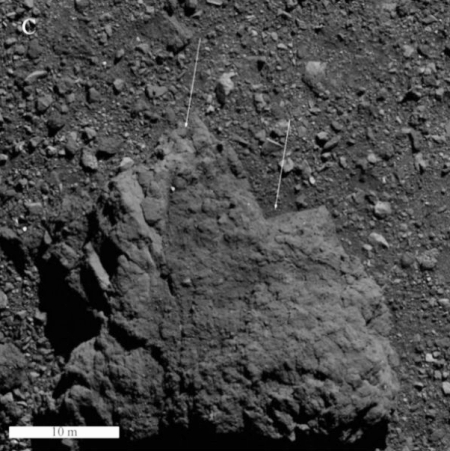
The white dot in the center of Dimorphus marks the rocks seen in the third image, taken about five seconds before impact. At this resolution so close to the surface, it appears the smooth areas are actually made up of many tiny pebbles and dust.

The biggest rock in the center of the picture is probably between ten to twenty feet in diameter.

The primary data from this mission will not be available for a few weeks. Scientists have to observe both asteroids to see how much, if at all, Dimorphus’s orbit was shifted by the impact. Also, the images from the Italian cubesat, LICIACube Explorer, which was flying parallel to DART and taking pictures of the impact, plume, and back side of Dimorphus, won’t be available until later this week. Those images should give us a measure of the spacecraft’s effect on the asteroid. They will also reveal a lot more about the asteroid’s geology.

12 comments

September 26, 2022 Quick space links

Courtesy of stringer Jay, who trolls Twitter so I don’t have to.

Mostly shows views of the Earth.

At the link the reason given is the “problems with the delivery of foreign-made parts.” Or to put it more bluntly, the sanctions against Russia due to its unprovoked invasion of the Ukraine has blocked many sophisticated computer parts that Russia cannot make itself.

All fantasy at this point. Russia’s been promising a next generation capsule replacing Soyuz for more than a decade.

Video at the link. The test occurred on September 23, 2022. No word yet on when they plan to launch.

0 comments

Zig-zag ridges on Mars

Zig-zag ridges on Mars
Click for full image.

Cool image time! The photo to the right, cropped and reduced to post here, was taken on April 9, 2022v by the high resolution camera on Mars Reconnaissance Orbiter (MRO). It shows a series of parallel zig-zag ridges in a flat, knobby terrain.

I don’t presume to explain this at all. According to one research paper,

This interplana region consists of extensive networks of ridges—the eponymous Aeolis Dorsa—and is interpreted as having formed by topographic inversion of fluvial and alluvial deposits.

Why these ridges zig-zag however does not seem to fit into either a fluvial or alluvial explanation, both of which involve the flow of water. The quote implies these could be inverted stream channels (where the compacted streambed becomes a ridge when the surrounding terrain erodes away), but once again, the distinct zig-zag pattern seems wrong. Rivers meander, but they don’t generally turn right and left so sharply. And why should we see parallel zig-zags? This doesn’t seem to fit with a river channel origin.

The particular location, as shown on the overview map below, is close to the dry Martian equator, on the edge of Medusae Fossae Formation, the largest field of volcanic ash dust on Mars.
» Read more

1 comment
1 694 695 696 697 698 2,928