
Mohammed Rafi – Jaan Pehchan Ho
An evening pause: From the 1965 Bollywood thriller Gumnaam. It ain’t Fred Astaire or Gene Kelly, but it definitely has that 1960s energy and enthusiasm.
Hat tip Jim Mallamace.
An evening pause: From the 1965 Bollywood thriller Gumnaam. It ain’t Fred Astaire or Gene Kelly, but it definitely has that 1960s energy and enthusiasm.
Hat tip Jim Mallamace.
NASA today officially announced that the rover Opportunity — built to last 90 days — is dead, only three weeks after celebrating its fifteenth anniversary operating on the Martian surface.
This is what project scientist Steve Squyres had to say about the rover’s finish:
“When I saw that the storm had gone global, I thought this could be it,” said Squyres, explaining that Opportunity was a solar-powered vehicle and needed the sun for energy. “To have Opportunity – designed for 90 days – taken out after fourteen and a half years by one of the most ferocious dust storms to hit the planet in decades, you have got to feel pretty good about it.”
He said: “It was an honorable end, and it came a whole lot later than any of us expected.”
The article gives some nice background into the personal stories of many of the scientists who worked on Opportunity for all those years. For some overall scientific context, see this article. Or you can read the many rover updates I have written in the past two and a half years, which will give you a detailed sense of Opportunity’s travels along the rim of Endeavour Crater.

On Christmas Eve 1968 three Americans became the first humans to visit another world. What they did to celebrate was unexpected and profound, and will be remembered throughout all human history. Genesis: the Story of Apollo 8, Robert Zimmerman's classic history of humanity's first journey to another world, tells that story, and it is now available as both an ebook and an audiobook, both with a foreword by Valerie Anders and a new introduction by Robert Zimmerman.
The print edition can be purchased at Amazon or any other book seller. If you want an autographed copy the price is $60 for the hardback and $45 for the paperback, plus $8 shipping for each. Go here for purchasing details. The ebook is available everywhere for $5.99 (before discount) at amazon, or direct from my ebook publisher, ebookit. If you buy it from ebookit you don't support the big tech companies and the author gets a bigger cut much sooner.
"Not simply about one mission, [Genesis] is also the history of America's quest for the moon... Zimmerman has done a masterful job of tying disparate events together into a solid account of one of America's greatest human triumphs."--San Antonio Express-News
Using its imaged track from several sources, scientists have now estimated the size and weight of the recent spectacular fireball over Cuba as being several meters across and weighing about 360 tons.
After reconstructing the trajectory in the atmosphere, the Colombian astronomers “played back” the impact and found that the culprit, a rock with an estimated size of several meters and a weight of about 360 tons, came from an eccentric orbit around the Sun with an average distance to our star of 1.3 astronomical units (1 astronomical-unit = 150 million km). Before impacting the Earth, the rock completed a turn around the Sun every 1.32 years. All that came to an end on February 1, 2019 when both, the rock and the Earth, found themselves at the same point in space, at the same time. The worse part was for the rock!
The article spends most of its time selling a computer model the scientists have developed that they claim can predict the approach trajectory of meteorites, something I find quite unconvincing. However, the result above is important for different reasons. Routinely astronomers today discover new small asteroids just days before they zoom harmlessly past the Earth. Each time one of these new near Earth asteroids is found, the press automatically goes into “Chicken Little mode,” suggesting that should this object have hit the Earth it would have caused massive damage.
Most of these newly discovered asteroids are about the same size as the Cuba meteorite, if not smaller. Thus, this meteorite gives us a clear idea of how completely harmless these other near Earth asteroids are. In fact, this impact suggests to me that in most cases an asteroid would have to be about ten times larger to pose a significant threat.
Keep this number — 360 tons — in mind the next time another near Earth asteroid is discovered.
InSight has successfully deployed its temperature instrument onto the Martian surface, where it will next begin drilling its heat sensor about sixteen feet down into the ground.
Equipped with a self-hammering spike, mole, the instrument will burrow up to 16 feet (5 meters) below the surface, deeper than any previous mission to the Red Planet. For comparison, NASA’s Viking 1 lander scooped 8.6 inches (22 centimeters) down. The agency’s Phoenix lander, a cousin of InSight, scooped 7 inches (18 centimeters) down.
“We’re looking forward to breaking some records on Mars,” said HP3 Principal Investigator Tilman Spohn of the German Aerospace Center (DLR), which provided the heat probe for the InSight mission. “Within a few days, we’ll finally break ground using a part of our instrument we call the mole.”
Whether the spike will be able to get to 16 feet will depend on many factors, such as whether a rock below the surface happens to be in the way.

Now available in hardback and paperback as well as ebook!
From the press release: In this ground-breaking new history of early America, historian Robert Zimmerman not only exposes the lie behind The New York Times 1619 Project that falsely claims slavery is central to the history of the United States, he also provides profound lessons about the nature of human societies, lessons important for Americans today as well as for all future settlers on Mars and elsewhere in space.
“Zimmerman’s ground-breaking history provides every future generation the basic framework for establishing new societies on other worlds. We would be wise to heed what he says.” —Robert Zubrin, founder of the Mars Society.
All editions are available at Amazon, Barnes & Noble, and all book vendors, with the ebook priced at $5.99 before discount. All editions can also be purchased direct from the ebook publisher, ebookit, in which case you don't support the big tech companies and the author gets a bigger cut much sooner.
Autographed printed copies are also available at discount directly from the author (hardback $29.95; paperback $14.95; Shipping cost for either: $6.00). Just send an email to zimmerman @ nasw dot org.
Reality strikes? Gavin Newsom, California’s new Democratic governor, announced during his state of the state speech today that he wants to abandon the very-overbudget-and-behind-schedule high speed rail project that the previous Democratic governor, Jerry Brown, had been pushing for years.
“Let’s level about the high-speed rail,” Newsom said. “Let’s be real, the current project as planned would cost too much and, respectfully, take too long. Right now, there simply isn’t a path to get from Sacramento to San Diego, let alone from San Francisco to L.A. I wish there were.”
Recent estimates assessed former Gov. Jerry Brown’s plan would be cost about $77 billion and be completed in 2033. Newsom then pivoted to his alternate proposal, to instead connect the two Central Valley cities, 160 miles apart.
Newsom wasn’t really arguing for common sense, since he proposed replacing this big project with a smaller rail project connecting two smaller cities in the middle of the state. Like the bigger project, the logic of this escapes me. It is very unlikely enough Californians will be want to use the new route to make it profitable, or even practical.
In addition, he also said he didn’t want to return the federal dollars provided for the big project, essentially saying he wants to steal that money from the federal government to use in ways it was not intended.
An evening pause: On this, Abraham Lincoln’s birthday, it is once again time to remember a man who stands as one of our nation’s — and possible one of the world’s — greatest leaders. Of our Presidents possibly only George Washington is more significant. We must above all not forget the incredible and now all too rare good will he held for everyone, even to those who hated him and wished to kill him. As I said in 2015: “We should also remind ourselves, especially in this time of increasing anger, bigotry, and violence, of these words from his second inaugural address, spoken in the final days of a violent war that had pitted brother against brother in order to set other men free:”
Fondly do we hope, fervently do we pray, that this mighty scourge of war may speedily pass away. Yet, if God wills that it continue until all the wealth piled by the bondsman’s two hundred and fifty years of unrequited toil shall be sunk, and until every drop of blood drawn with the lash shall be paid by another drawn with the sword, as was said three thousand years ago, so still it must be said “the judgments of the Lord are true and righteous altogether.”
With malice toward none, with charity for all, with firmness in the right as God gives us to see the right, let us strive on to finish the work we are in, to bind up the nation’s wounds, to care for him who shall have borne the battle and for his widow and his orphan, to do all which may achieve and cherish a just and lasting peace among ourselves and with all nations.
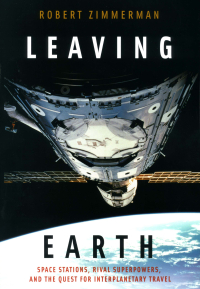
Leaving Earth: Space Stations, Rival Superpowers, and the Quest for Interplanetary Travel, can be purchased as an ebook everywhere for only $3.99 (before discount) at amazon, Barnes & Noble, all ebook vendors, or direct from my ebook publisher, ebookit.
If you buy it from ebookit you don't support the big oppressive tech companies and I get a bigger cut much sooner.
"Leaving Earth is one of the best and certainly the most comprehensive summary of our drive into space that I have ever read. It will be invaluable to future scholars because it will tell them how the next chapter of human history opened." -- Arthur C. Clarke
Rumors today say that during a press conference tomorrow NASA will announce that it is closing the books on the incredibly successful rover Opportunity.
From the first link:
NASA said Tuesday it will issue a final series of recovery commands, on top of more than 1,000 already sent. If there’s no response by Wednesday — which NASA suspects will be the case — Opportunity will be declared dead, 15 years after arriving at the red planet.
Opportunity was supposed to last 90 days. Instead, it lasted just under fifteen years, drove 28 miles, and saw far more of the Martian surface than anyone ever expected.
It now sits inside the rim of fourteen-mile Endeavour Crater, waiting for those first explorers to come and get it. I wonder when that will be.

Cool image time! The south polar cap of Mars is a strange place. It is largely ice, with a seasonal cap of frozen carbon dioxide, or dry ice. Because the dry ice sublimates away during the summer months, the cap undergoes regular changes that reshape it, producing alien features that are not seen on Earth.
The image on the right is another example of these alien features. I found it in the February image release from the high resolution camera on Mars Reconnaissance Orbiter. I have merely cropped the full image to focus at full resolution on its primary feature, a region of stippled-like surface surrounding an area of black striping that in turn surrounds a crescent-shaped pit outlined by whiter material.
Why is there a pit here? Why is it crescent-shaped? Why is it surrounded by that whiter material? I could guess and say that the pit is a vent from which water vapor from the lower cap of water sprays out onto the upper cap of frozen carbon dioxide, staining it with white ice, but I am most likely wrong.
Moreover, what causes the black striping, as well as the stippled material surrounding it? The black stripes are probably related to a similar process that forms the spider formations found in the polar regions, except that these are not spiders. Why the parallel straight lines?
A lot of questions with no answers. While many features on Mars are strange, the features near the poles are probably stranger still, as they form in a place with chemistry, temperatures, gravity, and materials in a combination and scale that we on Earth have no experience with.
They’re coming for you next: An Oklahoma television meteorologist was fired yesterday for showing innocent brainteaser to the audience that included a picture of a noose that apparently offended a viewer.
Mandy Bailey was a meteorologist over at KSWO. She was fired after doing a brain teaser that someone found offensive. The brain teaser was of the word THERE, with a noose hanging off the ‘T’. If you think about it, the answer is ‘Hang in There’, since the noose is inside the word there. Someone called KSWO to complain about this.
There appears to be some push back here, with several advertising saying they will no longer advertise at the station because of the firing.
Either way, you want to destroy innocent people? Complain about silly innocent things that only idiots would construe as offensive. Do it on Twitter, that home of mob mentality and the perpetually outraged. And aim the attack at weak-kneed media outlets that are already part of our leftist totalitarian culture and prone to bow to such mob attacks.
The uncertainty of science: New research suggests that the European ancient standing stones, such as Stonehenge, might all trace their origin from a region in France.
The very earliest megaliths, she found, come from northwestern France, including the famous Carnac stones, a dense collection of rows of standing stones, mounds, and covered stone tombs called dolmens. These date to about 4700 B.C.E., when the region was inhabited by hunter-gatherers. Engravings on standing stones from the region depict sperm whales and other sea life, which suggests the precocious masons may also have been mariners, Schulz Paulsson says.
Northwestern France is also the only megalithic region that also features gravesites with complex earthen tombs that date to about 5000 B.C.E., which she says is evidence of an “evolution of megaliths” in the region. That means megalith building likely originated there and spread outward, she reports today in the Proceedings of the National Academy of Sciences.
By about 4300 B.C.E., megaliths had spread to coastal sites in southern France, the Mediterranean, and on the Atlantic coast of the Iberian Peninsula. Over the next few thousand years, the structures continued to pop up around Europe’s coasts in three distinct phases. Stonehenge is thought to have been erected around 2400 B.C.E., but other megaliths in the British Isles go back to about 4000 B.C.E. The abrupt emergence of specific megalithic styles like narrow stone-lined tombs at coastal sites, but rarely inland, suggests these ideas were being spread by prehistoric sailors. If so, it would push back the emergence of advanced seafaring in Europe by about 2000 years, Schulz Paulsson says.
What this research also suggests is that the belief system that prompted the construction of these megaliths also spread in this manner, and for a while at least dominated the early tribal cultures of Europe.
The Chinese lunar lander Chang’e-4 and its rover Yutu-2 have both gone into hibernation as part of their preparation for surviving their second night on the Moon’s surface.
The Yutu-2 rover and lander will resume science and exploration activities on Feb. 28 and March 1, respectively, according to the release, with the rover needing to unfold solar panels and dissipate heat.
The previous lunar night saw the Chang’e-4 lander record a temperature low of -190 degrees Celsius (-310 Fahrenheit), with measurements made possible by a Russian-developed radioisotope thermoelectric generator which also acts as a prototype for future deep-space exploration.
Official updates on the progress of the mission had been sparse during the second lunar day of operations, though some new images and footage were released ahead of the Chinese New Year holiday, which ran from Feb. 4 to Feb. 10.
Yutu-2 has traveled about 400 feet so far.
Faced with self-imposed delays of the launch of the privately-built manned capsules of Boeing and SpaceX, NASA has now arranged to stretch out the launch schedule of its last few Soyuz manned missions in order to maintain a presence on ISS.
According to Russian sources:
“The following scheme is planned for now: two NASA astronauts will remain on the ISS for nine months instead of the usual six. So, Nick Hague starts his mission on March 14 [2019] on the Soyuz MS-12 and returns to Earth on 18 December on the Soyuz MS-13, while Andrew Morgan will travel to the orbital station on Soyuz MS-13 on 6 July and will return on Soyuz MS-15 in April 2020″, the source said.
In the end it does appear that NASA can no longer slow-walk these American commercial manned capsules. When April 2020 rolls around, they must be operational or we will have no astronauts on board our own space station.
Mars One, the company that claimed in 2013 that it was going to send tourists on one way trips to Mars by 20218, has been liquidated.
Actually, the headline here isn’t quite right. The patient was never alive. All that has happened is that we will no longer have a corpse to kick around. From day one I never gave this company any credence, considering it to be nothing more than a publicity stunt. It appears the company itself has finally admitted this.
The swamp attacks! The inspector general for the Defense Department has begun a review of the process the Air Force used to certify SpaceX as a qualified military launch provider.
“Our objective is to determine whether the U.S. Air Force complied with the Launch Services New Entrant Certification Guide when certifying the launch system design for the Evolved Expendable Launch Vehicle-class SpaceX Falcon 9 and Falcon Heavy launch vehicles,” the inspector general said in a memo to Air Force Secretary Heather Wilson sent on Monday.
The only reason I can see for this investigation is that the launch companies that have development contracts with the military — ULA, Northrop Grumman, and Blue Origin — are applying pressure to get SpaceX eliminated as a competitor. And since there are many in the government aerospace bureaucracy who are in bed with these companies and are also hostile to SpaceX, that pressure has succeeded in getting this investigation started.
SpaceX meanwhile has successfully launched one military payload, and has two more military launches scheduled for 2019. Its prices are so low that these other companies cannot presently compete, not without political help. Worse, it appears these other companies, and the Air Force, do not appear interested in reducing the cost of their next generation rockets to become more competitive. Instead, they apparently have decided to turn the screws on SpaceX and get it eliminated as a competitor.
Meanwhile, SpaceX might be doing its own political push back, behind the scenes. At least, why else did two California lawmakers recently demand a review of the Air Force’s rocket development contracts to all of SpaceX’s competitors, but not SpaceX?
All of this has absolutely nothing to do with picking the best and cheapest launch companies to save the taxpayer money. Instead, the entire way our government operates today is completely uninterested in the needs of the nation. The focus of lawmakers and government officials is to play political games in an effort to take out their opponents. And in this battle the country be damned.
According to U.S. officials, Iran has attempted and failed twice in the past month to place satellites in orbit.
Iran’s second try in less than a month to send a satellite into orbit apparently failed shortly after liftoff from a remote desert launch pad under daily surveillance from a fleet of commercial imaging spacecraft, according to U.S. government officials and independent analysts.
Images of the launch pad in north-central Iran taken by orbiting satellites owned by U.S. companies suggest a rocket launch occurred last week, but the U.S. military’s catalog of space objects registered no new spacecraft in orbit. A satellite launch attempt was expected in recent weeks based on statements from Iran’s government and observations of increasing activity at the launch site.
Iran has admitted to a launch failure on January 15, though it denies the failure last week, claiming instead that the February launch succeeded in placing its satellite in orbit, even though no new satellite has been detected.
The Mars orbiter MAVAN, designed primarily to study Mars’s atmosphere, is now lowering its orbit as it shifts its primary function from science to communications between the Earth and the rovers on the surface.
A strong telecommunications antenna signal is not the only benefit of a tighter orbit. Coming in nearly 1,000 miles (about 1,500 kilometers) closer also will allow the MAVEN orbiter to circle Mars more frequently – 6.8 orbits per Earth day versus 5.3 previously – and thus communicate with the Mars rovers more frequently. While not conducting relay communications, MAVEN will continue to study the structure and composition of the upper atmosphere of Mars. “We’re planning a vigorous science mission far into the future,” Jakosky said.
In a sense, NASA here is finding a way to replace the Mars communications satellite that it wanted but was not able to get funded.
An evening pause: We should know that our messages do get caught.
To my readers: We are now entering the second week of my February birthday fund-raising campaign. Your support is most desperately needed to keep Behind the Black operating.
Unfortunately, because John Batchelor is presently recovering from an illness (recovering well I must add), he was off the air in the first week of February, and will be off the air again this week. Thus, I do not have his aid in publicizing this fund-raiser, and so his normally very generous listeners are unaware it is happening.
I therefore need the help of my readers all the more. Please consider making a donation, or subscribing, as indicated by the tip jar above. Your support will be appreciated deeply, and will make it possible for me to continue to report on space.
This announcement will stay on the top of the page for the rest of today. Scroll down for new posts.
After spending the last few years complaining about certain specific issues with the manned capsule efforts of SpaceX and Boeing, NASA’s safety panel this past weekend released its annual 2018 report. (You can download the report here [pdf].) Its position now on those certain specific issues can now be summarized as follows:
They make no mention of the parachute issues that forced Boeing to do numerous extra tests, causing probably a year delay in the program, though Boeing has had decades of experience with capsule parachutes and the entire American aerospace industry has never had a parachute failure.
The panel also admits that their concerns about SpaceX’s rocket fueling procedures is really not an issue.
The NESC [NASA Engineering and Safety Center] has independently studied the load and go procedure and provided a thorough report that identifies the hazards and available controls. Based on the NESC report, the CCP [Commercial Crew Program] has decided that the load and go concept is viable if subsequent analysis is adequate and if verifiable controls are identified and implemented for all the credible hazard causes that could potentially result in an emergency situation or worse.
As Emily Litela said, “Never mind!” Their concerns were never credible, as it really doesn’t matter if you fuel the rocket before or after the astronauts board, because in either case they are there when a lot of fuel is present. All the panel did was delay the first Dragon launch by at least a year by pushing this issue.
The panel is still holding onto its concerns about the installation blankets (COPV) used in SpaceX’s internal helium tanks, the location of the problem that caused the September 2016 launchpad explosion. Despite SpaceX’s apparent fixing of this problem, with 40 successful launches since that failure, they are listing further vague requirements:
» Read more
They’re coming for you next: The International Monetary Fund today announced a proposed plan that would allow banks to charge negative interest on any deposited funds, a plan that would essentially allow banks, and governments, to steal money from their customers.
The plan also involves making cash a second-class method of payment, because it is impossible for them to charge negative interest on cash. When banks in Europe have charged negative interest, they have found they have instead created a run on their banks as customers rush to pull their money out.
One option to break through the zero lower bound would be to phase out cash. But that is not straightforward. Cash continues to play a significant role in payments in many countries. To get around this problem, in a recent IMF staff study and previous research, we examine a proposal for central banks to make cash as costly as bank deposits with negative interest rates, thereby making deeply negative interest rates feasible while preserving the role of cash.
The proposal is for a central bank to divide the monetary base into two separate local currencies—cash and electronic money (e-money). E-money would be issued only electronically and would pay the policy rate of interest, and cash would have an exchange rate—the conversion rate—against e-money. This conversion rate is key to the proposal. When setting a negative interest rate on e-money, the central bank would let the conversion rate of cash in terms of e-money depreciate at the same rate as the negative interest rate on e-money. The value of cash would thereby fall in terms of e-money.
To illustrate, suppose your bank announced a negative 3 percent interest rate on your bank deposit of 100 dollars today. Suppose also that the central bank announced that cash-dollars would now become a separate currency that would depreciate against e-dollars by 3 percent per year. The conversion rate of cash-dollars into e-dollars would hence change from 1 to 0.97 over the year. After a year, there would be 97 e-dollars left in your bank account. If you instead took out 100 cash-dollars today and kept it safe at home for a year, exchanging it into e-money after that year would also yield 97 e-dollars. [emphasis mine]
I have highlighted the entire last paragraph because it contains the heart of the matter. You deposit $100, but they only give you $97 at the end of the year, keeping the $3 for their own benefit.
Buried deep in the article is this minor point:
Still, implementing such a system is not without challenges. It would require important modifications of the financial and legal system. In particular, fundamental questions pertaining to monetary law would have to be addressed and consistency with the IMF’s legal framework would need to be ensured. Also, it would require an enormous communication effort.
To put this in plain language, charging negative interest in most western nations would be considered outright theft. To do it they need to get the laws changed, while also running an intense propaganda campaign to convince depositors that having their money stolen is a good thing.
Sadly, I think this might happen. We live in dark times, with many people enamored by foolish ideas.