NASA pushes for funds to save the James Webb Space Telescope
NASA pushes for funds to save the James Webb Space Telescope.
NASA pushes for funds to save the James Webb Space Telescope.
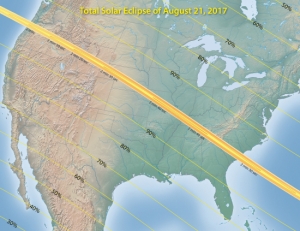
Time to start making your vacation plans. On August 21, 2017 a total eclipse of the sun is going to traverse the entire length of the continental United States, from Oregon to South Carolina. Kentucky will have the longest view, with totality as long as three minutes.
And astronomers are already thinking of ways to harness the help of the American people in observing this event. In a paper published today on the Los Alamos astro-ph website, a team of astronomers are proposing organizing something they have dubbed the U.S. Eclipse MegaMovie, whereby they gather together as many images of the totality as possible and assemble them into a single film, showing the evolution of the sun’s corona as it crosses the continent.
» Read more
The mystery of Vesta’s south pole depression.
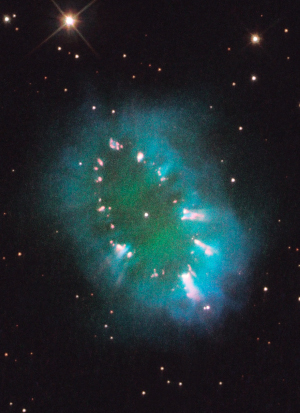
Who needs aliens and imagined cities on the moon when you have a reality that produces such strange and beautiful things as the image on the right?
On July 2, the Hubble Space Telescope took this image of a planetary nebula, aptly dubbed the Necklace Nebula. As the caption explains,
A pair of stars orbiting close together produced the nebula, also called PN G054.2-03.4. About 10,000 years ago one of the aging stars ballooned to the point where it engulfed its companion star. The smaller star continued orbiting inside its larger companion, increasing the giant’s rotation rate.
The bloated companion star spun so fast that a large part of its gaseous envelope expanded into space. Due to centrifugal force, most of the gas escaped along the star’s equator, producing a ring. The embedded bright knots are dense gas clumps in the ring.
The binary still exists, and can be seen as the star in the center of the necklace. The two stars are now only a few million miles apart and complete an orbit around each other in about a day.
Oxygen molecules have been detected for the first time in space, and they were found in the Orion nebula, a giant molecular cloud where stars are being born. More here.
Astronomers have spotted the first Trojan asteroid to the Earth.
The asteroid is roughly 1,000 feet (300 meters) in diameter. It has an unusual orbit that traces a complex motion near a stable point in the plane of Earth’s orbit, although the asteroid also moves above and below the plane. The object is about 50 million miles (80 million kilometers) from Earth. The asteroid’s orbit is well-defined and for at least the next 100 years, it will not come closer to Earth than 15 million miles (24 million kilometers).
The Herschel space telescope has discovered that the water expelled from the tiger stripes on Enceladus eventually rains down on Saturn.
Enceladus expels around 250 kg of water vapour every second, through a collection of jets from the south polar region known as the Tiger Stripes because of their distinctive surface markings. These crucial observations reveal that the water creates a doughnut-shaped torus of vapour surrounding the ringed planet. The total width of the torus is more than 10 times the radius of Saturn, yet it is only about one Saturn radius thick. Enceladus orbits the planet at a distance of about four Saturn radii, replenishing the torus with its jets of water.
The Russian orbiting radio telescope Spektr-R has successfully unfurled its 10 meter dish.
The Messenger spacecraft has now been in orbit around Mercury since the end of March, almost four months. During that time the probe has sent back many fascinating images, showcasing a hot, alien planet whose surface was formed by impacts, volcanic activity, and some processes that no one as yet understands.
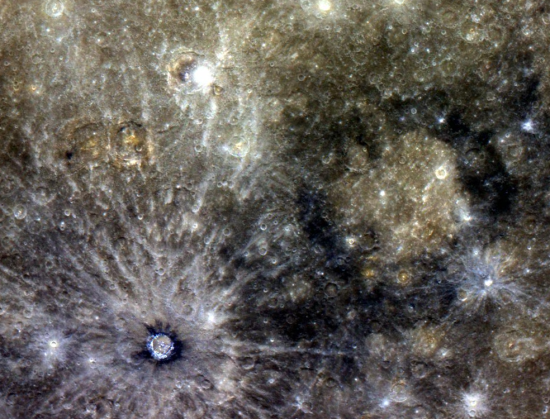
Most of the released images, however, have been in black and white, which at first glance makes one think that Mercury is not unlike the Moon. This week the Messenger team released a color image, demonstrated clearly how false this assumption is. The image below shows two very different craters, a dark-haloed crater named Basho at the bottom left of the image, and a very bright crater, Kalidasa crater, near the top left. On the right of the image is a dark haloed Tolstoj basin. For an uncropped full resolution version go here.
A new image of Vesta from Dawn.
Hubble has discovered a fourth moon orbiting Pluto.
The dying NASA astrophysics program.
With support from President Barack Obama, the agency’s Earth science budget is at an all-time high. Over the next four months, the planetary science division is due to launch three major missions: to the Moon, to Mars and to Jupiter. And the heliophysics division plans to send a probe plunging into the blistering atmosphere of the Sun, closer than ever before. But because the overall NASA science budget is relatively flat, something had to give. Since 2008, astrophysics funding has plunged relative to other NASA science and relative to physics and astronomy funding at other agencies.
Some good news: Dawn has returned its first sharp close-up image of Vesta.
The image to below the fold is to me a relief, as it shows that the spacecraft’s camera is fine and that my engineering friends were correct in telling me so. Forgive me for being a skeptical and nervous reporter.
» Read more
The Russians yesterday successfully launched their first space telescope since the fall of the Soviet Union. Here is a Google translation of a Russian article describing Spektr-R’s research goals:
[Spektr-R is] designed to study galaxies and quasars in the radio, the study of black holes and neutron stars in the Milky Way, as well as the regions immediately adjacent to the massive black holes. In addition, using the observatory, scientists expect to receive information about pulsars and the interstellar plasma. It is planned that the “Spektr-R” will work in orbit for at least 5 years.
Though this particular space telescope is probably not going to rewrite the science of astrophysics, its launch is historically significant. It indicates that Russia has just about recovered from the seventy-plus years of bankrupt communist rule that ended in 1990.
» Read more
Dawn enters orbit around Vesta.
A new analysis of the orbits of Ceres and Vesta says that in a surprisingly short time those orbits become chaotic and therefore unpredictable. More significantly, those orbits interact with the Earth’s and also make its long term orbit chaotic and unpredictable. From the abstract:
Although small, Ceres and Vesta gravitationally interact together and with the other planets of the Solar System. Because of these interactions, they are continuously pulled or pushed slightly out of their initial orbit. Calculations show that, after some time, these effects do not average out. Consequently, the bodies leave their initial orbits and, more importantly, their orbits are chaotic, meaning that we cannot predict their positions. The two bodies also have a significant probability of impacting each other, estimated at 0.2% per billion year. Last but not least, Ceres and Vesta gravitationally interact with the Earth, whose orbit also becomes unpredictable after only 60 million years. This means that the Earth’s eccentricity, which affects the large climatic variations on its surface, cannot be traced back more than 60 million years ago. This is indeed bad news for Paleoclimate studies. [emphasis mine]
The scientists found that it became impossible to calculate the orbits of the two largest asteroids after only several ten thousand years. They also found that “numerous asteroids in the main belt will behave in the same way with . . . much more chaotic behavior than previously thought.” Worse, the possibility of collisions was far higher than ever thought. Ceres and Vesta have a 1 in 500 chance of colliding with each other every billion years, while other asteroids have chances as low as 1 in 1000.
The importance of this discovery, which still needs to be confirmed by other researchers, cannot be understated.
» Read more
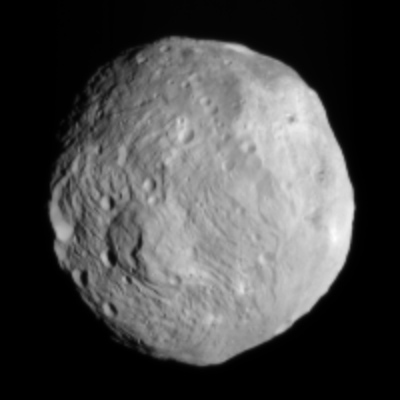
Another image of Vesta from Dawn has been released. This image was taken on July 9 from a distance of 26,000 miles away. It is definitely an improvement over the previous image, with more small details becoming visible. However, I once again wonder about the softness of the image. Look at the limb of the planet. It is soft against the black sky. This is not what one would expect from perfectly focused camera.
Dawn goes into orbit around Vesta next week. We sure learn then for sure if there is a problem with its camera, or whether I am merely being a bit too nervous.