
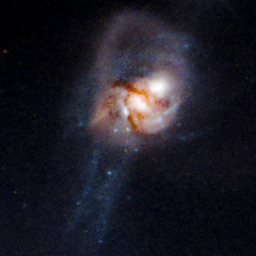
A barred spiral galaxy with distorted galaxy

A barred spiral galaxy
Click for full image.

Cool image time! The photo to the right, reduced and cropped to post here, was taken by the Hubble Space Telescope and shows a barred spiral galaxy about 214 million light years away.

Scientists used NASA’s Hubble Space Telescope to image NGC 6956 to study its Cepheid variable stars, which are stars that brighten and dim at regular periods. Since the period of Cepheid variable stars is a function of their brightness, scientists can measure how bright these stars appear from Earth and compare it to their actual brightness to calculate their distance. As a result, these stars are extremely useful in determining the distance of cosmic objects, which is one of the hardest pieces of information to measure for extragalactic objects.

The press release of course focuses on this magnificent barred spiral. I however want to draw your attention to the smaller galaxy in the white box.
background distorted galaxy

Since we do not know the distance to this distorted galaxy, we do not know if its distortion is caused by the barred spiral. It could be the bigger galaxy’s gravity is pulling material away.

More likely, based on the shape of this smaller galaxy, is that it is many light years farther away — which is why it looks so much smaller — and has been distorted because it is actually a collusion of two galaxies. The two bright nuclei with the red dust between strongly suggests such a collusion.

I highlight this background galaxy because it illustrates the importance when looking at any Hubble image to look at everything. To coin a phrase, there is gold in them thar hills, if you make the effort to look.

3 comments

Astronomers determine that two super-Earths are not as rocky as previously believed

Using observations from both the Hubble Space Telescope and the now retired Spitzer infrared space telescope, astronomers now think that two super-Earth-sized explanets are not as rocky as previously believed, and are in fact liquid worlds with as much as half their make-up comprised of water. From the press release:

Water wasn’t directly detected at Kepler-138 c and d, but by comparing the sizes and masses of the planets to models, astronomers conclude that a significant fraction of their volume – up to half of it – should be made of materials that are lighter than rock but heavier than hydrogen or helium (which constitute the bulk of gas giant planets like Jupiter). The most common of these candidate materials is water.

“We previously thought that planets that were a bit larger than Earth were big balls of metal and rock, like scaled-up versions of Earth, and that’s why we called them super-Earths,” explained Björn Benneke, study co-author and professor of astrophysics at the University of Montreal. “However, we have now shown that these two planets, Kepler-138 c and d, are quite different in nature and that a big fraction of their entire volume is likely composed of water. It is the best evidence yet for water worlds, a type of planet that was theorized by astronomers to exist for a long time.”

With volumes more than three times that of Earth and masses twice as big, planets c and d have much lower densities than Earth. This is surprising because most of the planets just slightly bigger than Earth that have been studied in detail so far all seemed to be rocky worlds like ours. The closest comparison, say researchers, would be some of the icy moons in the outer solar system that are also largely composed of water surrounding a rocky core.

This data simply underlines a basic point: The information we have of all exoplanets is sparse, practically nil. Any conclusions about their make-up is an educated guess, at best. Even now the conclusion that these are water worlds should be treated with great skepticism.

8 comments

More results from DART impact of Dimorphos

Didymos and Dimorphos as seen from Earth
Click for movie.

At a science conference this week scientists provided an update on the changes that occurred to the asteroid Dimorphos after it was impacted by the DART spacecraft in September, shortening its orbit around the larger asteroid Didymos by 33 minutes.

The image to the right is a screen capture from a short movie made from 30 images taken by the Magdalena Ridge Observatory in New Mexico, and part of a new image release of the asteroid pair.

It shows the motion of the Didymos system across the sky over the course of roughly 80 minutes, and features a long, linear tail stretching to the right from the asteroid system to the edge of the frame. The animation is roughly 32,000 kilometers across the field of view at the distance of Didymos.

According to the scientists, the impact displaced more than two million pounds of material from Dimorphos.

Observations before and after impact, reveal that Dimorphos and its larger parent asteroid, Didymos, have similar makeup and are composed of the same material – material that has been linked to ordinary chondrites, similar to the most common type of meteorite to impact the Earth. These measurements also took advantage of the ejecta from Dimorphos, which dominated the reflected light from the system in the days after impact. Even now, telescope images of the Didymos system show how solar radiation pressure has stretched the ejecta stream into a comet-like tail tens of thousands of miles in length.

Putting those pieces together, and assuming that Didymos and Dimorphos have the same densities, the team calculates that the momentum transferred when DART hit Dimorphos was roughly 3.6 times greater than if the asteroid had simply absorbed the spacecraft and produced no ejecta at all – indicating the ejecta contributed to moving the asteroid more than the spacecraft did.

This information is teaching us a great deal about these two particular asteroids, which could be used if for some reason their totally safe orbit got changed and they were going to impact Earth. However, NASA’s repeated effort to make believe this info would be useful for deflecting other asteroids is somewhat absurd. It is helpful, but each asteroid is unique. The data from DART is mostly helping astronomers get a better understanding of the geology of these specific asteroids, which will widen their understanding of asteroids in general. Planetary defense is really a very minor aspect of this work.

5 comments

NASA approves $1.2 billion asteroid-hunting space telescope

NASA has given the go-ahead to build NEO-Surveyor for $1.2 billion, more than twice the cost of its original proposal, to launch by 2028 and then look for potentially dangerous asteroids.

Notably, NEO Surveyor was earlier estimated to cost between $500 million and $600 million, or around half of the new commitment. The NASA statement said that the cost and schedule commitments outlined align the mission with “program management best practices that account for potential technical risks and budgetary uncertainty beyond the development project’s control.” Earlier this year, the project’s launch was delayed two years, from 2026, due to agency budget concerns.

The mission is designed to discover 90% of potentially Earth-threatening asteroids and comets 460 feet (140 meters) or larger that come within 30 million miles (48 million kilometers) of Earth’s orbit. The spacecraft will carry out the survey while from Earth-sun Lagrange Point 1, a gravitationally stable spot in space about 930,000 miles (1.5 million kilometers) inside the Earth’s orbit around the sun.

A prediction: It will cost more, and not launch on time. NASA’s decision to double the budget and delay the launch two years suggests it did not trust the JPL cost and time estimates. Based on most NASA-centered projects, however, it is likely the new numbers will still be insufficient.

5 comments

A wall of smoke, as seen by Hubble

A wall of smoke, as seen by Hubble
Click for full image.

Using the Hubble Space Telescope, astronomers have produced a magnificent image of an interstellar cloud, cropped and reduced to post here. From the caption:

A portion of the open cluster NGC 6530 appears as a roiling wall of smoke studded with stars in this image from the NASA/ESA Hubble Space Telescope. NGC 6530 is a collection of several thousand stars lying around 4350 light-years from Earth in the constellation Sagittarius. The cluster is set within the larger Lagoon Nebula, a gigantic interstellar cloud of gas and dust. It is the nebula that gives this image its distinctly smokey appearance; clouds of interstellar gas and dust stretch from one side of this image to the other.

Astronomers investigated NGC 6530 using Hubble’s Advanced Camera for Surveys and Wide Field Planetary Camera 2. They scoured the region in the hope of finding new examples of proplyds, a particular class of illuminated protoplanetary discs surrounding newborn stars. The vast majority of proplyds have been found in only one region, the nearby Orion Nebula. This makes understanding their origin and lifetimes in other astronomical environments challenging.

The first proplyds were seen in the very first images taken by Hubble after it was fixed and could finally take sharp pictures. That so few have been seen since is thus somewhat surprising.

2 comments

Astronomers confirm Webb galaxies from the early universe

Astronomers using Webb have now confirmed with spectroscopy the age of at least four galaxies from the very very early universe, existing only a short time after the theorized Big Bang.

Four of the galaxies studied are particularly special, as they were revealed to be at an unprecedentedly early epoch. The results provided spectroscopic confirmation that these four galaxies lie at redshifts above 10, including two at redshift 13. This corresponds to a time when the universe was approximately 330 million years old, setting a new frontier in the search for far-flung galaxies. These galaxies are extremely faint because of their great distance from us.

The scientists had aimed Webb at Hubble’s Ultra Deep Field, doing a long infrared exposure lasting 28 hours over three days in order to gather the faintest infrared radiation (that Hubble could not see) and thus the most distant galaxies. The spectrum of individuals stars was then measured, which indicating their redshift and their estimated age.

The astronomers will next aim Webb at the more famous Hubble Deep Field, the first such long exposure that optical telescope took back in the late 1990s.

1 comment

SOFIA to retire to Arizona museum

NASA yesterday announced that its airborne 747 SOFIA telescope will be retired to the Pima Air & Space Museum in Tucson, Arizona, making its final flight there December 13, 2022.

Pima, one of the world’s largest aerospace museums, is developing plans for when and how the SOFIA aircraft will eventually be on display to the public. Along with six hangars, 80 acres of outdoor display grounds, and more than 425 aircraft from around the world, Pima also has its own restoration facility where incoming aircraft like SOFIA are prepared for museum immortalization after their arrival.

While the idea of SOFIA, putting a astronomical telescope on an airplane to get it above most of the atmosphere, has some merit, this particular NASA project was always too costly and simply produced too little science to justify its expense.

In many ways, this museum display will provide one of the best ways to see a 747 itself, now also retired.

3 comments

Webb’s infrared view of the Southern Ring Nebula

Two views of Southern Ring Nebula by Webb
Click for original image.

The two images to the left were produced by the Webb Space Telescope, showing in false colors the Southern Ring Nebula as seen by two of Webb’s infrared cameras.

The two images shown here each combine near-infrared and mid-infrared data to isolate different components of the nebula. The image at [top] highlights the very hot gas that surrounds the central stars. The image at [bottom] traces the star’s scattered molecular outflows that have reached farther into the cosmos.

Based on the data, astronomers posit that up the system could have as many as five stars orbiting each other, with three as yet unseen, or the inner ones might no longer exist, having been absorbed by the bigger stars.

It’s possible more than one star interacted with the dimmer of the two central stars, which appears red in this image, before it created this jaw-dropping planetary nebula. The first star that “danced” with the party’s host created a light show, sending out jets of material in opposite directions. Before retiring, it gave the dim star a cloak of dust. Now much smaller, the same dancer might have merged with the dying star – or is now hidden in its glare.

A third partygoer may have gotten close to the central star multiple times. That star stirred up the jets ejected by the first companion, which helped create the wavy shapes we see today at the edges of the gas and dust. Not to be left out, a fourth star with an orbit projected to be much wider, also contributed to the celebration. It circled the scene, further stirring up the gas and dust, and generating the enormous system of rings seen outside the nebula. The fifth star is the best known – it’s the bright white-blue star visible in the images that continues to orbit predictably and calmly.

Much of this remains mere theory, based on the available data. Nonetheless, the data from many such planetary nebula continues to suggest their strange and wonderful shapes are created by multiple stars, acting as a mix-master to churn up the nebula’s dust.

0 comments

New gamma ray burst violates the explanations of scientists

The uncertainty of science: A newly discovered long gamma ray burst (GRB) that appears to have been formed by the merger of two neutron stars has contradicted the long held views of scientists as to the origin of this particular type of GRB.

Prior to the discovery of this burst, astronomers mostly thought that there were just two ways to produce a GRB. The collapse of a massive star just before it explodes in a supernova could make a long gamma-ray burst, lasting more than two seconds. Or a pair of dense stellar corpses called neutron stars could collide, merge and form a new black hole, releasing a short gamma-ray burst of two seconds or less.

But there had been some outliers. A surprisingly short GRB in 2020 seemed to come from a massive star’s implosion (SN: 8/2/21). And some long-duration GRBs dating back to 2006 lacked a supernova after the fact, raising questions about their origins. “We always knew there was an overlap,” says astrophysicist Chryssa Kouveliotou of George Washington University in Washington, D.C., who wrote the 1993 paper that introduced the two GRB categories, but was not involved in the new work. “There were some outliers which we did not know how to interpret.”

There’s no such mystery about GRB 211211A: The burst lasted more than 50 seconds and was clearly accompanied by a kilonova, the characteristic glow of new elements being forged after a neutron star smashup.

Kouveliotou’s claim is not how I remember things back in 1990s. Then, the astronomers seemed certain that the two GRB classes were entirely separate, with no overlap, despite the large number of uncertainties.

2 comments

Webb and Keck telescopes track clouds on Titan

Clouds on Titan
Click for original image.

Astronomers have used the Webb Space Telescope and the Keck Observatory in Hawaii to take infrared images days apart of the evolving clouds on the Saturn moon Titan.

The false-color infrared images to the right are those observations. From the press release:

As part of their investigation of Titan’s atmosphere and climate, Nixon’s team used JWST’s Near-Infrared Camera (NIRCam) to observe the moon during the first week of November. After seeing the clouds near Kraken Mare, the largest known liquid sea of methane on the surface of Titan, they immediately contacted the Keck Titan Observing Team to request follow-up observations.

“We were concerned that the clouds would be gone when we looked at Titan a day later with Keck, but to our delight there were clouds at the same positions on subsequent observing nights, looking like they had changed in shape,” said Imke de Pater, emeritus professor of astronomy at the University of California, Berkeley, who leads the Keck Titan Observing Team.

Using Keck Observatory’s second generation Near-Infrared Camera (NIRC2) in combination with the Keck II Telescope’s adaptive optics system, de Pater and her team observed one of Titan’s clouds rotating into and another cloud either dissipating or moving out of Earth’s field of view due to Titan’s rotation.

These images only increase my mourning for a Saturn orbiter. Since the end of Cassini’s mission in 2017, we have essentially been blind to the ringed planet and its many moons. These images, while producing excellent data, also illustrate well what we have lost.

0 comments

China completes construction of world’s largest solar radio telescope array

China has now completed the construction of world’s largest solar radio telescope array, dubbed the Daocheng Solar Radio Telescope (DSRT), made up of 313 separate radio dishes laid out in a giant two-mile wide circle.

DSRT is focused on observing solar flares and coronal mass ejections (CMEs) which can interfere with or overload electronics and wreak havoc on and above Earth. CMEs are triggered by realignments in the star’s magnetic field that occur in sunspots, and when directed at Earth, can threaten power grids, telecommunications, orbiting satellites and even put the safety of astronauts aboard the International Space Station and China’s newly-completed Tiangong space station at risk.

Assuming China shares the data from this telescope with the rest of the world, it will function as a back-up to several very old NOAA satellites in orbit that NOAA has failed to replace. If China doesn’t share the data, however, the western world will become very vulnerable should its own satellites finally fail.

1 comment

A ghost goddess in space

Ghost goddess in space
Click for original image.

Cool image time! The image to the right, cropped, rotated, reduced, and enhanced to post here, is without doubt one of my favorite objects that the Hubble Space Telescope has photographed over the decades. This new image combines imagery obtained by earlier Hubble cameras and the newer cameras installed in 2009.

The delicate sheets and intricate filaments are debris from the cataclysmic death of a massive star that once lived in the Large Magellanic Cloud, a small satellite galaxy of the Milky Way. DEM L 190 — also known as LMC N49 — is the brightest supernova remnant in the Large Magellanic Cloud and lies approximately 160 000 light-years away from Earth in the constellation Dorado.

What makes this supernova remnant so visually appealing to my eye is its ghostly resemblance to a woman’s face, her hair blowing freely to the right. The original 2003 Hubble picture, shown below, has been the desktop image of my computer for almost two decades.
» Read more

3 comments

Webb makes its first detailed survey of an exoplanet’s atmosphere

Astronomers have now completed the first detailed survey of an exoplanet’s atmosphere using the Webb Space Telescope, looking at a gas giant about one third the mass of Jupiter about 700 light years away.

Using three of its instruments, JWST was able to observe light from the planet’s star as it filtered through WASP-39b’s atmosphere, a process known as transmission spectroscopy. This allowed a team of more than 300 astronomers to detect water, carbon monoxide, sodium, potassium and more in the planet’s atmosphere, in addition to the carbon dioxide. The gives the planet a similar composition to Saturn, although it has no detectable rings.

The team were also surprised to detect sulfur dioxide, which had appeared as a mysterious bump in early observation data. Its presence suggests a photochemical reaction is taking place in the atmosphere as light from the star hits it, similar to how our Sun produces ozone in Earth’s atmosphere. In WASP-39b’s case, light from its star, slightly smaller than the Sun, splits water in its atmosphere into hydrogen and hydroxide, which reacts with hydrogen sulfide to produce sulfur dioxide.

The data also suggested the clouds in the atmosphere are patchy, and that the planet’s formation process was not exactly as predicted.

These observations are part of a program to study 70 exoplanets during Webb’s first year of operation, using its infrared capabilities to get spectroscopy not possible in other wavelengths.

0 comments

Astronomers spot asteroid mere hours before it burned up in Earth’s atmosphere

For only the sixth time, astronomers this past weekend were able to image an asteroid just before it hit the Earth’s atmosphere and burned up over Canada.

The mini-asteroid, less than 3 feet (1 meter) wide, was spotted by astronomer David Rankin at Mount Lemmon Observatory in Arizona, according to SpaceWeather.com. Subsequent observations by other astronomers confirmed that the rock, coming from the direction of the main asteroid belt between the orbits of Mars and Jupiter, was on a collision course with Earth.

Only three hours after the first detection, the object, since dubbed C8FF042, sliced through the sky above Canada and landed in Lake Ontario, according to NASA.

While it is believed that most of the meteorite’s pieces that reached the ground fell into Lake Ontario, there is a chance some pieces might still be found along the south coast of the lake between Hamiliton and Niagara Falls.

0 comments

Smeared colliding galaxies

Smeared colliding galaxies
Click for full image.

Cool image time! The photo to the right, cropped and reduced to post here, was taken by the Hubble Space Telescope as part of its continuing program to collect images of unusual galaxies that had previously not been observed at high resolution.

The Arp-Madore catalogue is a collection of particularly peculiar galaxies spread throughout the southern sky, and includes a collection of subtly interacting galaxies as well as more spectacular colliding galaxies. Arp-Madore 417-391, which lies around 670 million light-years away in the constellation Eridanus in the southern celestial hemisphere, is one such galactic collision. The two galaxies have been distorted by gravity and twisted into a colossal ring, leaving the cores of the two galaxies nestled side by side.

It is likely that this collision has been going on for many millions of years, and will not be over for many millions of years to come. In the end the two galaxies will likely merge into one whose final shape cannot be predicted.

8 comments

Webb finding more galaxies in early universe than expected

The uncertainty of science: Astronomers using the Webb Space Telescope are finding in very early universe many more galaxies that are also far more developed then had been predicted.

The Webb observations nudge astronomers toward a consensus that an unusual number of galaxies in the early universe were so much brighter than expected. This will make it easier for Webb to find even more early galaxies in subsequent deep sky surveys, say researchers.

“We’ve nailed something that is incredibly fascinating. These galaxies would have had to have started coming together maybe just 100 million years after the big bang. Nobody expected that the dark ages would have ended so early,” said Garth Illingworth of the University of California at Santa Cruz, a member of the Naidu/Oesch team. “The primal universe would have been just one hundredth its current age. It’s a sliver of time in the 13.8 billion-year-old evolving cosmos.”

Erica Nelson of the University of Colorado in Boulder, a member of the Naidu/Oesch team, noted that “our team was struck by being able to measure the shapes of these first galaxies; their calm, orderly disks question our understanding of how the first galaxies formed in the crowded, chaotic early universe.”

The galaxies are smaller, more compact than present day galaxies, and appear to be forming stars at a tremendous rate. Because their distances, presently estimated, still need to be confirmed by spectroscopy, these conclusions remain somewhat tentative though quite alluring.

We should not be surprised if in the next two years data from Webb will overturn almost all the theories that presently exist about the Big Bang and its immediate aftermath.

2 comments

A hidden baby star, seen in infrared

A hidden baby star, seen in infrared
Click for original image.

Using the Webb Space Telescope, astronomers have obtained a new high resolution infrared false color view of the bi-polar jets of a new solar system and star, hidden within its dark cloud of dust.

That image is the photo to the right, reduced and sharpened to post here. From the press release:

NASA’s James Webb Space Telescope has revealed the once-hidden features of the protostar within the dark cloud L1527, providing insight into the beginnings of a new star. These blazing clouds within the Taurus star-forming region are only visible in infrared light, making it an ideal target for Webb’s Near-Infrared Camera (NIRCam).

The protostar itself is hidden from view within the “neck” of this hourglass shape. An edge-on protoplanetary disk is seen as a dark line across the middle of the neck. Light from the protostar leaks above and below this disk, illuminating cavities within the surrounding gas and dust.

The region’s most prevalent features, the clouds colored blue and orange in this representative-color infrared image, outline cavities created as material shoots away from the protostar and collides with surrounding matter. The colors themselves are due to layers of dust between Webb and the clouds. The blue areas are where the dust is thinnest. The thicker the layer of dust, the less blue light is able to escape, creating pockets of orange.

Scientists estimate this star is only about 100,000 years old, and is in its earliest stage of formation. That protoplanetary disk is estimated to be about the size of our solar system.

0 comments

Hubble takes a long exposure of spiral galaxy

A Hubble long exposure of a spiral galaxy
Click for original image.

This morning’s cool image on the right, reduced and sharpened to post here, comes courtesy of the Hubble Space Telescope.

NGC 7038 lies around 220 million light-years from Earth in the southern constellation Indus. This image portrays an especially rich and detailed view of a spiral galaxy, and exposes a huge number of distant stars and galaxies around it. That’s because it’s made from a combined 15 hours worth of Hubble time focused on NGC 7038 and collecting light. So much data indicates that this is a valuable target, and indeed, NGC 7038 has been particularly helpful to astronomers measuring distances at vast cosmic scales.

The press release focuses on how astronomers will use this data to refine the techniques they use to estimate distances to astronomical objects. However, a deep field image of this galaxy offers a wealth of other data. Note the reddish streams of dust along and between the spiral arms. This dust, as well as the bright patches in those arms likely signal star-forming regions. And I expect the details in the full resolution image, too large to make available on a webpage, would tell astronomers a lot about what is going on in the galaxy’s central regions.

6 comments

Astronomers discover a new large potentially dangerous near-Earth asteroid

Using a variety of ground-based telescopes, astronomers have discovered three new near-Earth asteroids orbiting the Sun but inside Earth’s orbit, with one of these asteroids having the possibility of one day in the future impacting the Earth.

An international team using the Dark Energy Camera (DECam) mounted on the Víctor M. Blanco 4-meter Telescope at Cerro Tololo Inter-American Observatory in Chile, a Program of NSF’s NOIRLab, has discovered three new near-Earth asteroids (NEAs) hiding in the inner Solar System, the region interior to the orbits of Earth and Venus. This is a notoriously challenging region for observations because asteroid hunters have to contend with the glare of the Sun.

By taking advantage of the brief yet favorable observing conditions during twilight, however, the astronomers found an elusive trio of NEAs. One is a 1.5-kilometer-wide asteroid called 2022 AP7, which has an orbit that may someday place it in Earth’s path. The other asteroids, called 2021 LJ4 and 2021 PH27, have orbits that safely remain completely interior to Earth’s orbit. Also of special interest to astronomers and astrophysicists, 2021 PH27 is the closest known asteroid to the Sun. As such, it has the largest general-relativity effects of any object in our Solar System and during its orbit its surface gets hot enough to melt lead.

You can read their paper here [pdf].

2002 AP7 is the largest such potentially dangerous asteroid discovered in eight years. Its present orbit however never brings it closer to the Earth than 4.4 million miles, and it will be many thousands of years before that orbit might result in an impact. This of course doesn’t prevent foolish mainstream news outlets like the New York Times to label it a “planet-killer.”

The importance of this study however is that it underlines the possibility that there might be other such asteroids lurking close to the Sun that are difficult to spot. This is a blind spot in our asteroid surveys that needs to be eliminated.

14 comments

Distant interacting galaxies

Interacting galaxies
Click for original image.

Cool image time! The picture to the right, cropped and reduced to post here, was taken by the Hubble Space Telescope as part of a survey of known “weird and wonderful galaxies.” This particular pair is dubbed Arp 248, and is estimated to be about 200 million light years away.

Two spiral galaxies are viewed almost face-on; they are a mix of pale blue and yellow in colour, crossed by strands of dark red dust. They lie in the upper-left and lower-right corners. A long, faint streak of pale blue joins them, extending from an arm of one galaxy and crossing the field diagonally. A small spiral galaxy, orange in colour, is visible edge-on, left of the lower galaxy.

The connecting stream indicates that these galaxies are interacting with each other, gravity drawing stars and gas from the upper galaxy towards the lower.

0 comments
1 24 25 26 27 28 114