Past tree ring spikes in carbon-14 were likely not caused by solar flares

The uncertainty of science: According to researchers, past tree ring spikes in carbon-14 found in found at five different times going back seven thousand years were likely not caused by solar flares, as previously thought.

The team behind the new research created software to analyse every available piece of data on tree rings, producing the most comprehensive research on Miyake events to date. They found that the events didn’t show a consistent relationship to the 11-year solar cycle, which is the cycle that the Sun’s magnetic field goes through. (Currently we’re heading towards the solar maximum which means more sunspots and solar flares.)

This lack of relationship to the solar cycle means that Miyake events probably aren’t due to a solar flare, as flares occur more during the solar maximum.

The scientists also found that the events lasted years, not days as one would expect by a solar flare.

You can read their paper here. The bottom line is that the cause of these spikes remains unknown.

0 comments

Lucy’s view of the Earth-Moon system during its October fly-by

The Earth and Moon system, as seen by Lucy
Click for original image.

Lucy's planned route
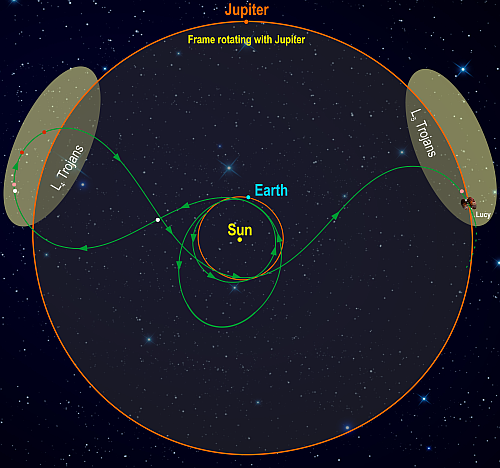
Lucy’s planned route to explore the Trojan asteroids

In the days prior to its October 16, 2022 fly-by of the Earth, the Lucy asteroid probe took several calibration images of the Earth and the Moon. The photo above, cropped, reduced, and enhanced to post here, shows both the Earth and the Moon together. From the caption:

On October 13, 2022, NASA’s Lucy spacecraft captured this image of the Earth and the Moon from a distance of 890,000 miles (1.4 million km). The image was taken as part of an instrument calibration sequence as the spacecraft approached Earth for its first of three Earth gravity assists. These Earth flybys provide Lucy with the speed required to reach the Trojan asteroids — small bodies that orbit the Sun at the same distance as Jupiter.

In the original, the Moon is so dim, compared to the Earth, that it was hard to find in the picture. I therefore brightened it considerably more than the Earth to make it easily seen above.

0 comments

A hole in space

A hole in space
Click for full image.

Cool image time! The photo to the right, cropped and reduced to post here, was taken by the Hubble Space Telescope and was released today as its picture of the week. From the caption:

This peculiar portrait from the NASA/ESA Hubble Space Telescope showcases NGC 1999, a reflection nebula in the constellation Orion. NGC 1999 is around 1350 light-years from Earth and lies near to the Orion Nebula, the closest region of massive star formation to Earth. NGC 1999 itself is a relic of recent star formation — it is composed of detritus left over from the formation of a newborn star.

Just like fog curling around a street lamp, reflection nebulae like NGC 1999 only shine because of the light from an embedded source. In the case of NGC 1999, this source is the aforementioned newborn star V380 Orionis which is visible at the centre of this image. The most notable aspect of NGC 1999’s appearance, however, is the conspicuous hole in its centre, which resembles an inky-black keyhole of cosmic proportions.

Once astronomers thought the black area was caused by dust, blocking the light. Now, based on a lot of new data from multiple ground- and space-based telescopes, they know that it actually is a black empty void. Why it exists however is not yet understood.

3 comments

Astronomers discover an exoplanet with the density of a marshmallow

Using ground-based telescopes to gather more data about an exoplanet discovered by the orbiting TESS telescope, astronomers have found that it has the density of a marshmallow.

The planet orbits a red dwarf star, the most common star in the universe, and is the “fluffiest” yet seen around this type of star.

Red dwarf stars are the smallest and dimmest members of so-called main-sequence stars — stars that convert hydrogen into helium in their cores at a steady rate. Though “cool” compared to stars like our Sun, red dwarf stars can be extremely active and erupt with powerful flares capable of stripping a planet of its atmosphere, making this star system a seemingly inhospitable location to form such a gossamer planet.

Astronomers remain puzzled how such a large fluffy planet could have formed around such a dim small star.

3 comments

Rate of micrometeorite impacts on Webb holding as expected

According to this Space.com article, the rate and size of micrometeorite impacts on the main mirror of the Webb Space Telescope has held steady at the rate and size expected, since the first surprisingly large micrometeorite impact in May that slightly dinged one mirror segment.

At this point, JWST has experienced a total of 33 micrometeoroid events, according to Smith’s slides. But the most damaging one came before JWST began science observations; in late May, a particularly large micrometeoroid struck the observatory’s mirror, leaving its mark on one golden hexagon. The team estimates that a strike of that size should occur about once a year, Smith said.

“So we got that at month five,” he said. “We haven’t seen another one yet, so it’s still consistent with the statistics that we expected.”

Smith noted that, at the current impact rate, Webb will still be meeting its five-year performance requirement 10 years into the mission. Scientists estimate that the observatory has enough fuel to operate for 20 years.

Meanwhile, one of Webb’s infrared cameras is not doing spectroscopy as engineers analyze the high levels of friction in a “grating wheel.” At this point it appears they still do not understand the cause of the friction, and thus have not come up with a plan for mitigating it.

0 comments

Twelve years of data from WISE

The Wide Field Infrared Survey Explorer (WISE) was launched in 2009 with an intended mission of two years, during which it would map the sky looking for asteroids. In 2011 NASA extended the mission, renaming the telescope for inexplicable reasons to NEOWISE (adding “Near-Earth Object” to the beginning).

In the more than a decade since, the telescope has been able to get eighteen repeated scans of the entire sky, allowing scientists to track many changes in a variety of stellar objects over time.

Yesterday NASA issued a press release celebrating this long achievement.

Every six months, NASA’s Near-Earth Object Wide Field Infrared Survey Explorer, or NEOWISE, spacecraft completes one trip halfway around the Sun, taking images in all directions. Stitched together, those images form an “all-sky” map showing the location and brightness of hundreds of millions of objects. Using 18 all-sky maps produced by the spacecraft (with the 19th and 20th to be released in March 2023), scientists have created what is essentially a time-lapse movie of the sky, revealing changes that span a decade.

There is a bit of hype in this claim. The data isn’t really useful when looked at across the entire sky. One has to zoom into particular objects to see them evolve over time. Also, many of these changes, such as with variable stars, are well known and tracked by many other telescopes.

Nonetheless, this infrared database is very valuable. It can be used for example by astronomers to identify objects that should be viewed with high resolution in the infrared, by Webb.

0 comments

Webb takes infrared image of Hubble’s Pillars of Creation

The Pillars of Creation, as seen by Hubble and Webb
Click for original image.

Not unexpectedly, astronomers have quickly begun aiming the Webb Space Telescope’s infrared eye at some of the most famous targets previously imaged in optical wavelengths by the Hubble Space Telescope.

The newest example is shown to the right and reduced and labeled to post here. It shows what NASA officials dubbed “The Pillars of Creation” when Hubble first photographed this nebula in 1995, with a later 2014 Hubble optical image at the top and the new 2022 Webb infrared image on the bottom. From this image’s caption:

A new, near-infrared-light view from NASA’s James Webb Space Telescope, at [bottom], helps us peer through more of the dust in this star-forming region. The thick, dusty brown pillars are no longer as opaque and many more red stars that are still forming come into view.

While the pillars of gas and dust seem darker and less penetrable in Hubble’s view [top], they appear more diaphanous in Webb’s. The background of this Hubble image is like a sunrise, beginning in yellows at the bottom, before transitioning to light green and deeper blues at the top. These colors highlight the thickness of the dust all around the pillars, which obscures many more stars in the overall region.

In contrast, the background light in Webb’s image appears in blue hues, which highlights the hydrogen atoms, and reveals an abundance of stars spread across the scene. By penetrating the dusty pillars, Webb also allows us to identify stars that have recently – or are about to – burst free. Near-infrared light can penetrate thick dust clouds, allowing us to learn so much more about this incredible scene.

While the Hubble colors attempt to mimic the colors seen by the human eye, the colors in the Webb image are all false colors, chosen by the scientists to distinguish the different infrared wavelengths produced by different features in the picture.

2 comments

The first Greek star catalog discovered hidden in medieval parchment

Scientists have discovered part of the first Greek star catalog created by Hipparchus — thought by many to have invented the modern field of astronomy — hidden in a medieval parchment that had been reused for other puposes.

Scholars have been searching for Hipparchus’s catalogue for centuries. James Evans, a historian of astronomy at the University of Puget Sound in Tacoma, Washington, describes the find as “rare” and “remarkable”. The extract is published online this week in the Journal for the History of Astronomy. Evans says it proves that Hipparchus, often considered the greatest astronomer of ancient Greece, really did map the heavens centuries before other known attempts. It also illuminates a crucial moment in the birth of science, when astronomers shifted from simply describing the patterns they saw in the sky to measuring and predicting them.

The manuscript came from the Greek Orthodox St Catherine’s Monastery in the Sinai Peninsula, Egypt, but most of its 146 leaves, or folios, are now owned by the Museum of the Bible in Washington DC. The pages contain the Codex Climaci Rescriptus, a collection of Syriac texts written in the tenth or eleventh centuries. But the codex is a palimpsest: parchment that was scraped clean of older text by the scribe so that it could be reused.

Using modern multi-spectral imaging, the researchers were able to decipher the older text, and determined it was almost certainly written by Hipparchus and included his star measurements.

Read the whole article at the link. It is a fascinating detective story describing the origins of modern astronomy in western civilization.

2 comments

Jets from baby stars

Jets from baby stars
Click for full image.

Cool image time! The picture to the right, rotated and reduced to post here, was taken across multiple wavelengths by the Hubble Space Telescope and shows two different Herbig–Haro objects (HH 1 at the top and HH 2 on the bottom). Herbig-Haro objects are the bright cloud clumps found near newly formed baby stars. These particular clouds are about 1,250 light years away. The jets flowing away from HH 1 are speeding away at about 250 miles per second.

Note that the baby stars themselves are not visible, buried in the dust that surrounds them. The bright star in the upper right is an unrelated foreground star.

In the case of HH 1/2, two groups of astronomers requested Hubble observations for two different studies. The first delved into the structure and motion of the Herbig–Haro objects visible in this image, giving astronomers a better understanding of the physical processes occurring when outflows from young stars collide with surrounding gas and dust. The second study instead investigated the outflows themselves to lay the groundwork for future observations with the NASA/ESA/CSA James Webb Space Telescope. Webb, with its ability to peer past the clouds of dust enveloping young stars, will revolutionise the study of outflows from young stars.

There is a lot of complexity here that this image only hints at. Note for example the smaller cloud objects near HH1, the shape of which suggest a shaping by some interstellar wind.

5 comments

Two solar eclipses coming to the U.S. next year

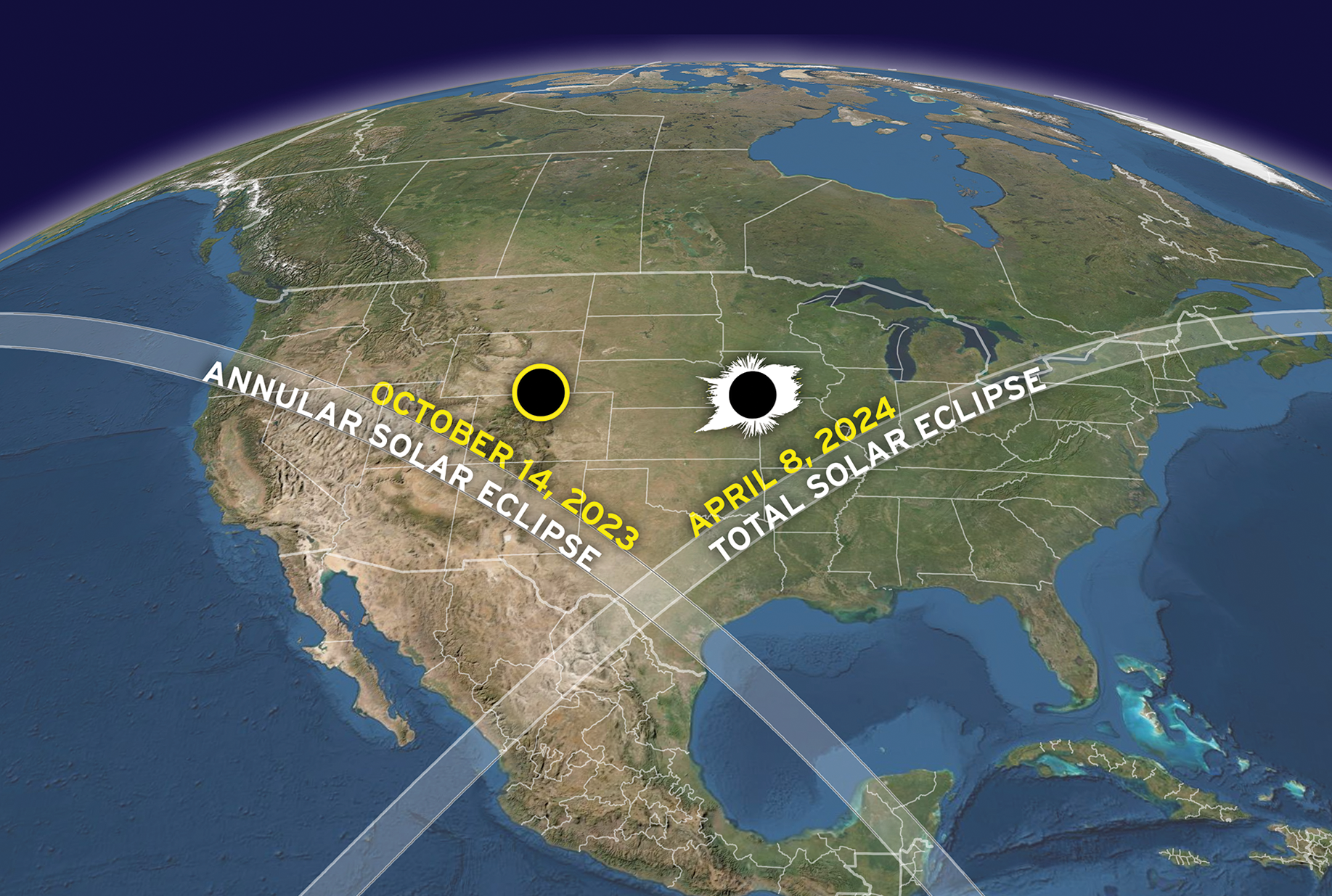
The next eclipses to cross the U.S.
Map by Michael Zeiler (GreatAmericanEclipse.com). Click for original.

The U.S. public will get to see two different solar eclipses during a six month period, starting one year from today.

The map to the right, cropped and reduced to post here, shows the dates and the path of both eclipses.

On 14 October 2023, anyone under clear skies within a path that sweeps from Oregon to Texas and then through parts of Central and South America will see an annular (“ring”) eclipse. Just six months later, on 8 April 2024, a total solar eclipse will sweep from Mexico to Texas to the Canadian Maritimes, plunging day into night and revealing the magnificent solar corona for anyone fortunate to be within the path of totality and under clear skies. Nearly everyone in North America will have a partial solar eclipse both days.

As always with eclipses, great care must be taken to watch it. With the 2017 eclipse Diane and I had good filters, but even so I noticed my eyes were very tired for several days afterward.

21 comments

Final decision: Arecibo will not be rebuilt

The National Science Foundation has made it official: It will not rebuild the Arecibo Observatory in Puerto Rico, though it will fund the facility as an education center instead.

Now, the National Science Foundation (NSF), which owns the site, has determined that despite scientists’ pleas, Arecibo Observatory won’t be getting any new telescope to replace the loss. The new education project also doesn’t include any long-term funding for the instruments that remain operational at the observatory, including a 40-foot (12 m) radio dish and a lidar system.

…Instead, the NSF intends to build on the observatory’s legacy as a key educational institution in Puerto Rico by transforming the site into a hub for science, technology, engineering and math (STEM) education, due to open in 2023, according to a statement. The observatory is also home to the Ángel Ramos Foundation Science and Visitor Center, which opened in 1997.

It seems unclear how this education center will function. Will it be a school that students attend? Or simply a type of museum with a visitors center? This new plan appears to call for about $2 million per year in funding, which does not appear enough to do much of anything, other than to keep the lights on and hang some pretty astronomy pictures on the walls.

12 comments

The known near Earth asteroid catalog now tops 30,000

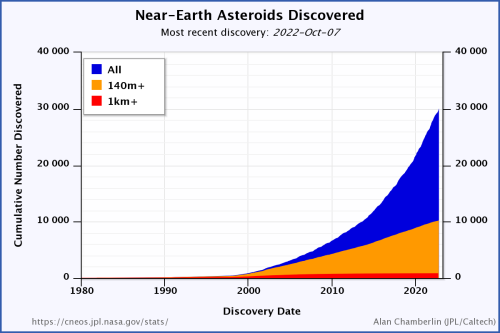
Chart of NEA's discovered over time

The catalog of known near Earth asteroids that have been identified using a number of survey telescopes in space and on the Earth now totals 30,039. As defined at the link:

An asteroid is called a near-Earth asteroid (NEA) when its trajectory brings it within 1.3 Astronomical Units (au) of the Sun. 1 au is the distance between the Sun and Earth, and so NEAs can come within at least 0.3 au, 45 million km, of our planet’s orbit.

Currently, near-Earth asteroids make up about a third of the roughly one million asteroids discovered so far in the Solar System. Most of them reside in the asteroid belt between Jupiter and Mars.

NEAs are also called NEOs (Near Earth Objects). The chart above, produced by the Center for NEO Studies which tracks these objects, shows the number of NEAs discovered over time.

Of the 30,039 now known, about 1,400 have orbits with “a non-zero” chance of hitting the Earth. None however will do so in the next hundred years at least.

Though the pace of discovery is vastly improving — as indicated by the steep rise in the curve in the graph — only when that curve begins to flatten out will we know that we are getting close to having a more-or-less complete survey of these objects.

5 comments

Shells of dust surrounding massive binary star

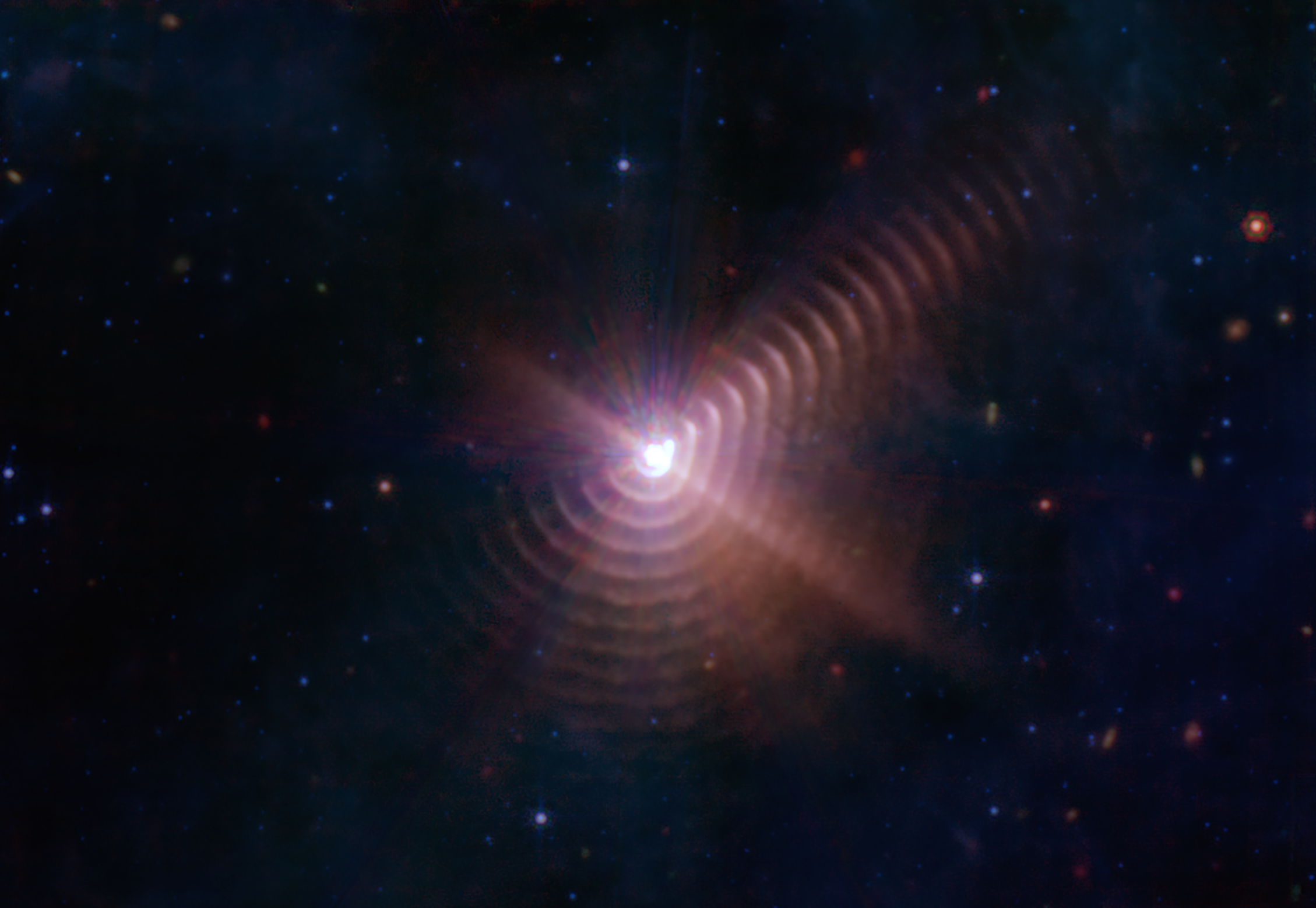
Webb infrared image of dust shells surrounding binary star system
Click for full image.

Cool image time! Using the Webb telescope, astronomers have detected a series of concentric shells surrounding the massive binary star dubbed Wolf-Rayet 140.

The infrared image to the right shows these shells quite clearly. As noted by astronomer Ryan Lau:

“On the night that my team’s Early Release Science observations of the dust-forming massive binary star Wolf-Rayet (WR) 140 were taken, I was puzzled by what I saw in the preview images from the Mid-Infrared Instrument (MIRI). There seemed to be a strange-looking diffraction pattern, and I worried that it was a visual effect created by the stars’ extreme brightness. However, as soon as I downloaded the final data I realized that I was not looking at a diffraction pattern, but instead rings of dust surrounding WR 140 – at least 17 of them.

“I was amazed. Although they resemble rings in the image, the true 3D geometry of those semi-circular features is better described as a shell. The shells of dust are formed each time the stars reach a point in their orbit where they are closest to each other and their stellar winds interact. The even spacing between the shells indicates that dust formation events are occurring like clockwork, once in each eight-year orbit. In this case, the 17 shells can be counted like tree rings, showing more than 130 years of dust formation. Our confidence in this interpretation of the image was strengthened by comparing our findings to the geometric dust models by Yinuo Han, a doctoral student at the University of Cambridge, which showed a near-perfect match to our observations.

Furthermore, the spectroscopy from Webb says these dust shells are carbon-enriched, showing that the dust released by these aged massive stars is a significant source of the carbon in the universe, the fundamental atom needed for life.

5 comments

DART’s impact shortened Dimorphus’s orbit around Didymos by 32 minutes

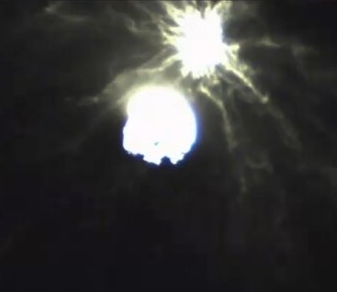
LICIACube Explorer image of DART impact
LICIACube Explorer image just after the DART
impact. Dimorphus is the blob near the top.

After two weeks of analyzing the orbit of Dimorphus around its parent asteroid Didymos, astronomers have determined that the impact of DART on Dimorphus shortened its orbit by 32 minutes.

Prior to DART’s impact, it took Dimorphos 11 hours and 55 minutes to orbit its larger parent asteroid, Didymos. Since DART’s intentional collision with Dimorphos on Sept. 26, astronomers have been using telescopes on Earth to measure how much that time has changed. Now, the investigation team has confirmed the spacecraft’s impact altered Dimorphos’ orbit around Didymos by 32 minutes, shortening the 11 hour and 55-minute orbit to 11 hours and 23 minutes. This measurement has a margin of uncertainty of approximately plus or minus 2 minutes.

Before its encounter, NASA had defined a minimum successful orbit period change of Dimorphos as change of 73 seconds or more. This early data show DART surpassed this minimum benchmark by more than 25 times.

It also appears the ejecta from the impact — much greater than expected — helped propel Dimorphus, a result that I think was also not expected.

Researchers are now shifting to studying the debris and asteroid itself, to better understand what happened as well as the nature of Dimorphus itself. This will also include a European probe dubbed Hera that will launch in 2024 an dvisit both asteroids in 2026.

14 comments

Webb gets first direct infrared image of exoplanet

Exoplanet as seen in the infrared by Webb

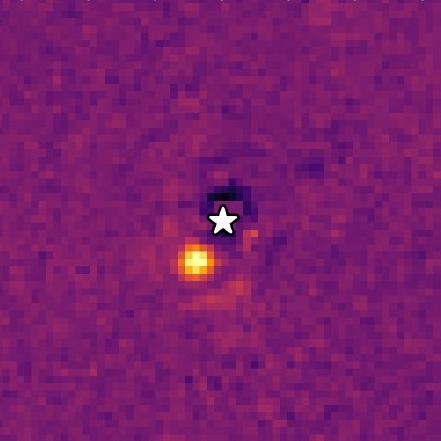
Using the Webb Space Telescope, scientists have obtained that telescope’s first direct infrared image of an exoplanet, covering four different wavelengths.

The image to the right is from the wavelength image with the least distortion (formed by Webb’s own optics and the shape of its mirror and indicated by the faint ring surrounding the planet). The star indicates the masked location of the star itself.

The planet is about seven times the mass of Jupiter and lies more than 100 times farther from its star than Earth sits from the sun, direct observations of exoplanet HIP 65426 b show. It’s also young, about 10 million or 20 million years old, compared with the more than 4-billion-year-old Earth.

You can download the full research paper here.

1 comment

Chandra takes an X-ray look at early Webb infrared observations

Chandra's X-ray vision of the Cartwheel Galaxy
Chandra’s X-ray view of the Cartwheel Galaxy

Webb's view of the Cartwheel Galaxy
Webb’s infrared view of the Cartwheel Galaxy
Click for full image.

Hubble's optical view of the Cartwheel Galaxy
Hubble’s optical view of the Cartwheel Galaxy. Click for original image.

Astronomers have now taken X-ray images using the orbital Chandra X-ray Observatory of four of the first Webb Space Telescope observations. The four targets were the Cartwheel Galaxy, Stephan’s Quintet, galaxy cluster SMACS 0723.3–7327, and the Carina Nebula.

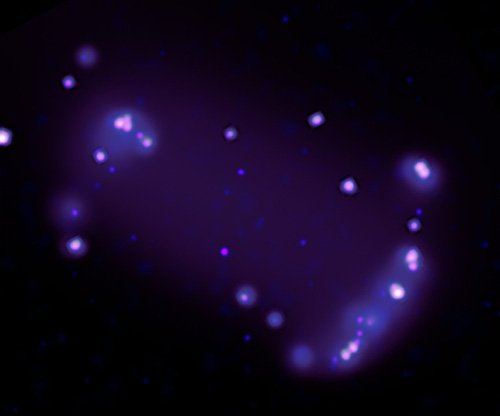
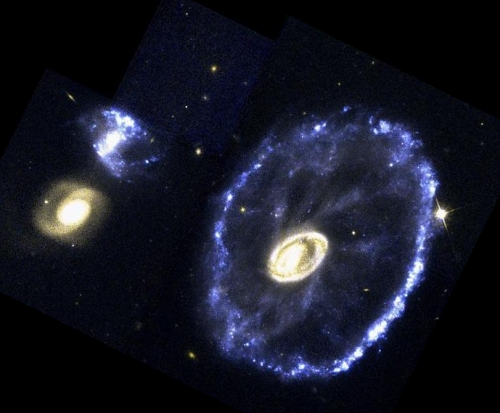
The three images to the right illustrate the importance of studying astronomy across the entire electromagnetic spectrum. Each shows the Cartwheel Galaxy as seen by three of the world’s most important space-based telescopes, each looking at the galaxy in a different wavelength.

The top picture is Chandra’s new X-ray observations. As the press release notes,

Chandra data generally show higher-energy phenomena (like superheated gas and the remnants of exploded stars) than Webb’s infrared view. … X-rays seen by Chandra (blue and purple) come from superheated gas, individual exploded stars, and neutron stars and black holes pulling material from companion stars.

The middle picture was produced by Webb, shortly after the start of its science operations. It looks at the galaxy in the infrared.

In this near- and mid-infrared composite image, MIRI data are colored red while NIRCam data are colored blue, orange, and yellow. Amidst the red swirls of dust, there are many individual blue dots, which represent individual stars or pockets of star formation. NIRCam also defines the difference between the older star populations and dense dust in the core and the younger star populations outside of it.

The bottom picture was taken by the Hubble Space Telescope in 1995. I have rotated the image to match the others. It looks at the galaxy in optical wavelengths, the wavelengths that our eyes perceive.

Note how bright the central galactic region is in the infrared and optical, but is invisible in X-rays. Chandra is telling us that all the most active regions in the Cartwheel are located in that outer ring, not in its center.

2 comments

Two days after DART’s impact of Dimorphus, ejected dust extends like a comet tail out more than 6,000 miles

Dust tail from Dimorphus two days after DART impact
Click for full image.

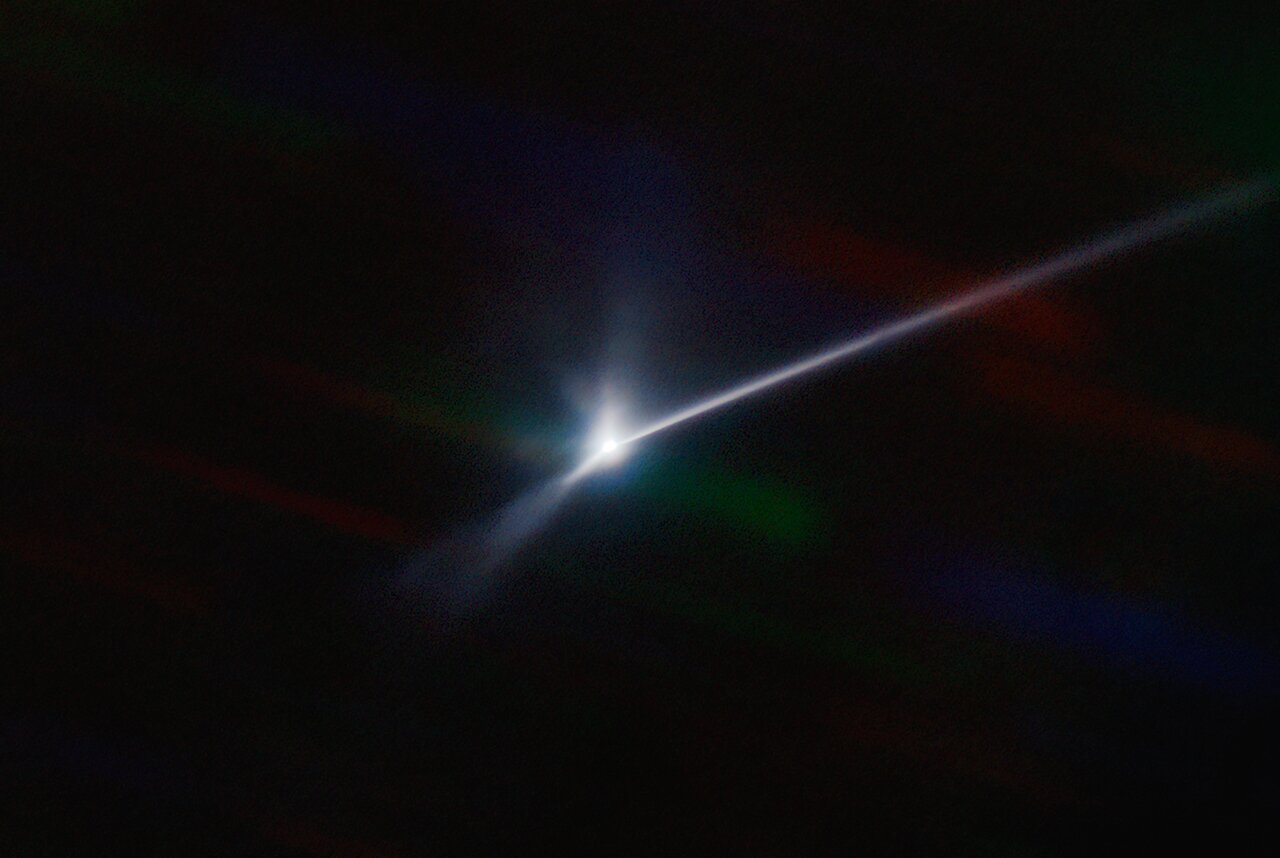
Using a telescope in Chile, astronomers photographed the ejecta two days after the impact of DART into the 525-foot-wide asteroid Dimorphus, and detected a tail of dust extending out more than 6,000 miles.

The picture to the right, cropped and reduced to post here, shows that tail.

In this new image, the dust trail — the ejecta that has been pushed away by the Sun’s radiation pressure, not unlike the tail of a comet — can be seen stretching from the center to the right-hand edge of the field of view. … At Didymos’s distance from Earth at the time of the observation, that would equate to at least 10,000 kilometers (6000 miles) from the point of impact.

Didymos is the larger parent asteroid that Dimorphus orbits.

It is still too soon to get the numbers on how Dimorphus’s path in space was changed by that impact. In fact, we still really don’t have a clear idea what is left of Dimophus itself. The ejecta cloud needs to clear somewhat to see what’s hidden inside it.

5 comments

Interacting galaxies

Interacting galaxies
Click for full image.

The news is light this morning, so this cool image will be the first of three. The picture to the right, cropped and reduced to post here, was taken by the Hubble Space Telescope and released today. From the caption:

The two interacting galaxies making up the pair known as Arp-Madore 608-333 seem to float side by side in this image from the NASA/ESA Hubble Space Telescope. Though they appear serene and unperturbed, the two are subtly warping one another through a mutual gravitational interaction that is disrupting and distorting both galaxies.

I did a search for any research of this galaxy pair, and found that its identification was only part of a larger survey, with only a little research done on its spectroscopy. Thus, I can’t tell you the size or distance, or how far apart from each other these galaxies lie.

0 comments

SpaceX and Jared Isaacman offer private mission to NASA to raise Hubble’s orbit

Capitalism in space: In a press release issued yesterday, NASA revealed that it has signed an unfunded agreement with SpaceX and Jared Isaacman’s Polaris program (which has purchased a series of manned missions on Dragon) to study the possibility of sending one of those private manned missions to the Hubble Space Telescope to raise its orbit.

SpaceX – in partnership with the Polaris Program – proposed this study to better understand the technical challenges associated with servicing missions. This study is non-exclusive, and other companies may propose similar studies with different rockets or spacecraft as their model.

Teams expect the study to take up to six months, collecting technical data from both Hubble and the SpaceX Dragon spacecraft. This data will help determine whether it would be possible to safely rendezvous, dock, and move the telescope into a more stable orbit.

In my book describing the history of the people who created Hubble, The Universe in a Mirror, I repeatedly noted how throughout its history people have tried to kill it, first in the design phase, then in the budget, then during construction, then after it was launched and the mirror was found to be ground incorrectly, and then after the Columbia accident when NASA management tried to cancel its last shuttle servicing mission.

Every attempt failed. As I have noted in that book and many times since its publication, Hubble is a telescope that will not die. NASA has for years intended to launch a mission to de-orbit it when its orbit had decayed enough that it was unstable. I’ve always said that when that time came, someone would propose and push for a mission to instead raise that orbit.

That prediction is now coming true. Though no robot arm exists yet for Dragon to use to grab Hubble in any rendezvous attempt, creating one is hardly difficult. At that point raising the telescope’s orbit becomes relatively trivial.

Whether such a mission could do more, such as replace Hubble’s ailing gyroscopes, is unknown. It would be foolish however not to review that possibility as well.

12 comments
1 25 26 27 28 29 114