Initial Webb results revised because telescope wasn’t yet fully calibrated

The uncertainty of science: Though it appears that no results will have to be abandoned, the scientists who published some of the very first results from the Webb Space Telescope have been scrambling to adjust and revise their papers because the telescope is only now getting fully calibrated.

“This caused a little bit of panic,” says Nathan Adams, an astronomer at the University of Manchester, UK, who, along with his colleagues, pointed out the problem in a 9 August update to a preprint they had posted in late July3. “For those including myself who had written a paper within the first two weeks, it was a bit of — ‘Oh no, is everything that we’ve done wrong, does it all need to go in the bin?’”

To try to standardize all the measurements, the STScI is working through a detailed plan to point Webb at several types of well-understood star, and observe them with every detector in every mode for every instrument on the telescope4. “It just takes a while,” says Karl Gordon, an astronomer at the STScI who helps lead the effort.

In the meantime, astronomers have been reworking manuscripts that describe distant galaxies on the basis of Webb data. “Everyone’s gone back over and had a second look, and it’s not as bad as we thought,” Adams says. Many of the most exciting distant-galaxy candidates still seem to be at or near the distance originally estimated. But other preliminary studies, such as those that draw conclusions about the early Universe by comparing large numbers of faint galaxies, might not stand the test of time. Other fields of research, such as planetary studies, are not affected as much because they depend less on these preliminary brightness measurements.

Overall, it does not appear the more precise calibrations will change much of signficance, since most of the earliest observations were simply that, observations, not theoretical. Because the distance estimates remain largely unchanged however the theorists are left with the same conundrum: The age and apparent nature of the most distant objects does not seem to fit with what the theories had predicted Webb would see.

1 comment

Hubble & Webb make first coordinated observations, tracking DART impact of Dimorphus

Webb and Hubble together look at DART impact of Dimorphus
Click for full image.

For the first time scientists have used both the Hubble Space Telescope and the James Webb Space Telescope to observe the same astronomical event, in this case the impact of the DART spacecraft on the asteroid Dimorphus on September 26, 2022.

The two images to the right show the asteroid several hours after impact. Both telescopes also captured images before the impact as well. From the press release:

Observations from Webb and Hubble together will allow scientists to gain knowledge about the nature of the surface of Dimorphos, how much material was ejected by the collision, and how fast it was ejected. Additionally, Webb and Hubble captured the impact in different wavelengths of light – Webb in infrared and Hubble in visible. Observing the impact across a wide array of wavelengths will reveal the distribution of particle sizes in the expanding dust cloud, helping to determine whether it threw off lots of big chunks or mostly fine dust. Combining this information, along with ground-based telescope observations, will help scientists to understand how effectively a kinetic impact can modify an asteroid’s orbit.

When Webb was first conceived in the late 1990s, it was exactly for this reason, to combine Hubble’s optical vision with Webb’s infrared view. Though more than a decade late, it has finally happened.

It will be months before scientists begin to decipher the data produced by all the telescopes and spacecraft used to observe the DART impact. What we are seeing now are merely hints at what has been learned.

10 comments

Celestron to modify commercial amateur telescope for space use

Capitalism in space: Amateur telescope manufacturer Celestron has signed a deal to adapt one of its more expensive ground-based telescopes for use in space.

Trans Astronautica Corp. announced an agreement Sept. 27 with telescope manufacturer Celestron to develop a space-qualified version of the company’s Rowe-Ackermann Schmidt Astrograph (RASA) ground-based telescope. “We’ve been using Celestron’s RASA telescopes in our space domain awareness and asteroid prospecting systems, and we found them to be very affordable, high-quality optical systems,” Joel Sercel, TransAstra founder and CEO, told SpaceNews. “We looked at the designs and we realized it would not be that hard to adapt them for space use.”

Over the next year, TransAstra plans to modify the RASA telescope design and substitute materials to produce a telescope that can withstand radiation exposure, temperature swings, and the vibration and shock loads of space launch.

TransAstra provides tracking data on space junk to both the commercial and defense industry. It also has a new deal to use its telescopes to provide schools use of these telescopes for educational purposes. The goal is to put this capability into orbit.

The future ramifications however are profound. Once Celestron has a commercial relatively inexpensive telescope capable of operating in space (or on the Moon), it will not take long before customers begin lining up eager to buy and launch it. Think about it: though there will be engineering issues to overcome, the cost of placing one of these telescopes on one of the new commercial lunar landers for operation on the Moon will not be far beyond the budgets of many amateur astronomers, some of whom spend hundreds of thousands of dollars on their own ground-based observatories.

9 comments

First ground-based telescope view of DART impact on Dimorphus

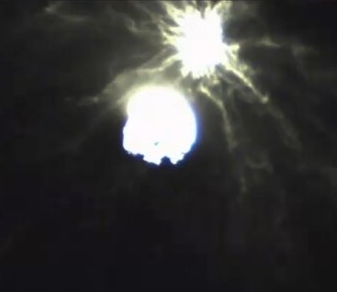
LICIACube Explorer image of DART impact

We now have the first ground-based images of the DART impact on the 525-foot-wide asteroid Dimorphus yesterday, captured by the Hawaiian telescope ATLAS.

You need to watch the video of the full sequence of images, available here, to get a true sense of the impact. The cloud of material quickly expands to about twice the asteroid’s size, then dissipates away, with the remaining asteroid now appearing larger (?). That larger size could be caused by a remaining cloud of material that still needs to settle back to the surface.

More images have been released by a Chinese telescope. Also, the first images from the Italian cubesat LICIACube Explorer, flying in parallel with DART, have been released. I have posted one to the right. The large blob near the center is the parent half-mile-wide asteroid, Didymos. Dimorphus is buried in the debris cloud above and slightly to the right.

Hat tip stringer Jay for the links to these images.

1 comment

DART hits Dimorphus

Didymos and Dimorphus

Dimorphus

The surface of Dimorphus

The probe DART today successfully impacted the small 525-foot-wide asteroid Dimorphus. From the data produced engineers will calculate how much that impact changed Dimorphus’ orbit around it parent asteroid, half-mile-wide Didymos.

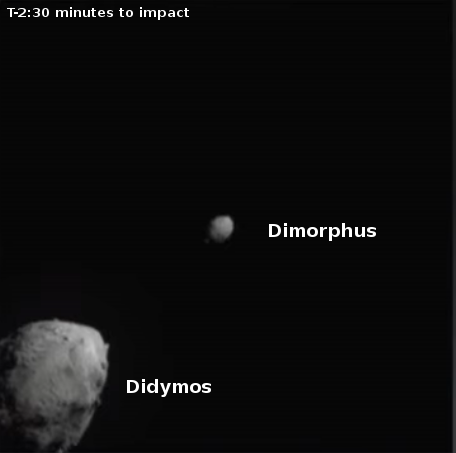
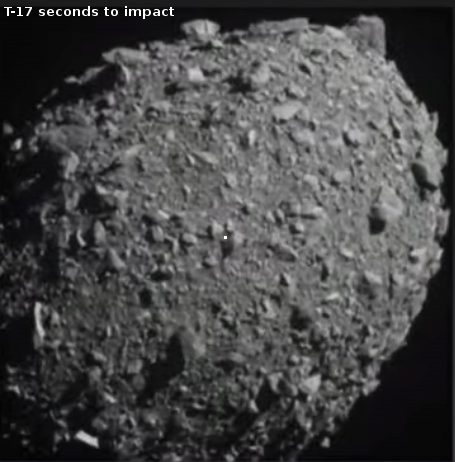
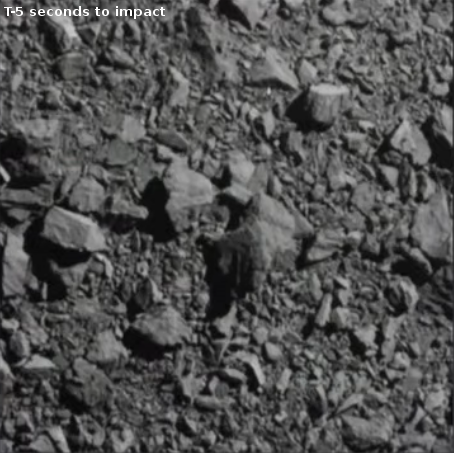
The three images to the right give a sense of the approach and impact.

The first, at 2 minutes and 30 seconds from impact, shows Didymos in the left bottom corner. You can actually see individual boulders on its surface. At this distance and resolution is is unclear whether it is a rubble pile or a more solid body. Dimorphus is no longer a mere dot, but no surface features can yet be discerned.

The second image, only seventeen seconds before DART crashed into Dimorphus, shows us the entire asteroid. Though it appears to be a pile of rocks, it also appears less of a rubble pile than both Ryugu and Bennu, visited by probes in 2019 and 2020. Those rubble-piles had almost no smooth surface areas. Dimorphus however at this distance and resolution does appear to have a lot of areas where the surface is relatively smooth, suggesting its structure is more solid than a rubble pile.

At only 525 feet across, some of those bigger boulders are about 50 to 60 feet in diameter.

The white dot in the center of Dimorphus marks the rocks seen in the third image, taken about five seconds before impact. At this resolution so close to the surface, it appears the smooth areas are actually made up of many tiny pebbles and dust.

The biggest rock in the center of the picture is probably between ten to twenty feet in diameter.

The primary data from this mission will not be available for a few weeks. Scientists have to observe both asteroids to see how much, if at all, Dimorphus’s orbit was shifted by the impact. Also, the images from the Italian cubesat, LICIACube Explorer, which was flying parallel to DART and taking pictures of the impact, plume, and back side of Dimorphus, won’t be available until later this week. Those images should give us a measure of the spacecraft’s effect on the asteroid. They will also reveal a lot more about the asteroid’s geology.

12 comments

A galaxy slowly being eaten by its black hole

Spiral galaxy
Click for full image.

Cool image time! The photo to the right, rotated and reduced to post here, was taken by the Hubble Space Telescope. From the caption:

NGC 5495, which lies around 300 million light-years from Earth in the constellation Hydra, is a Seyfert galaxy, a type of galaxy with a particularly bright central region. These luminous cores — known to astronomers as active galactic nuclei — are dominated by the light emitted by dust and gas falling into a supermassive black hole. This image is drawn from a series of observations captured by astronomers studying supermassive black holes lurking in the hearts of other galaxies.

Essentially Seyfert galaxies are galaxies whose central supermassive black hole has become dominant, large enough that its gravity is slowly eating up the rest of the galaxy. As it increasingly swallows stars and gas, the black hole emits more and more energy, thus becoming an active galactic nuclei.

Two stars from our own galaxy also dominate this picture, one inside and to the right of the galaxy’s center, and the other the bright star at the bottom of the picture, both identified by the diffraction spikes.

1 comment

Webb’s first infrared image of Neptune

Webb's infrared view of Neptune
Click for full image.

The science team for the James Webb Space Telescope today released that telescope’s first infrared image of Neptune.

That image is to the right, cropped and reduced slightly to post here. It is, as the press release touts, the best view in decades of Neptune’s rings. From the caption:

The most prominent features of Neptune’s atmosphere in this image are a series of bright patches in the planet’s southern hemisphere that represent high-altitude methane-ice clouds. More subtly, a thin line of brightness circling the planet’s equator could be a visual signature of global atmospheric circulation that powers Neptune’s winds and storms. Additionally, for the first time, Webb has teased out a continuous band of high-latitude clouds surrounding a previously-known vortex at Neptune’s southern pole.

The dots around the gas giant are the heat signatures of seven of its fourteen moons.

1 comment

Webb instrument has technical issue partly preventing its use

Because a an issue with the mid-infrared instrument (MIRI) on the James Webb Space Telescope, the telescope’s engineering team has paused use of that instrument while it reviews the situation.

On Aug. 24, a mechanism that supports one of these modes, known as medium-resolution spectroscopy (MRS), exhibited what appears to be increased friction during setup for a science observation. This mechanism is a grating wheel that allows scientists to select between short, medium, and longer wavelengths when making observations using the MRS mode. Following preliminary health checks and investigations into the issue, an anomaly review board was convened Sept. 6 to assess the best path forward.

The Webb team has paused in scheduling observations using this particular observing mode while they continue to analyze its behavior and are currently developing strategies to resume MRS observations as soon as possible. The observatory is in good health, and MIRI’s other three observing modes – imaging, low-resolution spectroscopy, and coronagraphy – are operating normally and remain available for science observations.

I am quoting almost entirely NASA’s short announcement. The announcement is vague, confusing, and (quite typically) written to minimize the reality of the issue. I can’t figure out how MIRI’s other observing modes are available if they have paused use of a mechanism that allows them to choose modes.

Regardless, Webb is awful young to have this kind of problem.

0 comments

Interstellar clouds backlit by nearby massive star

Interstellar clouds backlit by nearby massive star
Click for full image.

Cool image time! The photo to the right, cropped and reduce to post here, was taken by the Hubble Space Telescope of what astronomers believe is a newly formed massive star about 9,000 light years away that has periodically spewed out material during eruptions.

The scientists hope to use Hubble to determine the speed in which this material is flying away from the star by taking pictures at intervals and then measuring the amount of change from image to image. This data will also allow the scientists to better gauge the distance to this star, as well as its actual mass, information that will help them better understand what is happening.

I highlight this picture however simply because of its beauty. The interstellar clouds on the left are all apparently backlit by the brightest star on the right, and thus their shape is easy to perceive.

1 comment

Webb takes its first infrared image of Mars

Webb's first infrared image of Mars
Click for full image.

Astronomers have now released the the James Webb Space Telescope’s first infrared image of Mars, taken on September 5, 2022.

The image to the right, cropped and reduced to post here, shows some of the data obtained. Because Mars is so close, it is actually too bright for Webb’s instruments. To get any data, the exposures were very very short, and still the brightest areas — as indicated by large areas of yellow — are overexposed. The cause of the different brightness of Hellas Basin, however, is not simply because the basin — the deepest point on Mars — is cooler.

As light emitted by the planet passes through Mars’ atmosphere, some gets absorbed by carbon dioxide (CO2) molecules. The Hellas Basin – which is the largest well-preserved impact structure on Mars, spanning more than 1,200 miles (2,000 kilometers) – appears darker than the surroundings because of this effect. “This is actually not a thermal effect at Hellas,” explained the principal investigator, Geronimo Villanueva of NASA’s Goddard Space Flight Center, who designed these Webb observations. “The Hellas Basin is a lower altitude, and thus experiences higher air pressure. That higher pressure leads to a suppression of the thermal emission at this particular wavelength range [4.1-4.4 microns] due to an effect called pressure broadening. It will be very interesting to tease apart these competing effects in these data.”

The NASA press release says the scientists are preparing a paper analyzing the spectral data and what it revealed about “dust, icy clouds, what kind of rocks are on the planet’s surface, and the composition of the atmosphere,” I suspect however that Webb’s capabilities for studying Mars are much more limited than implied, and that it will over time take much fewer images of the red planet, compared to Hubble.

0 comments

New theory: Saturn’s rings came from a lost and destroyed moon

The uncertainty of science: According to a new computer simulation, scientists have proposed that the reason Saturn’s rings are tilted 27 degrees is because they were created by the destruction of a moon 160 million years ago, an event that was also linked to the way the orbits of Saturn and Neptune interact, combined with the on-going slow evolutionary changes in Titan’s orbit around Saturn.

Wisdom and his colleagues believe Saturn acquired its tilt because of a peculiar synchronicity: the precession of Saturn’s spin axis—the way it wobbles like a top with a particular rhythm—is suspiciously in tune with a precession in Neptune’s orbit. If Saturn and Neptune were trapped in this resonance, Saturn’s tilt would be “kind of vulnerable to other forces that could cause it to change,” says Rola Dbouk, an MIT graduate student in planetary science. In 2020, Cassini scientists discovered what the study team thinks is that external stimulus: Titan, Saturn’s largest moon, is migrating away from Saturn by 11 centimeters a year. In a study published today in Science, Dbouk, Wisdom, and colleagues show how Titan’s migration, in combination with the Saturn-Neptune resonance, could have ratcheted up Saturn’s tilt over the course of 1 billion years.

The work also yielded a potential explanation for the origin of Saturn’s rings. Using Cassini’s measurements of Saturn’s gravitational fields to model the planet’s interior structure, the researchers refined calculations for the wobble of Saturn’s spin axis and found it is no longer in sync with Neptune. “Something kicked it out of the resonance,” Dbouk says. They first ruled out the possibility that chaotic changes in the orbits of some of the largest of Saturn’s dozens of moons could be responsible. But when they added another moon to the mix, things got interesting.

In simulations, the researchers included an object about the size of Iapetus, Saturn’s third largest moon, orbiting about 43 Saturn radii out—between the orbits of Titan and Iapetus. They found this moon could have provided the necessary nudge to the resonance if it were suddenly knocked from its orbit because of chaotic interactions with its neighbors about 160 million years ago.

To say that this theory is uncertain is no different that saying the sky is blue. It is so uncertain that it is difficult to take it seriously. It could be right, but as one scientist quoted at the article noted, there is no way to test it.

3 comments

Overlapping galaxies

Overlapping galaxies, as seen by Hubble
Click for full image.

Cool image time! The picture to the right, cropped and reduced to post here, was taken by astronomers using the Hubble Space Telescope, and captures two galaxies that happen to overlap in their line of sight to Earth.

The two galaxies, which have the uninspiring names SDSS J115331 and LEDA 2073461, lie more than a billion light-years from Earth. Despite appearing to collide in this image, the alignment of the two galaxies is likely just by chance — the two are not actually interacting.

This image was taken as part of the citizen-scientist project dubbed Galaxy Zoo, whereby volunteers review lower resolution images of strange-looking galaxies and propose the best for Hubble higher resolution imaging.

2 comments

Astronomers propose method for predicting the stars that will go supernovae

The uncertainty of science: Using a computer model based on the most recent data that suggests red supergiant stars like Betelgeuse are the kind of stars that produce certain kinds of supernovae, astronomers now think they have a method for predicting which of those stars are about to go supernovae.

You can read the science paper here. From the link above:

In a few examples, astronomers have looked back at old catalogs and found images of the stars before they exploded, and they all seem to be red supergiants like Betelgeuse. That’s a clear indication that those kinds of stars are supernova candidates, ready to go off at a moment’s notice.

The stars that result in these kinds of supernovas are thought to have dense shrouds of material surrounding them before they explode. These shrouds are orders of magnitude denser than what’s measured around Betelgeuse.

More importantly, the data suggests that once this shroud of material forms, the supernova will follow, in just a few years. As the scientists conclude in their paper:

The final overarching conclusion we can make from this work is that, shortly before core-collapse, [red supergiants] must undergo some prodigious mass-losing event which radically alters the appearance of the star. Therefore, the signature of an imminent explosion should be a dramatic change in the progenitor stars’ optical – near-IR photometry on timescales of less than a month. Such a signature should be detectable in the coming era of wide-field short cadence photometry. [emphasis mine]

Near-IR (infrared) photometry is exactly in the wavelengths in which the James Webb Space Telescope operates. Thus, if it is lucky and sees this kind of star in an image, and a supernova follows shortly thereafter, this theory will have been proven correct.

3 comments

Inouye Solar Telescope begins science operations

The National Science Foundation yesterday announced the inauguration of science operations of the Daniel K. Inouye Solar Telescope in Hawaii.

The sample first images provided at the link are excellent, but rather than show this telescope’s abilities, they instead illustrate the absurdity of spending millions to build a ground-based telescope. None compare with the spectacular high resolution solar images being produced today from the myriad of solar telescopes in space.

Moreover, the history of this telescope tells us much about the bankrupt nature of all modern government projects:

Over 25 years ago, the NSF invested in creating a world-leading, ground-based solar observatory to confront the most pressing questions in solar physics and space weather events that impact Earth. This vision, executed by the Association of Universities for Research in Astronomy (AURA) through the NSF’s National Solar Observatory (NSO), was realized during the formal inauguration of the Inouye Solar Telescope. [emphasis mine]

It took our modern incompetent federal government a quarter century to build this single telescope. Compare that with the construction of the solar telescopes it is replacing. They were conceived, designed, and built in much less than a decade back in the early 1960s. And cost less too.

The press release at the link also spends a lot of space touting “diversity” and “Native Hawaiian” cultural needs, which really have nothing to do with the study of the Sun. That focus tells us how misguided our government has become, and how it is using its coercive power to drag us all along down that foolish path towards hell.

2 comments

Webb’s infrared view of the Tarantula Nebula

Two views of the Tarantula Nebula by Webb
Click for original image.

The two images to the right, reduced and annotated to post here, were released today by the science team of the James Webb Space Telescope, and show two different views of the Tarantula Nebula, located 161,000 light years away in the Large Magellanic Cloud.

It is home to the hottest, most massive stars known. Astronomers focused three of Webb’s high-resolution infrared instruments on the Tarantula. Viewed with Webb’s Near-Infrared Camera (NIRCam) [top], the region resembles a burrowing tarantula’s home, lined with its silk. The nebula’s cavity centered in the NIRCam image has been hollowed out by blistering radiation from a cluster of massive young stars, which sparkle pale blue in the image. Only the densest surrounding areas of the nebula resist erosion by these stars’ powerful stellar winds, forming pillars that appear to point back toward the cluster. These pillars contain forming protostars, which will eventually emerge from their dusty cocoons and take their turn shaping the nebula.

…The region takes on a different appearance when viewed in the longer infrared wavelengths detected by Webb’s Mid-infrared Instrument (MIRI) [bottom]. The hot stars fade, and the cooler gas and dust glow. Within the stellar nursery clouds, points of light indicate embedded protostars, still gaining mass. While shorter wavelengths of light are absorbed or scattered by dust grains in the nebula, and therefore never reach Webb to be detected, longer mid-infrared wavelengths penetrate that dust, ultimately revealing a previously unseen cosmic environment.

As with all images from Webb, these are false color, as the telescope views the infrared heat produced by stars and galaxies and interstellar clouds, not the optical light our eyes see. Thus, the scientists assign different colors to the range of wavelengths each instrument on Webb captures.

These photos once again illustrate Webb’s value. It will provide a new layer of data to supplement the basic visual information provided by the Hubble Space Telescope, allowing scientists to better understand the puzzles we see in the optical.

8 comments

Webb obtains first direct infrared images of exoplanet

Webb's first infrared images of an exoplanet
Click for original image.

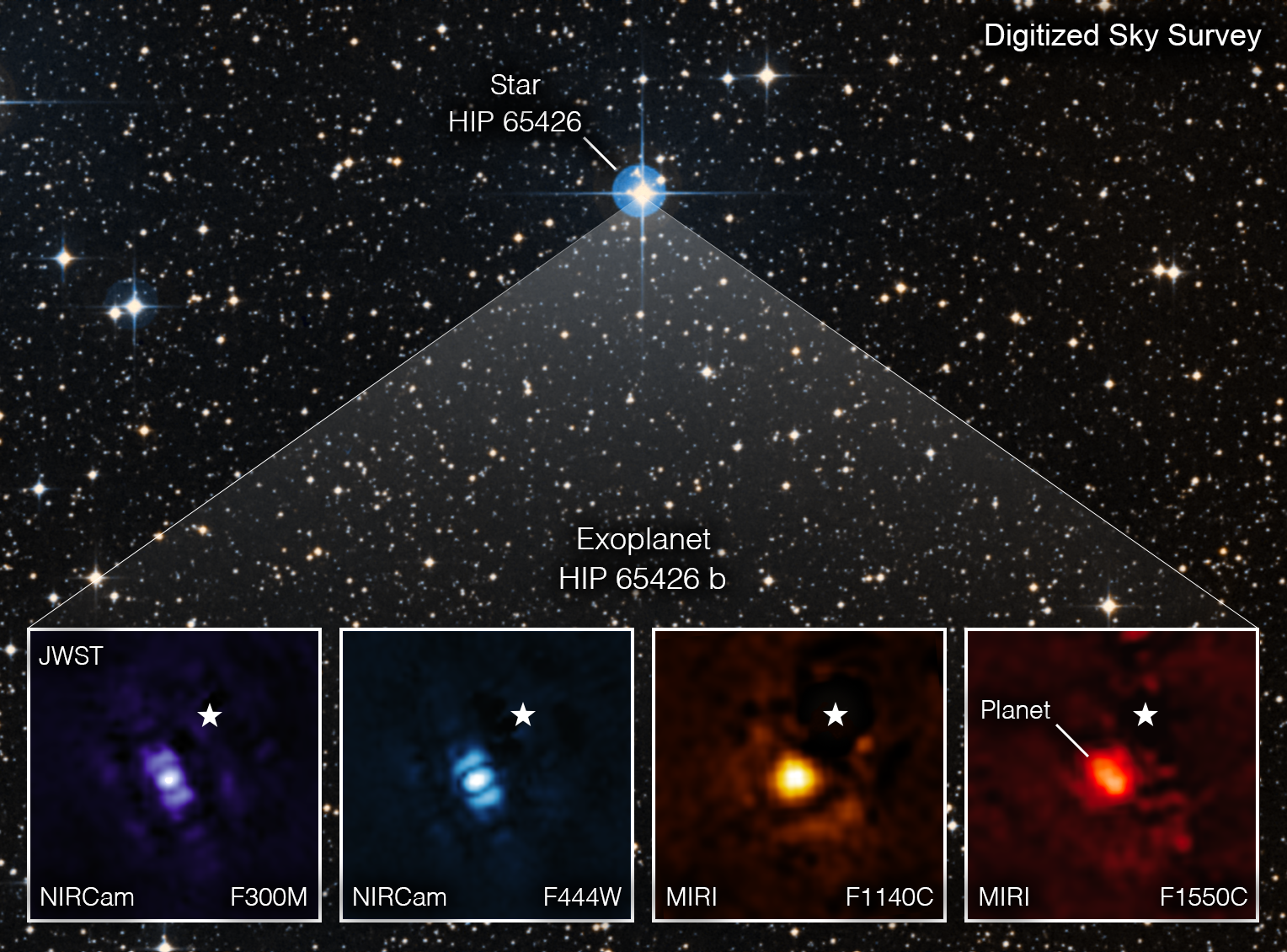
Using four different infrared instruments on the James Webb Space Telescope, astronomers have obtained the first infrared images of a gas giant with a mass about six to twelve times larger than Jupiter and circling about 100 times farther from its sun.

The montage to the right shows these four images. The white star marks the location of this star, the light of which was blocked out to make the planet’s dim light visible. The bar shapes on either side of the planet in the NIRCam images are artifacts from the instrument’s optics, not objects surrounding the planet.

This is not the first direct image of an exoplanet, as the Hubble Space Telescope has already done so, and done it in the visible spectrum that humans use to see. However, Webb’s infrared images provide a great deal of additional detail about this planet and its immediate surroundings that optical images would not. For example, the MIRI images appear to show us the outer atmosphere of this gas giant.

1 comment

Webb’s infrared view of a face-on spiral galaxy

M74, as seen by Webb and Hubble combined
Click for original image.

Using the James Webb Space Telescope, astronomers have produced a false-color infrared view of M74, a face-on spiral galaxy located 32 million light years away.

The montage above shows that image to the right, with a Hubble optical image to the left. In the center both images are combined.

The addition of crystal-clear Webb observations at longer wavelengths will allow astronomers to pinpoint star-forming regions in the galaxies, accurately measure the masses and ages of star clusters, and gain insights into the nature of the small grains of dust drifting in interstellar space.

Because infrared can see through cold dust, it provides a much sharper view of this galaxy’s central regions.

7 comments

Webb detects carbon dioxide in atmosphere of exoplanet

Scientists using the James Webb Space Telescope have detected carbon dioxide in the atmosphere of a hot gas giant exoplanet about 700 light years away.

WASP-39 b is a hot gas-giant with a mass roughly one-quarter that of Jupiter (about the same as Saturn) and a diameter 1.3 times greater than Jupiter. Its extreme puffiness is partly related to its high temperature (about 900° Celsius or 1170 Kelvin). Unlike the cooler, more compact gas giants in our solar system, WASP-39 b orbits very close to its star – only about one-eighth the distance between the Sun and Mercury – completing one circuit in just over four Earth-days. The planet’s discovery, reported in 2011, was made based on ground-based detections of the subtle, periodic dimming of light from its host star as the planet transits or passes in front of the star.

Previous observations from other telescopes, including the Hubble and Spitzer space telescopes, revealed the presence of water vapour, sodium, and potassium in the planet’s atmosphere. Webb’s unmatched infrared sensitivity has now confirmed the presence of carbon dioxide on this planet as well.

This is only the beginning. Astronomers have told me repeatedly that the most important area of research in astronomy in the next few decades will be the study of known exoplanets and their make-up. Webb is now a new tool in that effort. Combined with other telescopes looking at other wavelengths scientists will be able to identify a whole range of molecules in the atmospheres of these transiting exoplanets. We will begin to get our first glimpse into what other solar systems are like.

1 comment

Another Webb infrared image of Jupiter released

Jupiter as seen in the infrared by Webb
Click for original image.

The science team for the James Webb Space Telescope today released another infrared false-color image of Jupiter, this time processed for science instead of calibration of the telescope after launch.

That image is to the right, reduced to post here. From the caption:

Several exposures in three different filters were assembled to create this mosaic, after being corrected for the rotation of the planet. The combination of filters yields an image whose colors denote the height of the clouds and the intensity of auroral emissions.

The F360M filter (mapped to the red-orange colors) is sensitive to light reflected from the lower clouds and upper hazes. The red features in the polar regions are auroral emissions, caused by ions excited through collisions with charged particles at altitudes up to 1000 km above the cloud level. Auroral emission in red is evident in the northern and southern polar regions and reaches high above the limb of the planet. In the F212N filter (mapped to yellow-green colors), the gaseous methane in Jupiter’s atmosphere absorbs light; the greenish areas around the polar regions come from stratospheric hazes 100-200 km above the cloud level. The stratospheric haze that appears green in this composite is also concentrated in the polar regions, but extends down to equatorial latitudes and can also be seen along the limbs (edges) of the planet. The cyan channel holds the F150W2 filter, which is primarily sensitive to reflected light from the Jupiter’s deeper main cloud level at about one bar.

The Great Red Spot, the hazy equatorial region and myriad small storm systems appear white (or reddish-white) in this false-color image. Regions with little cloud cover appear as dark ribbons north of the equatorial region. Some dark regions — for example, those next to the Great Red Spot and in cyclonic features in the southern hemisphere — are also dark-colored when observed in visible wavelengths.

This image is part of the telescope’s early release science program.

7 comments

Universe’s most massive star is found to be less massive than previously believed

The uncertainty of science: Using data from the Gemini South telescope in Chile, astronomers have determined that the universe’s most massive star, dubbed R136a1, is actually less massive than previously believed.

By pushing the capabilities of the Zorro instrument on the Gemini South telescope of the International Gemini Observatory, operated by NSF’s NOIRLab, astronomers have obtained the sharpest-ever image of R136a1 — the most massive known star. This colossal star is a member of the R136 star cluster, which lies about 160,000 light-years from Earth in the center of the Tarantula Nebula in the Large Magellanic Cloud, a dwarf companion galaxy of the Milky Way.

Previous observations suggested that R136a1 had a mass somewhere between 250 to 320 times the mass of the Sun. The new Zorro observations, however, indicate that this giant star may be only 170 to 230 times the mass of the Sun. Even with this lower estimate, R136a1 still qualifies as the most massive known star.

What astronomers are trying to figure out is the highest possible mass a star can possibly have. This new data suggests that this upper limit is smaller than previously believed.

4 comments
1 26 27 28 29 30 114