Tag: budget
The job boom for government regulators under Obama
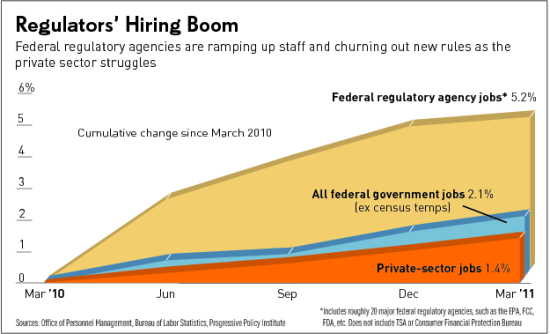
The chart of the day, from John Merlune at Investor’s Business Daily:

Merlune’s article outlines in frightening detail how there has been a job boom in only one place during the Obama administration, the government regulatory industry.
Regulatory agencies have seen their combined budgets grow a healthy 16% since 2008, topping $54 billion, according to the annual “Regulator’s Budget,” compiled by George Washington University and Washington University in St. Louis. That’s at a time when the overall economy grew a paltry 5%.
Meanwhile, employment at these agencies has climbed 13% since Obama took office to more than 281,000, while private-sector jobs shrank by 5.6%.
Justice Department has begun an investigation of Standard & Poor
Revenge and the abuse of power: The Obama Justice Department has begun an investigation of Standard & Poor.
“The left is going to have to compromise and cut some domestic welfare spending, and the right is going to have to compromise and cut some military spending.β
A government that kills
500 billion new reasons to repeal Obamacare
Making hard choices
A new poll shows that the congressional special election to replace Anthony Weiner in the traditionally Democratic district in Queens/Brooklyn, New York is surprisingly competitive.
The poll found [Democrat] Weprin, a state assemblyman, leading [Republican] Turner, a retired broadcasting executive, 48 percent to 42 percent in the race for the Democratic-friendly Queens and Brooklyn-area seat.
Two thoughts: First, this poll fits with another that shows for the first time a majority of adults don’t want their own Congressman reelected. If so, it shouldn’t be surprising that the Democrat appears so weak in Brooklyn/Queens, a place I lived for most of my life and a place I found to be so knee-jerk Democrat that you couldn’t admit to being Republican without risking being blacklisted from all things.
Second, despite the mess the federal government is in as well as the disgraceful scandal that caused the previously elected Democratic Congressman to resign, it is also not surprising that 48 percent of the population still wants to vote Democrat in this district. This is my biggest fear: the continuing unwillingness of too many Americans to honestly face our government’s budget problems.
» Read more
2012 is gonna be nasty
Thereβs no doubt that weβre in for a high level of personal nastiness and invective. This election is not going to be about some minor adjustment to spending, or some trifling adjustment of tax rates, or some nibbling at the edges of the regulatory state. What is at stake in the 2012 election is the continuation of a world-view; a political philosophy that sees ever-larger government as the cure to whatever ails us. This next election is the first big battle for the survival of that worldview as the majority view of the political class, or the survival of the insurgent TEA party idea that government has become to large, too intrusive, and too expensive, so therefore must be radically reduced. There is little room to compromise between these two visions of government. Indeed, in most ways, they are worldviews that are mutually exclusive. Over the next decade or so, we are going to learn which of these two views will prevail, and if the US, as presently composed, will remain a united polity.
Wisconsin Republicans hold off Democrats in recall elections
Wisconsin Republicans have held off the Democrats in the first round of recall elections.
Lying for Politicians
With the recently passed debt ceiling deal, there are going to be a lot of news reports talking about how that deal is going to force cuts and reductions in government spending. Everyone one of these stories will be a lie.
Take for example this story today in Nature, discussing the fate of science research under the deal. Here is how they describe what will happen if the Congressional “super-committee” cannot come up with an agreement and across-the-board “cuts” are triggered:
“Then there will be extraordinary pain,” says Michael Lubell, director of public affairs for the American Physical Society in Washington DC. “And it will get worse in 2014.”
The two-stage structure of the debt deal explains both the short-term reprieve and the long-term worry. The first set of agreed cuts, totalling US$917 billion, will be spread over 10 years, but two factors mitigate their effect. First, reductions to defence spending will account for a significant share of the cuts β meaning that other US agencies won’t bear the entire burden. Second, the cuts are heavily loaded forward onto the 2014 fiscal year and beyond, in an apparent effort to shelter the current fragile economy. Only minimal cuts will be implemented in fiscal years 2012 and 2013.
The trouble with this is that it is simply not true. There will be no cuts at all, under any condition, according the debt deal.
» Read more
Federal payments required by Obamacare understate the cost by as much as $50 billion
Finding out what’s in it: Federal payments required by Obamacare actually understate the cost by as much as $50 billion, according to a new study.
In May a congressional committee set the accounting rules that determine who will qualify for federal health care subsidies under the 2010 Patient Protection and Affordable Care Act. When the committee handed down the rules to the Congressional Budget Office, its formula excluded the health care costs of millions of workersβ spouses and children. The result was a final estimate for 2010 that hides those costs.
Treasury Adds Another $20 Billion In Debt Overnight, Just $160 Billion Below Revised Ceiling
Get ready for another battle in Congress: The U.S. Treasury added another $20 billion in debt last night, putting it just $160 billion below the newly passed debt ceiling.
The total US treasury balance (subject to the ceiling) is $14.54 trillion (and $14.58 trillion for total), an increase of $20 billion overnight, the Treasury will hit its latest ceiling no later than the end of September. . . . The debt ceiling now is $14.694 trillion: a number which Tim Geithner will hit in about a month.
According to the bill that raised the debt ceiling, the ceiling is only raised in stages. The next stage of $500 billion requires Obama to request it and Congress to okay it.
Life after the downgrade
An excellent summary of the consequences of a lower credit rating for the U.S. government.
There is a lot of anger at the moment in the US over the embarrassment of the downgrade, as well as shock. Iβm most amused by the shock, to tell the truth. S&P didnβt say anything yesterday that was not common knowledge and common sense. If you had to rate a potential investment that had an income of, say, $22,000 a year but had costs of $37,000 per year, a standing debt of $143,000, and contracted future debt that exceeded $1 million, would you give that investment a gold-plated AAA rating and buy their bonds at the lowest interest rate possible, or at all? Of course not, but thatβs exactly the fiscal situation of the US, at a 100,000,000:1 scale.
The hockey stick graphs of Obama
New NASA moon rocket could cost $38 billion
Maybe this is why NASA has been stalling about releasing its plans: The Congressionally-designed moon rocket, what I call the program-formerly-called-Constellation, is estimated to cost $38 billion to complete.
“Total fear.”
Dow dives below 12,000
The Dow today dived below 12,000, a nine-month low.
The report above tries to look past the just signed debt agreement, but I wonder if maybe it was the debt deal itself that worried investors, since the deal really did little to gain control of the federal government’s out-of-control spending.
Tea Partiers like “terrorists.”
Leftwing civility: Joe Biden accused the tea party Republicans today of “acting like terrorists” in the negotiations over the debt limit.
And why? Because they simply refused to back down to those who want to spend us into oblivion.
Then there’s this quote from Mike Doyle (D-Pennsylvania): “We have negotiated with terrorists. This small group of terrorists have made it impossible to spend any money.β
Impossible to spend any money? What kind of fantasy world does this idiot live in? The federal budget has doubled in the past ten years. Meanwhile, this debt ceiling bill does nothing to reduce the size of government. On the contrary, the so-called reductions in the deficit merely slow the growth of government. Under the agreed plan, in each of the next ten years the federal government’s budget will still grow, and it will do so at a rate far exceeding inflation in an dying economy choked by regulation and government interference.
How is it even possible to deal with this problem if you have to deal with people like this, who are so divorced from reality and consider anyone who disagrees with them the worst sort of monster? Sadly, it is impossible. Until we see a wholesale change in government, with most of these idiots thrown from office, we will see no change in how our government is operated.

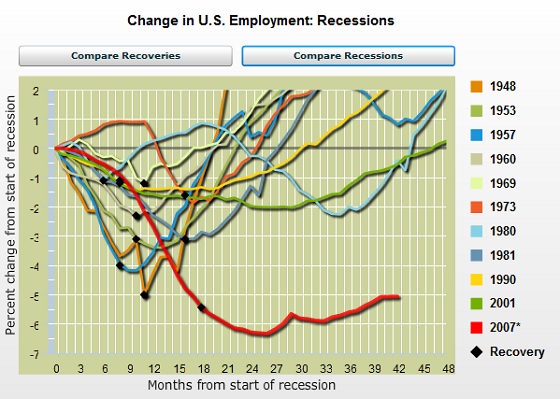
Guess what happened to that Obama recovery?
There never was one. And this graph from the article says it all. The Obama recession stands out as the worst by far.

Reactions to the debt deal: almost all unhappy
Reactions to the debt deal: almost all unhappy.