Giant lava tubes possible on the Moon

New analysis of the lunar geology combined with gravity data from GRAIL now suggests that the Moon could harbor lava tubes several miles wide.

David Blair, a graduate student in Purdue’s Department of Earth, Atmospheric and Planetary Sciences, led the study that examined whether empty lava tubes more than 1 kilometer wide could remain structurally stable on the moon. “We found that if lunar lava tubes existed with a strong arched shape like those on Earth, they would be stable at sizes up to 5,000 meters, or several miles wide, on the moon,” Blair said. “This wouldn’t be possible on Earth, but gravity is much lower on the moon and lunar rock doesn’t have to withstand the same weathering and erosion. In theory, huge lava tubes – big enough to easily house a city – could be structurally sound on the moon.”

You can read their paper here. If this is so, then the possibility of huge colonies on the Moon increases significantly, as it will be much easier to build these colonies inside these giant lava tubes.
10 comments

New images from Mangalyaan

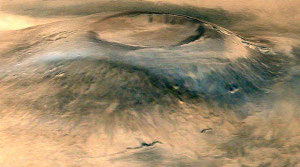
Arsia Mons

Indian scientists have released a new set of color images taken by their Mars orbiter, Mangalyaan.

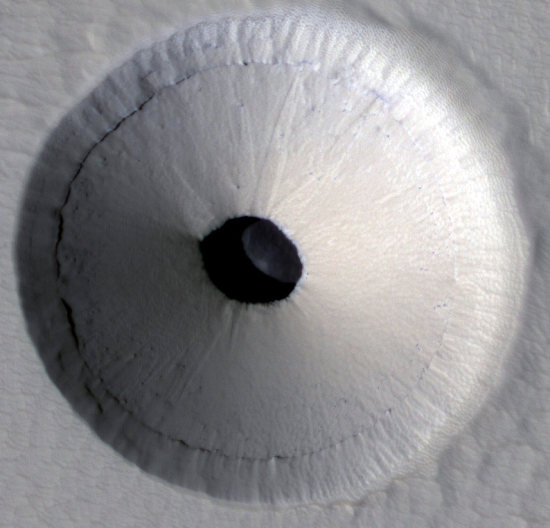
The image on the right is of Arsia Mons, one of the three giant volcanoes to the east of Mars’ biggest volcano, Olympus Mons. Arsia Mons is important for future manned colonization, as there are known caves on its western flanks. In addition, those western flanks show solid evidence of past glaciers, which means that it is very likely that those caves will harbor significant quantities of water-ice, making settlement much easier.

1 comment

Caves on the Moon!

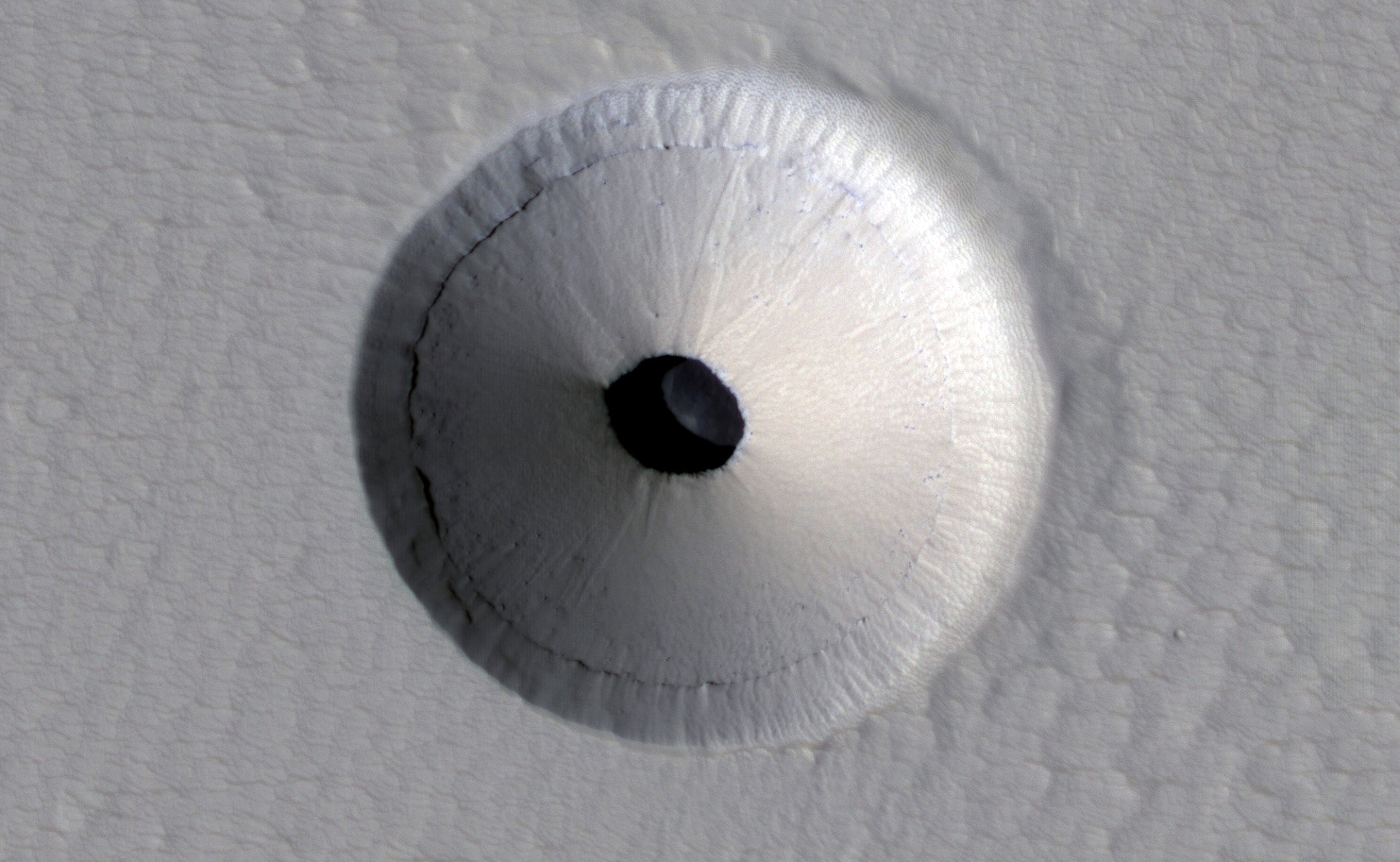
Scientists have now identified more than 200 cave pits on the Moon.

The pits range in size from about 5 meters (~5 yards) across to more than 900 meters (~984 yards) in diameter, and three of them were first identified using images from the Japanese Kaguya spacecraft. Hundreds more were found using a new computer algorithm that automatically scanned thousands of high-resolution images of the lunar surface from LRO’s Narrow Angle Camera (NAC).

This work is essentially the same as that done by James Fincannon and I back in 2011 (see links here, here, here, and here) but with much greater thoroughness.

8 comments

Cave exploration in the western mountains

scree slope
Anthony Smith struggling up a scree mountain slope.

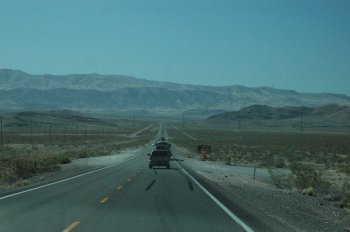
I have only visited Nevada twice before, and those visits had been limited to the area around Las Vegas. Thus, my impression of the state had been similar to what most other people assume: a big ostentatious urban city surrounded by boring flat deserts.

Instead what I found is that Nevada is probably one of the most beautiful states in the nation. It has many mountain ranges, interspersed with wide flat valleys, a number of which have lakes or swampy areas because the water is trapped there, draining neither to the Pacific or Atlantic.

Yet, it is desert country. The limited amount of water means that the state is lightly populated, and the few farms or ranches that you pass actually act to amplify the feeling of emptiness. This is further enhanced by the frequent mountain ranges. Every time you cross over a range, you find yourself high in the air with a spectacular view of the vast valleys below.

The Forest Service job that I was part of this past week was focused on inventorying and surveying a number of known caves covering a large area in northeastern Nevada. The work had actually started several years earlier, so that this particular week was the final wrap up, mapping the last few known caves on the list while also ridge-walking several different canyons in an effort to find some new discoveries.
» Read more

6 comments

Off to Nevada

Nevada

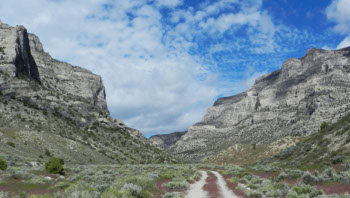
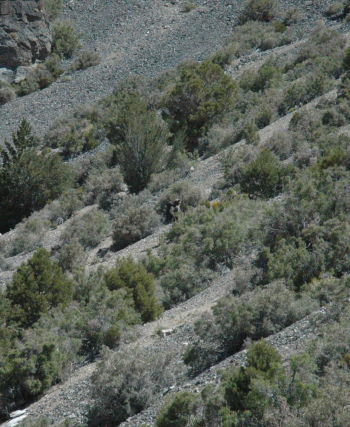
For the next seven days my daytime posting is going to be spotty, as I will be in some remote areas of Nevada working on an on-going Forest Service project to inventory and survey caves in an area in the northeastern area of the state. The project is mostly over, but as I have surveyed, sketched, and done the cartography for many eastern U.S. caves, the guy running the project asked if I would be interested in participating. Interested? I was thrilled.

Though we will be in a somewhat remote area, I still hope to post periodically during the week, not only about the usual topics but also about some of the caves we will have surveyed, some of which are rarely visited. I will also try to post some pictures of the spectacular country we expect to visit. (The photo on the right was provided to me by Tom Gilleland, who is running the project.) Stay tuned.

3 comments

A 33,000-year-old dog skull found in a Siberian cave, when compared with other ancient dog remains found in a Belgium cave, suggest to scientists that the domestication of dogs took place separately in many different places.

A 33,000-year-old dog skull found in a Siberian cave, when compared with other ancient dog remains found in a Belgium cave, suggest to scientists that the domestication of dogs took place separately in many different places.

0 comments

For as yet unexplained reasons, scientists have been finding isolated colonies of little brown bats β€” once the most common bat species in the region and the hardest hit by white nose syndrome β€” surviving and healthy.

Hope for North America’s bats: For as yet unexplained reasons, scientists have been finding isolated colonies of little brown bats β€” once the most common bat species in the region and the hardest hit by white nose syndrome β€” surviving and healthy.

In Vermont, biologists have identified 15 colonies in the western part of the state where the numbers of little brown bats, while still far fewer than before white nose appeared, are surviving, said Vermont Fish and Wildlife Biologist Scott Darling. “We visited each and every one of those colonies and to some degree, much to our surprise, they seem to be healthy,” Darling said. “It begged the question, ‘Why are you the lucky ones?'”

0 comments
1 2 3 4