New long term analysis of solar activity suggests the Sun is undergoing some form of internal structural change
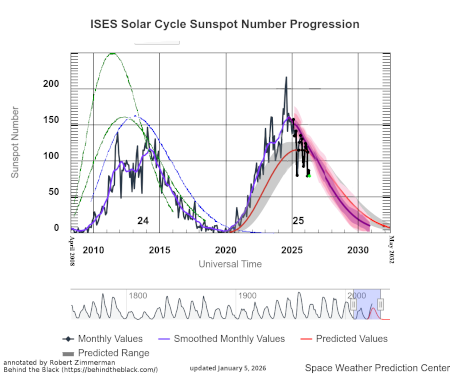
Sunspot activity for the past two cycles
NOAA’s chart of sunspot activity.
Click for the most recent update.

The uncertainty of science: Scientists doing a new analysis of more than forty years of solar data have concluded that some form of “subsurface structural changes associated with successive 11-year [sunspot] cycles” are taking place, with those changes “ever more progressively confined just beneath the solar surface.”

Using almost 40 years of helioseismic data from six telescopes around the world in the Birmingham Solar Oscillations Network (BiSON), the researchers uncovered a gradual change in structure just beneath the surface that has spanned multiple cycles, with the current solar cycle 25 showing particularly strong signatures of these changes.

Lead author Professor Bill Chaplin, from the University of Birmingham, said: “The Sun has its own ‘active biorhythm’ creating rising and falling magnetic activity that shapes space weather. However, traditional surface measures don’t capture the full story – that the Sun may be entering a different mode of behaviour unfolding over decades.

“We have uncovered evidence of systematic changes in the solar activity cycle. Crucially, magnetic activity is becoming more tightly confined near the surface with each cycle.”

The confinement appears to be within the first 600 miles below the surface, which for the Sun is barely skin deep.

In reading the paper [pdf], it is very clear they have detected these changes, but are as yet unable to apply them to any larger fundamental processes. They are observing the Sun change, but don’t know why. It could be simply random fluctuations of behavior, or it could be part of the Sun’s normal behavior related to its magnetic field and the nuclear fusion that makes it burn.

In either case, this lack of deeper understanding means it is impossible as yet to predict what will happen next, or how those future changes will impact us here on Earth.

1 comment

Sunspot update: The number of sunspot continues to decline

For only the second time since I started this website in 2010, I forgot last month to do my monthly sunspot update. No matter. The Sun’s behavior in producing sunspots in the past two months was actually amazingly similar, so doing both months at once works.

According to NOAA’s monthly graph of the sunspot activity on the Earth-facing hemisphere, the amount of sunspots in both March and April continued to be low, well below the predictions put forth by NOAA’s panel of scientists in their April 2025 prediction.

That graph is below, annotated with extra information by me to illustrate the larger scientific context.
» Read more

11 comments

Sunspot update: Solar activity continues to decline as predicted

Another month has passed, and so it is time for my monthly update on the never-ending sunspot cycle on the Sun. using NOAA’s own monthly update of its graph of sunspot activity and annotating it with extra information to illustrate the larger scientific context.

The green dot on the graph below indicates the level of sunspot activity on the Sun’s Earth-facing hemisphere during the month of October. Not only did the number of sunspots decline from the count in the previous month, as predicted in April 2025 by NOAA’s panel of solar scientists (as indicated by the purple/magenta line), it dropped below their prediction.
» Read more

5 comments

The hurricane season in 2024 confounded the predictions again

The trail of bad global warming predictions

The uncertainty of science: Though the climate science community had predicted that last year’s hurricane season was going to be one of the most active ever, a new study published two weeks ago in Geophysical Research Letters of the American Geophysical Union (AGU) found that the 2024 season did not behave as predicted. It ended up producing about the predicted number of hurricanes, but did so only because of a sudden rise in activity near the end of the season, after a long lull with almost no activity. From the study’s conclusion:

As has been noted throughout this study, the lull was immediately followed by one of the busiest ends to an Atlantic hurricane season on record, including two major hurricane landfalls in Florida (Helene and Milton), resulting in more than 250 fatalities and $100 billion in damage (National Centers for Environmental Information, 2025). Though the final overall number of hurricanes and major hurricanes were aligned with the seasonal forecasts, the extremely busy beginning and end to the season and marked lull in the middle highlight just how unusual the season was.

Last year’s prediction was not the first to be incorrect, though this time the error was in how the season unfolded instead of the total numbers. In the past two decades — since Al Gore prophesied that global warming would cause a gigantic increase in violent storms — NOAA has repeatedly called for very active hurricane seasons, and repeatedly those predictions have turned out wrong. In fact, from 2006 until 2018 there were almost no major hurricanes at all, the exact opposite to what Gore had foretold. Since then the seasons have returned to more normal numbers, but the predictions of the scientists have continued to be no better than throwing a dart at a wall while wearing a blindfold.

The ongoing 2025 hurricane season is following this same pattern. In May 2025 NOAA predicted this year would be a very active hurricane season. Instead, this season has matched those from 2006 to 2016, in which no hurricanes made landfall in the U.S. and the number of strong hurricanes was almost nil.

The season of course is not yet over. We could see a burst of activity in the next few months, similar to what happened in 2024. Nonetheless, the important takeaway from this story is that the scientists who claim to know what is going to happen simply don’t know anything. They are guessing, because as the paper above admits, the Earth’s weather and climate are incredibly complex, and our understanding of it is still in its infancy.

Remember this when you read the next “We’re all gonna die!” prediction touted in the propaganda press.

20 comments

Sunspot update: For one month the Sun does what the scientists predicted!

It is the start of the month, which means it is time for my monthly sunspot update, using NOAA’s own monthly update of its graph of sunspot activity and annotating it with extra information to illustrate the larger scientific context.

This graph is below, with the green dot showing the sunspot number for activity on the Sun’s Earth-facing hemisphere in September. As you can see, the count closely matched the April 2025 prediction by NOAA’s panel of solar scientists, which posited that the Sun was finally beginning its ramp down from solar maximum (as indicated by the purple/magenta line).
» Read more

2 comments

Climategate global-warming activist Michael Mann resigns from PennU after celebrating murder of Charlie Kirk

Michael Mann
Climate activist Michael Mann

Though he has claimed to be a climate scientist for decades, Michael Mann at the University of Pennsylvania has been proven time and again to merely be a leftwing global-warming activist, faking data to make it appear the increase of carbon dioxide in the atmosphere is causing global warming, falsely claiming he was a Nobel laureate winner, and acting to destroy the careers of anyone who challenged the veracity of his research.

Sadly, when these facts were discovered almost two decades ago, about the time the climategate emails were released, the climate science community ignored the facts (a very bad thing for scientists to do) and acted to defend Mann. Thus he was able to continue to publish while keeping his job as a professor in academia, first at Pennsylvania State University and then at the University of Pennsylvania.

Mann’s ability to survive fraud and abuse of power however has finally come to an end, and it did so because he decided to go on line after Charlie Kirk was assassinated to joke about that murder and to slander Kirk by reposting comments that called Kirk “head of Trump’s Hitler Youth.”

Though Mann subsequently denied that was what he was doing, deleting some of his worst tweets while claiming to condemn such violence, it appears no one believes him. As a result, he announced yesterday that he resigning his position at Pennsylvania University in order to become a full time political activist. From his resignation statement:
» Read more

41 comments

Sunspot update: Activity rises slightly in April

It is the start of the month, so it is of course time for my monthly report on sunspot activity, based on the update that NOAA posts each month to its own graph of sunspots activity. As I have done since the start of Behind the Black in 2010, I take that graph each month and annotate it with extra information to illustrate the larger scientific context.

Sunspot activity in April did nothing to tell us anything about the Sun’s future activity. It rose slightly, but not by enough to suggest that the prediction put forth last month by NOAA scientists that the ramp down to solar minimum has begun is wrong.
» Read more

4 comments

Trump cuts apparently shutting down NASA’s climate office in New York

Schmidt's data tampering, as documented in 2017
Schmidt’s data tampering, as documented in 2016.

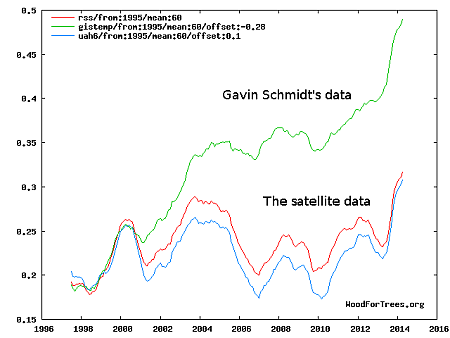
As part of the Trump administration’s aggressive effort to trim the federal budget as well as shift the research focus at the federal government’s many science agencies, on April 24, 2025 it revealed that it has canceled the building lease for the Goddard Institute for Space Studies (GISS) in New York that has existed since 1961 and in 2016 and 2017 was found to be tampering with past climate data with no explanation, lowering past temperature numbers while raising more recent ones in order to make the data fit the as-yet unproven theory that human activity is causing global warming.

Those “adjustments” have never been justified in any way. Nor has Gavin Schmidt, the man who heads GISS, ever done anything to correct them. Moreover, when his office was accused of this tampering in 2016 he not only refused to fix or justify the changes, he responded by claiming “planetary warming does not care about the election.” In the years since it has been his office that annually declares each year “the hottest on record,” using these tampered numbers to do so and demonstrating that he has been acting not as a real researcher but as a political operative of the global warming crowd.

Though the office lease is being canceled, GISS has not been shut down, as of now.

While NASA is terminating the lease on the GISS offices, it is not closing the institute itself. Lystrup said in the email that it will help employees move “to remote work agreements in the short-term as the agency seeks a new, permanent space for the team.”

I suspect this statement is merely designed by Trump officials to dampen the screams of opposition against its actions. It is very likely GISS is going away, and most of its employees will have to find new jobs.

The hope is that new scientists can be hired to review these tampered numbers and get them fixed so that climate research in the future can proceed with reliable data.

8 comments

Sunspot update: NOAA scientists try to hide how wrong they have gotten things

My monthly sunspot update today will have less to do with the Sun’s sunspot activity itself — which continues to show a very very slow decline from a peak in August 2024 — and more to do with more games-playing by NOAA solar scientists to fool the public into believing they know more than they do.

Below is my annotated version of NOAA’s monthly graph showing the amount of sunspot activity on the Earth-facing hemisphere of the Sun. This graph is significantly different from the graph that NOAA’s scientists have issued for the past few years, with all the changes designed to make it seem as if these scientists’ predictions are on the money, when they have been entirely wrong now for two solar cycles in a row.
» Read more

10 comments

Sunspot update: Sunspot activity continued its decline in January

Another month has passed, meaning it is time for another update on the Sun’s sunspot cycle, based on NOAA’s monthly graph tracking that activity but annotated by me with additional information.

In January the decline in sunspot activity on the hemisphere facing Earth since August 2024 continued, with the number of sunspots dropping to a level not seen since May 2023, when the Sun’s was ramping up from solar minimum to solar maximum.
» Read more

5 comments

The American Geophysical Union shows off its ignorance of the scientific method

Recently a climate scientist caused an uproar among scientists and peer-review journals when he admitted in an op-ed that the only way he could get his climate paper published in the journal Nature was to fake his results in order to fit them to the narrative that human-caused global warming is causing all our environmental problems.

In my paper, we didn’t bother to study the influence of these other obviously relevant factors. Did I know that including them would make for a more realistic and useful analysis? I did. But I also knew that it would detract from the clean narrative centered on the negative impact of climate change and thus decrease the odds that the paper would pass muster with Nature’s editors and reviewers.

While that op-ed brutally exposed the political biases at Nature that make it impossible to get honest research published, it only told a part of the story. Nature is only one journal, and if it was the only place this corruption of science was occurring, the problem would be manageable.

In truth it is only one example of a far more widespread problem, because it is now practically impossible for any skeptic of global warming to get his or her work published in almost any scientific journal. Worse, most of the major science organizations worldwide no longer simply favor pro-global warming climate research, they act aggressively to promote only one kind of result, to the point that the things they publish sometimes are little different than Soviet propaganda.

The American Geophysical Union, where science is no longer practiced
The American Geophysical Union, where
science is no longer practiced

As a prime example, I want to focus today on the American Geophysical Union (AGU), an scientific organization initially formed as an umbrella group to help American scientists publish and publicize their research on the study of the Earth, its interior, and its nature as a planet. To do so the AGU publishes a wide range of peer-review journals, all intended as fair-minded outlets for new research.

Sadly, in the past two decades the AG abandoned that primary function. For example, it has made its global-warming biases clear for several decades, essentially telling every climate scientist worldwide that if you submit any paper that raises any questions about global warming, it will be rejected outright.

More recently however the AGU has become even more up front and public about its close-minded approval of the as-yet unproven theory that humans are causing the climate to heat up. » Read more

6 comments

The sunspot count in August demonstrates fully the utter uncertainty of science

In doing these sunspot updates every month since I started Behind the Black thirteen years ago, one of the repeated common themes has been noting how little we really know about the basic fundamental processes within the Sun. We know the process involves nuclear fusion combined with fission, and that process also creates a powerful magnetic field that every eleven years flips in its polarity. We also know that this eleven year cycle corresponds to an eleven year cycle of rising and then falling sunspot activity.

The devil however is in the details, and we know very little about those details. How those larger processes link to the specific changing features on the Sun remains little understood, if at all. The sudden and entirely unexpected steep drop in sunspot activity in August, as noted in the release yesterday of NOAA’s monthly update of its graph that tracks the number of sunspots on the Sun’s Earth-facing hemisphere, demonstrates this level of ignorance quite starkly.
» Read more

17 comments

Reviewing a book blacklisted by Amazon because it dared say things Amazon doesn’t like

The Plague of Models, blacklisted by Amazon

They’re coming for you next: Last week I posted an essay on the over-use and misuse of computer modeling in today’s scientific community, focused specifically on the unreliability of all climate models to successfully predict any actual climate trends.

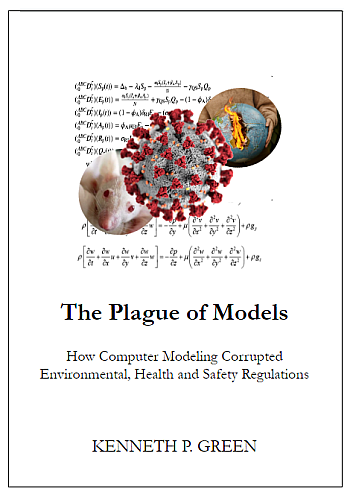
One of the individuals who read my essay, Kenneth Green, immediately commented here on Behind the Black to note that he had just published a book on this very subject, entitled The Plague of Models: How Computer Modeling Corrupted Environmental, Health, and Safety Regulations, describing how the misuse of models has resulted in the proliferation of government regulations based not on actual data but on computer models that in many ways are nothing more than the opinions of the computer programs.

Green also noted that Amazon has refused to make his book available for sale, essentially banning it for no justifiable reason. As he explained to me in an email,

My publisher, who is a start-up small Canadian publisher specializing in public policy books, tried to upload The Plague of Models to Amazon, as he had previously done with half a dozen other books while working at previous institutions as in-house publisher.

This time, unlike his previous experiences, the book was taken down shortly after it was uploaded (and we know the upload process worked, since the book was available briefly for preview, so there was no technical issue with the manuscript file). The publisher got a form-letter email saying that the book had been taken down because it may have violated some (non-specific) Amazon Term of Service. When he sent a note back requesting clarification/appeal, he got another form letter, this one repeating that the book may have violated some term of service, and warning that any attempt to re-upload would get his entire account terminated.
» Read more

16 comments

Sunspot update: April activity drops steeply

NOAA this week once again published an update of its monthly graph that tracks the number of sunspots on the Sun’s Earth-facing hemisphere. As I do every month, I have posted this graph below, with some additional details included to provide some context.

In April the number of sunspots dropped again, for the second time in the past three months. The high activity previously had suggested that the solar maximum was going to be much higher than predicted, or possibly would come sooner than expected. The drop however now suggests that the fast rise in sunspot activity that we have seen since the beginning of the ramp up to solar maximum in 2020 might finally be abating.
» Read more

7 comments

Sunspot update: Sunspots in January went through the roof!

NOAA this week updated its monthly graph that tracks the number of sunspots on the Sun’s Earth-facing hemisphere. Below is that updated graph, with January’s numbers added to the timeline. As I have done monthly for the past dozen years here on Behind the Black, I have added some additional details to that graph to provide context.

Just as in December, the number of sunspots in January 2023 shot up to the highest amount since September 2014, which was during the previous solar maximum. Unlike December, however, January’s numbers came only a hairs-breath from topping that 2014 number. In fact, except for that one 2014 month, January 2023 saw the most sunspots on the Sun since November 2002, twenty years ago. In 2002 the Sun was ramping down from what had been a relatively strong double-peaked solar maximum, and was about to begin an extremely long period of little or no activity, followed by a very weak double-peaked solar maximum in 2013.

That period of little activity also corresponded with a long twenty-year period in which the Earth’s climate appeared to stop warming.
» Read more

3 comments

NOAA once again over-predicts the hurricane count

As it has done repeatedly in recent years, NOAA in 2022 once again over-predicted the hurricane count for this past hurricane season, predicting an above-normal season when it actually ended up to be well below-normal.

In late May and again in early August 2022 NOAA predicted that the year 2022 Atlantic Hurricane Season (between June to end November calendar period) would be an “above normal” season with 14-21 named storms, between 6-10 hurricanes including 3-6 major hurricanes (Category 3,4 and 5) as shown in NOAA’s diagram below.

Colorado State University’s Department of Atmospheric Science/Tropical Meteorology Project has compiled the year 2022 tropical storm data, establishing that, compared to its 30 year North Atlantic data records covering the Climatological period 1991-2020, the year 2022 hurricane season was below average in Named Storms, Named Storm Days, Hurricane Days, Major Hurricanes, Major Hurricane Days and Accumulated Cyclone Energy (ACE).

The many graphs at the link also demonstrate that the predictions that there will be an increase in extreme weather events due to increased use of fossil fuels is also proving false.

4 comments

Sunspot update: The pause in the ramp up to solar maximum continues

NOAA has once again published its monthly update of its monthly graph that tracks the number of sunspots on the Sun’s Earth-facing hemisphere. Below is that November graph, annotated by me with some additional details added to provide context.

Though sunspot number continued to be much higher than the prediction (almost double), October saw almost exactly the same number of sunspots as seen in September, which is why this new graph seems almost identical to last month’s.

In other words, the pause in the ramp up to solar maximum, first noted in August, continues.
» Read more

4 comments

Deadly climate change on Mars!

Junk science! A new computer simulation by scientists now proposes that there was microscopic life on Mars billions of years ago, but its existence served to destroy the climate and kill all life!

The press appears to be eating this story up, with enthusiasm. From the New Atlas story above:

Humans might not be the first lifeforms in the solar system to face the threat of their own activity changing the climate of their home planet. A new model suggests that ancient Mars was once habitable enough to support methane-producing microbes, and they may have wiped themselves out by causing irreparable damage to the Red Planet’s atmosphere. [emphasis mine]

A Space.com story is written better, but it still jumps on the bandwagon:
» Read more

6 comments

Sunspot update: Solar activity continues to exceed sunspot predictions

It is the beginning of September and time to post another update on the Sun’s ongoing solar cycle. Below is NOAA’s monthly graph tracking the number of sunspots on the Sun’s Earth-facing hemisphere, with the activity in August now added. I have also added some additional details to the graph to give the numbers a larger context.

Though sunspot activity dropped in August it remained significantly above the predictions of the panel of government solar scientists put together by NOAA. The predicted sunspot number for August, as indicated by the red curve, was supposed to be about 48. The actual number was 75.

» Read more

4 comments

Scientists claim rocket launches are going to damage ozone layer

Junk science: This week NOAA government scientists published a paper claiming that the upcoming increase in rocket launches worldwide is a threat to the ozone layer and will also — my heart be still — promote climate change!

The study found that a tenfold increase in the amount of soot injected into the stratosphere every year would after 50 years lead to an annual temperature increase in that layer of 1 to 4 degrees Fahrenheit (0.5 to 2 degrees Celsius). The stratosphere is the layer of the atmosphere just above the lowest troposphere. The study found that the projected warming would slow down subtropical jet streams, bands of strong wind circling the planet at the lower edge of the stratosphere that influence the African and Indian summer monsoons.

Warmer temperatures in the stratosphere would also degrade the protective ozone layer, which blocks harmful ultraviolet radiation from the sun from reaching the planet’s surface.

The paper’s abstract also said this:

We show that the rocket black carbon increases stratospheric temperatures and changes the global circulation, both of which cause a reduction in the total ozone column, mainly in the northern high latitudes. Comparing the amplitude of the atmospheric response using different emission rates provides insight into stratospheric adjustment and feedback mechanisms. Our results show that the stratosphere is sensitive to relatively modest black carbon injections.

This is garbage science, and I wouldn’t bother posting a link to it if other news sources weren’t promoting it. These predictions — based on a very simple computer model — are nothing more than guesses, and are apparently designed to both attack the growing space industry as well as garner funding for more such junk science, as illustrated by this quote from the NOAA press release:

“We need to learn more about the potential impact of hydrocarbon-burning engines on the stratosphere and on the climate at the surface of the Earth,” said lead author Christopher Maloney, a CIRES research scientist working in NOAA’s Chemical Sciences Laboratory. “With further research, we should be able to better understand the relative impacts of different rocket types on climate and ozone.”

For almost a half century climate scientists — many working for government agencies like NASA and NOAA — have been publishing junk papers like this, predicting climate doom in only a few decades unless we do as they say, while funneling boatloads of cash into their pockets. Almost none of those predictions have turned out to be correct.

This report is equally suspect, especially because it touts the false statistic that “launch rates have tripled in recent decades.” The number of launches has not tripled from its long-term average since Sputnik. The only way you can get manufacture that fake statistic is if you compare last year’s total (134) with the launch numbers from the early 1960s, before the space race had even begun. And while the launch numbers are likely to rise dramatically in the coming years, the numbers will still be infinitesimal compared to other industries. Going from 50-100 launches to 200-500 launches is hardly the end of the world.

It really is far past time for the press and the general public to stop listening to these fake papers.

19 comments
1 2 3 8