Space Force study says it needs a third spaceport besides Cape Canaveral and Vandenberg

According to the head of Air Force at a House hearing yesterday, the Space Force is about to complete a study that concluded the military will need a third spaceport besides Cape Canaveral and Vandenberg to accomplish its future space goals.

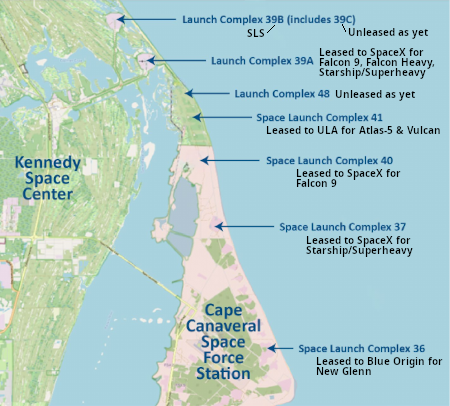
Air Force Secretary Troy Meink highlighted the finding during a May 20 House Armed Services Committee hearing, noting that the study is still moving through the approval process. The Space Force operates the nation’s busiest spaceports at Cape Canaveral Space Force Station, Fla., and Vandenberg Space Force Station, Calif.—both of which are running out of room. “At a high level, what it says is we probably need another site that’s capable of heavy and super heavy launch capability, both from a resiliency perspective and just, even at the Cape, limitations on how much space we’ve got,” Meink said.

He didn’t expand any further on the findings of the study, which was mandated by Congress in the Fiscal 2026 National Defense Authorization Act, and it’s not clear what locations the service is considering.

It is expected that both the Florida and California spaceports will be able to handle as many as 700 launches per year by the mid-2030s — based on all projections by all the private launch providers — but Meink indicated this will not meet the expected needs of the military, which expects to launch far more than that as part of its Golden Dome implementation. Though it hopes to meet some of this additional demand from other state- and privately-run spaceports, he implied even that will be insufficient.

Pecan Island SpaceX facility?

I think Meink is looking at this issue backwards. Rather than proposing the Pentagon establish its own third spaceport, it should be partnering with the private and state launch providers to meet its needs. For one, if the rumors turn out to be true and SpaceX is buying that 200+ square mile plot of land at Pecan Island in Louisiana, it would make great sense for the Pentagon to demand SpaceX allow other launch providers to lease launchpads there. Not only will there be ample land for such additional launchpads, it will be the fastest and cheapest way to get what the military needs. Finding and buying its own facility will take more time and cost more.

I am of course assuming it is SpaceX that plans to buy that Louisiana land. Right now nothing is confirmed. It is even possible that it is the military itself that has been in discussions there, or if not, is about to insert itself into the mix.

6 comments

SpaceX launches 29 more Starlink satellites

SpaceX early today successfully placed another 29 Starlink satellites into orbit, its Falcon 9 rocket lifting off from Cape Canaveral Space Force Station in Florida.

The first stage (B1077) completed its 28th flight, landing on a drone ship in the Atlantic, 64 days after its previous flight. With this flight, the booster moves into a tie for seventh place with the Columbia shuttle in the rankings of the most reused launch vehicles:

39 Discovery space shuttle
34 Falcon 9 booster B1067
33 Atlantis space shuttle
33 Falcon 9 booster B1071
32 Falcon 9 booster B1063
31 Falcon 9 booster B1069
28 Columbia space shuttle
28 Falcon 9 booster B1077
27 Falcon 9 booster B1078

Sources here and here.

The leaders in the 2026 launch race:

59 SpaceX
28 China
8 Russia
6 Rocket Lab

For the third straight year SpaceX leads the entire world combined in total launches, 59 to 50.

1 comment

SpaceX files first IPO documents with SEC

Starship/Superheavy (version 3) on launchpad
Starship/Superheavy (version 3) on launchpad for launch
later today.

After months of speculation and behind the scenes planning, SpaceX yesterday finally filed the initial public offering (IPO) documents with the Securities and Exchange Commission (SEC) outlining the company’s financial standing, in order to give potential stock purchasers an idea of what they are buying.

The filing shows SpaceX’s Connectivity segment, driven primarily by Starlink, has become the company’s financial engine. The segment generated $11.4 billion in revenue during 2025, along with $4.4 billion in operating income and $7.2 billion in adjusted earnings before interest, taxes, depreciation and amortization. The company said the business benefited from subscriber growth [now 10.3 million], wider enterprise adoption and improved network efficiency, with operating income rising more than 120% year over year.

By contrast, the company’s newly acquired AI segment is consuming cash at a remarkable pace. The AI business generated $3.2 billion in revenue during 2025 but posted an operating loss of $6.4 billion as SpaceX ramped investment in AI applications and compute infrastructure. Capital expenditures tied to the AI segment reached $12.7 billion during the year, far exceeding spending in the Space and Connectivity businesses.

…SpaceX’s Space segment generated $4.1 billion in revenue in 2025 and posted a $657 million operating loss. The company spent more than $3 billion on research and development tied to Starship during the year alone. The filing described Starship as the “key enabler” of SpaceX’s long-term growth strategy, saying the vehicle is designed to dramatically improve payload capacity, reusability and launch frequency while opening entirely new categories of missions.

Capital expenditures in the Space segment totaled $3.8 billion in 2025, reflecting the enormous infrastructure demands tied to developing and scaling the Starship program. On a consolidated basis, SpaceX reported $18.7 billion in revenue during 2025, alongside an operating loss of $2.6 billion and adjusted EBITDA of $6.6 billion. For the first quarter of 2026, the company reported revenue of $4.7 billion and an operating loss of nearly $1.9 billion.

In other words, Starlink and rocket sales are paying for the development of Starship and AI.

It appears the company is targeting an early to mid June date for the actual IPO, which some on Wall Street predict could bring in $75 billion in cash. This will be in addition to the $12 billion SpaceX has already raised in private investment capital as well as the more than $12 billion in revenue it earns each year from its Starlink subscribers. Note also that this Starlink annual revenue is presently about half that of NASA’s annual budget, with no upper limit in sight.

In other words, if all goes as planned, the company will have about $100 billion on hand to develop all its business models, with Starship/Superheavy likely leading the way.

I repeat: SpaceX is America’s space program. NASA is merely a sideshow that will become increasingly irrelevant as SpaceX gears up to full speed. And if things go as I believe they will, SpaceX’s success will act to fuel the rest of the American space industry, making the government even less important.

19 comments

Vast unveils new high powered satellite bus to support the expected boom in satellite construction

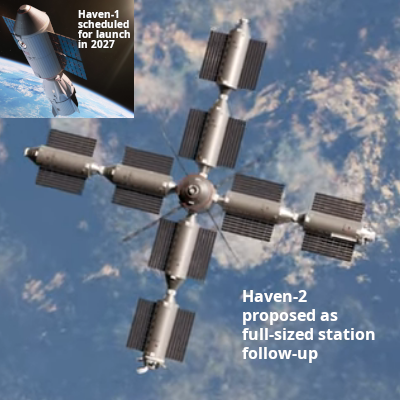
Haven-1 with docked Dragon capsule
Artist rendering of Vast’s Haven-1 station, with a docked
Dragon capsule. Like Have Demo, it is being built using
company funds with no government support.

The space station startup Vast yesterday unveiled a new product line of high powered satellite buses, dubbed Vast Satellite, designed to support the expected boom in satellite construction.

With the launch of Vast Satellite, Vast is expanding beyond commercial space stations into high-volume spacecraft platforms designed for high-performance orbital missions. The first offering is a 15 kW-class satellite bus designed to support a wide array of power-intensive missions through flexible configurations.

Built around common in-house subsystems—including avionics, power, communications, propulsion, and flight software—Vast Satellite leverages technologies already developed for its Haven-1 space station, and validated through the successful Haven Demo mission in 2025. This shared architecture combined with Vast’s vertically integrated manufacturing model and advanced production capabilities is designed to support faster development timelines, lower costs, and increased mission reliability.

The company says it has already sold four buses to a confidential customer, with an option for 200 more. This sale occurred because Vast has proved itself with its policy of committing its own investment capital in designing, building, and flying demo missions. The Haven Demo was initially launched to test the subsystems to be used on the Haven-1 single module station the company hopes to fly next year on a three-year mission, during which four two-week manned crews will occupy it. That success allowed Vast to now diversify, using what it learned and proved on that demo to sell new products to other customers.

Similarly, its Haven-1 station, built on its own dime with no NASA funds, is intended to prove its capability as a space station provider. If successful, it is certain at that point to attract customers, including NASA.

9 comments

SpaceX launches 24 Starlink satellites

SpaceX in the early morning hours today successfully placed another 24 Starlink satellites into orbit, its Falcon 9 rocket lifting off from Vandenberg Space Force Base in California.

The first stage completed its second flight, landing on a drone ship in the Pacific.

The leaders in the 2026 launch race:

58 SpaceX
28 China
8 Russia
6 Rocket Lab

For the third straight year SpaceX leads the entire world combined in total launches, 58 to 50.

0 comments

BUMPED: 12th Starship/Superheavy test delayed another day to May 21, 2026

UPDATE: One day after its announcement below, SpaceX announced another one day delay. The 12th Starship/Superheavy launch is now targeting May 21, 2026, with a launch window beginning at 5:30 pm (Central).

Original post:
———————
SpaceX earlier today announced a revised launch date for the 12th Starship/Superheavy orbital test flight, delayed one day from May 19, 2026 to May 20, 2026, with a launch window opening at 5:30 pm (Central).

No reason was given. I suspect weather might have played a factor, but it is also possible that some technical issues required a short delay.

Either way, the link to the X live feed will be posted here once it goes live. I will also embed it on Behind the Black once it goes live.

33 comments

Several major American satellite companies release a joint guide on “orbital safety”

Working with the American Institute of Aeronautics and Astronautics (AIAA), the American satellite companies building large orbital constellations — SpaceX, Amazon, Iridium, and Eutelsat — have now released a joint reference guide for building and operating their satellites, dubbed “Satellite Orbital Safety Best Practices 3.0.”

  • Emphasizes the design phase for improved orbital safety
  • Stresses pre-launch coordination and collision avoidance analysis, especially near crewed vehicles, mitigating hazards during post-launch identification and cataloging of new orbital objects
  • Provides guidance on data sharing across design and operations emphasizing the critical importance of sharing and screening high quality ephemeris with covariance from deployment through disposal
  • Includes an Appendix with data exchange recommendations to mitigate conjunctions

The companies have apparently decided they needed to get together to make sure they were not stepping on each other’s toes. I would expect other companies to soon join this cooperative effort, as it is in no one’s interest to have satellites colliding in orbit.

12 comments

New fuel startup unveils rocket and jet fuels that it says are as much as 32% more efficient

A new startup, CycloKinetics, has announced a product line of chemically engineered rocket and jet fuels that it says are as much as 32% more efficient that standard fuels.

CycloKinetics’ approach is to create “plug-in” fuels that can replace conventional fuels in various vehicles without requiring modifications to the craft or its engines. There’s nothing particularly wild or exotic about this, and no unobtanium-type elements are involved. It’s more a matter of changing the geometry of the hydrocarbon molecules that make up the fuel itself.

Conventional aviation fuels consist of linear and branched hydrocarbon molecules, which limits how much energy can be packed into a given volume. CycloKinetics instead engineers cycloparaffinic hydrocarbons – that is, ring-shaped molecular structures that pack more carbon and hydrogen atoms into the same space as would be occupied by conventional fuels.

The upshot is 32% more energy in the same volume as standard Jet A fuel. That means, for example, an aircraft capable of flying 1,500 nautical miles (1,726 miles, 2,778 km) on standard fuel could potentially exceed 1,950 nautical miles (2,244 miles, 3,611 km) using the new superfuel, while reconnaissance aircraft could remain on station up to 30% longer.

The company is also selling its version of RP-1, the kerosene fuel used for example by SpaceX’s Falcon 9 rocket.

It remains unclear whether it will be cost effective for rocket or airline companies to consider buying this fuel. For one, the extra cost to make it might outweigh the fuel savings. For another, it is unclear the company will be able to produce enough to meet the market. Nonetheless, the concept is intriguing, and could pay-off for this startup in the long run.

9 comments

Astrolab’s Flip lunar rover will carry 4 NASA payloads

Moon's south pole, with landers indicated

When NASA cancelled in 2024 its Viper rover, removing it as the main payload on Astrobotic’s Griffin lunar lander, the company quickly made a deal in 2025 with the rover startup Astrolab to put its s FLIP prototype lunar rover on board instead.

Astrolab yesterday announced that NASA has agreed to purchase payload space on FLIP, placing four different science instruments on the rover, each from a different NASA center.

The map to the right indicates the location where Griffin is supposed to land, about 100 miles from the Moon’s south pole. Nova-C, Intuitive Machines first attempt to soft land on the Moon, landed at the green dot, but failed when it fell over at landing. Its second lunar lander, Athena, also fell over when it landed in the same region that is now Griffin’s target landing zone.

Griffin’s launch itself has been delayed repeatedly. Astrobotic was originally issued its NASA contract for Griffin in 2020, with a launch planned for November 2023, carrying NASA’s Viper rover. In July 2022 however it was delayed one year to November 2024 because Astrobotic said it needed more time. This date was then delayed to 2025 when Viper was canceled, and then in October 2025 the launch was pushed back again to July 2026.

According to the press release at the link above, that July 2026 launch date is now invalid, with the new launch date set for before the end of 2026. I strongly suspect that date will slip again.

0 comments

France’s space agency CNES gives ESA 5-year extension at French Guiana spaceport

French Guiana spaceport
The French Guiana spaceport. The Diamant launchsite is labeled “B.”
Click for full resolution image. (Note: The Ariane-5 pad is now the
Ariane-6 pad, and the Soyuz pad is now controlled by rocket startup
MaiaSpace.)

France’s space agency CNES and the European Space Agency (ESA) yesterday announced a new five year agreement extending ESA’s operations at France’s French Guiana spaceport.

The contract covers all activities required to operate Europe’s Spaceport that is on French territory and so falls under the responsibility of the French government represented by CNES. The contract includes both daily operations and running of the facilities and continuous upgrades to adapt the Spaceport to changes taking place in the space sector, including the arrival of new rockets and launch services.

The signature covers three years of operations, renewable for a further two years, including a total investment of over €1 billion with €635 million funded by the European Space Agency – showing the agency’s central role in supporting the operation of Europe’s Spaceport. In support of the transformation of the space sector, the contract takes new launch operators into account as well as sharpening safety requirements even more – ensuring launches from Europe’s Spaceport are reliable, safe and competitive.

While the deal is not surprising — neither ESA nor CNES have any reason to end this arrangement — there is one aspect of the deal that is significant: Nowhere in the press release or agreement is there any mention of Arianespace, ESA’s commercial division. For decades Arianespace ran French Guiana for ESA and France. It is now gone, eliminated as an unnecessary middle-man as Europe shifts to the capitalism model.

At the moment, ESA has reduced Arianespace’s role to just one task, marketing and launching the Ariane-6 rocket. At the same time numerous European nations are doing whatever they can to encourage the development of competing independent rocket companies, all aimed at replacing Ariane-6 eventually, and as soon as possible. While that effort will take at least a decade, it is definitely happening.

1 comment
1 2 3 4 5 6 897