A Martian cliff of ash, flushed by wind

A Martian cliff of ash flushed by wind
Click for original image.

Cool image time! The picture to the right, rotated, cropped, reduced, and sharpened to post here, was taken on December 27, 2023 by the high resolution camera on Mars Reconnaissance Orbiter (MRO). Described merely as an “exposed scarp” by the science team, this cliff edge is actually much more.

First some basic details. The elevation drop from the plateau down to the base of this cliff is about a thousand feet. The material that forms this plateau, scarp, and its base is all volcanic ash. The thicker sections of ash has caused its lower levels to compress, harden into a kind of sandstone. Near the surface however it is more friable, and like sandstone can break apart somewhat more easily.

The prevailing winds at this site are generally blowing to the south, but beginning to turn to the east, which explains the northwest to southeast orientation of the features.

The best analogy I can come up with to explain the erosion of this scarp is as follows: Imagine a deposit of dry mud a few inches thick on pavement. Take a leaf blower and blow at it hard, always in one direction. Eventually the outer edge will break up and blow away, leaving a sharp edge, that will also retreat with time as the wind continues to blow.

Here the winds are eroding that cliff, causing periodic avalanches which dissolve into sand that then blows away, leaving no debris pile at the base of the cliff. The ridges indicate harder material, that breaks away last, which is why there are some ridgelines extending outward from the scarp in line with these ridges. At the same time, these ridges of harder ash still break up with time, as some are cut off suddenly at the cliff edge.
» Read more

0 comments

Air leak in Russia’s half of ISS continues and has increased slightly

Zvezda module of ISS
The Zvezda module, with aft section indicated
where the cracks have been found.

The leak in the Russia half of ISS continues to bleed air from the space station and has even increased slightly in recent months, though both NASA and Roscosmos say the rate of loss is tiny and poses no danger to the station’s inhabitants.

“There is no threat to the crew or the station itself,” [Roscosmos] said in a statement carried by Russian news agencies. Roscosmos’ statement followed comments by Joel Montalbano, NASA’s station project manager, who noted Wednesday that the leak in the Russian segment has increased but emphasized that it remains small and poses no threat to the crew’s safety or vehicle operations.

As indicated by the graphic to the right, the air loss is suspected to come from stress fractures in the Zvezda module, the station’s second oldest and one in which many dockings have occurred over the past two decades. Russia had suspended dockings in this port shortly after the leaks and cracks were detected, but have apparently resumed those dockings recently. One wonders if this new activity is contributing to the increase in loss of air.

4 comments

Final images from Odysseus, lying on its side

One of three pictures downloaded after landing
Click for original picture.

In a press conference yesterday, NASA and the private company Intuitive Machines released three pictures taken by the Odysseus lunar lander after it came down a bit too fast, skidded on the ground so that one leg broke, and then tilted over.

The first images from the lunar surface are now available and showcase the orientation of the lander along with a view of the South Pole region on the Moon. Intuitive Machines believes the two actions captured in one of their images enabled Odysseus to gently lean into the lunar surface, preserving the ability to return scientific data.

The best picture, reduced and annotated to post here, is to the right. The spacecraft is tilted about 30 degrees from the vertical. Another picture showed the broken leg on the lander’s other side. The “two actions” mentioned in the NASA quote above refer to the issues that caused the broken leg: the limited ground data the lander used to land, and its larger than expected lateral speed.

The spacecraft is expected to be shut down by today because of lack of power and the advent of the long lunar night. Company officials remain hopeful it will come back to life when the sun rises in several weeks.

Officials from both NASA and Intuitive Machines have correctly noted that this was an engineering test mission, so even these failures make it a success in that the company can use them to improve the next lander. Nonetheless, it would have been nice if things had worked better on this first flight, especially because the problem that led to all the breakdowns, the failure to turn the lander’s range finding system back on after installation on the rocket, was an incredibly stupid human error that should not have happened at all.

3 comments

Russia launches weather satellite plus eighteen smallsats

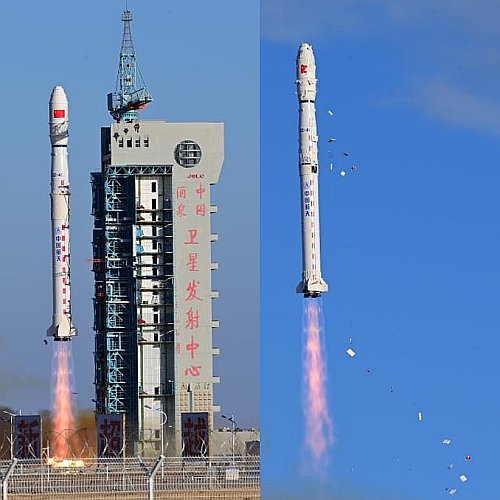
Russia yesterday successfully launched a new weather satellite as well as eighteen smallsats, including one for Iran, its Soyuz-2 rocket lifting off from its Vostochny spaceport in the far east of Russia.

The rocket’s stages crashed in several designated drop zones within Russia and the Arctic Ocean.

The leaders in the 2024 launch race:

18 SpaceX
9 China
3 Russia

American private enterprise still leads the entire world combined 21 to 18 in successful launches, while SpaceX by itself is now tied with the the rest of the world (excluding other American companies) 18 all.

0 comments

Inspector General: Mars Sample Return mission in big trouble

The present plan for Mars Sample Return

Though the audit published today [pdf] by NASA’s inspector general of the NASA/ESA Mars Sample Return mission partnership tries to couch its language positively, the conclusion one reaches by reading the report is that the project is a mess and will almost certainly not fly when scheduled in 2029, and might even get delayed so much that the Perseverance rover on Mars — an essential component of the mission plan — might no longer be operational at that time.

First the budget wildly out of control.

The trajectory of the MSR Program’s life-cycle cost estimate, which has grown from $2.5 to $3 billion in July 2020, to $6.2 billion at KDP-B in September 2022, to an unofficial estimate of $7.4 billion as of June 2023 raises questions about the affordability of the Program.

In addition, the audit noted that this is not the end, and that based on another independent review the budget could balloon to $8 to $11 billion before all is said and done. (I will predict that as presently designed, that budget will likely reach $15 billion.)
» Read more

6 comments

“Thar’s gold in them there asteroids!”

Actually, the “gold” in the quote refers less to the actual element and more to the potential wealth lurking within the resources available in many asteroids in space. I base this optimistic assessment, which is looking at the very long term and not the near future, based on the following chart, just published in a new white paper report [pdf] dubbed “Asteroid Mining: Key to Large-Scale Space Migration or Rocky Road?” The chart itself comes from this October 2023 research paper.

The estimated resources in the metallic asteroids, compared to Earth

Except for gold, the estimated abundances in metallic asteroids of all these important minerals exceeds the entire reserves contained on Earth, by many times. And even though the asteroid reserves of gold do not exceed that of Earth, that in-space gold is likely far easier to access and mine. As the report notes:
» Read more

24 comments

Rocket Lab unveils a family of four different service modules for all kinds of satellites

Rocket Lab continues to expand its product line beyond just rockets, today unveiling a family of four different types of service modules, designed to provide maneuvering, communications, and power to satellites.

The four service modules, dubbed Photon, Lightning, Pioneer, and Explorer, are each designed to serve different types of satellites, from low orbit to geosynchronous. The company is also developing a larger rocket, Neutron, in addition to its Electron rocket.

Presently only Electron and Photon are operational, both having serviced multiple customers. Neutron is still scheduled for a first launch later this year, though a delay into 2025 is expected. It is not clear when Lightning, Pioneer, and Explorer will make their first flights.

0 comments

Update on Starship/Superheavy preparations at Boca Chica

Link here. After two separate but aborted dress rehearsal countdowns, the rocket has been destacked with Superheavy rolled back to the assembly building.

After two Wet Dress Rehearsal (WDR) aborts, SpaceX opted to destack Ship 28 before removing Booster 10 from the Orbital Launch Mount (OLM). The Booster has since rolled back to the Production Site, while Ship 28 conducted standalone testing on Pad B, opening with a Spin Prime test on Monday.

A March launch of Flight 3 for Starship is still possible, pending the completion of full stack testing and approval from the FAA.

While the aborts suggest some technical issues occurred that need addressing, the destacking and additional work could also be for other reasons. The FAA has still not issued a launch license, and is demanding certain actions before doing so. It could be that the company is being forced to make certain upgrades on these prototypes it would have rather left to the next test launch with more advanced prototypes.

Either way, it now appears that a March launch is possibly threatened.

3 comments

Astra’s founders slash their offer price to buy the company

The two founders of the startup Astra have now slashed their offer price from $1.50 to $0.50 per share to buy the company and take it private.

Kemp and London cited several reasons for cutting the share price. They included continued cash burn by the company since they tendered the original offer and higher “non-operating expenses” as the company used multiple third-party advisers to assess options. They also said the special committee, as well as customers and investors, sought a plan that ensured a sufficient cash balance to support company operations once the deal closed.

It appears that they are willing to let the company go into bankrupty rather than pay their original offer. The new offer of $0.50 per share however remains significantly below the present trading price of about $1.76.

1 comment

ULA begins stacking Atlas-5 rocket for launching the first manned mission of Starliner

ULA has begun to assemble the Atlas-5 rocket that will hopefully launch Boeing’s Starliner capsule on its first manned mission to ISS, presently targeting a late April lift-off.

The rocket’s main stage was transferred from the nearby Advanced Spaceflight Operations Center to the integration facility Wednesday, Feb. 21, where it will await integration with the rocket’s upper Centaur stage and Starliner. The spacecraft will carry NASA astronauts Suni Williams and Butch Wilmore to the orbiting laboratory for a short stay of about one to two weeks before returning to a landing site in the southwest United States.

The late April date appears to be a slight delay from previous announcements.

5 comments

Major layoff expected at Northrop Grumman’s facility at Redondo Beach, California

On February 26, 2024 Northrop Grumman issued a required notice to its employees at its facility at Redondo Beach, California, that a major layoff of about a thousand employees, about 14% of its workforce at this location, is upcoming.

No reason was given for the cuts, nor did the notice indicate what divisions at the facility would be most affected. However, the cancellation only two weeks ago of a $733 million satellite contract with the Space Force — due to scheduling issues and budget overages — is likely a factor. In addition, the cost overruns in building the habitable module for NASA’s Lunar Gateway space station probably also contributed.

The company has also had problems with its Antares rocket, which relied on Russian engines and a Ukrainian-built first stage. It is presently grounded while Firefly designs and constructs a new American-built first stage. Northrop has had to also spend extra money to buy launch services from SpaceX to get its Cygnus cargo capsule to ISS.

0 comments

Odysseus’ tip-over likely caused because it landed without good elevation data

It appears that the improvised switch to a NASA range finder instrument just before landing only partly worked during Odysseus’s landing attempt on the Moon, causing the spacecraft to hit the ground at too great a speed with too much laterial motion, resulting in the snapping of one leg and the lander tipping over.

Apparently, Odysseus could no longer process altitude data from the NASA instrument once it was within 15 kilometers of the surface. It had to rely on its optical cameras, a poor substitute.

By comparing imagery data frame by frame, the flight computer could determine how fast it was moving relative to the lunar surface. Knowing its initial velocity and altitude prior to initiating powered descent and using data from the inertial measurement unit (IMU) on board Odysseus, it could get a rough idea of altitude. But that only went so far. “So we’re coming down to our landing site with no altimeter,” Altemus said.

Unfortunately, as it neared the lunar surface, the lander believed it was about 100 meters higher relative to the Moon than it actually was. So instead of touching down with a vertical velocity of just 1 meter per second and no lateral movement, Odysseus was coming down three times faster and with a lateral speed of 2 meters per second.

Though the spacecraft landed upright, the high speed and sideways motion caused one leg to snap, and the spacecraft then fell over. In this sideways position Odysseus’ main solar panel could not get enough sunlight, forcing the mission to end prematurely.

A final press conference summing up the mission is scheduled for 2 pm (Eastern) today.

Was the mission a success? The failures and problems during touchdown illustrated engineering and management issues that must be addressed before the next flight. At the same time, the mission’s number one goal was to soft land on the Moon, and it did do so, even with those serious engineering problems.

More important, this flight’s first and foremost goal was an engineering test of that technology. In this sense that mission succeeded brilliantly, revealing those last technical issues.

5 comments
1 236 237 238 239 240 1,352