The dry and dusty equatorial regions of Mars

The dry cratered highlands of Mars
Click for full image.

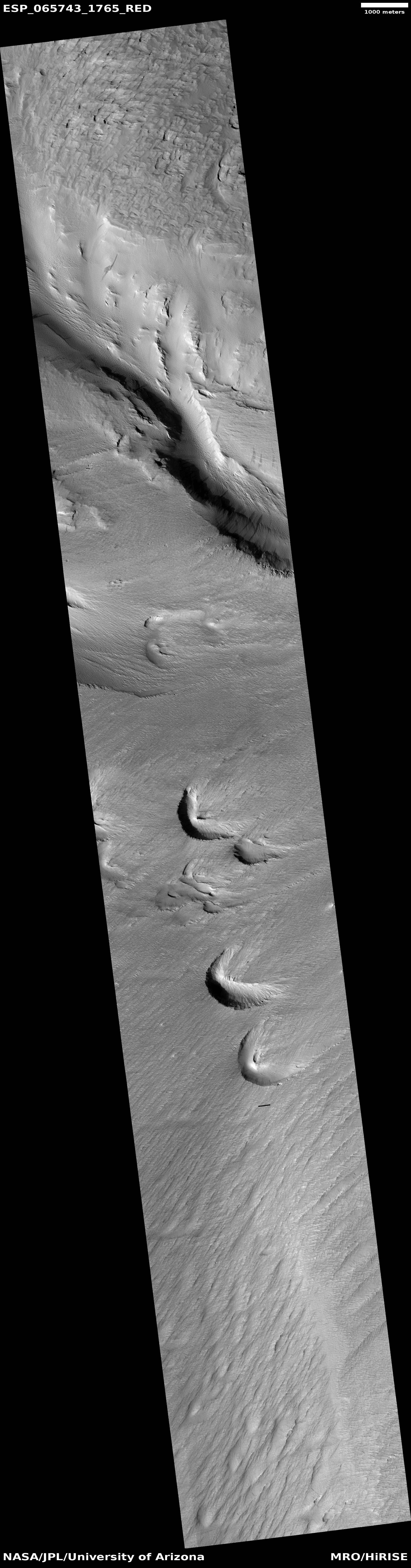
Cool image time! The photo to the right, rotated, cropped, and reduced to post here, was taken on October 2, 2022 by the high resolution camera on Mars Reconnaissance Orbiter (MRO). It shows a cluster of craters filled with ripple dunes.

The color strip tells us something [pdf] about the surface materials here. The reddish-orange in the craters is thought to be dust. The greenish terrain above the craters is likely coarse rock or bedrock, covered with a veneer of dust.

There is no ice here, just dust that over time has become trapped in the craters and cannot escape. And though there is also dust on the surrounding terrain, there is not that much. The craters themselves are likely very ancient, based on their shape and the eroded condition of their rims.

» Read more

1 comment

Voyager signs deal with Airbus to build its private space station

Voyager Space, the division of Nanoracks that has a contract with NASA for building one of four private space stations, has now signed a deal with Airbus, which will provide Voyager additional technical support.

It appears this deal is going to give Europe access to at least one of those American stations, once ISS is gone.

“We are proud to partner with Airbus Defence and Space to bring Starlab to life. Our vision is to create the most accessible infrastructure in space to serve the scientific community,” said Dylan Taylor, Chairman and CEO of Voyager Space. “This partnership is unique in that it engages international partners in the Commercial Destinations Free-Flyer program. Working with Airbus we will expand Starlab’s ecosystem to serve the European Space Agency (ESA) and its member state space agencies to continue their microgravity research in LEO.”

Unlike ISS, where profit was not a motive, Voyager has to make money on its Starlab space station. If Europe wants in, it needs to provide Voyager something, and this deal is apparently part of that contribution. I also suspect that high level negotiations occurred within NASA, ESA, and Voyager to make this deal happen so that Europe would continue to have access to at least one of the American stations.

0 comments

Updates on India’s space effort

It appears that India’s effort in space is evolving rapidly, based on several news stories today.

First, the Indian space agency ISRO signed a deal with Microsoft, whereby the software giant will provide support to private Indian space start-ups.

As part of a memorandum of understanding that Microsoft has signed with the Indian Space Research Organization, the firm will also provide space tech startups with go-to-market support and help them become enterprise ready, it said.

Startups handpicked by ISRO will be onboarded to Microsoft for Startups Founders Hub platform, where they will receive free access to several tools and resources. These tools include help with building and scaling on Azure, as well as GitHub Enterprise, Visual Studio Enterprise, Microsoft 365 and Power BI and Dynamics 365. [emphasis mine]

The highlighted phrase indicates once again that there is an aggressive turf war going on in India about who will control the aerospace industry. Similar to the battles that occurred at NASA in the 00s and 10s, there are people within ISRO who do not wish to cede their power to an independent private industry, and are doing whatever they can to block the Modi government’s effort to create such an independent industry.

In the end, as long as Modi government stands firm, this effort will fail. Private companies will increasingly succeed, and that success will feed the transition from a government-run industry to an independent and competitive one.

In other stories from India:
» Read more

2 comments

Drainage out of a Martian crater

Drainage out of a Martian crater
Click for full image.

Today’s cool image to the right, rotated, cropped, reduced, and sharpened to post here, not only gives us another example of a Martian geological feature that is unique to Mars and whose origins are not yet understood, it also shows what appears to have once been a lake-filled crater that over time drained out to the east through a gap.

This picture was taken on October 14, 2022 by the high resolution camera on Mars Reconnaissance Orbiter (MRO). The inexplicable geology is called brain terrain, and it fills the floor of the crater on the picture’s left side. The rim shows a gap, from which a meandering channel continues downhill to the east. The lake inside the crater might not have been liquid water, but ice. The channel might not have been formed by flowing water, but by a glacial flow downhill.

What makes this glacial evidence especially interesting is that it is located in a very different part of the Martian mid-latitudes.
» Read more

1 comment

January 3, 2023 Quick space links

Courtesy of BtB’s stringer, who trolls the web to make sure I don’t miss any important stories.

  • Astronaut Walt Cunningham has passed away
  • Cunningham only flew in space once, on Apollo 7, the first shakedown flight of the Apollo capsule in October 1968. The flight lasted ten days, had no technical problems at all, though all three astronauts caught colds. Its success paved the way for the Apollo 8 mission around the Moon two months later.


  • The trailer for the Russian sci-fi movie, The Challenge, that was partly filmed on ISS last year, has now been released
  • It is very clear that they got a lot of good footage when they were on ISS. It is a shame however that this trailer doesn’t have English subtitles, because I think it probably could make some money from American filmgoers.

1 comment

China releases first update on status of Yutu-2 since September

Yutu-2's travel path through December 2022
Click for full image. The red flag marks the landing site.

China today released its first update since September on the status of its Yutu-2 rover on the far side of the Moon. The map on the right shows the rover’s travels through December 2022.

As of today the rover has traveled 4,774 feet total, and about 450 feet since September. The goal, as stated in April 2021, was to “move northwest toward the basalt distribution area located about 1.2 km away.” At the time the rover was only averaging about 100 feet travel per lunar day. According to these numbers, it picked up the pace in the past year, though it is unclear whether it has reached that goal.

1 comment

The soft icy Martian northern lowland plains

The soft icy Martian northern lowland plains
Click for full image.

In a cool image post last week, I noted that the near surface “ice sheets in the northern lowland plains are never … smooth, even if well protected.” The picture to the right, cropped, reduced, and sharpened to post here, provides an excellent example. It was taken on November 2, 2022 by the high resolution camera on Mars Reconnaissance Orbiter (MRO).

It is winter, and the sunlight is coming from the southwest, only 27 degrees above the horizon. The mound on the left is soft, while the depression on the upper right appears to have sand dune ripples sitting on top of a flat glacial mound. This depression may be an eroded crater (no upraised rim) or it could be a sink caused by the sublimation of the near surface ice.

Everywhere else the flat plains are stippled with small knobs.

The overview map below provides more context.
» Read more

0 comments

Largest volcanic eruption in years detected on Io

Using instruments on a ground-based telescope, one scientist based at the Planetary Science Institute (PSI) in Arizona has detected the largest volcanic eruption in years on the Jupiter moon Io.

PSI Senior Scientist [Jeff] Morgenthaler has been using IoIO, located near Benson, Arizona to monitor volcanic activity on Io, since 2017. The observations show some sort of outburst nearly every year, but the largest yet was seen in the fall of 2022. Io is the innermost of Jupiter’s four large moons and is the most volcanic body in the Solar System thanks to the tidal stresses it feels from Jupiter and two of its other large satellites, Europa and Ganymede.

IoIO uses a coronagraphic technique which dims the light coming from Jupiter to enable imaging of faint gases near the very bright planet. A brightening of two of these gases, sodium and ionized sulfur, began between July and September 2022 and lasted until December 2022. The ionized sulfur, which forms a donut-like structure that encircles Jupiter and is called the Io plasma torus, was curiously not nearly as bright in this outburst as previously seen. โ€œThis could be telling us something about the composition of the volcanic activity that produced the outburst or it could be telling us that the torus is more efficient at ridding itself of material when more material is thrown into it,โ€ Morgenthaler said.

The material released by this eruption could impact Juno during future close approaches of Jupiter.

0 comments

SpaceX raises another $750 million in private investment capital

SpaceX has just completed another round of fund-raising, gaining another $750 million in private investment capital.

This additional money now means that SpaceX has raised about $10 billion in private money, most of which is being used for the development of Starship and Superheavy. When we add the $4 billion SpaceX will get from NASA for Starship, the company now has $14 billion to build this new rocket.

5 comments

Rocketry went BOOM! in 2022, but in a good way

In my 2021 annual report on the global launch industry, I noted that while 2021 was a banner year for the global launch industry:

Not all is sweetness and light of course. Competition and freedom always includes risk. Some of these new companies will certainly fail. The demand for launch services might not be enough to sustain them all. And factors outside the control of anyone, such as war and further panics like the Wuhan panic, could shut them all down.

In 2022 the launch industry not only topped 2021, setting a new record for successful launches in a single year, the industry was reshaped and changed by the very factors I warned about one year ago. The Russian invasion of the Ukraine resulted in Russia losing its one remaining satellite customer from the west, OneWeb, while the challenges of rocketry caused one already successful launch company, Astra, to suspend its launch services in order to develop a more competitive rocket.

Nonetheless, 2022 remained the most successful year ever in rocketry, smashing the record for successful launches in a single year, set the previous year, by more than 33%. The graph below illustrates well the unprecedented success of 2022.
» Read more

10 comments

Hakuto-R successfully completes second mid-course correction

Lunar map showing Hakuto-R's landing spot
Hakuto-R’s planned landing site is in Atlas Crater.

According to Ispace, the private lunar lander company based in Japan, its Hakuto-R lander has now successfully completed second mid-course correction, and is functioning as expected on its way to the Moon.

The maneuver was carried out shortly after midnight on Jan. 2, 2023 (Japan Standard Time) and operations were managed from ispaceโ€™s mission control center located in Nihonbashi, Tokyo. This orbital control maneuver is the second maneuver to occur while the lander has been traveling to the moon. The first orbital control maneuver was completed on December 15, 2022. The second maneuver was carried out at a greater distance from Earth and lasted for a longer period than the first maneuver, verifying the companyโ€™s capability to carry out orbital maneuvers under various conditions.

As of Jan. 2, 2023, the lander has traveled approximately 1.24 million kilometers from the Earth and is scheduled to be at its farthest point of approximately 1.4 million km from the Earth by Jan. 20, 2023. Once the lander reaches its farthest point from Earth, a third orbital control maneuver may be performed, depending on its navigational status.

While Hakuto-R carries a number of commercial payloads — including Rashid, the first lunar rover built by the United Arab Emirates (UAE) — its primary goal is engineering. Ispace is using this mission to demonstrate its ability as a company to do this, in anticipation of later commercial planetary missions.

0 comments
1 369 370 371 372 373 1,353