Sunspot update: The most sunspots since 2014

Time for my monthly sunspot update, based on NOAA’s monthly graph that tracks the number of sunspots on the Sun’s Earth-facing hemisphere. The newest graph, with December’s numbers added to the timeline, is below. As always, I have added some additional details to provide context.

In December the half-year pause in the ramp up to solar maximum ceased, with the Sun seeing the most sunspots since September 2014. This high activity far exceeded the predicted sunspot count for December 2023, almost doubling it. In fact, December’s sunspot count almost equaled the predicted peak for the upcoming solar maximum, which is not supposed to happen until sometime in 2025.

» Read more

27 comments

A spray of Martian hollows

A spray of Martian sinks
Click for full image.

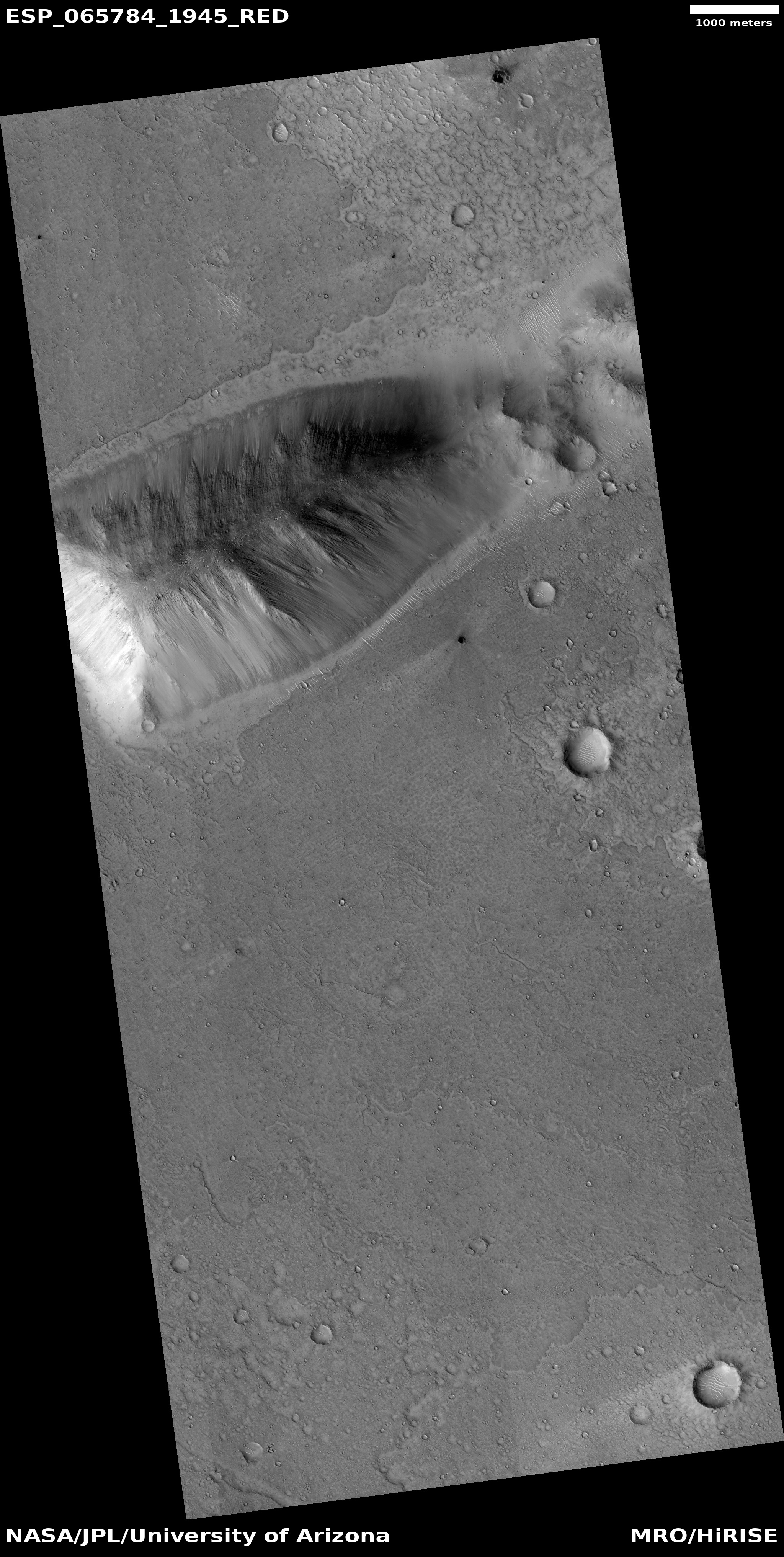
Cool image time! The photo to the right, rotated, cropped, reduced, and sharpened to post here, was taken on October 12. 2022 by the high resolution camera on Mars Reconnaissance Orbiter (MRO). Dubbed simply as a a “terrain sample” by the science team, the picture was not taken as part of any specific research project, but instead to fill a gap in the orbiter’s shooting schedule so as to maintain the camera’s proper temperature. When MRO’s science team does this, they try to pick something in the area below that might be interesting. Sometimes they succeed, but often the features in the picture are nondescript.

The white line delineates the rim of a faint and very eroded small crater. Are the depressions that are mostly concentrated just to its south and east sinks or past impact craters? I haven’t the faintest idea. The overview map below helps to answer this question, but only partly.
» Read more

1 comment

Philippines issues warning about Chinese rocket debris from launch

Flight path of Long March 3B
Click for full resolution image.

UPDATE: A tweet from China shows that the strap-on boosters of this rocket crashed near homes in China, though no one was hurt.

Original post:
—————–
The Philippine government issued a statement yesterday warning the public about possible debris from the December 29th launch by China of its Long March 3B rocket.

The Philippine Space Agency (PhilSA) is recommending precautionary measures related to expected unburned debris from the Long March 3B rocket scheduled for launch today between 12:33 PM and 01:10 PM Philippine time from the Xichang Satellite Launch Center in Xichang, Sichuan Province, China. Upon confirmation of planned launch dates, PhilSA immediately issued an advisory to all relevant government agencies on the estimated drop zone area and proposed the issuance of appropriate warnings on air and marine access.

Based on the Notice to Airmen (NOTAM) issued by the Civil Aviation Administration of China (CAAC) to the Civil Aviation Authority of the Philippines (CAAP), expected unburned debris, such as the rocket boosters and payload fairing, is projected to fall within a drop zone area located within the vicinity of Recto bank, approximately 137 kilometers from Ayungin Shoal and 200 kilometers from Quezon, Palawan. The unburned debris is designed to be discarded as the rocket enters outer space. While not projected to fall on land features or inhabited areas within the Philippine territory, falling debris poses danger and potential risk to ships, aircraft, fishing boats, and other vessels that will pass through the drop zone.

Though the drop zone avoided inhabited areas, it included regions where fisherman worked, and the flight path still flew over inhabited areas. The risk was extremely low, but it appears China also made no effort prior to launch to coordinate this situation with other governments, such as the Philippines. Its warning apparently arrived just before launch. Thus, there was risk that Filipino fisherman were in the drop zone at launch.

3 comments

South Korea test flies a solid-fueled missile

South Korea has successfully completed the second test flight of a solid-fueled missile.

The test came after North Korea claimed earlier this month to have staged a test of a “high-thrust, solid-fuel” rocket motor to develop a “new-type” strategic weapon system.

…In March, the state-run Agency for Defense Development carried out the first test of an indigenous solid-fuel space rocket at a testing site in Taean, 150 kilometers southwest of Seoul, to confirm its capabilities.

The rocket is designed to put a small satellite into a low Earth orbit for surveillance operations. Compared with liquid-fuel space vehicles, solid-fuel ones are known to be usually simpler and more cost-effective to launch.

South Korea might claim this rocket is intended for launching smallsats, but its main purpose almost certainly is as a military missile to counter the missile program of North Korea that has accelerated since Joe Biden became president.

5 comments

SpaceX successfully launches Israeli imaging satellite

SpaceX today successfully launched an Israeli Earth-observation satellite, using its Falcon 9 rocket.

The first stage successfully completed its eleventh flight, touching down softly at SpaceX’s facility at Vandenberg Space Force Base.

This launch completes SpaceX’s 2022 launch year, with a record 61 launches, one more than predicted by the company earlier in the year, and the most ever by a privately owned company.

The leaders in the 2022 launch race:

62 China
61 SpaceX
21 Russia
9 Rocket Lab
8 ULA

The U.S. now leads China 85 to 62, while trailing the rest of the entire world combined 94 to 85. The 85 launches for the U.S. is a new record for a single year, smashing the record of 70 launches set in 1966.

On Monday I will publish my annual full roundup of the state of global launch industry, based on the 2022 numbers.

8 comments

A hint at Mars’ past climate cycles

Terraced glaciers in Martian crater
Click for full image.

Cool image time! The photo to the right, cropped to post here, was taken on October 28, 2022 by the high resolution camera on Mars Reconnaissance Orbiter (MRO). It shows what the scientists label as a “layered feature” inside a small 4,500-foot-wide crater.

Located at 36 degrees north latitude, we are likely looking at glacial ice layers inside this crater, with each layer probably marking a different Martian climate cycle. The terraces suggest that during each growth cycle the glaciers grew less, meaning that less snow fell with each subsequent cycle. This in turn suggests a total loss of global water over time on Mars.

The overview map below gives us the wider context.
» Read more

0 comments

China to build giant ground-based optical telescope

China has announced its plan to build ground-based multi-segmented optical telescope, similar in design to the 10-meter Keck Telescope in Hawaii.

Peking University wants to build the largest optical telescope in Asia and close the gap in astronomy capabilities with the rest of the world.

The project aims to create an initial telescope with an aperture of 19.7 feet (6 meters) by 2024; the mirror will be expanded to 26.2 feet (8 m) by 2030. The project, which in English is called the Expanding Aperture Segmented Telescope (EAST), is being led by Peking University.

Like Keck, the primary mirror would be made of smaller segments, fitted together to create the larger mirror. While not as large as Keck, EAST would be among the largest in the world.

4 comments

China’s Long March 3B rocket launches “experimental satellite”

China today successfully used its Long March 3B rocket to launch from an interior spaceport what its state-run press labeled an “experimental satellite.”

No word on where the rocket’s strap-on side boosters or first stage crashed within China.

The leaders in the 2022 launch race:

62 China
60 SpaceX
21 Russia
9 Rocket Lab
8 ULA

The U.S. still leads China 84 to 62 in the national rankings, but trails the entire world combined 94 to 84.

This launch cements for China the top spot in launches over SpaceX, since SpaceX only has one more launch planned in 2022, scheduled for just before midnight tonight.

5 comments

Lex Fridman – Playing Guitar in a Self-Driving Car

An evening pause: The guitar playing is great, but if this is supposed to be a demonstration of the abilities of self-driving cars, to me it is a utter failure. The drive was on a test track, with no other cars. The car itself was probably never going faster than 25 miles per hour.

In fact, if anything this proves the impracticality of self-driving cars. Such technology might work in a completely controlled environment, but as soon as you add any random human element, it can’t work. Thus our options: we continue to drive ourselves, or we give up our freedom to drive so that all vehicles can be autonomous.

But as I say, the guitar playing is great.

Hat tip Wayne Devette.

12 comments

A “What the heck?” glacier image on Mars

Glacial material on Mars
Click for full image.

Sometimes a cool image goes from bafflement to obvious as you zoom into it. The cool image to the right, cropped to post here, does the opposite. It was taken on October 11, 2022 by the high resolution camera on Mars Reconnaissance Orbiter (MRO). I have purposely cropped it at full resolution, so that its eroded glacier nature is most obvious.

The cracks and hollows are likely caused by the sublimation of the near surface underground ice, breaking upward so that the protective surface layer of debris and dust collapses at some points, and cracks at others.

The overview map below further confirms the likelihood that we are looking at glacial features, but when we also zoom out from this close-up we discover things are not so easily explained.
» Read more

6 comments

Using reflected light from Jupiter to photograph Ganymede’s night side

Ganymede as seen in the reflected light of Jupiter
Click for full image.

During Juno’s June 7, 2021 close fly-by of Ganymede, scientists used its instruments to obtain the first good image of a part of this Jupiter moon. What made the achievement especially amazing was that the area photographed was only lit by the reflected light from Jupiter, the equivalent of its “earthshine.” From the paper’s abstract:

On 7 June 2021, the Juno spacecraft flew within about 1,000 km of the surface of Jupiter’s largest moon, Ganymede. The Mission used their sensitive navigation camera to photograph the moon’s dark side where it was lit only by scattered sunlight from Jupiter. This new imaging approach revealed multiple surface features, including a patchwork of different surface textures (such as grooved terrain), several craters, and ejecta deposits. These features had not been visible in images collected by previous spacecraft.

The picture to the right is from figure 2 of the paper, cropped and reduced to post here. It shows a region on Ganymede that in the earlier images had shown few details because the lighting was poor and thus features were not easily discerned (as can be seen by the inset in the lower right). In the new picture, the only light was reflected from Jupiter, and its low angle brings out the surface topography.

0 comments

Russian investigators conclude leak on Soyuz caused by external impact

ISS as of November 28, 2022
ISS after November 28, 2022 docking of unmanned Dragon freighter.
MS-22 is the Soyuz capsule that is leaking.

The Russian investigators yesterday concluded that the coolant leak on the Soyuz capsule docked to ISS was caused by an external impact, either by a meteroid or a small piece of space junk.

A decision on whether this capsule is still usable for manned flight will be made sometime in January. If not, Russia will move up the launch of the next Soyuz to ISS one month from March to February, but launch it empty. If so, managers will leave the schedule as is.

If the engineers determine the capsule is not flightworthy, it will mean however that until February, ISS is short one lifeboat. At present there are two Dragon capsules docked to ISS, one manned and one cargo. Both return to Earth with a habitable interior, but the cargo capsule is not intended for manned flight. In an emergency however it might be possible to use it.

This situation suggests that NASA should pay to get SpaceX to upgrade the cargo Dragons so that they could always be used as an emergency lifeboat.

9 comments
1 370 371 372 373 374 1,353