Sunspot Update: The Sun quiets down, but just a little

With the posting yesterday by NOAA of its monthly update to its graph showing the long term trends in the Sun’s sunspot activity, it is time for me to do my own update, showing this graph below with annotations in order to provide some context.

While sunspot activity dropped slightly in January, the activity still remained well above the prediction made by NOAA’s panel of solar scientists in 2020, with the upward trend towards a solar maximum much steeper than predicted as well.
» Read more

5 comments

Sunspot update: The Sun blasts off!

Over the weekend NOAA posted its monthly update to its graph showing the long term trends in the Sun’s sunspot activity. As I do every month, I have posted that graph below, annotated to show the previous solar cycle predictions and thus provide context.

In December the Sun’s sunspot activity not only continued the pattern of the past two years — whereby sunspot activity has consistently exceeded the prediction of NOAA’s solar scientist panel — the amount of activity shot up like a rocket. December 2021 saw the most sunspots in a single month since September 2015, when the Sun was about a third of the way into its ramp down from the solar maximum in 2014.

» Read more

15 comments

FAA’s approval of SpaceX’s Starship operations delayed at least a month

The FAA has now had to delay the final approval of its environmental reassessment of SpaceX’s Starship facility and operations at Boca Chica for at least one month because NOAA has refused to approve the plan.

That puts NOAA’s generic review of Rocket Landing and Launches back to at least the end of January, with the much more complex and contentious USFWS [Fish and Wildlife] review also pending (this one is habitat and species review of impacts to bird and wildlife populations specific to Boca Chica).

The earliest approval by the FAA (which again, is far from a sure thing) should be projected into February. And the actual launch license process can’t be started until then. March is absolutely the earliest even the giddiest optimist could expect for Starship’s Maiden Orbital Flight.

It appears that the bureaucrats in NOAA are hostile to the launch site, and are looking for reasons, mostly environmental, to either block it or slow it down.

It also appears that a second Department of the Interior agency must sign off, and it is also hostile.

Based on this story, it looks like Starship’s first orbital flight will not happen until the latter half of ’22, if then. Nor can we expect any help from the Biden administration. Unlike Trump, the Democrats now running the executive branch of government do not like private enterprise and business, and generally look for excuses to regulate and even block it, especially if they think there is the slightest chance it might harm some formerly unknown species somewhere.

This is America today, no longer free. Rather than you making the decision freely, as an American citizen, un-elected federal government officials now decide whether you can do anything, or not.

13 comments

Sunspot update: Sun continues to be more active than predicted

Time for our monthly sunspot update, using NOAA’s most recent monthly graph of sunspot activity. That graph is below, annotated to show the previous solar cycle predictions and thus provide context. It covers all activity through the month of November.

The pattern for the past two years since the end of the solar minimum continues, with sunspot activity consistently exceeding the prediction of NOAA’s panel of solar scientists, as indicated by the red curve. The activity in November dropped very slightly from October, but remained more active than the prediction.

» Read more

14 comments

Sunspot update: Sun continues its higher than predicted activity

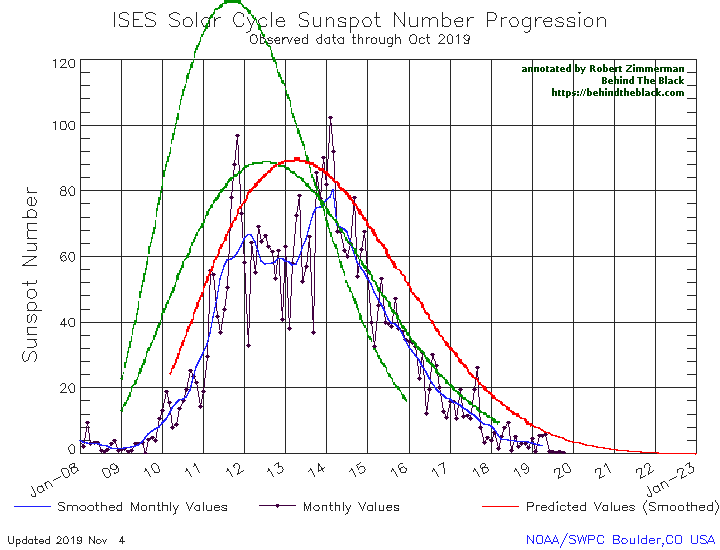
With the beginning of a new month comes my monthly sunspot update, based on NOAA’s most recent monthly graph of sunspot activity. That graph is below, annotated to show the previous solar cycle predictions and thus provide context. It has now been extended from last month to include the Sun’s sunspot activity in October.

Sunspot activity in October continued to be higher than predicted, though the month saw a slight drop from September. Even so, the number of sunspots seen on the Sun’s facing hemisphere in October were the most since August of 2016, when the Sun was ramping down to solar minimum.

» Read more

3 comments

Drop in aviation during COVID lockdowns caused no change in high cirrus clouds, contrary to predictions of climate models

The uncertainty of climate science: In the twenty-five years since I became a science journalist, I cannot count the number of high profile press releases and scientific papers that I’ve read claiming that the increase in aviation and the resulting contrails from airplanes was going to be a major contributor to human-caused global warming. According to the models, the increase in contrails was increasing the high altitude cirrus cover, and thus in a variety of ways acting to warm the planet.

Well, a paper just published in Geophysical Research Letters took a look at the effect the sudden and almost complete cessation of aviation during the 2020 COVID lockdowns had on high altitude cirrus clouds. If the models were right, the lack of air traffic should have caused a reduction in cirrus clouds, thus demonstrating the models were correct.

The models were wrong, once again. From the abstract:

We find that, despite the very large reduction in air traffic, neither cirrus cover nor temperature ranges changed by enough to be detectable relative to the year-to-year variability of natural cirrus. Comparing the satellite observations to previous model-simulated aviation cirrus, we determine that any aviation-induced change in cirrus would have a much smaller magnitude than would be inferred from climate model simulations. These results suggest that the warming effect of cirrus clouds produced by aircraft may be smaller than previously believed. [emphasis mine]

In other words, air traffic apparently has no impact on the high altitude cloud cover. The models that said this traffic was a contributor to global warming were 100% wrong. It apparently is not.

Of course, there remains some uncertainty even with this result, as it is for only one year. The effect of air traffic on clouds could have been disguised in 2020 by the natural fluctuations normally seen from year to year, though the paper’s authors think not.

Assuming this data is confirmed, the authors also concede that the plans to mitigate contrails by rerouting planes so that they do not all fly along the same routes could be very counter-productive. It will cause those detours to burn more fossil fuels, while changing nothing in the cloud cover in the upper atmosphere.

Ah, the law or unintended consequences once again rears its ugly head. Too bad global warming activists never seem to admit it exists, even though it constantly bites them in the rear, time after time after time after time after time….

69 comments

California environment overregulation sole cause of shipping backup

California environment regulations that ban the use of any truck more than three years old, essentially banning half of all fleet trucks and practically all small private truck companies, is the real cause of the shipping backlog that is piling up outside the ports of Los Angles and Long Beach.

This banning was established by a deal the EPA made with California in October 2020, when Trump was still president.

In effect, what this 2020 determination and settlement created was an inability of half the nation’s truckers from picking up anything from the Port of LA or Port of Long Beach. Virtually all private owner operator trucks and half of the fleet trucks that are used for moving containers across the nation were shut out.

In an effort to offset the problem, transportation companies started using compliant trucks (low emission) to take the products to the California state line, where they could be transferred to non-compliant trucks who cannot enter California. However, the scale of the problem creates an immediate bottleneck that builds over time. It doesn’t matter if the ports start working 24/7, they are only going to end up with even more containers waiting on a limited amount of available trucks.

Essentially, California is now holding the entire nation hostage. The backlog is only going to get worse. Moreover, the deal as designed favored big operations, such as Amazon, Walmart, UPS, FedEx, Samsung, The Home Depot and Target, because they can afford the extra costs of shipping to alternative ports. The small companies are essentially shut out.

So much for protecting the little guy, Mr. Trump. This highlights again Trump’s primary failure. He did not clean house when in office, and thus allowed the bureaucracy — clearly operating as agents of the Democratic Party — to double cross and stymie him at every opportunity.

42 comments

Sunspot update: The boom in sunspots returns!

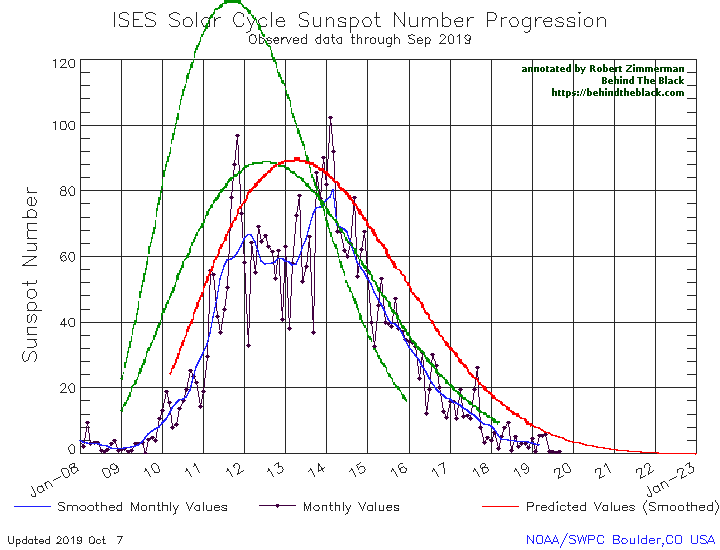
It is time for my monthly sunspot update, based on the most recent NOAA monthly graph, showing the changes in the Sun’s sunspot activity during September. That graph is below, annotated to show the previous solar cycle predictions and thus provide context.

In September sunspot activity boomed once again, producing the most sunspots in a month since 2016 and ending the slight drop in activity in August to return to the pattern the Sun has exhibited since the end of solar minimum. Consistently the number of sunspots on the visible hemisphere of the Sun since 2020 has exceeded the April 2020 prediction of the NOAA scientist panel, as indicated by the red curve in the graph.

» Read more

19 comments

Sunspot update: Activity declines in August to just above prediction

On September 1st NOAA released its update of its monthly sunspot cycle graph, showing the Sun’s sunspot activity for the past month. That graph is below, annotated to show the previous solar cycle predictions and thus provide context.

In August sunspot activity dropped from July so that it was only slightly above the prediction of NOAA’s panel of solar scientists, as indicated by the red curve. The blank streak at the very end of July ended on August 2nd (a streak of seven days and the longest in years), but was followed during the month by an additional five blank days.

» Read more

5 comments

The knives aimed at SpaceX are getting sharpened

Starship must be banned!
Banning Starship: The new goal of our leftist masters.

Two stories today mark what appears to be a growing political campaign focused on squelching by any means possible the continued unparalleled success of the company SpaceX. And the simultaneous publication of both stories on the same day also suggests that this campaign is deliberately timed to force the FAA to shut down SpaceX at Boca Chica.

First we have a story at Space.com aimed at SpaceX’s Starlink constellation, making it the big villain in the growing threat of satellite collisions.

SpaceX’s Starlink satellites alone are involved in about 1,600 close encounters between two spacecraft every week, that’s about 50 % of all such incidents, according to Hugh Lewis, the head of the Astronautics Research Group at the University of Southampton, U.K. These encounters include situations when two spacecraft pass within a distance of 0.6 miles (1 kilometer) from each other.

Lewis, Europe’s leading expert on space debris, makes regular estimates of the situation in orbit based on data from the Socrates (Satellite Orbital Conjunction Reports Assessing Threatening Encounters in Space ) database. This tool, managed by Celestrack, provides information about satellite orbits and models their trajectories into the future to assess collision risk.

Though his data appears accurate and the growing risk of collisions is real, it appears from the story that Lewis, one of only two experts interviewed, has a strong hostility to SpaceX. He doesn’t like the fact that SpaceX is so successful in such a short time, and appears to want something done to control it.

The article also nonchalantly sloughs off one very significant fact: Very few satellite collisions have actually occurred. While the risk is certainly going to increase, that increase is not going to be fueled just by SpaceX. At least four large constellations are presently in the works, all comparable to Starlink in some manner. To focus on SpaceX in particular makes this article appear like a hatchet job.

Then we have a news story from CBS and its very partisan and leftist news show, Sixty Minutes+, providing a loud soapbox for the very small number of anti-development environmentalists fighting to block SpaceX’s operations in Boca Chica, Texas.
» Read more

31 comments

Sunspot update: Another month of greater activity than predicted

NOAA this past weekend released an update of its monthly sunspot cycle graph, showing the Sun’s sunspot activity for the past month. That graph is below, annotated to show the previous solar cycle predictions and thus provide context.

In July the Sun’s hot streak of sunspot activity continued. The number of sunspots on its visible hemisphere continued to exceed the prediction of NOAA’s solar science panel, with the numbers in July easily topping June’s numbers. Only at the very end of July was there a streak of five blank days, the first time the Sun has been blank of sunspots since May 6th, a stretch of activity not seen for years, since the last solar maximum was ramping down to solar minimum in ’16-’17.

The political consequences of this continuing high activity could be quite profound.
» Read more

3 comments

FAA, local Texas DA, and environmental group out to get SpaceX and Starship

Two news articles today suggest that a number of government officials, environmental groups, and some news media are beginning to team up to damage SpaceX and hinder its ability to succeed.

First we have this Verge article, aimed at suggesting that SpaceX violated its launch license and ignored FAA warnings not to launch during a December 9th test flight of the eighth Starship prototype.

Minutes before liftoff, Elon Musk’s SpaceX ignored at least two warnings from the Federal Aviation Administration that launching its first high-altitude Starship prototype last December would violate the company’s launch license, confidential documents and letters obtained by The Verge show. And while SpaceX was under investigation, it told the FAA that the agency’s software was a “source of frustration” that has been “shown to be inaccurate at times or overly conservative,” according to the documents.

The article generally takes the side of the FAA, suggesting that SpaceX was lax and nonchalant about the risks relating to weather and launch conditions, and proceeded with its launch even though FAA officials thought it unsafe. It also quotes Wayne Monteith, the head of the FAA’s space division, blasting SpaceX for showing “a concerning lack of operational control and process discipline that is inconsistent with a strong safety culture,” claiming that FAA software showed a risk to nearby buildings and homes should the rocket explode in the air.

However, buried far down in the article it also notes,
» Read more

23 comments
1 7 8 9 10 11 73