Glacial layers in Mars’ glacier country

Glacial layers in Mars' glacier country
Click for original image.

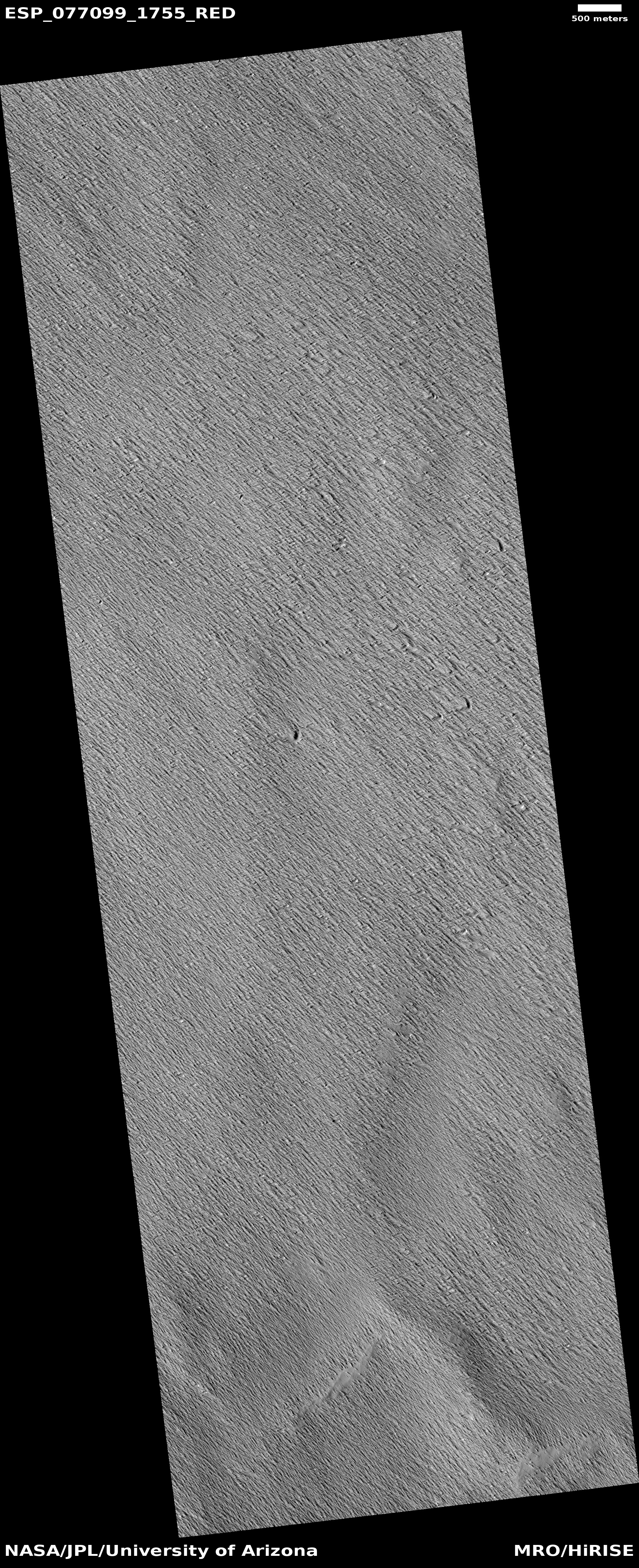
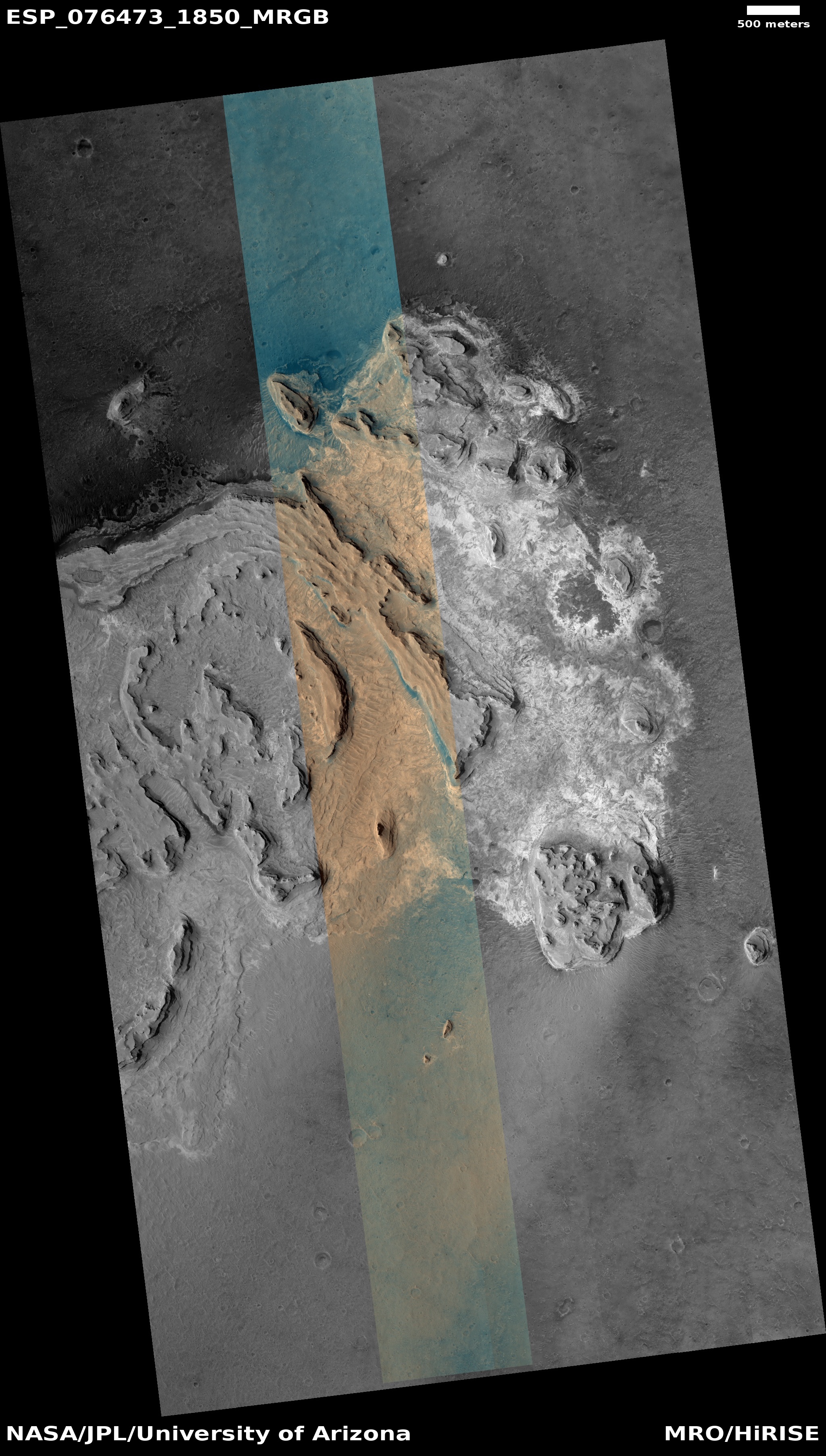
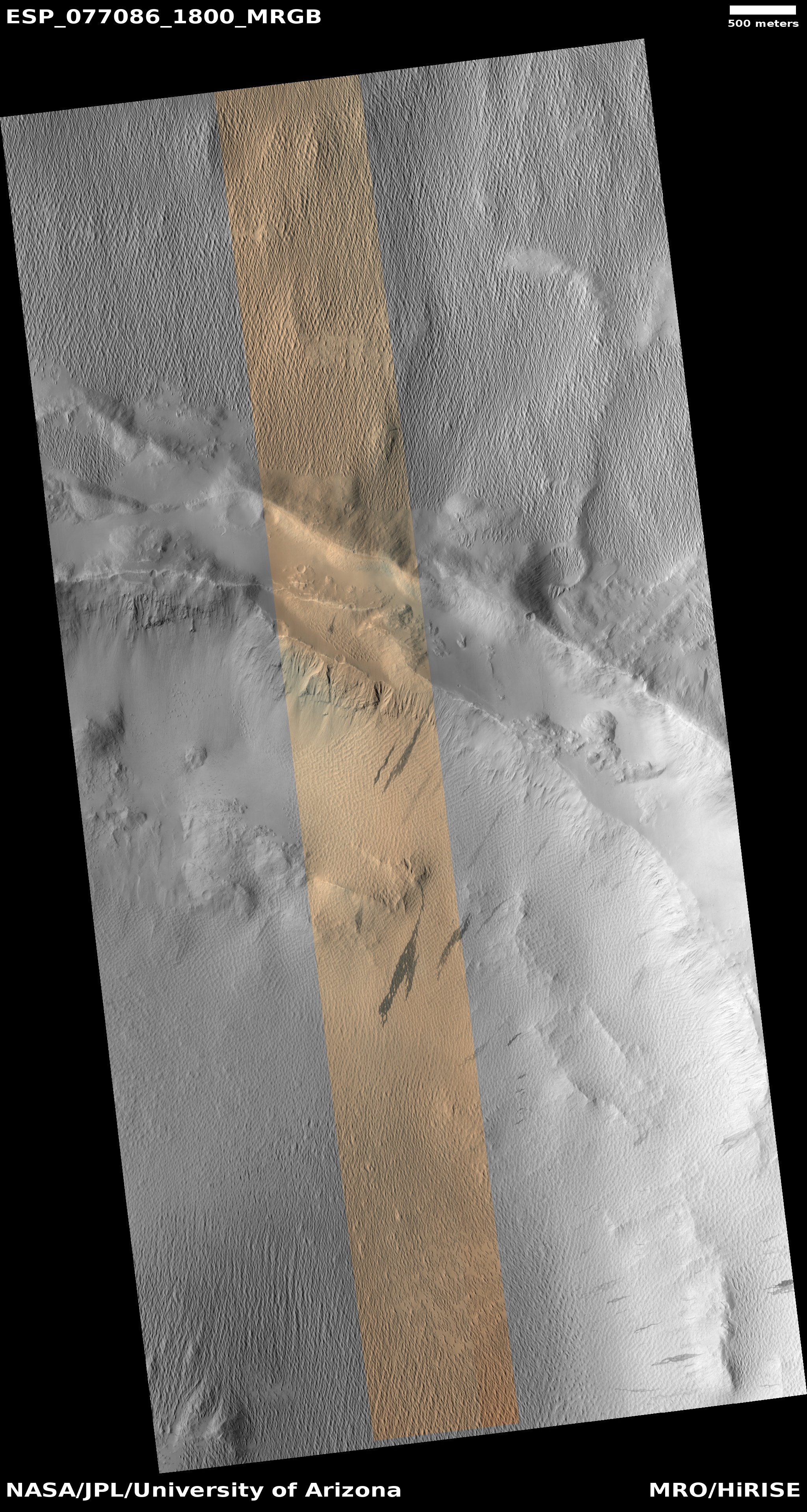
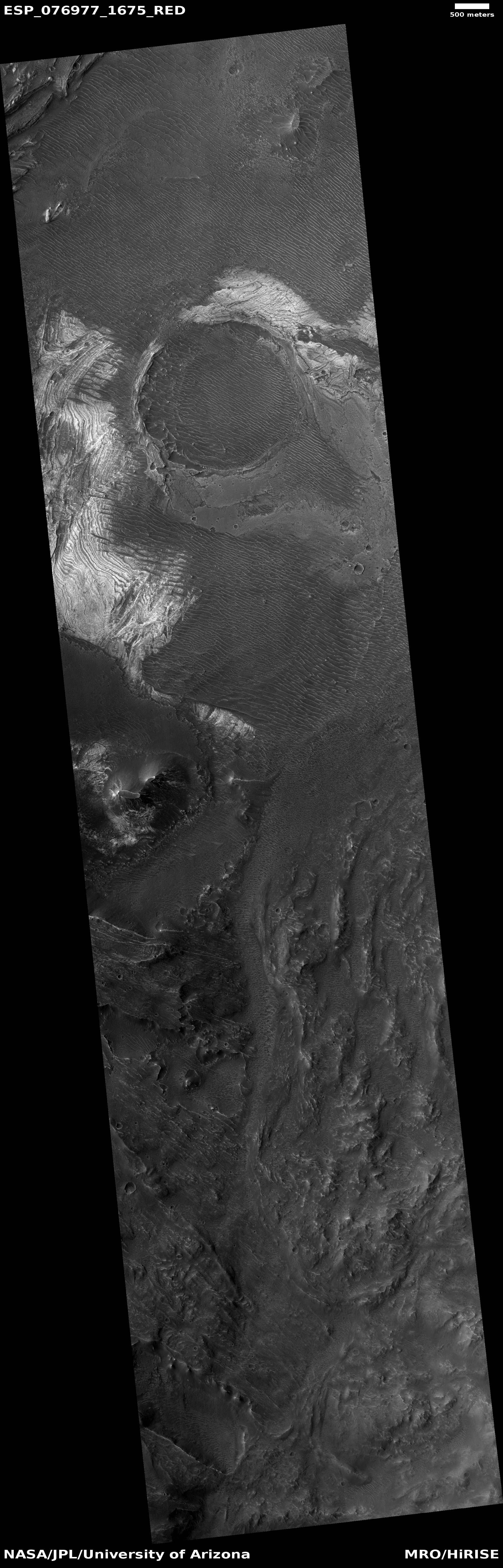
Cool image time! The picture to the right, cropped, reduced, and sharpened to post here, was taken on August 20, 2023 by the high resolution camera on Mars Reconnaissance Orbiter (MRO). It features a 250-foot-high north-south cliff that appears to have numerous horizontal layers within it.

Moreover, both on the plateau above the cliff as well as the floor below it, the entire surface seems to resemble a thick snow/ice field, made even more evident by the distortion of many craters and the apparent glacial material inside each crater.

The layers suggest that this ice was laid down in a series of cycles. During cold periods snow fell and accumulated as ice over time. When things became warmer some of that ice sublimated away, but not all. With the next cold cycle a new layer was put down.

The many layers suggest many climate cycles on Mars, none of which were caused by SUVs or coal-firing electrical power stations.
» Read more

1 comment

A land of buttes on Mars

A land of buttes on Mars
Click for original image.

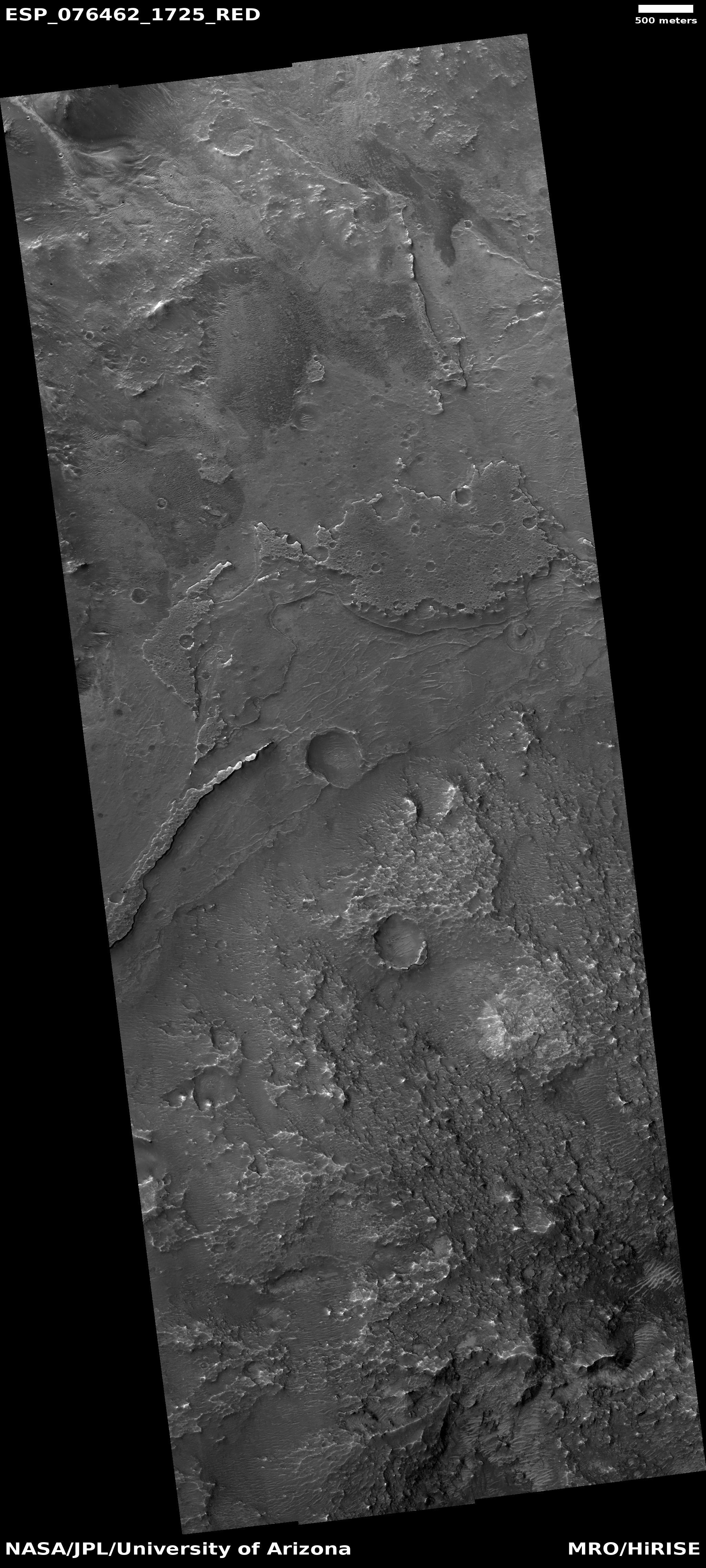
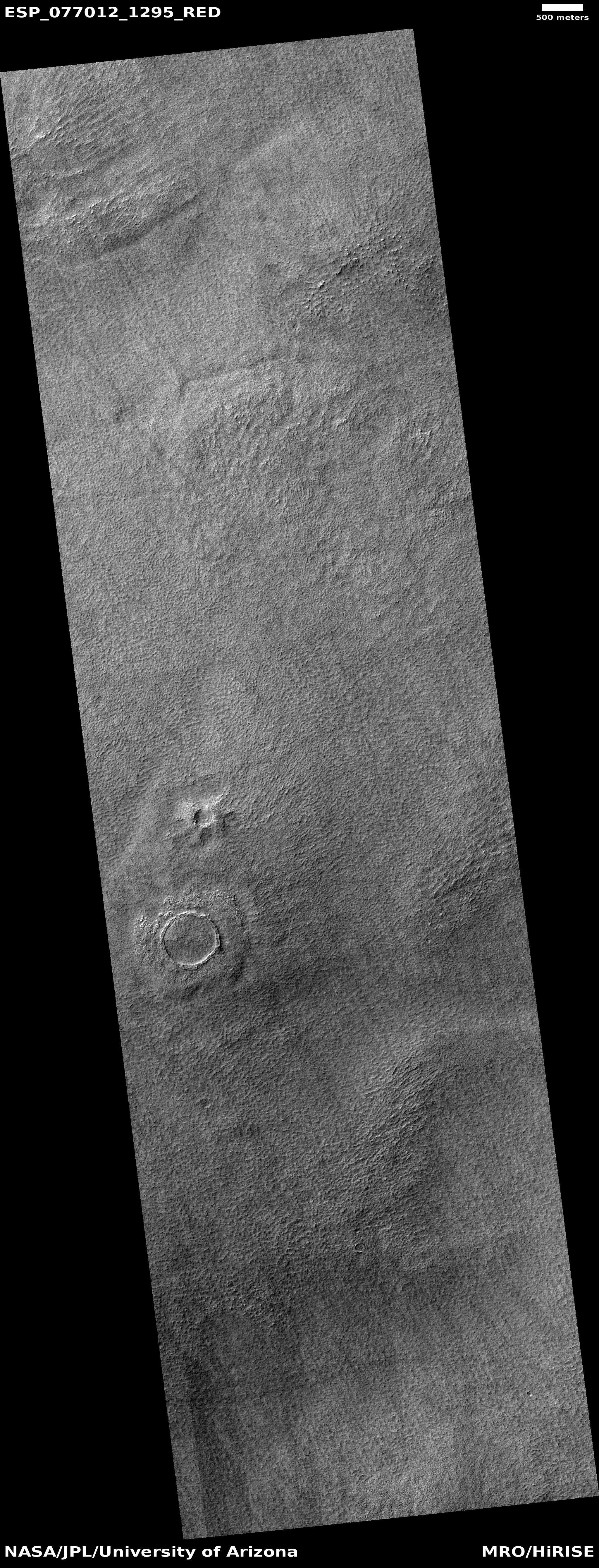
Cool image time! The picture to the right, cropped, reduced, and sharpened to post here, was taken on October 4, 2023 by the high resolution camera on Mars Reconnaissance Orbiter (MRO). Labeled a “terrain sample” by the science team, it was likely shot not as part of any specific research project but to fill a gap in the schedule so as to maintain the camera’s proper temperature. When the camera team has to do this they try to pick targets that are of some interest. Usually they succeed, considering the enormous gaps we presently have of Mars’ geological history.

This picture is no different. It shows a land of buttes and mesas, all ranging from 20 to 200 feet high, surrounded by canyons filled with ripple dunes of Martian dust. If you look at the floor of those canyons closely, you will notice that where there are no ripple dunes the ground is slightly higher and smooth. It is as if that ground was a kind of sandstone that was eroded away by wind into sand, which then formed the dunes.
» Read more

0 comments

The nearest star-forming region, as seen in infrared by Webb

The nearest star-forming region, as seen by Webb
Click for original image.

Time for another cool image on this somewhat quiet Monday. The false-color infrared image to the right, reduced and sharpened to post here, was taken by the Webb Space Telescope, and shows the Rho Ophiuchi star-forming region, the nearest to our solar system at a distance of about 460 light years.

It is a relatively small, quiet stellar nursery, but you’d never know it from Webb’s chaotic close-up. Jets bursting from young stars crisscross the image, impacting the surrounding interstellar gas and lighting up molecular hydrogen, shown in red. Some stars display the telltale shadow of a circumstellar disc, the makings of future planetary systems.

The young stars at the centre of many of these discs are similar in mass to the Sun or smaller. The heftiest in this image is the star S1, which appears amid a glowing cave it is carving out with its stellar winds in the lower half of the image. The lighter-coloured gas surrounding S1 consists of polycyclic aromatic hydrocarbons, a family of carbon-based molecules that are among the most common compounds found in space.

There are two features that are most compelling to me in this image. First, the red hydrogen jet that cuts across the entire right half of the image from top to bottom. At the top you can see how that jet is pushing material before it. Second, we have the cave-like structure surround S1, the central star. The yellowish cloud is almost like a hand cupped around that star.

6 comments

A galaxy of violence

A galaxy of violence
Click for original image.

Time for another cool image! The picture to the right, cropped, reduced, and sharpened to post here, was taken by the Hubble Space Telescope, and shows a well defined spiral galaxy face-on in optical wavelengths.

This whirling image features a bright spiral galaxy known as MCG-01-24-014, which is located about 275 million light-years from Earth. In addition to being a well-defined spiral galaxy, MCG-01-24-014 has an extremely energetic core, known as an active galactic nucleus (AGN), so it is referred to as an active galaxy. Even more specifically, it is categorised as a Type-2 Seyfert galaxy. Seyfert galaxies host one of the most common subclasses of AGN, alongside quasars. Whilst the precise categorisation of AGNs is nuanced, Seyfert galaxies tend to be relatively nearby ones where the host galaxy remains plainly detectable alongside its central AGN, while quasars are invariably very distant AGNs whose incredible luminosities outshine their host galaxies.

In contrast, the core of our own Milky Way galaxy is very quiet, which is likely a factor in why it was possible for life to form on Earth.

0 comments

Webb takes another infrared image of Uranus

Uranus as seen in infrared by Webb
Click for original image. Go here for Uranus close-up

Astronomers have used the Webb Space Telescope to take another infrared image of Uranus, following up on earlier observations with Webb in April.

The new false-color infrared picture is to the right, cropped, reduced, and enhanced to post here. Though the close-up of Uranus is in the left corner, the overall view is somewhat wider than the image I highlighted previously, showing many background galaxies and at least one star. The star is the spiked bright object on the left. In false color the galaxies all been given an orange tint, while the blue objects near Uranus are its moons. Because Uranus’s rotational tilt is so extreme, 98 degrees compared to Earth’s 23 degrees, its north pole is presently facing the Sun directly, and is in the center here.

One of the most striking of these is the planet’s seasonal north polar cloud cap. Compared to the Webb image from earlier this year, some details of the cap are easier to see in these newer images. These include the bright, white, inner cap and the dark lane in the bottom of the polar cap, toward the lower latitudes. Several bright storms can also be seen near and below the southern border of the polar cap. The number of these storms, and how frequently and where they appear in Uranus’s atmosphere, might be due to a combination of seasonal and meteorological effects.

The polar cap appears to become more prominent when the planet’s pole begins to point toward the Sun, as it approaches solstice and receives more sunlight. Uranus reaches its next solstice in 2028, and astronomers are eager to watch any possible changes in the structure of these features. Webb will help disentangle the seasonal and meteorological effects that influence Uranus’s storms, which is critical to help astronomers understand the planet’s complex atmosphere.

If you want to see what Uranus looks like to our eyes, check out the Hubble pictures taken in 2014 and 2022. Though fewer features are visible in optical wavelengths, those two images showed long term seasonal changes.

Webb has now revealed some shorter term changes.

1 comment

Another minor canyon on Mars that would be a world wonder on Earth

Another minor canyon on Mars
Click for original image.

Cool image time! The picture to the right, rotated, cropped, reduced, and sharpened to post here, was taken on August 6, 2023 by the high resolution camera on Mars Reconnaissance Orbiter (MRO). It shows the steep north canyon wall of one small part of the Martian canyon complex dubbed Noctis Labyrinthus

The elevation drop in this picture is about 8,000 feet, but the canyon’s lowest point is several miles further south and another 7,000 feet lower down. What is most intriguing about the geology here is its age. If you look at the full resolution image, you will see that there are scattered small craters on the smooth slopes that resemble sand that gravity and wind is shaping into those long streaks heading downhill.

Those craters, however tell us that these smooth slopes are very old, and have not changed in a long time. Furthermore, though the material appears to look like soft sand, the craters also tell us it long ago hardened into a kind of rock. If wind is shaping this material, it must be a very slow process.

The light areas on the rim as well as the ridge peaks below the rim suggest the presence of geological variety, which fits with other data that says Noctis Labyrinthus has a wide variety of minerals.
» Read more

2 comments

Perseverance looks at Jezero Crater in high resolution

Perseverance's future route
Click for full image.

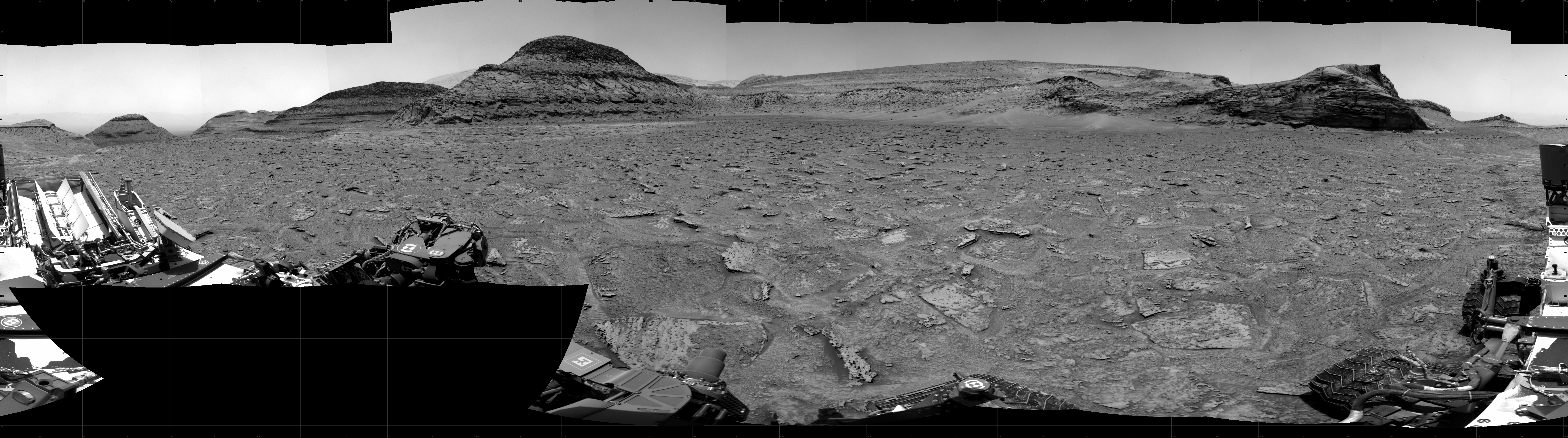
The Perseverance science team earlier this week released a mosaic taken by the rover’s high resolution over three days in November, showing the entire 360 degree view of Jezero Crater from where Perservance sat during the month long solar conjunction that month, when communications with Mars was cut off due to the Sun being in the way.

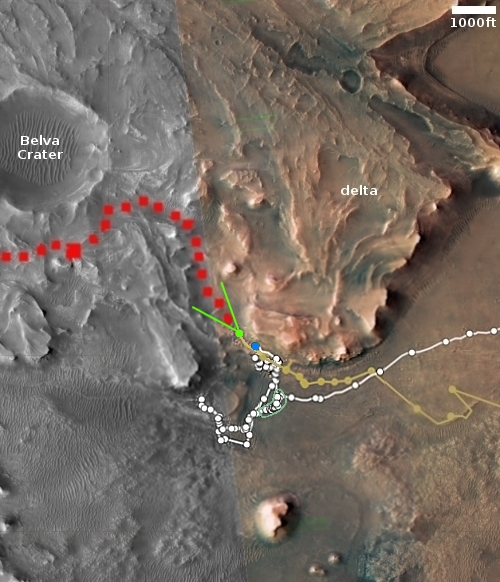
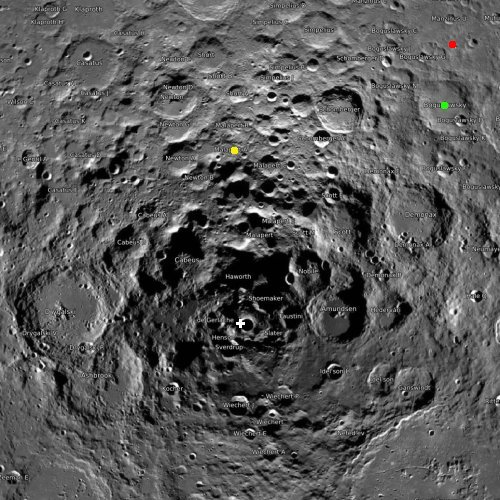
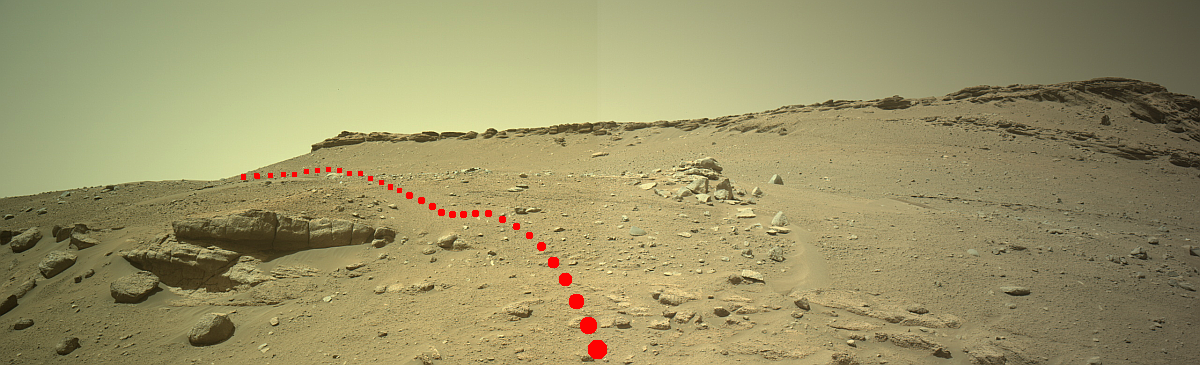
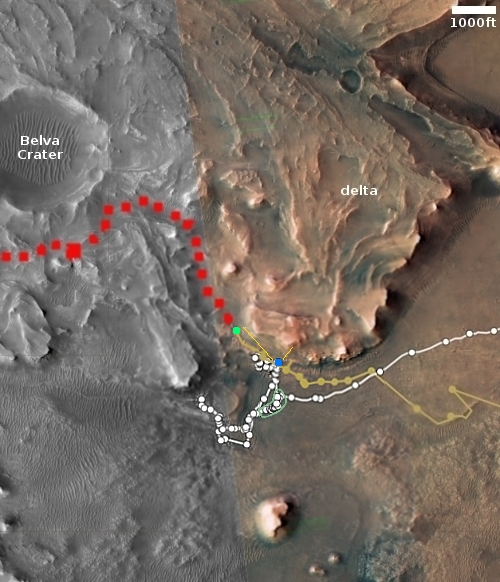
Part of that panorama, significantly reduced, cropped, and enhanced, is posted above, focusing on the western rim of Jezero Crater and the route that Perseverance will likely take in the future. Below is an overview map that indicates by the yellow lines the approximate area covered by this picture. The light blue dot marks Perseverance’s present location, while the dark blue dot marks where it took the mosaic and was also stationed during that solar conjunction. The dotted red line on both images marks the approximate proposed route that the science team is considering for leaving Jezero crater. Instead of going out through Neretva Vallis, they are instead considering heading south to go over the crater’s rim itself.

Ingenuity’s present position is marked by the green dot. This is where it landed after flight 67 on December 2nd. On December 8th the helicopter’s engineering team had released the flight plan for flight 68, scheduling it for December 9th, but as of this date it appears that flight has not occurred. I suspect the delay is because communication between Ingenuity and Perseverance is presently spotty, though the Ingenuity team has released no information.

Overview map
Click for interactive map.

0 comments

The end of a 400-mile-long Martian escarpment

The end of a 400-mile-long escarpment
Click for original image.

Cool image time! The picture to the right, cropped, reduced, and enhanced to post here, was taken on August 14, 2023 by the high resolution camera on Mars Reconnaissance Orbiter. It shows the cracked top of a enscarpment, with the bottom point to the west about 2,400 feet lower in elevation.

The north-south cracks at the top of the cliff indicate faults. They also suggest that the cliff itself its slowly separating from eastern plateau. North from this point, beyond the edge of this picture, are several places where such a separation has already occurred, with the collapsed cliff leaving a wide pile of landslide debris at the base.

This cliff actually continues north for another 400 miles, suggesting that the ground shifted along this entire distance, with the ground to the east going up and ground to the west going down. Because the cliff is such a distinct and large feature, it has its own name, Claritas Rupes, “rupes” being the Latin word for cliff.
» Read more

0 comments

Martian crater or mud caldera?

Martian crater or volcano?
Click for original image.

Cool image time! The picture to the right, cropped, reduced, and sharpened to post here, was taken on October 18, 2023 by the high resolution camera on Mars Reconnaissance Orbiter (MRO).

The scientists only call this a “feature,” likely because they don’t wish to guess as to its nature without more data. However, the 2.5 mile wide splash apron around the central double crater certainly merits a closer look. That double crater could be from impact, but it also could be a caldera, with the apron the result of material that flowed from the caldera.

That there appear to be fewer craters on the apron than on the surrounding terrain strengthens this last hypothesis. The apron would have erased many earlier impact craters, resulting in this lower count.

The location however suggests that if this feature was volcanic in origin it might not have been spewing out magma.
» Read more

0 comments

Craters in a row

Craters in a row
Click for original image.

Cool image time from Mars! The picture to the right, rotated, cropped, reduced, and sharpened to post here, was taken on October 13, 2023 by the high resolution camera on Mars Reconnaissance Orbiter (MRO). It highlights a string of craters, all lined up in an almost straight line.

Were these craters caused by the impact of an asteroid that broke up as it burned its way through the thin Martian atmosphere? The lack of any raised rims argues instead that these are sinks produced not from impact but from a collapse into a void below, possibly a fault line.

Yet, almost all of the craters in this image, even those not part of this crater string, show no raised rims. If sinks, the voids below don’t seem to follow any pattern, which once again argues in favor of random impacts, with the string produced by a bolide breaking up just prior to hitting the ground.
» Read more

3 comments

The steep mountain slopes inside Valles Marineris

Overview map

The steep mountain slopes inside Valles Marineris
Click for full image.

Time for another cool image showing the dramatically steep terrain of Valles Marineris on Mars, the largest known canyon in the solar system. The picture to the right, cropped, reduced, and enhanced to post here, was taken on October 31, 2023 by the high resolution camera on Mars Reconnaissance Orbiter (MRO).

The scientists rightly label this picture “Steep Slopes in West Melas Chasma”. The red dot marks the high point on this ridgeline. The green dot at the upper left marks the lowest point in the picture, about 4,800 feet below the peak. The blue dot on the right edge marks the low point on the ridge’s eastern flank, about 4,600 feet below the peak. The cliff to the east of the peak drops quickly about 1,300 feet in less than a mile.

On the overview map above, the white dot marks the location. The inset is an oblique view, created from a global mosaic of MRO’s context camera images, with the white rectangle indicating approximately the area covered by the picture above.

The immense scale of Valles Marineris must once again be noted. The elevations in this picture are comparable to the descent you make hiking down from the South Rim of the Grand Canyon. They pale however when compared to Valles Marineris. In the inset I have indicated the rim and floor of Valles Marineris in this part of the canyon. The elevation distance between the two is 18,000 feet.

In other words, the canyon to the east of this ridge is quite comparable in size to the Earth’s Grand Canyon, and it is hardly noticeable within the larger canyon of Valles Marineris.

0 comments

The big 25th anniversary of ISS is really still two years away

The first crew of ISS, from left to right, Yuri Gidzenko, Sergei Krikalev, Bill Shepherd
The first crew of ISS, from left to right,
Yuri Gidzenko, Sergei Krikalev, Bill Shepherd

In a press release today NASA touted the 25th anniversary of the mating in orbit of the first two modules of the International Space Station (ISS), Zarya (built by Russia but paid for by the U.S.) and Unity (built by Boeing for NASA).

25 years ago today, the first two modules of the International Space Station – Zarya and Unity – were mated during the STS-88 mission of space shuttle Endeavour. The shuttle’s Canadarm robotic arm reached out and grappled Zarya, which had been on orbit just over two weeks, and attached it to the Unity module stowed inside Endeavour’s payload bay. Endeavour would undock from the young dual-module station one week later beginning the space station assembly era.

Though this anniversary is nice, it really isn’t the most significant. The most significant ISS anniversary is still two years away, when we celebrate 25 years of continuous human presence in space. That record began on October 31, 2000, when a Soyuz-2 rocket lifted off from Baikonur in Kazahkstan, carrying American Bill Shepherd and Russians Yuri Gidzenko and Sergei Krikalev on what was to be the first crew occupancy of the station. Since that launch humans have occupied ISS without break.

With the present operation of China’s space station, and about four American commercial stations under development as well as plans by India and Russia to build their own, it is very likely that October 30, 2000 will remain the last day in human history where no human was in space.

That is the significant date. That is the moment in history that should be noted and marked as significant.

1 comment
1 49 50 51 52 53 89