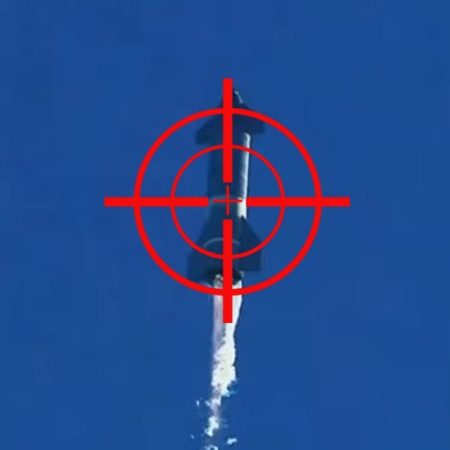
Musk provides update to his Boca Chica crew

The candidate landing zone on Mars for Starship

Elon Musk yesterday gave a 44-minute update on Starship/Superheavy to his team in Boca Chica, outlining what he now expects in the next two years as well as in the next two decades.

You can watch his presentation here. Musk began by once again describing his fundamental goal behind the company, to make the human race multi-planetary, for its own survival, and that Mars is at this time the best choice for doing so. He then provided some details about the on-going development of Starship/Superheavy:

  • SpaceX will be ready to launch 4th test flight in early May
  • There is an 80-90% chance they will attempt a tower landing of Superheavy, caught by its chopstick arms, by the end of this year
  • Starship will require at least two precision ocean landings before they attempt a tower landing
  • To provide tower redundancy for these test landings, by next year they will have 2 towers at Boca Chica, 2 at Cape Canaveral, with Cape Canaveral operational by next year
  • In 2024 they hope to build 6 Superheavys and Starships for test flights
  • By 2025 they plan to test full refueling of Starship in orbit
  • The third iteration of Starship/Superheavy will be capable of placing 200 tons in orbit
  • That third iteration will cost less to launch than Falcon 1, $2-3 million
  • To make a base on Mars self-sufficient quickly, he anticipates sending large fleets of Starships every two years, everytime the flight window to Mars opens.
  • The preferred landing sites will be in the low mid-latitudes, 30-40 degrees, with elevations two kilometers below the Martian “sea level”, to take advantage of a thick atmosphere.
  • If all goes as planned, Musk expects SpaceX to establish a Mars colony in about two decades

That next-to-last bullet point fits perfectly with the region north of Amazonis Planitia, as shown on the map above, where SpaceX has requested numerous images from the high resolution camera on Mars Reconnaissance Orbiter (MRO). It is two kilometers below the “sea level” of Mars. It is at a latitude either on or close to 40 degrees north latitude. It is a region that orbital data says has lots of very near-surface ice. And it is flat, making those first landings relatively safe.

10 comments

SpaceX launches 22 Starlink satellites, with 6 capable of direct-to-cell service

The beat goes on: SpaceX tonight launched another 22 Starlink satellites, six of which were capable of direct-to-cell service. The Falcon 9 rocket lifted off from Vandenberg, with its first stage completing its sixth flight, landing on a drone ship in the Pacific.

The leaders in the 2024 launch race:

35 SpaceX
14 China
5 Russia
4 Rocket Lab

American private enterprise now leads the rest of the world combined 40 to 25, while SpaceX by itself leads the rest of the world, including other American companies, 35 to 30.

1 comment

Varda quickly raises $90 million after completing its first orbital manufacturing mission

As expect, Varda announced yesterday that it raised $90 million in investment capital following the publication of the results of its first orbital manufacturing mission, where its returnable capsule was used to produce test pharmaceuticals in space that cannot be made on Earth.

Varda announced April 5 it raised a Series B round led by venture firm Caffeinated Capital, with participation from Lux Capital, General Catalyst, Founders Fund and Khosla Ventures. The company has raised $145 million to date. The funding round comes on the heels of the successful conclusion of its first demonstration mission, W-1, on Feb. 21 when the company’s capsule landed at the Utah Test and Training Range. The capsule had been part of a spacecraft launched in June 2023 to test the ability to produce pharmaceuticals in microgravity.

The new funding will allow Varda to scale up production of spacecraft that take advantage of microgravity to produce pharmaceuticals that are not possible or cost-effective to make on the ground.

The company already has a second returnable capsule scheduled for launch this summer on a Rocket Lab Electron rocket.

3 comments

Mitsubishi joins private consortium building the Starlab commercial space station

The Japanese big space company Mitsubishi has now joined the private consortium building the Starlab commercial space station for NASA, teaming up with Voyager Space and Airbus.

At this moment it appears that Voyager, the lead company in this station, is attempting to capture the international market that up to now has been part of ISS. Airbus gets it direct access to European companies and the Europeans Space Agency (ESA). Mitsubishi now gets it direct access to Japanese government financing.

The other stations being built with NASA financing, Axiom and Orbital Reef, so far seem more focused on getting American business, as is Vast’s Haven-1 station, being built entirely from private funds.

3 comments

SpaceX launches another 23 Starlink satellites

Like an Energizer bunny: SpaceX last night successfully placed 23 Starlink satellites into orbit, its Falcon 9 rocket lifting off from Cape Canaveral.

The first stage successfully completed its 14th flight, landing on a drone ship in the Atlantic.

The leaders in the 2024 launch race:

34 SpaceX
14 China
5 Russia
4 Rocket Lab

American private enterprise now leads the rest of the world combined 39 to 25, while SpaceX by itself leads the rest of the world, including other American companies, 34 to 30. SpaceX also has another launch scheduled for tonight.

1 comment

NASA picks three commercial companies to build manned lunar rovers

Capitalism in space: NASA yesterday announced that it has picked three commercial companies, Astrolab, Intuitive Machines, and Lunar Outpost, to begin feasibility design work on its new manned lunar rovers, dubbed a Lunar Terrain Vehicle (LTV), for its planned Artemis missions to the Moon.

NASA will acquire the LTV as a service from industry. The indefinite-delivery/indefinite-quantity, milestone-based Lunar Terrain Vehicle Services contract with firm-fixed-price task orders has a combined maximum potential value of $4.6 billion for all awards.

The three companies are actually each a partnership of several American companies, as follows:

  • Astrolab is building its FLEX rover in partnership with Axiom Space, Inc., and Odyssey Space. Its contract is worth up to $1.9 billion.
  • Intuitive Machines is building its RACER rover in partership with AVL, Boeing, Michelin, and Northrop Grumman. This initial award is worth $30 million, but future buys from NASA could exceed $1 billion.
  • Lunar Outpost is building its Lunar Dawn rover in partnership with Lockheed Martin, General Motors, Goodyear, and MDA Space.

All three lead companies are essentially startups that have partnered with older established players, a likely requirement imposed by NASA to give their effort some experienced help. Though this system of dividing up the work between all the players follows the old scheme used by NASA and the established big space companies for decades in order to guarantee every company gets steady work and a continuing cash flow from the government, the difference is that the product will be designed, built, and owned by each partnership, not NASA, allowing each to sell that product to others outside the agency.

If this goes as planned, eventually the government money will become somewhat irrelevant, once a real commercial industry starts functioning in space and on the Moon. That’s what happened in the airplane industry in the 1920s to the 1950s.

8 comments

Biden’s anti-Christian Easter proclamation means the Democrats believe their November victory is certain

Biden's proclamation declaring Easter a day to honor the queer agenda
Biden’s proclamation declaring Easter a day
honoring the queer agenda. Click for full proclamation.

The decision by the White House to declare Easter Sunday, the holiest day of the Christian religion, to instead be this year’s “Transgender Day of Visibility”, as shown by the screen capture of his declaration to the right, outraged and insulted millions of religious people throughout the country.

That outrage was further inflamed when the very next day Joe Biden boldly denied he had done any such thing, even though he had done it only one day previously.

“I didn’t do that,” Biden said when asked about proclaiming Easter Sunday ‘trans day of visibility.” Asked about Speaker Johnson’s claim otherwise, the president replied, “he’s thoroughly uninformed.”

Most political analysis of these events has focused on whether these actions suggest Biden is entirely incompetent, or whether it proves that others run things in the White House and that Biden is merely a puppet on a string. In either case, those analyses noted that these actions showed an amazing contempt for the religious community that could only hurt Biden in November.

I see this in an entirely different way. While the decision showed utter contempt of Christians, who consider the queer agenda to be deviant and sinful, it also showed us two things about the Democratic Party leadership, whether Biden or the puppet masters pulling his strings, that should truly terrify every single American who values our democratic republic, its Constitution, and its Bill of Rights.
» Read more

26 comments

First manned Starliner mission now targeting a May 6, 2024 launch

In order to work around scheduling issues at ISS, NASA and Boeing have now scheduled the first manned Starliner mission to launch no earlier than May 6, 2024.

Following a review of the International Space Station operations, NASA’s Boeing Crew Flight Test now is targeting no earlier than Monday, May 6, for Starliner’s first launch with astronauts to the orbital complex. The date adjustment optimizes space station schedule of activities planned toward the end of April, including a cargo spacecraft undocking and a crew spacecraft port relocation required for Starliner docking. NASA and Boeing also are performing prelaunch closeout work and completing final certification for flight.

Two astronauts will fly the capsule to ISS for a two week stay, testing its systems in order to determine if it is ready for regular operations.

This launch is years behind schedule due to numerous technical problems that have cost Boeing billions in extra costs as well as lost income. In order to convince other customers besides NASA to buy seats on Starliner will likely require the capsule to fly many times without issues. Until then, I suspect anyone wishing to do a tourist flight in space will pick SpaceX instead, because of its now proven safety and reliability record.

0 comments

Video shows Astra rocket exploding on launchpad during early 2020 launch attempt

In March 2020 the rocket startup Astra was attempting to complete its first orbital test launch. After one attempt that was scrubbed, the next ended with what the company called “an anomaly” when a fire destroyed the rocket on the launchpad.

Immediately after that failure the company furloughed one fifth of its workforce, and did not succeed in getting a rocket to orbit until November 2021, after another two failures.

Video obtained by Tech Chrunch now shows what happened on that March 2020 failure. The Astra rocket simply exploded on launchpad, destroying everything.

The company has been an example of the risks of freedom and private enterprise. It appeared to be one of the big successes, getting rockets built and launched, during which it also went public. Instead, after a few launch successes it abandoned its rocket, ran out of cash, and then the stock was purchased for pennies by the company’s two founders — taking it private once again. At the moment it is not clear if the company will ever rise from the ashes.

In other words, buyer beware. The claims of any new company is not to be trusted blindly. Sometimes their claims are filled with hubris.

1 comment

SpaceX launches 22 Starlink satellites

SpaceX tonight successfully placed another 22 Starlink satellites into orbit, its Falcon 9 rocket lifting off from Vandenberg in California.

The first stage completed its fifteenth flight, landing on a drone ship in the Pacific.

The leaders in the 2024 space race:

33 SpaceX
13 China
5 Russia
4 Rocket Lab

American private enterprise now leads the entire world combined in successful launches 38 to 24, and SpaceX by itself remains ahead everyone one else combined 33 to 29.

1 comment

Boeing’s problems are only the tip of the iceberg

Most of all beware this boy.’
As noted by the Spirit of Christmas Present in Dickens’ The Christmas
Carol
, ‘This boy is ignorance, this girl is want. Beware them both,
but most of all beware this boy.’

Since the beginning of this year, following the near disaster when a door of a Boeing 737-Max airline blew off during the Alaska Airlines flight, the media has been obsessed with reporting every single subsequent Boeing airplane incident as attributed to bad management and quality control at Boeing.

The problem with this shallow reporting is that it fails entirely in recognizing the real depth of the problem.

First, in most of the incidents reported, the planes involved were not recent purchases from Boeing, but had been owned by the airlines for years, sometimes decades. Thus, any maintenance issues, such as a wheel falling off after take-off or a landing gear collapsing on landing or the sudden failure of an Airbus plane’s hydraulic system, are not Boeing’s fault, but the fault of the airline the plane belongs to. In the case of these particular incidents, that airline was United, and in every case, the failure was with its maintenance department, not Boeing’s bad management and poor quality control.

A similar string of incidents has also occurred at American Airlines, involving both Boeing and Airbus airplanes. With both United and American, evidence suggests that the quality of its maintenance staff has likely declined significantly since 2020, when both companies decided to abopt Diversity, Equity, and Inclusion (DEI) hiring practices, which made skin color and sex the most important qualification in hiring, rather than talent, skill, experience, or knowledge.

It is important for readers to recognize this fact when they see new stories about a Boeing plane forced to make an emergency landing, such as the story today about a United Airlines’ Boeing 787. It apparently had a cracked windshield, requiring an unscheduled landing in Chicago. The article at the link focuses a great deal on Boeing, but the focus should instead be on United Airlines, not the airplane maker, since it is United’s responsibility to keep its fleet flightworthy. When an airline fails to do so, future customers should take note, and consider other options when they need to fly.

In other words, you shouldn’t avoid flying on a Boeing plane, you should avoid flying on airlines that maintain their airplanes badly.

Having said this, I don’t want my readers to think I am trying to let Boeing off the hook. Far from it. » Read more

27 comments

Australian spaceport on sourthern coast prepares for launch

Australian commercial spaceports
Click for original map.

According to a report today, the first suborbital launch from a new commercial spaceport on the sourthern coast of Australia is now expected by the end of April or early May.

New launch facilities at the Koonibba Test Range, South Australia’s first permanent spaceport, are almost complete ahead of the impending inaugural launch. Located northwest of Ceduna, the range is a partnership between Southern Launch and the Koonibba Community Aboriginal Corporation. It is the largest commercial testing range in the Southern Hemisphere.

Space Industries Minister Susan Close is today visiting the site ahead of the sub-orbital test launch of German manufacturer HyImpulse’s SR75 rocket, which, subject to final regulatory approval, will go ahead at the end of April or early May. The rocket will reach an altitude of 50 kilometres before parachuting back to Earth where it will be recovered for testing.

Southern Launch, marked on the map to the right, is on south coast of Australia. Two other Australian commercial spaceports also under development are noted on the northern and eastern coasts.

We shall see if this suborbital launch occurs as planned. Recently the evidence has suggested that Australia’s regulatory state is as bad as the United Kingdom, taking forever to issue licenses for private launches.

4 comments
1 152 153 154 155 156 684