
India puts five satellites in orbit with one rocket launch
The competition heats up: India today successfully launched five British satellites on a single launch of its PSLV rocket.
The competition heats up: India today successfully launched five British satellites on a single launch of its PSLV rocket.
The competition heats up: Hindustan Aeronautics has completed construction and handed over to ISRO the orbiter structure of India’s next lunar mission, Chandrayaan-2.
The mission will include an orbiter, lander, and rover, and is aiming for launch sometime after 2017.
The competition heats up: The first test flight of India’s prototype scaled-down version of a reusable spaceplane is expected by late July or early August at the latest.
It appears the Modi government is accelerating development of this mini-shuttle, which is essentially India’s version of Sierra Nevada’s Dream Chaser. If they build it first, it will mean they will have the chance to grab the business that Sierra Nevada has been hoping to grab.
The competition heats up: A committee in India is reviewing proposals for that country’s next unmanned interplanetary probe.
The mission could go back to the Moon or Mars, or maybe go to Venus.
The competition heats up: Construction of India’s scaled-down prototype of a mini-shuttle is almost complete as they prepare for a July test flight.
This is an unmanned test vehicle. The full scale version, not yet built, would be manned.
The competition heats up: India has successfully completed a full duration test of its upgraded cryogenic rocket engine.
This gets them much closer to not only having the ability to launch all of their own geosynchronous satellites, it gets them closer to building a rocket capable of putting human capsules into orbit.

Having successfully completed its nominal six month mission and continuing to operate perfectly, ISRO has extended the mission of India’s Mangalyaan Mars orbiter for another six months.
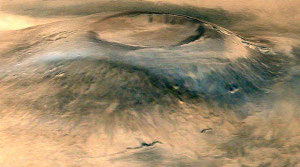
Take a gander at the images the orbiter has been sending down. Quite impressive. The cropped image on the right shows the western slopes of the giant volcano Arsia Mons, with white water vapor hovering above those slopes. (Click on the image for the full resolution version.) The water vapor is significant because scientists believe that this region once had many glaciers, and that much of that water is still present and trapped below the surface as ice, possibly in many of the caves that are there. The vapor’s presence, a routine occurance here, strengthens this theory.
The competition heats up: India’s ISRO space agency successfully completed a 20 second engine test of its new home-built cryogenic rocket engine.
India this year has budgeted $1.2 billion for ISRO, the government agency that runs its space program.
The most astonishing thing I learned from this article however was this tidbit:
The total, presented to the parliament Feb. 28, is roughly level with the 2014-15 budget presented last year. However, ISRO typically spends significantly less money than is allocated in any given budget year — for 2014-15 it spent just 58 billion rupees of the 72 billion rupee allocation — so it seems likely that spending in the coming year will fall short of 73.9 billion rupees. ISRO spokesman Deviprasad Karnik acknowledged the possibility that ISRO’s budget will be reduced before the end of the year. [emphasis mine]
Who ever heard of any government agency in the United States routinely spending less than its budget. The idea is unheard of!
Indian scientists have released a new set of color images taken by their Mars orbiter, Mangalyaan.
The image on the right is of Arsia Mons, one of the three giant volcanoes to the east of Mars’ biggest volcano, Olympus Mons. Arsia Mons is important for future manned colonization, as there are known caves on its western flanks. In addition, those western flanks show solid evidence of past glaciers, which means that it is very likely that those caves will harbor significant quantities of water-ice, making settlement much easier.
The competition heats up: India’s space agency ISRO has announced that they will test fly a prototype space plane sometime between April and June this year.
The test and prototype both sound very similar to Europe’s IXV prototype space plane, test flown only a few weeks ago.
“Technology Demonstrator winged body vehicle weighing 1.5T will be lofted to a height of 70 km using solid booster, thus attaining five times the speed of sound. Thereafter, it will descend by gliding and splashing down into the sea”, said an official statement. This test flight would demonstrate the Hypersonic aerodynamics characteristics, Avionics system, Thermal protection system, Control system and Mission management.
Both programs also remind me of many similar NASA engineering test programs, most of which ended up as dead ends, with the new technology never applied to actual real world missions. Whether that happens in Europe and India remains the main question. The increasing competition in space should help prevent it, but these are also government-run programs, so their goal has less to do with profit and competition than pork and political maneuvering.
The competition heats up: The new head of ISRO, India’s space agency, announced Thursday that India will test fly a prototype suborbital spaceplane sometime in 2016.
The description makes me think this prototype is similar to Europe’s IXV, which was half scale and designed only as a test vehicle.
The competition heats up: The Indian government has picked a career space engineer, Alur Seelin Kiran Kumar, to run ISRO, its space agency.
Expect India to increase its focus on planetary and manned space exploration as well as it launch rocket industry under Kumar.
After three months in orbit around Mars, India’s Mangalyaan spacecraft continues to function as designed, and is expected to operate beyond its planned six month mission.
In the last three months, Mangalyaan has captured nearly 300 pictures. On an average the spacecraft takes four pictures in three days. Besides capturing the images of dust storm activities, it has also taken images of comet Siding Spring.
Because of Mangalyaan’s orbit and the wide-angle nature of its camera the pictures are generally global. This output also is not spectacular compared to other probes. Nonetheless, this is an achievement for which India should be proud.
The competition heats up: India has successfully completed both a test launch of the first stage of its upgraded GSLV rocket as well as the suborbital deployment and splashdown of a test manned capsule.
More details are sure to follow, but at the moment it appears that everything went exactly as planned.
Link here. The launch is scheduled for 11 pm Eastern tonight.
Thursday’s test launch will check the performance of the GSLV Mk. 3’s first stage and strap-on boosters, which will carry the rocket out of the atmosphere beyond the boundary of space. The launcher’s cryogenic upper stage, which will be active and fueled by liquid hydrogen on future missions, will be dormant on Thursday’s flight.
…After the rocket’s propulsion shuts down, a gumdrop-shaped capsule will separate from the GSLV Mk. 3’s dummy upper segment about five-and-a-half minutes after liftoff, according to the Times of India, another English-language paper in India. The capsule weighs about 8,000 pounds — about 3.6 metric tons. Indian engineers from Hindustan Aeronautics Ltd. fabricated the car-sized module, and ISRO added sensors, strain gauges, a guidance and control system and a heat shield for the suborbital flight, which is called the Crew Module Atmospheric Re-entry Experiment, or CARE.
This short article gives us a short but detailed look at India’s plans for manned space, describing both the first test flight of a engineering version of their manned capsule in a little more than a month and the program’s overall goals.
The test flight:
“The first test trial, that of the crew module, will be undertaken in November last week or December first week on the GSLV MK-III,” [Isro chairman K Radhakrishnan told Deccan Herald.] The crew module will be injected into orbit by the GSLV at a height of 110-120 km in space from where it will fall towards the earth and be recovered from sea. Isro will examine how the crew module and thermal shield around it handle the heat and temperatures during re-entry into the earth’s atmosphere.
Their eventual goal is to put two astronauts in orbit for seven days. To do that they will first have to complete at least four to six test launches of their new GSLV MK-III rocket, which has only completed one successful launch after literally two decades of failures. If successful, the test flight described above will be GSLV’s second successful launch.
Note that because of poor writing the article gives the improper impression that the test flight will be manned. It will not. Also, the article states incorrectly that the space shuttle Columbia broke up during re-entry because “the thermal heat shields could not withstand the heat.” This is false. The heat shield would have worked fine, as it had done on numerous previous launches, except that there were gaping holes in it that were put there by pieces of foam during launch.
The competition heats up: Indian engineers have successfully completed their first tests of a new more powerful upper stage engine for their biggest launch rocket.
Taking a big step forward in the development of bigger and more powerful locally-built rocket engines, the Liquid Propulsion Systems Centre (LPSC) on Monday successfully conducted the first ‘cold flow test’ on the CE-20 cryogenic engine, which will power the upper stage of the Geosynchronous Satellite Launch Vehicle-Mk III (GSLV-Mk III). “It’s a milestone,” LPSC director Dr K Sivan told ‘Express’ here on Tuesday, confirming that the test had gone as planned at the LPSC facility in Mahendragiri, Tamil Nadu. The first ‘hot test’ – where the engine will be fired for a few seconds- will be performed in three weeks’ time, Sivan said.
In a cold test, the propellants are not ignited. On Monday, the fuel, Liquid Hydrogen (LH2), and the oxidiser, Liquid Oxygen (LOX), were injected into the chambers for the checking of various parameters.
In related news, Mangalyaan has taken another global view of Mars.
The competition heats up: India today successfully launched the third of seven home-built GPS satellites.
The head of ISRO, India’s NASA, also noted after the launch that the next test flight of their much larger GSLV rocket should occur within the next six weeks. If things go as expected, that flight will also include a test flight of an engineering prototype of an India-built manned capsule.
The global image from India”s Mars probe shows a developing dust storm in the northern hemisphere. Because the spacecraft’s orbit takes it higher above the planet then past probes, it will be able to take many such images, tracking the changing atmospheric conditions on Mars with a frequency that up until now has been impossible.