Curiosity takes a close look at a Martian cliff

A cliff of Mars
Click for full resolution. Original images here and here.

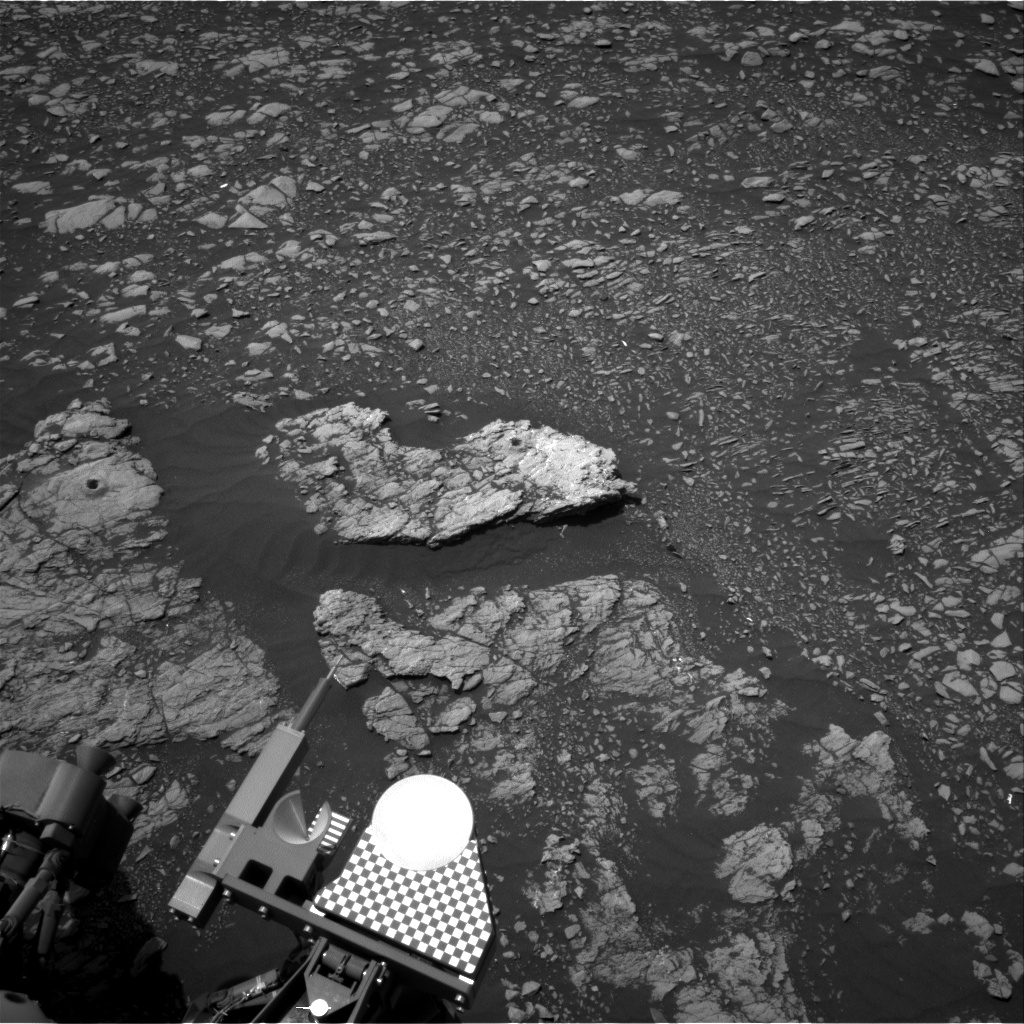
Curiosity has now moved up and into Maria Gordon Notch, a gap in the mountains of Gale Crater that is about forty feet wide, with a 40-foot-high cliff on its western side and a 30 to 60 foot cliff on its eastern side.

The mosaic above, created from two navigation camera images, looks up at the top half of that western cliff. Note the many many layers, each one of which records some climate or volcanic event in Mars’ geological history. The Mars we see today took a long time and many events to become what it is. Such layers however have not been seen everywhere by Curiosity. Compare for example this layered cliff with the massive outcrop dubbed Siccar Point and looked at closely by the rover in October. In that outcrop the layers were either non-existent, or merged together during some subsequent geological process.

Note also the pond of sand/dust at the center-bottom, nestled in a hollow but sitting almost vertical. That the dust can maintain itself at such an angle illustrates Mars’ lighter gravity, about 39% of Earth’s, which in turn allows for a much steeper angle of repose. That lighter gravity also allows for some sections of rock to stick out more precariously than possible on Earth.

As Curiosity moves through the notch in the next few days, more such cool pictures will become available, and I shall post them.

5 comments

Strange eroded glacial flows in unnamed crater on Mars

Eroded glacial flows in unnamed crater on Mars
Click for full resolution image.

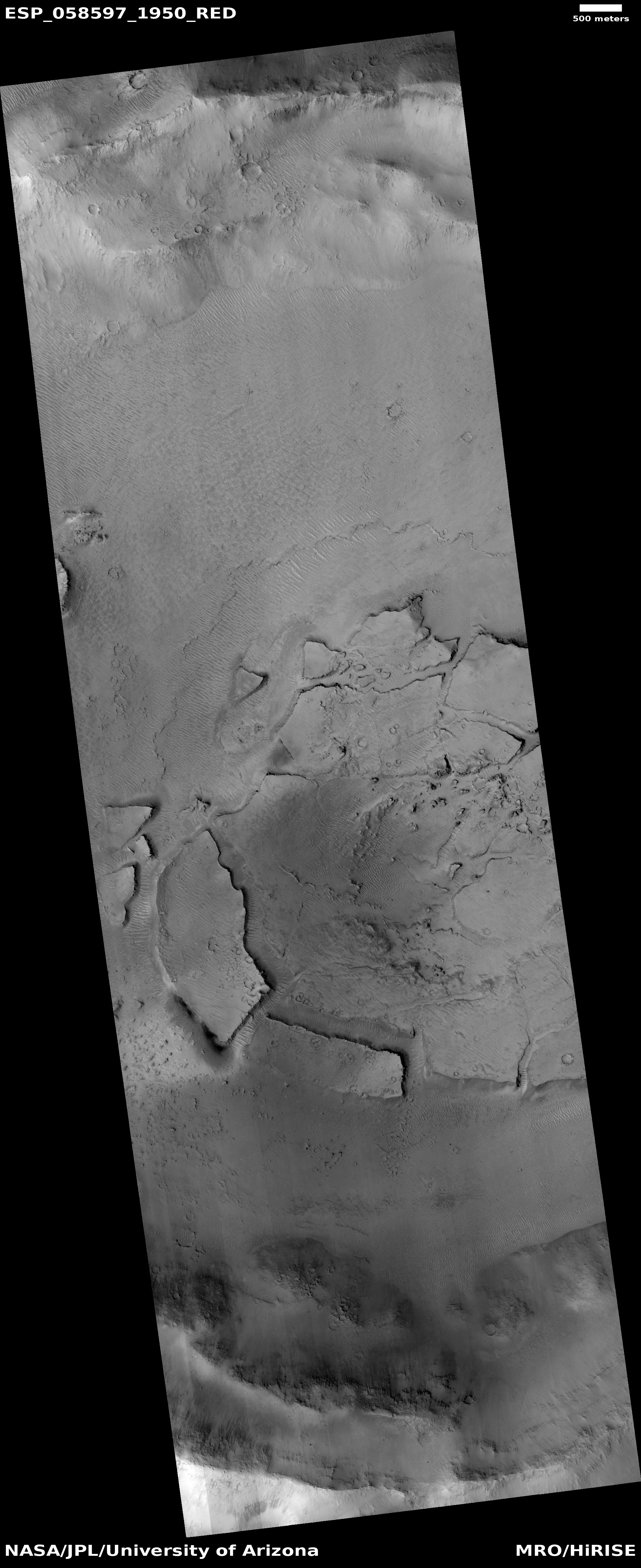
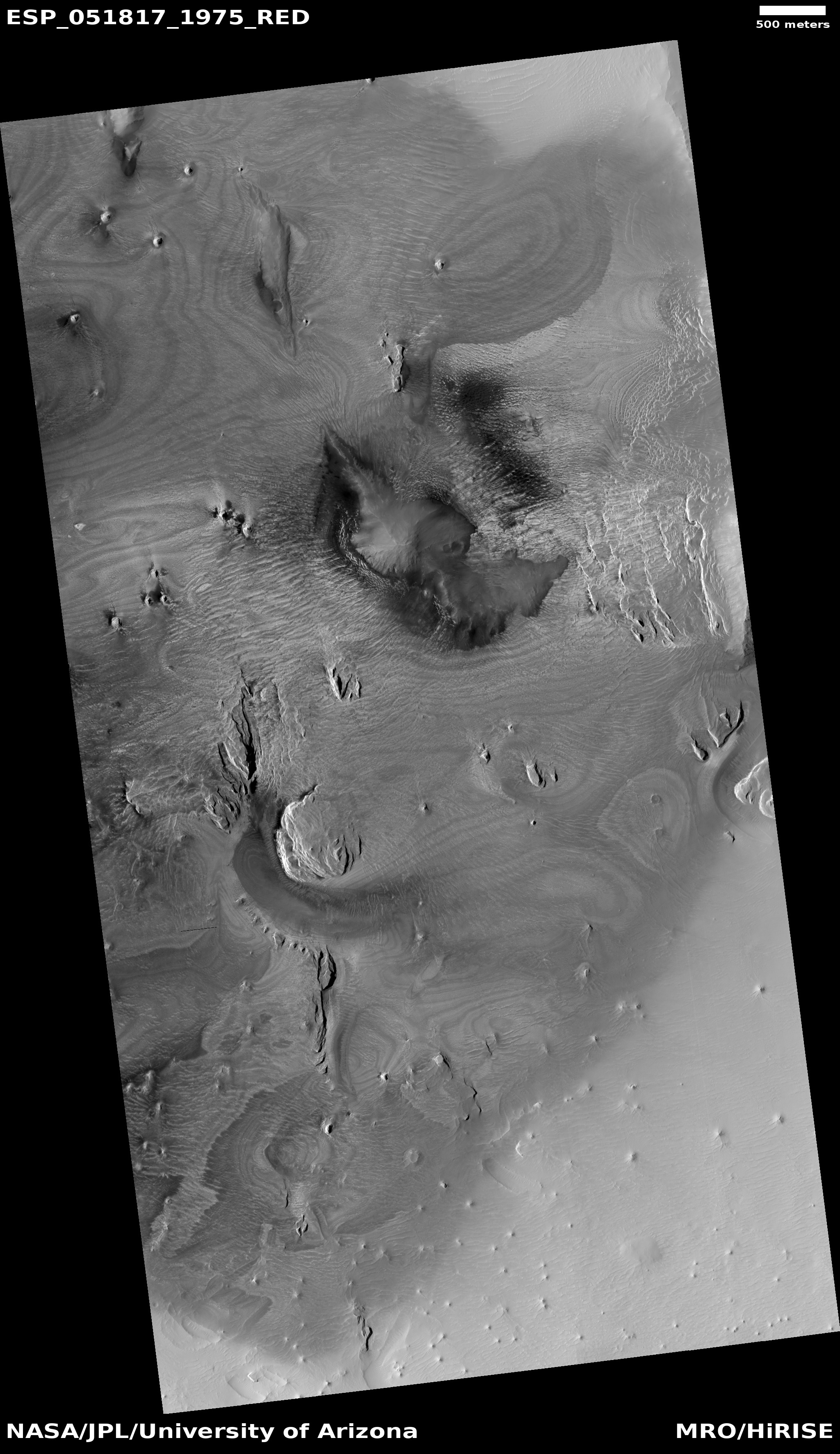
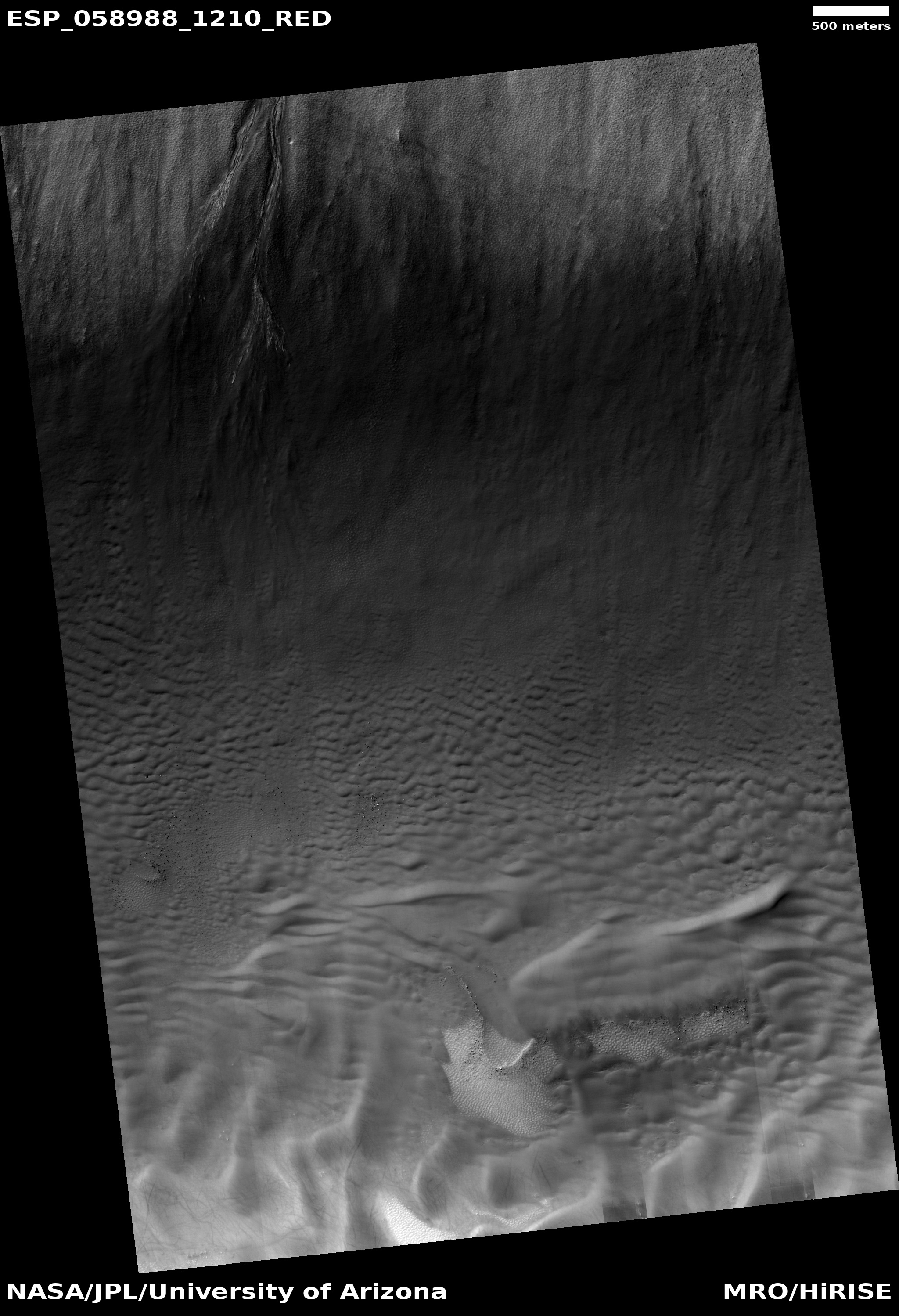
Cool image time! The photo to the right, rotated, cropped, and reduced to post here, was taken on November 1, 2021 by the high resolution camera on Mars Reconnaissance Orbiter (MRO). It shows a series of strange glacial-like flows coming off the western slopes of the central peak of a 40-mile-wide unnamed crater, located smack dab in what I call Mars’ glacier country, that 2,000 long mid-latitude strip where almost every image shows evidence of glaciers.

The cropped section to the right doesn’t really do these strange flows justice. Make sure you click on the image to see the full resolution version. There are numerous separate flows coming off that central peak. Each appears to show that as time passed, each flow traveled a shorter distance down the mountain, leaving a moraine behind at higher and higher points.

The overview map below provides the context.
» Read more

0 comments

Where Ingenuity and Perseverance presently sit in Jezero Crater

Perseverance and Ingenuity, December 8, 2021
Click for interactive map.

The map to the right, annotated to post here, shows the present location of the rover Perseverance (the red dot) in relation to the 17th flight of the helicopter Ingenuity (indicated by the green line and dot) that successfully occurred on December 5, 2021.

Perseverance has been very very very very slowly retreating south, following the same route it took to move into the rough sand dune region the scientists have dubbed Seitah. Based on their long term plans, the rover will retrace its path (the white dotted line) to its landing site, and then continue along the yellow dashed line to eventually reach the base of the delta, dubbed Three Forks, that in the distant past poured through a gap in the rim of Jezero Crater.

The helicopter meanwhile is also retracing its flights, heading north to the spot where Perseverance first placed it on the ground. Because of the seasonally thinner atmosphere, the helicopter’s flights during that return journey must be shorter, which is why the 17th flight only traveled halfway across Seitah. In crossing it the first time it had done so in one flight. Now it will take two.

During that 17th flight it appears that the topography between the rover and the helicopter’s landing site caused a loss of communications as the helicopter was landing.

The Ingenuity team believes the 13-foot (4-meter) height difference between the Perseverance rover and the top of Bras [an outcrop] contributed to the loss of communications when the helicopter descended toward the surface at the end of its flight.

That loss of communications apparently caused no problems, but it will likely mean that Ingenuity will do no more flights until Perseverance can get closer and better positioned.

0 comments

Curiosity moves into a mountain gap

Maria Gordon Notch
Click for full resolution version. Original images here and here.

Curiosity's location, December 6, 2021
Click for interactive map.

For the last three weeks the Curiosity science team has had the rover poking about at the base of the 40 foot cliff on the right of the panorama above. At that location many rocks and boulders had fallen from the top of the cliff, which gave them an opportunity to study the geology of the plateau above, even though it was literally beyond reach.

Beginning yesterday that work ended, and the science team finally made the commitment to move forward, into the gap above where the rover will turn right, climb up onto that plateau through a notch they have dubbed Maria Gordon Notch. The map to the right shows this coming route with the red dotted line.

Once in that notch Curiosity will truly be in the mountains of Gale Crater, even if those mountains are only the foothills to Mount Sharp.

It is interesting to contrast the roughness of the terrain that Curiosity is now routinely traveling, with the relatively benign ground that Perseverance is traversing on the floor of Jezero Crater. While Curiosity is pushing forward into steeper and rougher terrain, the Perseverance team is retreating from the somewhat mild sand dune ground of South Seitah, even though that ground is far less challenging than anything faced by Curiosity. You can see this retreat at the interactive map here. Zoom in and place your cursor over each waypoint. Rather than push forward, the Perseverance team seems willing to have the rover retreat and retrace its route around Seitah, even though to retrace those steps will likely take a few weeks, during which they will cover no new ground and will likely learn little new.

Why the Perseverance team seems so timid is puzzling. It could be they are still working out the kinks of their operation. It could be that they want to take no risks at all this early in their mission. And it could also be that the team culture at Perseverance is simply less daring than that of the Curiosity team.

Only time will answer this question. I suspect as the Perseverance mission unfolds its scientists will become more bold. We just need to give them time.

0 comments

Ingenuity’s images from 16th flight on November 21st

Ingenuity color image from 16th flight
Click for full image.

Cool image time! The photo to the right, reduced and enhanced to post here, was the first color image taken by Ingenuity during its 16th flight on Mars on November 21st. The picture was taken about fifteen seconds after take-off, and I think looks west toward the rim of Jezero Crater in the distance.

The flight itself was relatively short, essentially a quick hop about 380 feet to the north to land at the edge of the rough area dubbed Seitah. The team is going to slowly take the helicopter back to its initial landing field, Wright field, over several hops. This was the first.

If you want to peruse all 113 images from the flight, go here and set the sol range from 268 (November 20) to 274 (November 26). That will show all 113 images taken during the November 21st flight.

3 comments

Mars Express successfully relays data from Zhurong to Earth

The European Space Agency’s Mars Express orbiter has successfully been used to relay data from China’s Zhurong Mars rover to Earth and then to China.

In November, ESAโ€™s Mars Express and CNSAโ€™s Zhurong teams carried out a series of experimental communication tests in which Mars Express used this โ€˜in the blindโ€™ mode to listen for signals sent to it by the Zhurong Rover.

The experiments culminated in a successful test on 20 November. โ€œMars Express successfully received the signals sent by the rover, and our colleagues in the Zhurong team confirmed that all the data arrived on Earth in very good quality.โ€ says ESAโ€™s Gerhard Billig.

Apparently, normal communications would first involve “handshake” communications between the two, but that requires communications frequencies Zhurong does not use. Mars Express instead had to grab the data on the blind. The test was a success, which means the ESA will likely act as another communications relay for Zhurong, in addition to China’s Tianwen-1 orbiter, as the rover’s mission on Mars continues.

0 comments

Sculptured lava south of Olympus Mons?

Sculptured lava?
Click for full image.

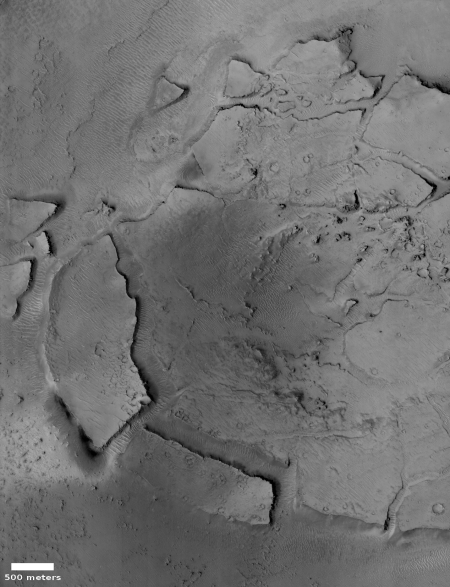
Time for a cool image! The photo to the right, rotated, cropped, and reduced to post here, was taken on September 8, 2021 by the high resolution camera on Mars Reconnaissance Orbiter (MRO). It shows a region of strangely sculptured terrain located several hundred miles south of Olympus Mons.

It appears the prevailing winds are to the west. The question is whether the wind is shaping a hard lava surface, over eons, or is shaping instead layers of dust or volcanic ash quickly and seasonally. At this location either is possible. In fact, we might even be seeing evidence of both at the same time.

The overview map below shows that the location is just outside the Medusae Fossae Formation, the largest volcanic ash deposit on Mars.
» Read more

6 comments

Ingenuity completes 16th Mars flight

According to a tweet by the Ingenuity team, the Mars helicopter successfully completed its 16th flight on Mars on November 21st.

“#MarsHelicopter continues to thrive!” mission personnel wrote in a tweet posted Monday (Nov. 22). “The mighty rotorcraft completed its 16th flight on the Red Planet last weekend, traveling 116 meters northeast for 109 seconds. It captured color images during the short hop, but those will come down in a later downlink.”

No images have as yet been downloaded from the flight.

1 comment

Video of Ingenuity’s 13th flight

Using the high resolution camera on Perseverance, the science team has now released two videos taken of Ingenuity’s 13th flight on Mars, on September 4, 2021.

One is a very wide view, which makes it hard to see the helicopter. The closer view can be seen here.

At the beginning of the video, Ingenuity is near the lower left of frame, at a distance of about 980 feet (300 meters) from the rover. It climbs to an altitude of to 26 feet (8 meters) before beginning its sideways translation. The helicopter leaves the camera’s field of view on the right. Soon after, the helicopter returns into the field of view (the majority of frames that did not capture helicopter after it exited the camera’s field of view were purposely not downlinked from Mars by the team) and lands at a location near its takeoff point.

1 comment

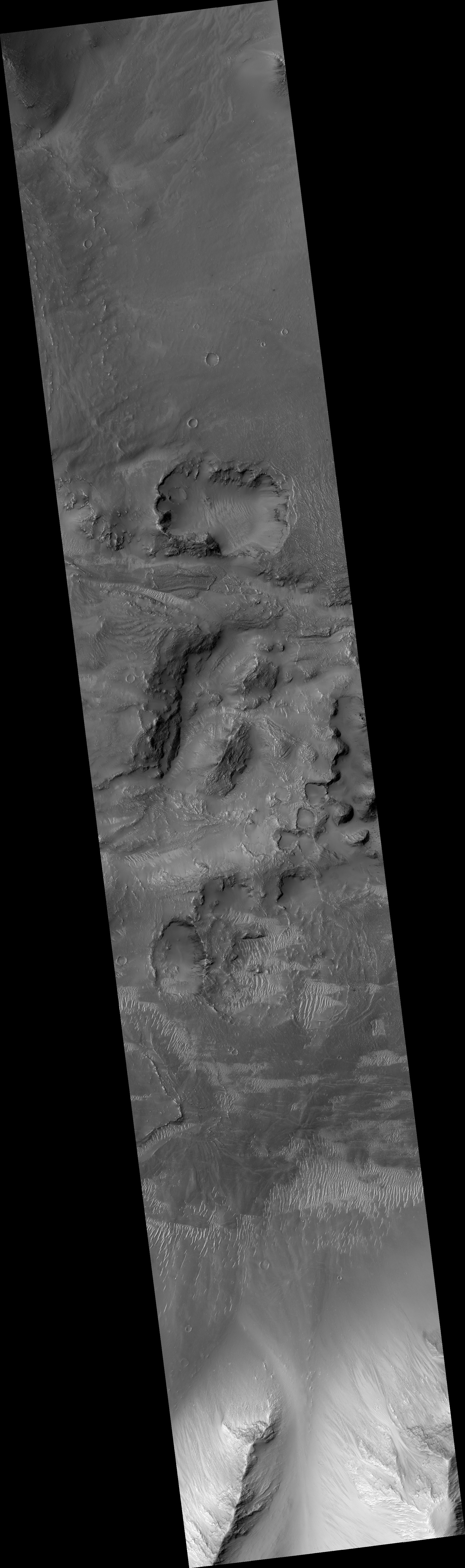
Volcanic vent on Mars

Overview of Arsia Mons pits

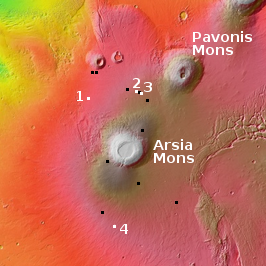
To understand today’s cool image we really should start from a distance and zoom in. The overview map to the right focuses in on the two southernmost giant volcanoes in the string of three that sit to the east of Mars’ biggest volcano, Olympus Mons, and to the west of the planet’s biggest canyon, Valles Marineris.

The black dots mark the locations of the many high resolution photos taken by Mars Reconnaissance Orbiter that I have featured previously on Behind the Black. Many are isolated openings with no related geological features. Others appear to be skylights into a more extensive lava tube, hinted at by either a continuing surface depression or a series of similar skylights.

The white dot marks the location of today’s cool image, about 350 miles south of Arsia Mons’ caldera.
» Read more

2 comments

UAE Al-Amal Mars orbiter finds surprising variations in Mars atmosphere

Oxygen variations in Martian atmosphere
Click for full graphic.

The United Arab Emirates Al-Amal (“hope” in English) Mars orbiter has discovered unexpected variations of oxygen and carbon monoxide in the Martian atmosphere.

The EMM team had expected to observe a relatively uniform emission from oxygen at 130.4 nm across the planet and yet here we are, faced with unpredicted variations of 50% or more in the brightness.

The image to the right, cropped and reduced to post here, shows the variations in oxygen on Mars’s dayside. Though the map does not indicate the geography below, the concentration of oxygen in the northern latitudes appears to correspond to the planet’s northern lowland plains. In fact, the variations should not have been a surprise, since the surface of Mars has such a stark dichotomy between its northern and southern hemispheres.

0 comments

Ingenuity’s 16th Martian flight is now scheduled for November 18

According to an update today from the Ingenuity science team, Ingenuity’s sixteenth flight on Mars is scheduled for no earlier than November 18th, and will be a relatively short hop of about 100+ meters to the north, compared to previous flights.

It appears the roughness of the terrain on this flight can cause an accumulating error in its flight software. Because the landing area is also rough, they want to bring the helicopter down sooner to make sure it lands close to where it should.

The present plan is to hop north to return to the location of Ingenuity’s first flight, at Wright Brothers Field. Along the way they will also consider installing an update in the flight software to improve the helicopter’s capabilities.

0 comments
1 83 84 85 86 87 212