Perseverance as seen by Ingenuity

Perserverance as seen by Ingenuity
Click for full image.

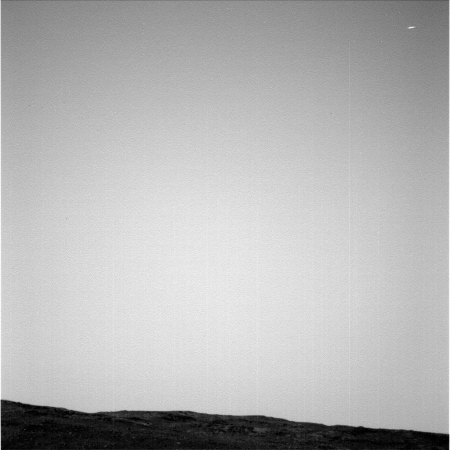
Cool image time! JPL today released the photo to the right, cropped to post here. It was taken by the helicopter Ingenuity during its third flight on April 25th and shows the rover Perseverance at its left edge.

The horizon is tilted because the camera lens is very wide angle to capture as much terrain as possible and thus produces a fisheye curved distortion to the image’s periphery.

This image was taken as Ingenuity flew north about 160 feet away from Perseverance, probably in the first part of its flight as seen by photos taken by Perseverance of Ingenuity during its flight.

The mountains in the distance are the rim of Jezero Crater.

2 comments

Martian pit on top of Martian dome

Dome with pit
Click for full image.

Cool image time! The photo to the right, cropped and reduced to post here, was taken on March 7, 2021 by the high resolution camera on Mars Reconnaissance Orbiter (MRO) and was simply labeled “Pit on Top of Dome in Promethei Terra.”

The cropped section to the right shows one of two such pits visible on the entire image. Promethei Terra is a large 2,000 mile long cratered region due east from Hellas Basin, the deepest large region on Mars.

What caused these pits? The known facts provide clues, but do not really solve the mystery.

First, this image is located in the southern cratered highlands at 45 degrees south latitude. Thus, it is not surprising that it resembles similar terrain in the northern lowlands that suggests an ice layer very close to the surface.
» Read more

0 comments

Study: increase in seasonal Martian streaks after 2018 global dust storm suggests dust not water is their cause

Map of Mars showing location of new linneae after 2018 global dust storm
Click for full image.

The uncertainty of science: A just-published survey of Mars following the 2018 global dust storm found that there was a significant increase in the seasonal dark streaks that scientists call recurring slope lineae, providing more evidence that these streaks are not caused by some form of water seepage but instead are related to some dry process.

The map to the right is figure 2 from that paper. The white dots show the candidate lineae that appeared following the 2018 global dust storm. About half were new streaks, not seen previously.

From the paper’s conclusion:
» Read more

2 comments

Ingenuity completes third flight!

Low resolution montage showing Ingenuity's third flight on Mars, April 25, 2021
Click for full resolution. Individual images can be found, in sequence, here, here, here, and here.

Early today Ingenuity successfully completed its third flight on Mars, traveling a considerable distance north from its taken-off point and then returning almost exactly to that point, as shown by the montage of four Perseverance navigation images above.

You will want to look at the high resolution montage, as the details are much clearer. The large mountains in the background are the rim of Jezero Crater. The smaller plateau in front of these mountains and much closer is the edge of the delta that Perseverance will explore.

According to this NASA press release:

The helicopter took off at 4:31 a.m. EDT (1:31 a.m. PDT), or 12:33 p.m. local Mars time, rising 16 feet (5 meters) – the same altitude as its second flight. Then it zipped downrange 164 feet (50 meters), just over half the length of a football field, reaching a top speed of 6.6 feet per second (2 meters per second).

I have embedded below the fold video of the helicopter’s take off, flight to the north, and then return and landing, created from Perseverance images. Because the camera did not pan the helicopter moves off frame for the middle part of its flight. In the coming days I expect they will assemble a video showing the entire flight.

The fourth flight is now only days away.
» Read more

2 comments

Curiosity’s mesa-top view of Gale Crater

The view of Gale Crater from on top of Mont Mercou
Click for full image.

Cool image time! The photo above, reduced slightly to post here, was taken on April 14, 2021 by one of the navigation cameras on Curiosity. The rover was then and is still sitting on top of the twenty foot high outcrop dubbed Mont Mercou.

Last week I had posted a panorama made from images at this viewpoint looking south towards Mount Sharp. Today’s image is from the same place, but now looks north across the floor of Gale Crater at the areas that Curiosity had previously traveled. I think the smallest mesas on the left of this image are the Murray Buttes which Curiosity was traveling through back in 2016, but am not certain.

The mountains in the far distance are the rim of the crater, about 30 miles away.

4 comments

China names its Mars rover Zhurong, after traditional fire god

The new colonial movement: The Chinese state-run press today announced that it has chosen Zhurong, a traditional Chinese fire god, as the name of the rover that is presently orbiting Mars on its Tianwen-1 orbiter and is targeting a landing sometime in mid-May.

They note that this name matches well with the Chinese name for Mars, “Huo Xing,” or fire star.

The announcement provided little additional information, other than stating that the prime landing site is in the previously announced Utopia Planitia region, which suggests the high resolutions images being taken by Tianwen-1 (unreleased by China) continue to show no reason to change that target.

0 comments

Ingenuity’s third flight late tonight

First color image from Ingenuity
Click for full image.

According to Håvard Grip, Ingenuity’s Mars Helicopter Chief, the helicopter’s team is now targeting very early Sunday morning for its third test flight.

For the third flight, we’re targeting the same altitude [as flight two], but we are going to open things up a bit too, increasing our max airspeed from 0.5 meters per second to 2 meters per second (about 4.5 mph) as we head 50 meters (164 feet) north and return to land at Wright Brothers Field. We’re planning for a total flight time of about 80 seconds and a total distance of 100 meters (330 feet).

While that number may not seem like a lot, consider that we never moved laterally more than about two-pencil lengths when we flight-tested in the vacuum chamber here on Earth. And while the 4 meters of lateral movement in Flight Two (2 meters out and then 2 meters back) was great, providing lots of terrific data, it was still only 4 meters. As such, Flight Three is a big step, one in which Ingenuity will begin to experience freedom in the sky.

The picture above was the first color image sent down by Ingenuity, taken during the second test flight when the helicopter was seventeen feet in the air and pitched slightly so that it could look east, toward Perseverance. From the caption:

The winding parallel discolorations in the surface reveal the tread of the six-wheeled rover. Perseverance itself is located top center, just out frame. “Wright Brothers Field” is in the vicinity of the helicopter’s shadow, bottom center, with the actual point of takeoff of the helicopter just below the image. A portion of the landing pads on two of the helicopter’s four landing legs can be seen in on the left and right sides of the image, and a small portion of the horizon can be seen at the upper right and left corners.

The data from tonight’s flight will arrive on Earth at around 7:16 am (Pacific) tomorrow.

2 comments

Polygons and an inexplicable depression in ancient Martian crater floor

Polygons and an inexplicable depression in ancient Martian crater
Click for full image.

Cool image time! The photo to the right, cropped to post here, was taken on February 26, 2021 by the high resolution camera on Mars Reconnaissance Orbiter (MRO) of a small section of the floor of 85-mile-wide Galilaei Crater.

The main focus of the image is the polygonal cracks that cover the flat low areas of the crater floor, interspersed randomly by small mesas and shallow irregular depressions. The depression in this particular image is especially intriguing. It to me falls into my “What the heck?!” category, for I can’t imagine why among this terrain of polygons and pointed mesas there should suddenly be an irregularly shaped flat depression with a completely smooth floor that has no cracks at all.

The polygons are less puzzling. Galilaei Crater is very old, its impact thought to have occurred about 4 billion years ago. Though it sits at 5 degrees north latitude, practically on the Martian equator and thus in what is now Mars’ most arid region, scientists believe that once there was a lot of liquid surface water here. The overview map below illustrates this.
» Read more

8 comments

Gale Crater’s small mesas were formed by wind, not liquid water

Route through Murray Buttes
The Murray Buttes. Click to see August 11, 2016 post.

The uncertainty of science: Though Curiosity has found apparent evidence of past liquid water during its early travels on the floor of Gale Crater, scientists have now concluded that the first small mesas and buttes it traveled past back in 2016, dubbed the Murray Buttes, were not formed by the flow of liquid water but by wind reshaping ancient sand dunes. From the press release:
» Read more

2 comments

Bumps and holes in the Martian mid-latitudes

Bumps and holes in the Martian mid-latitudes
Click for full image.

Today’s cool image to the right, taken on January 6, 2021 by the high resolution camera on Mars Reconnaissance Orbiter (MRO) and cropped and reduced to post here, focuses on what appears to be a volcanic bulge on the southeastern edge of the great Tharsis Bulge, home to Mars’ biggest volcanoes.

The terrain gives the appearance of hard and rough lava field, ancient and significantly scoured with time. The bumps and mounds suggest nodules that remained as the surrounding softer material eroded away. The holes suggest impact craters, but their relatively few number suggest that this ground was laid down in more recent volcanic events after the late heavy bombardment that occurred in the early solar system about 4 billion years ago. Since it is thought that the big Martian volcanoes stopped being active about a billion years ago, this scenario seems to fit.

However, the terrain also has hints of possible glacial features, as seen in the large crater-like depression in the image’s center. Below is a zoom in to that crater to highlight the flowlike features in its southern interior.
» Read more

1 comment

First images of Ingenuity’s second flight

Ingenuity's second flight, April 22, 2021
For full images go here, here, and here.

According to Mimi Aung, the project manager for Ingenuity, they attempted their second flight of the Mars helicopter early this morning, with the following flight plan:

[W]e plan to trying climbing to 16 feet (5 meters) in this flight test. Then, after the helicopter hovers briefly, it will go into a slight tilt and move sideways for 7 feet (2 meters). Then Ingenuity will come to a stop, hover in place, and make turns to point its color camera in different directions before heading back to the center of the airfield to land. Of course, all of this is done autonomously, based on commands we sent to Perseverance to relay to Ingenuity the night before.

No live stream was provided this time. However, the three images above from Perseverance, just downloaded today and taken about nine minutes apart, show Ingenuity before, during, and after that flight. If you compare the first and third images you can see that the helicopter was able to successfully return to the same landing spot.

I expect an announcement of this successful flight to be posted shortly.

UPDATE: JPL has now released an image taken by Ingenuity during its flight.

7 comments

Perseverance technology experiment produces oxygen from Mars’ atmosphere

An engineering test experiment dubbed MOXIE on the Perseverance rover has successfully produced oxygen from the carbon dioxide in the Martian atmosphere, a technology that will be essential for future human missions.

MOXIE (Mars Oxygen In-situ Resource Utilization Experiment), a small, gold box-shaped instrument on the rover, successfully demonstrated a solid oxide electrolysis technology for converting the Martian atmosphere to oxygen. The atmosphere on Mars is about 95% carbon dioxide.

MOXIE’s first oxygen run produced 5.4 grams of oxygen in an hour. The power supply limits potential production to 12 g/hr — about the same amount that a large tree would produce.

…The oxygen production process starts with carbon dioxide intake; inside MOXIE, the Martian CO2 is compressed and filtered to remove any contaminants. It is then heated, which causes separation into oxygen and carbon monoxide. The oxygen is further isolated by a hot, charged ceramic component; the oxygen ions merge into O2. Carbon monoxide is expelled harmlessly back into the atmosphere.

Human missions to Mars will not just need oxygen to breath. They will need it to provide the fuel for leaving the planet and returning to Earth, since it will be very impractical and expensive to bring everything they need with them. For colonization and planetary exploration to truly happen future space-farers must live off the land.

15 comments
1 99 100 101 102 103 212