Typical but still mysterious gullies in a crater on Mars

Gullies on crater interior wall

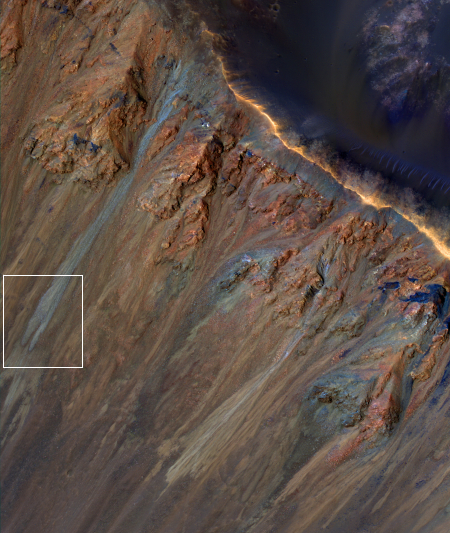
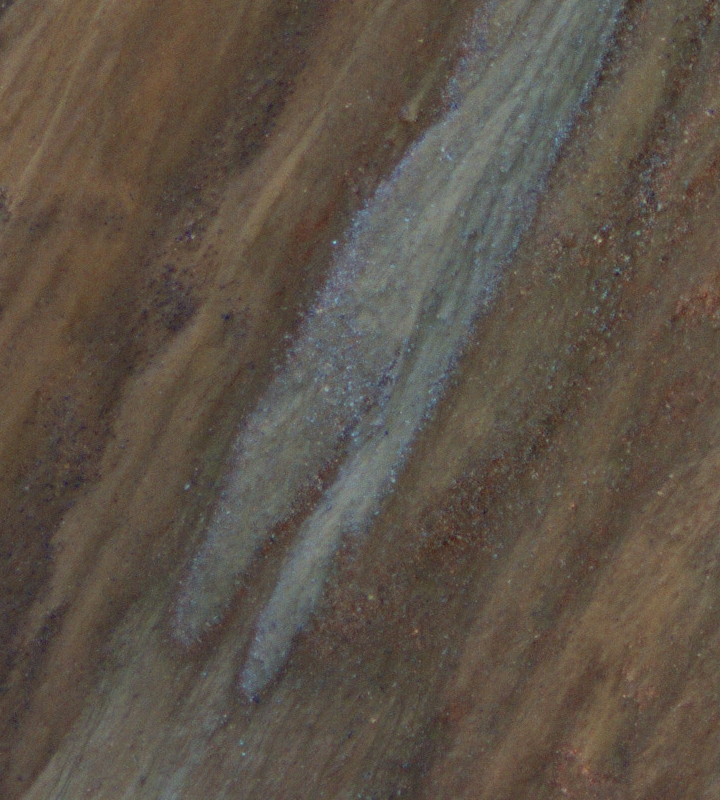
Today’s cool image to the right, cropped and reduced to post here, is of a crater in the mid-latitudes of Mars’s cratered southern highlands. The picture was taken on January 4, 2021 by the high resolution camera on Mars Reconnaissance Orbiter (MRO), and is actually the only high resolution image ever taken of this crater.

The gullies in the north interior wall of this crater are the reason why this picture was snapped. These gullies are very typical on the pole-facing slopes of mid-latitude Martian craters, and have puzzled scientists since they were first discovered in the late 1990s in images taken by Mars Global Surveyor. Since then, thousands have been found, almost all of which in the 30 to 60 degree mid-latitude bands where glacial features are also found. Most occur on the more shadowed pole-facing interior slopes of the craters, though at higher latitudes they are also found facing the equator.

Since their discovery scientists have puzzled over their cause, which because of their locations favoring colder temperatures suggest some form of seasonal weather factor. The most preferred hypotheses propose some interaction with water ice or dry ice, or are simply dry flows of rocky granular material. None of these hypotheses have been confirmed. Some evidence suggests they are dry flows, no water involved. Other evidence points to the influence of an underground layer of water ice.

The mystery of these gullies is enhanced by by the wider view from MRO’s context camera below, rotated and cropped to post here.
» Read more

1 comment

1st pictures from Zhurong finally released

Zhurong's front view
Click for full image.

Zhurong's rear view
Click for full image.

China today finally released the first images from its Mars rover Zhurong, proving that the rover landed successfully and is operating as planned. The link takes you to the website of the Chinese space agency, in Chinese. This link provides some details in English.

The two images to the right show the front and rear views from Zhurong, sitting on top of its landing. The black & white front view shows the deployed ramps that the rover will roll down when it begins it operational phase. It shows, as expected, the generally flat terrain of the northern lowlands plains of Utopia Planitia. In the distance however there appears to be distinct features, possibly the rim of a small crater. At the moment the exact location of the rover is not known, so no precise map yet exists of its surrounding terrain. This will change in the coming days as both Chinese and American scientists hone in on the rover using orbital images.

The color rear view shows that the rover’s solar panels and high gain antenna have properly deployed. While the design of Zhurong in many ways imitates the two American rovers Spirit and Opportunity (probably because China hacked into the JPL website for several years and downloaded their blueprints), it also includes several upgrades. For example, Zhurong’s solar panels unfold, providing a significantly larger surface area to gather sunlight. Both Spirit and Opportunity were somewhat hampered by the power they could obtain by their smaller solar panels. Both also experienced times when Martian dust on the panels reduced that power. Zhurong’s much larger panels will protect it better from these issues, and could allow it to survive longer on Mars.

2 comments

Martian mesas made entirely of dry ice!

Dry ice mesas on Mars
Click for full image.

Time for an especially cool image! The photo to the right, taken on February 13, 2021 by the high resolution camera on Mars Reconnaissance Orbiter (MRO) and cropped and reduced to post here, shows some mesas on the south polar ice cap of Mars.

What makes those mesas cool (literally and figuratively) is that they are thought to be made up entirely of dry ice, part of the thin but permanent frozen carbon dioxide cap in the south. As explained to me by Shane Byrne of the Lunar and Planetary Lab University of Arizona, who requested this image from MRO,

[These mesas are] unusually thick compared to other dry ice mesas (a common landform in the residual ice cap). I only have the lower resolution laser altimeter data to go off for heights here (we may get a stereo pair next year), but from that it looks like 13 meters thick.

That’s about forty feet high, from base to top. In length, the largest mesa on the left is about a mile long and about 1,500 feet wide, on average. And it is made entirely of dry ice!

The red cross on the map below shows the location of these mesas on the south pole ice cap.
» Read more

1 comment

Where is China’s Zhurong Mars rover?

Where is Zhurong?

At this moment we do not have confirmation that China’s rover Zhurong landed safely on Mars. Assuming it did, the mosaic to the right, made from two images from Mars Reconnaissance Orbiter’s (MRO) context camera, shows that landing zone, with the white cross indicating the centerpoint of the suspected landing site, as leaked to the Chinese press back in October 2020.

The red boxes are the only two images released by China that were taken by its Tianwen-1 orbiter of this landing zone. The two white boxes show the areas covered by two of the seven or so photographs taken by MRO’s high resolution camera since that location was revealed. Below is a map showing all the images MRO has taken of this location.
» Read more

24 comments

Why no visual confirmation of the landing on Mars of China’s Zhurong rover?

Despite more than 48 hours having passed since China announced the successful landing of its Zhurong rover on Mars in the northern lowland plain of Utopia Planitia, no images or data of any kind has been released by that nation or its space agency.

It is very possible that this is totally expected, since they have always said they will need about a week of checkouts before they rollled the rover off the lander and begin its operations.

At the same time, China has been very very creative with providing early images for all its planetary missions. For example, within hours of landing they had released images from their Chang’e-5 lunar sample return lander. Similarly, only hours after Chang’e-4 landed on the far side of the Moon with its Yutu-2 rover China released images.

They did the exact same thing when Chang’e-3 landed in 2013 with its Yutu-1 rover.

I can’t imagine they don’t have some cameras on the Mars lander to snap pictures of the horizon or the ground directly below. They might not, but if so the lack would be truly astonishing.

It is also possible China is holding the data close for any number of political reasons, though this doesn’t make much sense since the whole political point of these planetary missions is to sell China to the world.

The more time that passes with no confirmation data, the more it will appear that something is wrong. If this conclusion is incorrect, China needs to act now to dispel these doubts.

13 comments

China’s Zhurong rover successfully lands on Mars

The rover landing site for Tianwen-1's rover

The new colonial movement: China’s today successfully landed its Zhurong rover on the northern lowland plains of Mars dubbed Utopia Planitia.

China’s lander and rover began their descent to the surface at about 4:00 p.m. EDT (2000 GMT) by separating from the Tianwen-1 orbiter, which since March has been used to capture imagery of the targeted landing site for study. An aeroshell protected the stacked probes as they plunged into the atmosphere at 3 miles per second (4.8 km per second), generating tremendous heat in the process.

Once inside the atmosphere, while traveling at supersonic speeds, the spacecraft deployed a 2,150-square-foot (200 sq. meter) parachute to slow its approach to less than 328 feet per second (100 m per second). China based the canopy design on the parachutes it has used on Shenzhou missions to return astronauts to Earth.

Finally, the Tianwen-1 lander fired thrusters similar to the type on China’s Chang’e lunar landers to make the final descent. A laser range finder and a velocity sensor helped guide the craft as it hovered at about 328 feet (100 m) to identify obstacles and measure the slopes of the surface before touching down safely.

We don’t yet know the exact touchdown point. The image above is a mosaic of two wide angle photos from the context camera on Mars Reconnaissance Orbiter (MRO), with the white cross marking the spot previously leaked by the Chinese press as the landing site. The white box shows the area covered by the only high resolution MRO photo, as of October 2020. Since then MRO has taken a number of additional high resolution images of this area. The red boxes are the areas covered by the only two high resolution images released by China from its Tianwen-1 Mars orbiter

Note that the rover is actually not yet on the ground. It still sits on the lander. A ramp will be deployed and it will then roll down on the ground to begin what China says is a planned 90 day mission, with the most important data likely coming from the rover’s ground penetrating radar, looking for underground ice.

32 comments

The flaking and cracked floor of a Martian crater

The flaking and cracked floor of a Martian crater
Click for full image.

Cool image time! The photo to the right, cropped and reduced to post here, was taken on April 1, 2021 by the high resolution camera of Mars Reconnaissance Orbiter (MRO). It shows the central portion of the floor of an unnamed 5-mile-wide crater in northeast corner of Hellas Basin, the deepest large depression on Mars.

The latitude is 33 degrees south, where many glacier features have been identified, especially inside craters.

In this case, the cracked and flaked surface of this crater floor suggests what geologists call exfoliation, “the breaking off of thin concentric shells, sheets, scales, plates, and so on.” On Earth exfoliation generally refers to an erosion process seen on rock faces, though you can see it on other types of materials.

In this Martian crater we appear to be seeing the exfoliation of different ice layers, sublimating away at different rates as they are exposed to the Sun. The layers probably suggest different periods on Mars when snow was falling here, causing the glaciers to grow. The sublimation we see now suggest periods when this region was warmer and the ice was shrinking. Whether we are in such a period now is not yet determined by scientists.

Either way, the photo suggests at least two such cycles, though if we could drill down into this material we would likely find evidence of many more.

Below the fold is a global map of Mars, showing the location of this crater with a red cross in Hellas. The regions surrounded by white borders are areas where many glacial features have been found.
» Read more

0 comments

Martian glacial run-off?

Mosaic of glacial runoff
For original images click here and here.

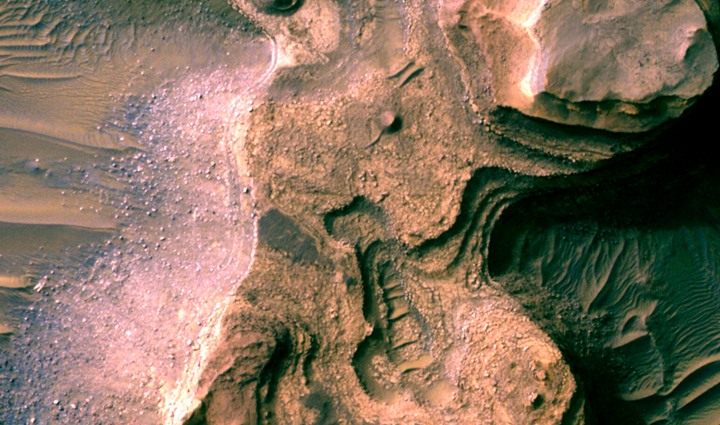
Today’s cool image provides us a glimpse at the carved canyons created when the mid-latitude glaciers on Mars were active in the past and slowly flowing downhill into the section of the northern lowland plains dubbed Acidalia Planitia.

The photo to the right is a mosaic of two images taken by the context camera on Mars Reconnaissance Orbiter and rotated, cropped, and reduced to post here. The mosaic shows a region at the very edge of Acidalia Planitia at latitude 43 degrees north.

Below is a close-up of the area in the white box, taken by MRO’s high resolution camera on February 28, 2021, as well as a global map marking the location of this image at the very edge of the glacier country found in the chaos terrain of Deuteronilus Mensae.
» Read more

1 comment

A crater with wings!

A crater with wings!
Click for full image.

Cool image time! The photo to the right, cropped and reduced to post here, was taken on April 5, 2021 by the high resolution camera on Mars Reconnaissance Orbiter (MRO), and shows a particularly unusual crater in the southern mid-latitudes on the eastern edge of Hellas Basin.

This region east of Hellas is where scientists have spotted many features that suggest buried glaciers. The terraced material inside this crater, as well as the splattered material surrounding it on three sides, are examples of such glacial material. You can also see similar glacial features, though less pronounced, inside the crater to the north.

The global map of Mars below marks the general location of this crater by a blue cross.
» Read more

3 comments

The atomic hydrogen in Mars’ atmosphere

Atomic hydrogen in Mars' atmosphere, as seen by Al-Amal

The two photos to the right, cropped and reduced to post here, were taken by the ultraviolet spectrometer on the UAE Mars orbiter Al-Amal (“Hope” in English) on April 24 and April 25.

During the 10 hours 34 minutes between the images, the Hope probe moved from being over the planet near noon and viewing the entire dayside (top) to being over the planet at dusk and seeing both the day and night side (bottom). These images will be used to reconstruct the 3D distribution of hydrogen and learn more about its production through the process of splitting water molecules by sunlight and its eventual escape to space.

This data will eventually allow scientists to more precisely measure the total water loss to space that Mars’ experiences annually, which will also allow them to determine approximately how much water the planet has lost over the eons.

2 comments

A look at Ingenuity’s legs

Link here. This update, written by Bob Balaram, the helicopter’s chief engineer at JPL and Jeremy Tyler, senior aero/mechanical engineer at AeroVironment, outlines the engineering that went into building the helicopter’s legs in order to make sure they could withstand the somewhat hard landings required in the Martian environment.

To withstand these firm landings, Ingenuity is equipped with a cushy suspension system, [with a] distinctive open hoop structure at each corner of the fuselage where the landing legs attach. The lower half of this hoop is a titanium spring that can bend as much as 17 degrees to provide 3.5 inches of motion in the suspension, while the upper half is a soft non-alloyed aluminum flexure that serves as the damper or โ€œshock absorber.โ€ By plastically deforming and fatiguing as it absorbs energy, this flexure acts much like the crumple zone structure of a car chassis. However, unlike a car or the crumple-cushioned landing gear of the Apollo moon landers, Ingenuityโ€™s titanium springs rebound after each impact to pull these aluminum dampers back into shape for the next landing.

The aluminum damper gets a little bit weaker with each cycle as cracks and creases develop. While it would eventually break after a few hundred hard landings, with only a few flights scheduled for this demonstration, thatโ€™s a problem we could only dream of having.

This is most likely the failure point that will end Ingenuity’s life, though at the present it is a bit in the future.

Also, the post reveals that JPL subcontracted much of the development of Ingenuity to this company.

AeroVironment designed and developed Ingenuityโ€™s airframe and major subsystems, including its rotor, rotor blades, and hub and control mechanism hardware. The Simi Valley, California-based company also developed and built high-efficiency, lightweight propulsion motors, power electronics, landing gear, load-bearing structures and thermal enclosures for NASA/JPLโ€™s avionics, sensors and software systems.

Good ol’ American capitalism does it again.

5 comments

The layers of Mars’ north pole icecap

The layers of Mars' north pole icecap
Click for full image.

Cool image time! The photo to the right, rotated, cropped, and reduced to post here, was taken on April 1, 2021 by the high resolution camera on Mars Reconnaissance Orbiter (MRO). It shows the high cliff edge of the Martian north polar ice cap, and was taken as part of the springtime monitoring for the numerous avalanches that fall from the icecap’s steep edge every spring.

This particular cliff is probably about 1,000 feet high. I cannot tell if the image captured any avalanches on the very steep north-facing cliff. What struck me about this image however was the terraced layers so visible on the west-facing scarp. You can clearly count about eleven distinct and thick layers, each forming a wide ledge.

Each layer represents a different climate epoch on Mars when the ice cap was growing, with new snow being deposited.
» Read more

3 comments
1 97 98 99 100 101 212