Glacial layers in a northern crater on Mars

Crater filled with many layered glacial features
Click for full image.

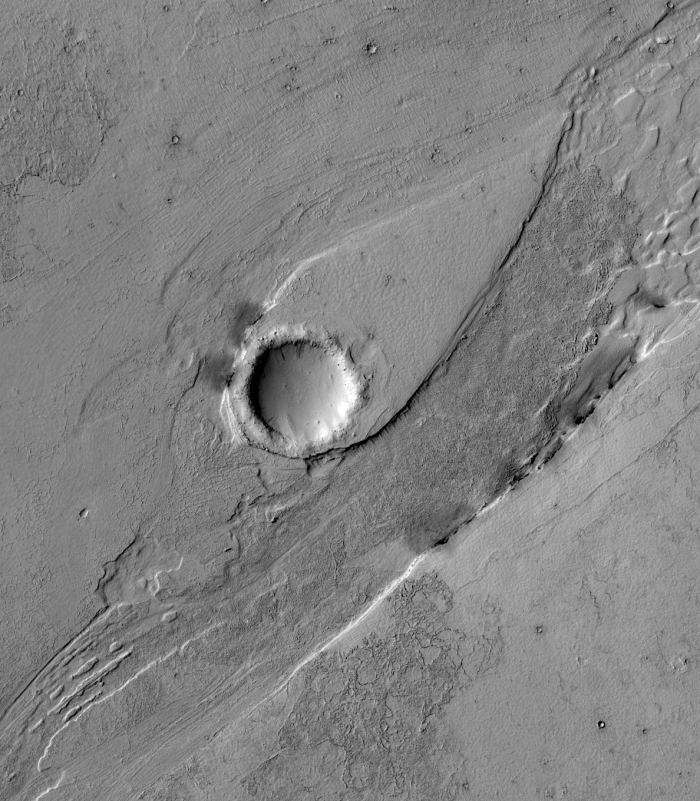
Cool image time! The photo to the right, cropped to post here, was taken by the high resolution camera on Mars Reconnaissance Orbiter on March 6, 2021, and shows a mid-latitude crater in the northern lowland plains of Mars with what appear to be layered glacial features filling its interior.

The theory that scientists presently favor for explaining many of the features we see on Mars is based on many climate cycles caused by the wide swings the planet routinely experiences in its obliquity, or rotational tilt. When that tilt is high, more than 45 degrees, the mid-latitudes are colder than the poles, and water ice sublimates southward to those mid-latitudes to fall as snow and cause active glaciers to form. When that obliquity is low, less than 20 degrees, the mid-latitudes are warmer than the poles and that ice then migrates back north.

Such cycles, which are believed to have occurred many thousands of times in the last few million years, will place many layers on the ground in both the mid-latitudes and at the poles. The layers in this crater hint at this.

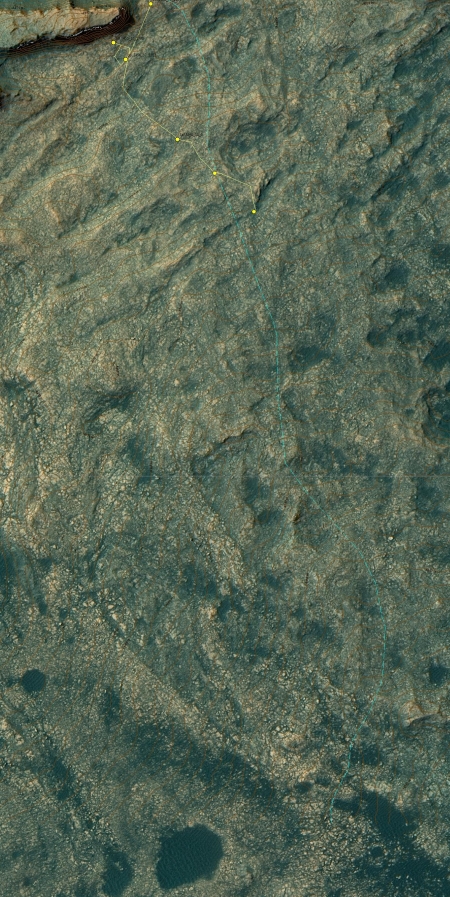
The overview map below gives some further context.
» Read more

0 comments

Four more flights for Ingenuity in the next eleven days.

According to MiMi Aung, Ingenuity’s project manager, the test flight campaign for the Mars helicopter Ingenuity has only about eleven days left, during which they will try to complete full flight program of four more test flights.

The helicopter’s one-month test flight campaign officially began April 3, then the Perseverance rover deployed Ingenuity onto the surface of Mars. “We have a 30 day experiment window, so we have two weeks left,” said MiMi Aung, Ingenuity’s project manager at NASA’s Jet Propulsion Laboratory in California.

She said the helicopter will attempt “increasingly bolder flights” that could travel more than 2,000 feet (600 meters) from its takeoff location. “We do want to push it, and I believe we have enough time to squeeze the next four flights in the next two weeks left.”

The second flight, where the helicopter will go up about 16 feet and then move sideways about seven feet before landing at its take-off point, could happen tomorrow. The third flight, which will travel as much as 150 feet, will follow soon thereafter.

4 comments

Video of Ingenuity’s flight, taken by Perseverance

JPL yesterday released a short one minute long video created from images taken by the high resolution mast camera on Perseverance.

You can view the animation here.

Stitched together from multiple images, the mosaic is not white balanced; instead, it is displayed in a preliminary calibrated version of a natural-color composite, approximately simulating the colors of the scene as it would appear on Mars.

6 comments

Spring arrives on the northern polar cap of Mars

Buzzell dunes and pedestal crater near the Martian north polar ice cap
Click for full image.

Cool image time! It is now spring in the northern hemisphere of Mars, and the first bits of sunlight are finally reaching its north polar ice cap. During the winter, as happens each Martian year, that polar cap of water ice gets covered by a thin mantle of dry ice no more than six feet thick. Moreover, this mantle doesn’t just cover the ice cap, it extends south as far as about 60 degrees latitude, covering the giant sea of dunes that surrounds the ice cap.

When spring comes that mantle begins sublimate away, with its base first turning to gas. When the pressure builds up enough, the gas breaks out through the frozen mantle’s weakest points, usually the crest or base of dunes or ridges, leaving behind a dark splotch caused by the material thrown up from below that contrasts with the bright translucent dry ice mantle.

Each year for the past decade scientists have been using the high resolution camera on Mars Reconnaissance Orbiter (MRO) to monitor this sublimation process. The photo above, taken on February 24, 2021 and cropped, enlarged, and brightened to post here, marks the start of this year’s monitoring program. Dubbed informally “Buzzell” by Candice Hansen of the Planetary Science Institute in Arizona, it shows dunes with a round pedestal crater just right of center. Though almost everything when this picture was taken is still covered by that dry ice mantle, in the lower left is a single splotch, the first breakout of CO2 gas that marks the beginning of the annual disappearance of this dry ice.

Last Martian year I repeatedly posted images of Buzzell to illustrate this annual process. The second image below was taken on April 4, 2019, at about the same comparable time in spring.
» Read more

0 comments

Ingenuity flies!

Ingenuity takes off!
For full images go here and here.

The first autonomous flight of the helicopter Ingenuity on Mars successfully took place early this morning, according to JPL engineers.

NASA has pulled off the first powered flight on another world. Ingenuity, the robot rotorcraft that is part of the agency’s Perseverance mission, lifted off from the surface of Mars on 19 April, in a 40-second flight that is a landmark in interplanetary aviation. “We can now say that human beings have flown a rotorcraft on another planet,” says MiMi Aung, the project’s lead engineer at the Jet Propulsion Laboratory (JPL) in Pasadena, California.

As shown by the two images taken by Perseverance above, the first flight was very simple. The helicopter simply rose about 10 feet, hovered for about 30 seconds as it swiveled 90 degrees, and then carefully descended back down. I have also embedded the video that JPL scientists have created compiling by high resolution Perseverance images below the fold.

Four more flights will next be attempted in the coming weeks.

Four further flights, each lasting up to 90 seconds, are planned in the coming weeks. In these, Ingenuity is likely to rise up to 5 metres [16 feet] above the surface and travel up to 300 metres [1000 feet] from the take-off point. Each successive flight will push Ingenuity’s capabilities to see how well the drone fares in Mars’s thin atmosphere, which is just 1% as dense as Earth’s.

» Read more

16 comments

The rovers’ view of Mars

The view from the top of Mont Mercou
Click for higher resolution. For original images, go here and here.

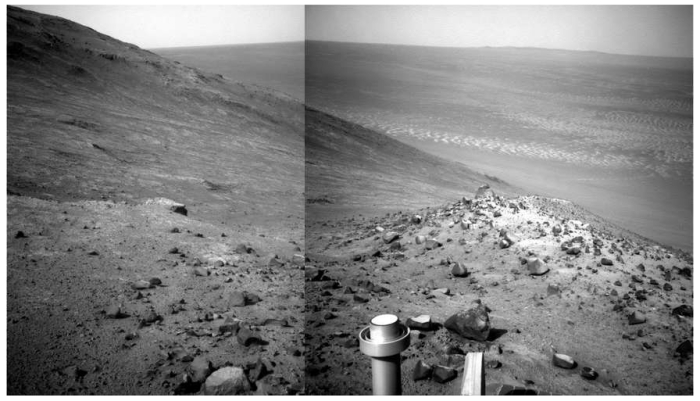
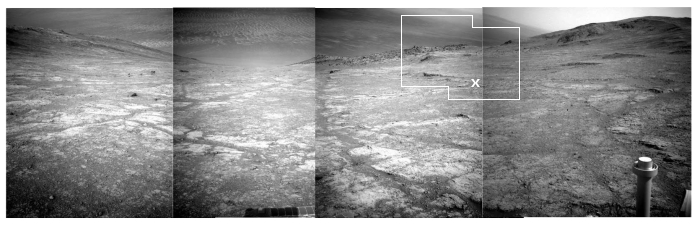
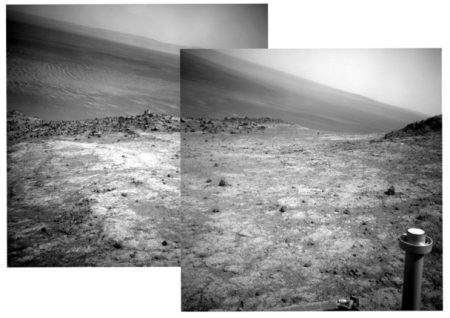
Some cool images to savor from Mars! Above is a panorama from Curiosity, created by me from two images taken by the rover’s left navigation camera today, April 18, 2021. The view is southwest towards the canyon regions where Curiosity will be heading in the coming months. Note the roughness of the ground. Travel is going to be tricky from here on out.

The photo was taken from the top of Mont Mercou, the 20-foot high outcrop that the rover spent several weeks studying at the cliff’s base. The Curiosity science team is presently preparing to drill into the bedrock at the top.

Ingenuity on the floor of Jezero Crater
Click for full image.

The photo to the right, reduced to post here, was taken by Perseverance on April 13, 2021, and looks west across the floor of Jezero crater. The high mountains in the distance are the crater’s rim. The low and much closer hill is the delta that is the rover’s primary geological target.

In the center of the picture is the helicopter Ingenuity. You can also see the tracks of Perseverance’s wheels just below it.

This will be the rover’s vantage point when Ingenuity attempts its first test flight in the early morning hours of April 19, 2021. The helicopter will head to the right once it lifts off.

2 comments

Ingenuity first test flight scheduled for 3:30 am (Eastern) tonight!

The engineering team for the Ingenuity helicopter on Mars have decided to attempt the first test flight tonight, scheduled for 3:30 am (Eastern) in the early morning hours tomorrow.

Data from the first flight will return to Earth a few hours [later] following the autonomous flight. A livestream will begin at 6:15 a.m. EDT (3:15 a.m. PDT) as the helicopter team prepares to receive the data downlink in the Space Flight Operations Facility at NASA’s Jet Propulsion Laboratory (JPL).

NASA propaganda will begin on NASA TV at 3:30 am (Eastern), but the actual live stream of the flight will not air until about 6:30 am (Eastern) on April 19th.

At the first link above the engineers explain their decision to proceed immediately.
» Read more

13 comments

Ingenuity successfully completes rapid spin test

Ingenuity’s engineers announced this morning that yesterday the helicopter on Mars was able to successfully complete a rapid spin test of its rotary blades.

Today, April 16, on the 154th anniversary of Wilbur Wright’s birth, the Ingenuity flight team received information that the helicopter was able to complete a rapid spin test. The completion of the full-speed spin is an important milestone on the path to flight as the team continues to work on the command sequence issue identified on Sol 49 (April 9).

…The approach that led to today’s successful spin test entailed adding a few commands to the flight sequence. This approach was tested extensively on both Earth and Mars, and was performed without jeopardizing the safety of the helicopter.

They have still not set a date for flight, because they might still decide, after they have analyzed fully the results from this test, to revise the helicopter’s software and upload that change. If not the flight will be relatively soon. If so there will be a longer delay to test that software fully before flight.

1 comment

InSight pauses science operations to conserve power

The science team for the InSight lander on Mars have been forced to suspend science operations because dust on the solar panels is reducing the available power.

InSight’s solar panels were producing just 27% of their energy capacity in February, when winter was arriving in Elysium Planitia. So NASA decided to start incrementally turning off different instruments on the lander. Soon the robot will go into “hibernation mode,” shutting down all functions that aren’t necessary for its survival.

By pausing its scientific operations, the lander should be able to save enough power to keep its systems warm through the frigid Martian nights, when temperatures can drop to negative-130 degrees Fahrenheit. “The amount of power available over the next few months will really be driven by the weather,” Chuck Scott, InSight’s project manager, said in a statement.

InSight is still in good condition – it’s even using its robotic arm – but the risk of a potentially fatal power failure is ever-present. If the lander’s batteries die, it might never recover.

As with the rovers Spirit and Opportunity, InSight engineers have depended on periodic strong wind events to periodically clean off the solar panels. Unfortunately, these events are somewhat random, and for the past few months none have occurred.

Note: the article at the link says that winter was arriving at InSight’s location in February, but this is incorrect. InSight sits at about 4 degrees north latitude. In February the end of winter was approaching in the northern hemisphere. More to the point, sitting at the equator you wouldn’t really expect InSight to experience much seasonal changes regardless.

It therefore seems that these issues had less to do with the seasons and much more to do with the accumulating dust on the panels.

6 comments

Evidence of glaciers in the Martian equatorial regions?

Equatorial crater with glacial features?

Cool image time! The photo to the right, cropped and reduced to post here, was taken on February 2, 2021 by the high resolution camera on Mars Reconnaissance Orbiter (MRO) and was labeled as “Exhumed Craters Exhibiting Concentric Fill”.

The term “Concentric Fill” is used by planetary scientists to mark glacial-type features frequently found inside craters at latitudes greater than 30 degrees latitude. This crater however is at 22 degrees north latitude, too close normally to the equator to expect a buried glacier inside it. Any ice at such a latitude is expected to be underground and well protected. A debris covered glacier would likely sublimate away, which I think is why the scientists labeled this “exhumed.” Though there are the concentric features near its inside rim as well as covered by the sand dunes on the crater’s floor, they are assuming this is only evidence of past ice, no longer there. This assumption is strengthened by the splattered but eroded nature of the surrounding terrain. Such splats are typical of high latitude impacts in regions with ample buried ice. The eroded nature of this splat however suggests it is very old and has likely lost its ice.

Then again, this is an assumption.
» Read more

1 comment

A lonely dry lava spring on Mars

A lonely dry lava spring on Mars
Click for full image.

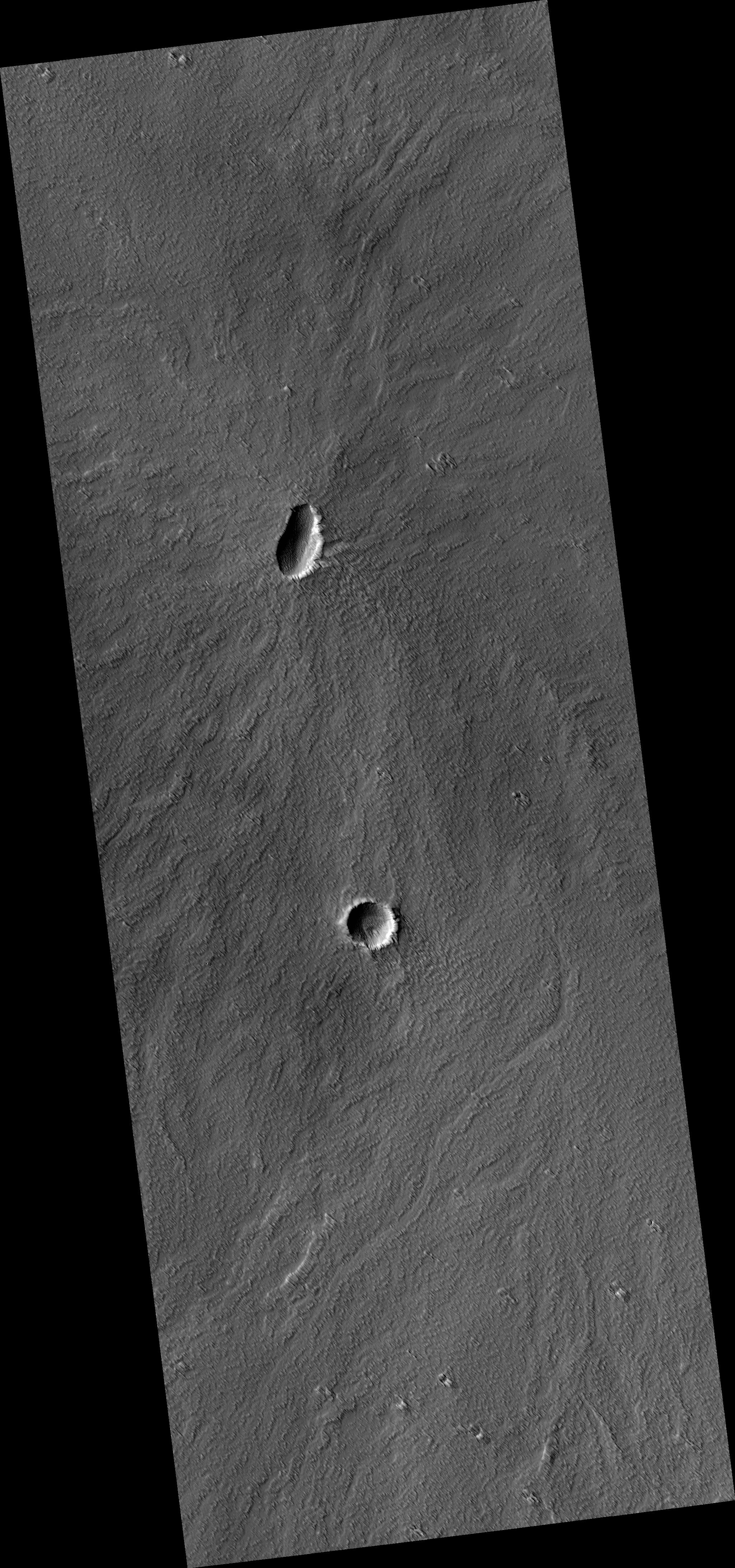
Today’s cool image from Mars takes us to the southern flank of the giant volcano Pavonis Mons. The photo to the right, rotated, cropped, and reduced to post here, shows what appears to be a volcanic vent from more than a billion years ago when it is believed Pavonis was actively erupting. The picture was taken on March 2, 2021 by the high resolution camera on Mars Reconnaissance Orbiter (MRO). The grade is mostly downhill to the east and south east.

It is very possible that this is the resurgence of a lava tube, the point where the underground flow either emerged to the surface or got so close to the surface that the ceiling was thin enough to later collapse, creating this depression. No pits or skylights are visible in this high resolution picture, however, so whether there is an underground lava tube here is not known, an unknown that is amplified by the wider MRO context camera image below.
» Read more

0 comments

Ingenuity requires software update before flying

JPL engineers have determined that they need to upload a software update on Ingenuity in order to solve the issue that caused the first high-speed spin test of its rotary blades to end prematurely.

In an update released late Monday by NASA’s Jet Propulsion Laboratory, mission managers said engineers identified a software fix for the “command sequence issue” that ended the high-speed spin-up test Friday.

Officials at JPL, which manages the Ingenuity helicopter project, did not announce a new target date for the rotorcraft’s first test flight. Ground teams hope to determine a new target date next week for the helicopter’s first flight.

According to the original plans, Ingenuity was to get about a 30 day test period, after which Perseverance would move on to its primary Mars science mission. It is not clear at this moment whether that test period will be extended because of these issues. I suspect they will extend it to get as many flight tests as possible, since Perseverance is functioning like a dream and can wait a few extra weeks before beginning what will be years of Martian roving. How often does one get to flight test a helicopter on another world?

6 comments
1 100 101 102 103 104 212