Opportunity takes a rest stop at a crater

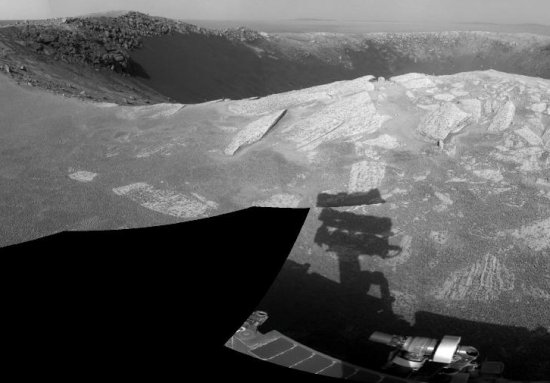
In its 14 mile multi-year trek to Endeavour Crater — now about half completed — the Mars rover Opportunity has stopped to take a short rest stop at a small crater.

The crater, dubbed “Santa Maria Crater” by the scientists who operater Opportunity, is about the size of a football field. What makes it especially interesting are the sharp rocks piled up on its rim, as they are probably debris ejected from the crater at impact. Since this material probably came from deep below the Martian surface, it is also likely to hold information about the Martian geological past, thereby making it a prime research site.

Santa Maria crater

0 comments

A Martian eclipse

The hubbub about this week’s lunar solstice eclipse was, from my perspective, mostly manufactured press blather. For those who had never seen a lunar eclipse, it was a spectacular experience, but there really was nothing scientifically or technically unique about the fact that it happened to occur on the solstice.

However, below is an eclipse that is definitely unique both technically and scientifically. Scientists using the Mars rover Opportunity have filmed an eclipse on Mars, showing the Martian moon Phobos crossing in front of the Sun. Consider the engineering accomplishment: not only did they need to be able to calculate exactly when this would happen at a very particular spot on the Martian surface, they had to have a camera there able to take the movie. And they had to operate it from Earth!

0 comments

More caves on Mars

And damn, do I want to rappel into them!

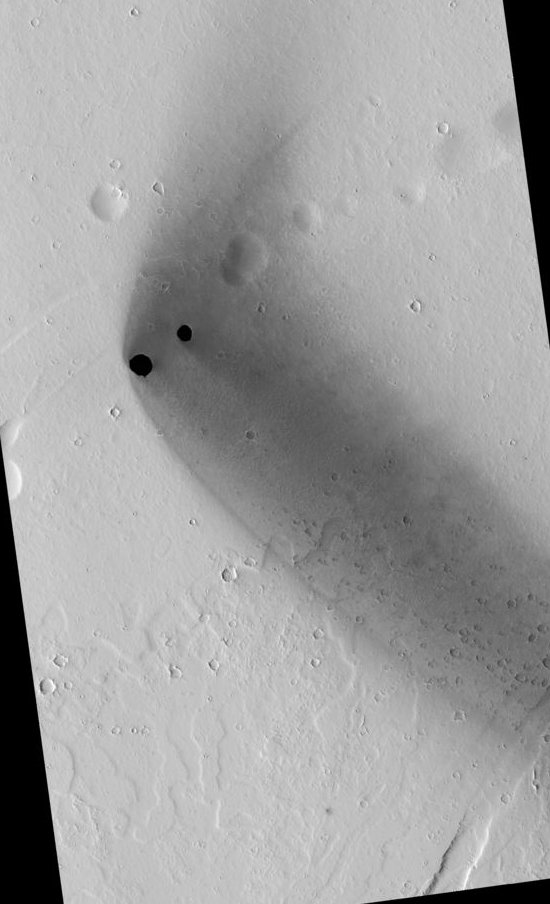
This week’s release of images from the HiRISE camera on Mars Reconnaissance Orbiter included these spectacular photos of two deep pits, approximately 180 and 310 meters in diameter and located aligned with a series of depressions that suggest additional passages at their base.

The first image shows the pits in the context of the surrounding terrain. From the caption:

These pits are aligned with what appears to be larger, degraded depressions. The wispy deposit may consist of dark material that has been either blown out of the pits or from some other source and scattered about by the local winds.

wide shot of pits

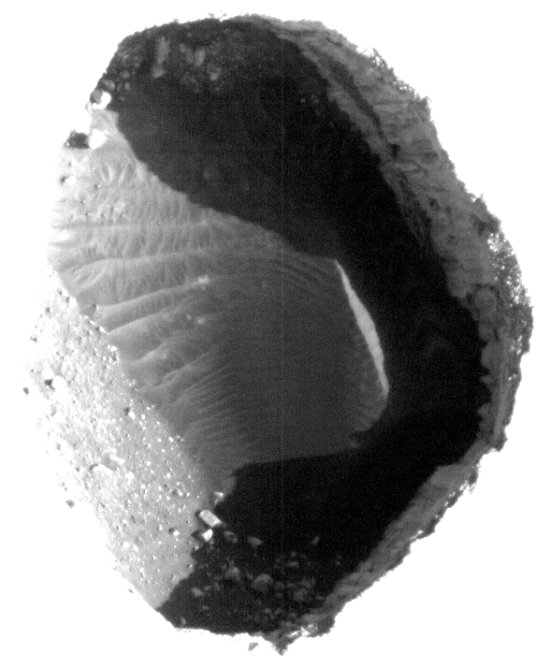
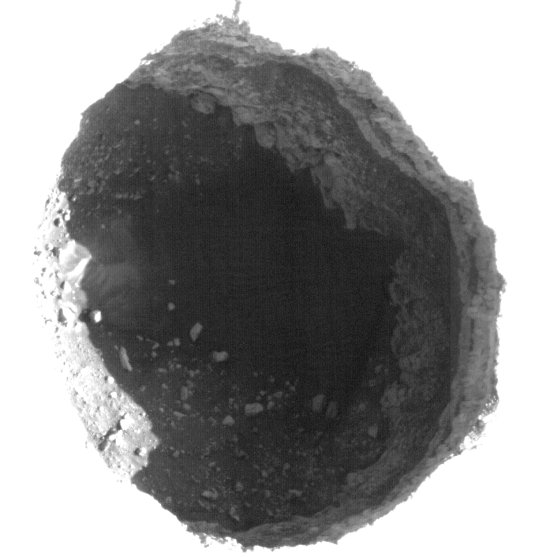
The next two images are heavily processed close-ups of each pit in order to bring out the detail within. From the caption:

The eastern most and smaller of the two pits contains boulders and sediment along its walls and brighter aeolian dune sediments on its floor. The larger, western most pit contains sediment and boulders with faint dune-like patterns visible on the deepest part of the floor. Both pits have steep eastern walls and more gently sloped western walls that transition gradually into the pit floor. Steep resistant ledges containing boulders that overhang and obscure the pit floors form the eastern walls.

The smaller pit, with dunes on floor

The larger pit

3 comments

Martian stream gullies

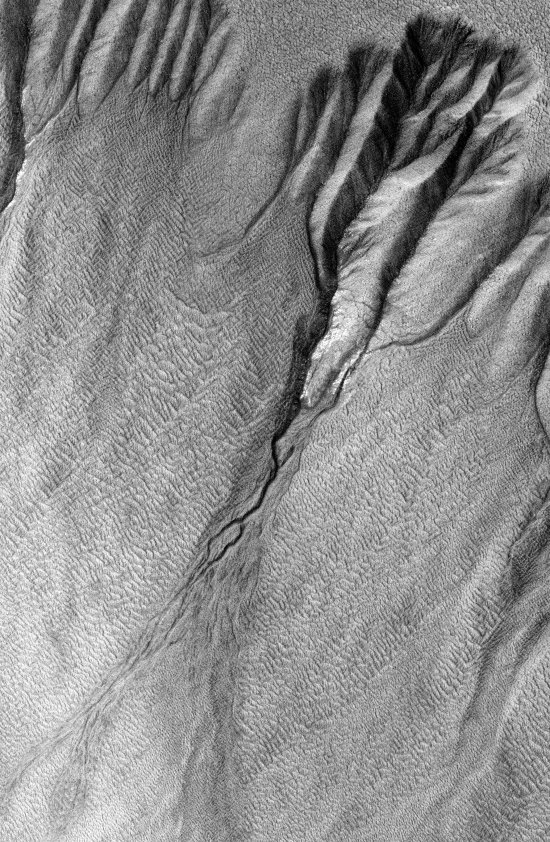
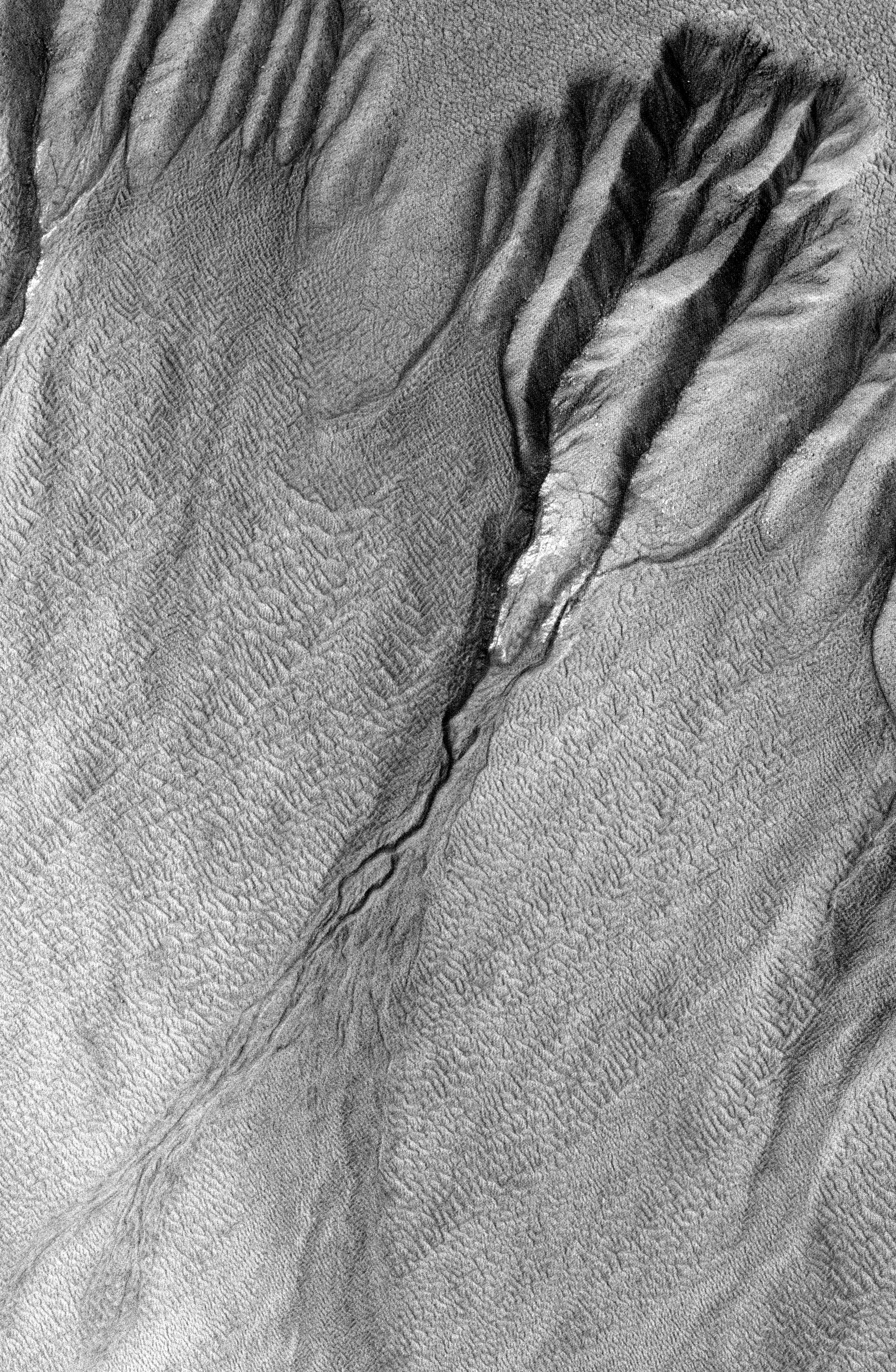
The image below from Mars Reconnaissance Orbiter shows gullies remarkably similar to gullies formed on Earth by flowing water, thus providing striking evidence that at some time in the past liquid water did flow on the Martian surface, something that is not possible now. Key quote from the caption:

The gullies shown in the subimage (approximately 710 x 1100 yards) have well developed alcoves, deeply incised channels, and large depositional fans, and are similar to terrestrial landscapes sculpted by surficial water.

The gullies shown in the subimage experienced several periods of activity, as evidenced by older channels cut by younger ones or by their deposits. The current and recent Martian temperatures and atmospheric conditions would not allow for water to be stable at the surface for extended periods of time: it is so cold that the water would freeze, and then it would sublime quickly, because the air is very thin and dry. These gullies could have formed under a different climate, or maybe by repeated bursts of transient fluids. Current leading hypotheses explaining the origin of gullies includes erosion from seepage or eruption of water from a subsurface aquifer, melting of ground ice, or dust-blanketed surface snow.

gullies in Sisyphi Planum

0 comments

Sightseeing on Mars

Those who visit this website regularly know that I repeatedly post images from the various Mars orbiters and rovers. I do this not only because the images have scientific interest or that they are cool, but because it is simply fun to sightsee, even if it is done by proxy using a robot many millions of miles away. Here are two more images of the sights of Mars.

The first is a mosiac image of a small crater that the rover Opportunity strolled past on November 9 in its four year journey to Endeavour Crater.
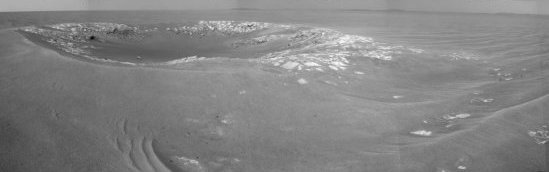
small crater on Mars

What always amazes me about the images that Opportunity has taken as it travels across the Martian desert is how totally lifeless this desert is. You would be very hard-pressed to find any desert on Earth like this. On Earth, life is everywhere, even in deserts with their harsh environment. Moreover, life on Earth has reshaped the surface drastically. Environmentalists like to whine about the havoc humans wreck on nature, but the truth is that all life does this continually. Plants and trees help soften the terrain. Animals (not just humans) mold the surface to their needs.

On Mars, however, all one sees is wind-strewn sand across barren bedrock. What this suggests is that, if there is life on Mars, it is well buried, not very visible, and possibly quite rare. It will thus be difficult to spot.

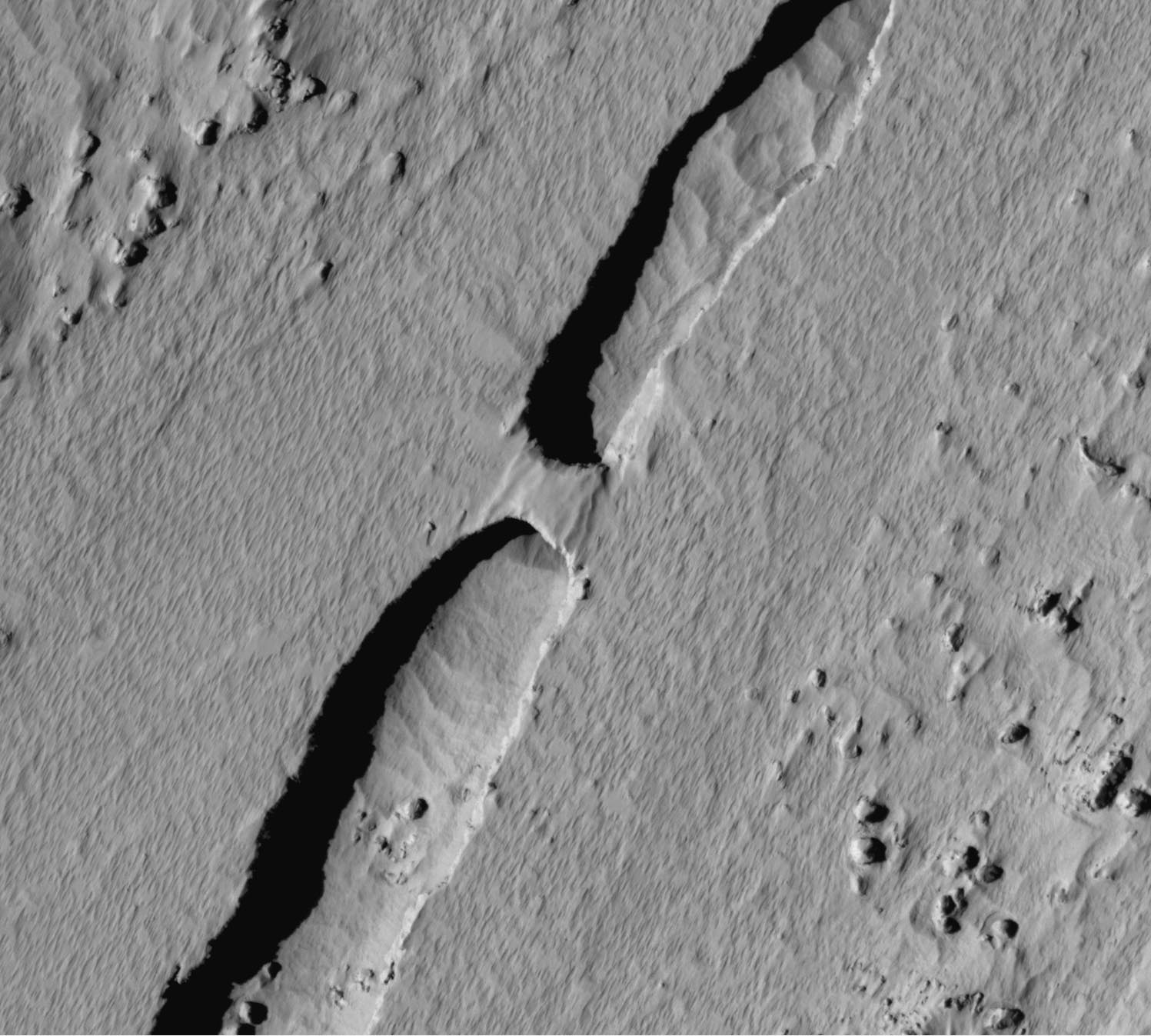
The second image is another one of those Martian collapse features, where some form of fluid flow under the surface washed out the supporting material. causing the surface to eventually collapse. In this case, however, the collapse left at least one natural bridge. Based on the scale (25 cm = 1 pixel), this bridge is about 80 feet wide and 100 feet long. (To calculate its height requires more mathematical skills than I have.)

Boy, wouldn’t this be a magnificent thing to hike under and across!
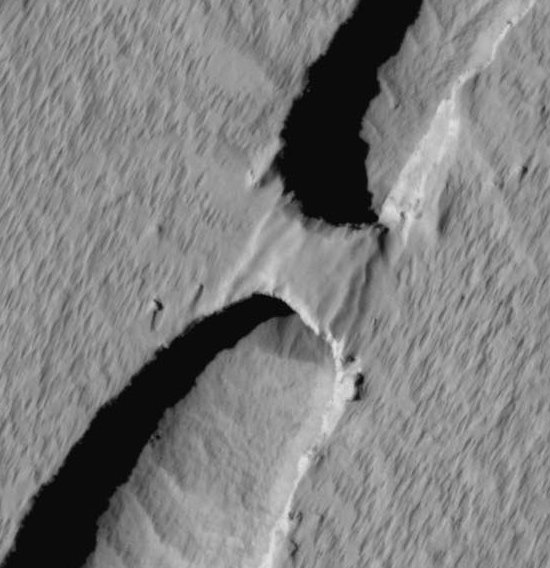
Natural Bridge on Mars

1 comment
1 207 208 209 210 211 212