Ingenuity’s 12th flight successful

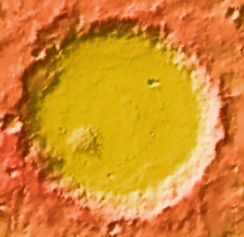
Ingenuity's shadow just before landing.

According to the Perseverance science team, the Mars helicopter Ingenuity successfully completed its twelfth flight on Mars early yesterday, making a short scouting round trip over an area called South Seitah to provide images that the team can use to plan the rover’s future route.

All told, Ingenuity flew just under 1,500 feet flying about 30 feet above the ground for just under three minutes. The picture to the right was taken just before landing, and shows the helicopter’s shadow on the ground. It is one of six so far downloaded. The remaining images will follow later.

The announcement was made on Twitter, and included some embarrassingly over-the-top prose:

The #MarsHelicopter’s latest flight took us to the geological wonder that is the “South Séítah” region.

South Seitah is hardly a “geological wonder”. It is a sandy area with some rocks and interesting geology.

I’m not sure why, but the Perseverance rover team seems prone to do this with their press releases and announcements. The claim they make over and over that Perseverance’s prime mission is to look for ancient life is junk Now they call a relatively undistinguished and small area on a crater floor a “wonder.”

Makes one think they somehow feel a need to justify what they are doing, something that is patently absurd. They are controlling a robotic rover and helicopter tens of millions of miles away as both explore a place on another planet no one had ever visited before. That certainly is spectacular enough, and does not need purple prose to justify.

3 comments

Regional Martian dust storms help suck water from Mars

Orbital data now shows that both global and regional dust storms on Mars help remove the planet’s water, allowing it to reach higher atmospheric elevations where solar radiation breaks it up and it escapes into space.

Scientists have long suspected that Mars, once warm and wet like Earth, has lost most of its water largely through this process, but they didn’t realize the significant impact of regional dust storms, which happen nearly every summer in the planet’s southern hemisphere. Globe-enveloping dust storms that strike typically every three to four Martian years were thought to be the main culprits, along with the hot summer months in the southern hemisphere when Mars is closer to the Sun.

But the Martian atmosphere also gets heated during smaller, regional dust storms, according to a new paper published August 16 in the journal Nature Astronomy. The researchers, an international team led by Chaffin, found that Mars loses double the amount of water during a regional storm as it does during a southern summer season without regional storms.

This conclusion is based on data gathers from three different orbiters during a regional dust storm in early 2019.

1 comment

A Martian river of ice

Glacial flow on Mars?
Click for full image.

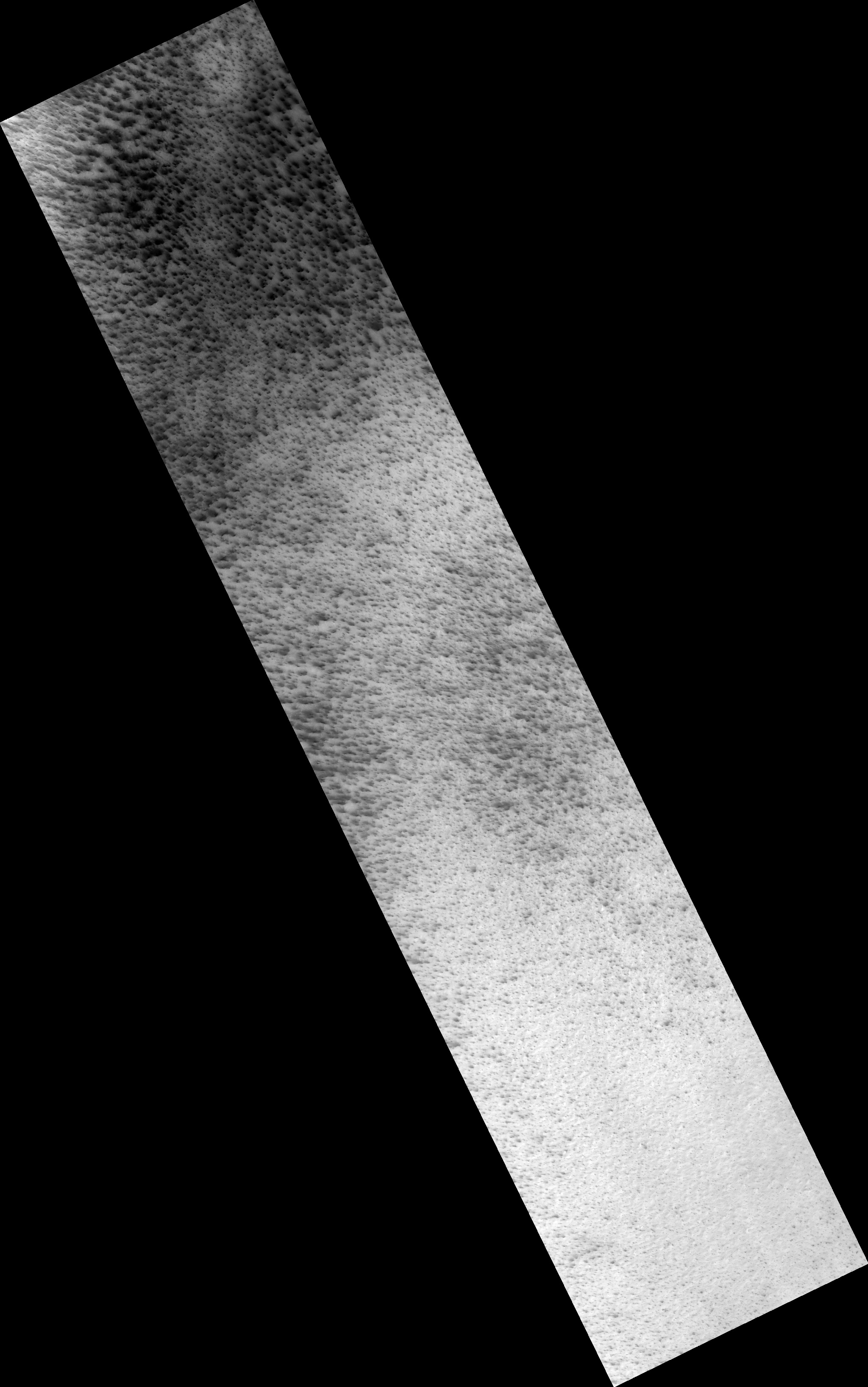
Cool image time! The photo to the right, rotated, cropped and reduced to post here, was taken on May 13, 2021 by the high resolution camea on Mars Reconnaissance Orbiter (MRO). It spans the entire 4.7 mile width of the southern hemisphere canyon dubbed Reull Vallis. The white arrow indicates the direction of the downhill grade

The scientists title this image “Lineated Valley Fill.” The vagueness of this title is because they have not yet confirmed that this lineated valley fill is a glacier flowing downhill to the west.

Nonetheless, the material filling this valley has all the features one expects glaciers to exhibit. Not only is the the lineation aligned with the flow, it varies across the width of the canyon as glaciers normally do. At the edge the parallel grooves are depressed, probably because they are torn apart by the canyon walls as the glacier flows past. In turn, at the center of the flow the grooves are thinner and more tightly packed, and appear less disturbed. Here, the flow is smooth, less bothered by surrounding features.

This pattern also suggests the merging of two flows somewhere upstream.

A glance at the spectacular Concordia glacier in the Himalayas near the world’s second highest mountain, K2, illustrates the similarity of this Martian feature to Earth glaciers.

Reull Vallis itself flows down to Hellas Basin, the deepest basin on Mars. As it meanders downhill along its 650 mile length it steadily gets wider and less distinct as it drops into Hellas. Along its entire length MRO has photographed numerous similar examples of this lineated fill, all suggesting that under a thin layer of debris is a thick glacier, slowerly carving this canyon out.

The overview map below illustrates these facts nicely, while further reinforcing these glacial conclusions.
» Read more

8 comments

Ingenuity’s next flight

Ingenuity's flight plane for 12th flight
Click for full image.

The Ingenuity engineering team today announced their plans for the helicopter’s twelfth flight on Mars, scheduled for early tomorrow.

Ingenuity will climb to an altitude of 10 meters and fly approximately 235 meters east-northeast toward the area of interest in Séítah. Once there, the helicopter will make a 5-meter “sidestep” in order to get side-by-side images of the surface terrain suitable to construct a stereo, or 3D, image. Then, while keeping the camera in the same direction, Ingenuity will backtrack, returning to the same area from where it took off. Over the course of the flight, Ingenuity will capture 10 color images that we hope will help the Perseverance science team determine which of all the boulders, rocky outcrops and other geologic features in South Séítah may be worthy of further scrutiny by the rover.

The map above shows South Seitah in the yellow oval. The yellow line marks Ingenuity’s past flights. The white line marks the path Perseverance has taken south since landing. The dashed lines mark Perseverance’s planned route.

Thus, the helicopter will be obtaining aerial photos of the region in Seitah where the scientists want to send Perseverance, in order to help them pick the best route.

6 comments

Curiosity looks backwards

Curiosity panorama looking southeast
Click for full resolution version. For original images go here and here.

Overview map
Click for interactive map.

Cool image time! The mosaic above was created from two photos taken on August 13, 2021 by Curiosity’s right navigation camera. It looks to the southeast, at the mountainous Martian terrain that the rover had been traveling just below for the past two months.

The overview map to the right shows with the yellow lines the approximate area covered by this mosaic. The white mountain at the top is the highest visible flank of Mount Sharp, and is beyond the right/bottom edge of the overview map. Mt. Sharp’s peak itself is not visible, as it is higher up and to the right. It is presently blocked by these mountainous foothills.

The science team probably took this image partly to provide another view of these mountains for comparison with earlier views. They can use this new data to look for changes as well as obtain better three-dimensional data.

They also took the image for the same reason I post it here. Having now climbed more than 1,500 feet from the floor of Gale Crater, Curiosity’s view is routinely spectactular. Why not enjoy it?

Mt. Sharp’s peak however is still about 13,000 feet above the rover. The climb up the mountain has just begun.

14 comments

A chain of Martian sinkholes

Chain of sinkholes on Mars
Click for full image.

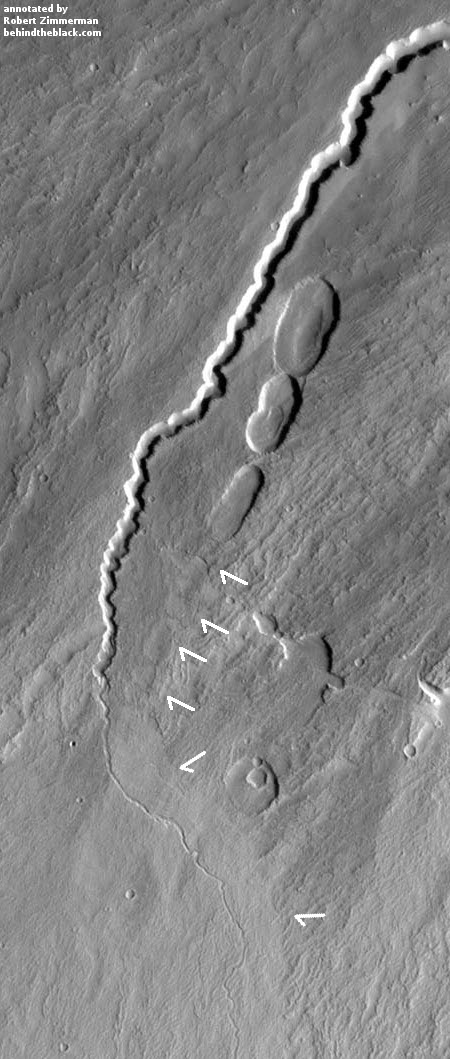
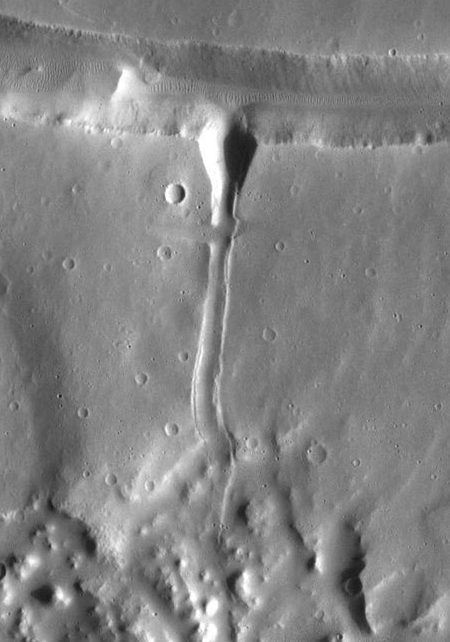
Cool image time! The photo to the right, rotated, cropped, and reduced to post here, was taken on June 17, 2021 by the high resolution camera on Mars Reconnaissance Orbiter (MRO). It shows a somewhat straight depression with several wider and deeper pits along it.

The feature immediately suggests sinkholes that exist because the ground is sagging into voids below ground. Yet, both the straight and circular depressions also appear filled, showing no evidence that they connect to any below ground cavities.

Are the sinks the result of a fissure produced by a graben, when two large blocks shift relative to each other to cause a fissure to appear? Or are they evidence of an underground lava tube? Or maybe they are the filled remains of a now mostly buried canyon carved by water or ice?

As always, a wider view helps clarify things, though whether it answers the question is uncertain.
» Read more

1 comment

Confirmed: Perseverance sample was too crumbly and poured away

Perseverance scientists have confirmed that the reason their sample container was empty once stored on the rover was because the material that they had drilled into was more crumbly than expected, and when the core was extracted from the ground the powder simply poured out of the core tube.

The team has decided to move on.

Rather than try again with the cratered floor fractured rough, Perseverance has already departed the area and is heading towards a region named South Séítah, which likely contains layered sedimentary rocks that are more similar to the Earth rocks that engineers drilled during tests before the mission’s launch. “We are going to step back and do something we are more confident of,” says Trosper. The rover will try to drill a core there, perhaps in early September. When it does, engineers will pause the automated drilling process to check whether a core has been extracted before the rover takes the next steps of sealing the tube and storing it away.

While it makes sense to find a different place to drill for a core sample, it appears that Perseverance is designed in a manner that it can do no analysis of any drill hole material:

Curiosity and Perseverance are similar in many respects — Perseverance was actually built using much of the leftover hardware from Curiosity — but there is one major difference in how they drill into the Martian surface. Curiosity intentionally grinds rock into powder, which it then places inside analytical instruments it has onboard to conduct scientific studies. NASA designed Perseverance to extract intact cores that slide into its sampling tubes. So crumbly rocks are good for Curiosity, but not for Perseverance.

If Perseverance can do no analysis of any drillholes, this limits the science it can do significantly. While putting aside samples for later return to Earth is an excellent idea, to make this the priority so that Perseverance can analyze nothing seems a terrible decision. What if that sample return mission never gets built?

If my supposition here is correct it also means NASA’s repeated claim that Perseverance is searching for ancient life on Mars is even more of a lie than I had assumed. It isn’t merely that this claim is a distortion of Perseverance’s actual research goals — to study the geology of Mars — the rover can’t look for ancient life. It has no way of looking at any samples it digs up.

I am not sure if my conclusions here are entirely correct. For example, maybe they hope to find this alien evidence by looking at the sealed core samples they store. Unfortunately, I have no idea, because I am somewhat handicapped in describing Perseverance’s day-by-day operations because, unlike Curiosity, the Perseverance team is providing no regular updates of their operations at their blog. While the Curiosity team posts something at least twice a week, the Perseverance team has posted nothing since just after landing in February. I’ve emailed NASA about this, but have gotten no response.

18 comments

Glacial ice sheets on Mars?

Glacial ice sheets on Mars?
Click for full image.

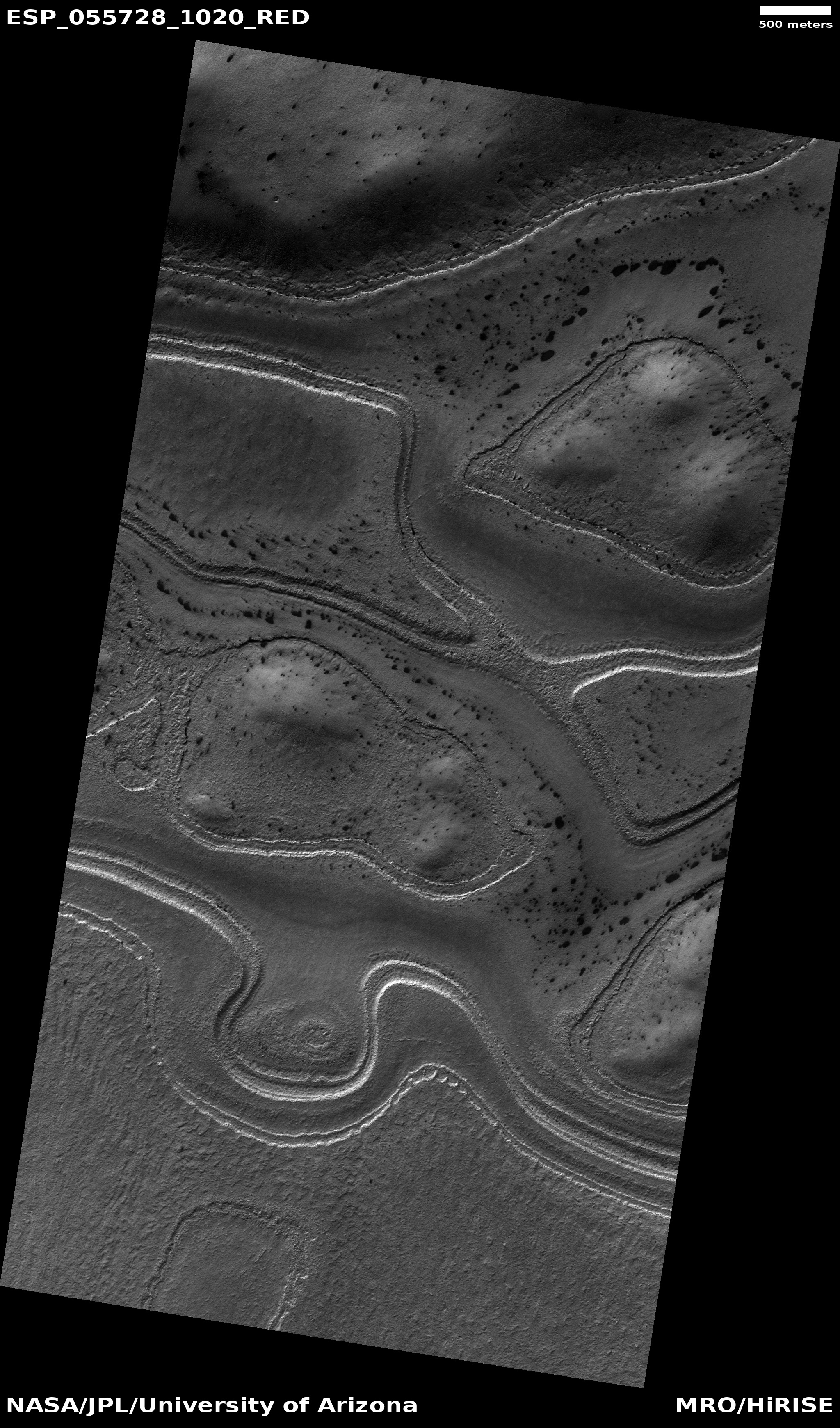
Cool image time! The photo to the right, rotated, cropped, and reduced to post here, was taken on June 29, 2021 by the high resolution camera on Mars Reconnaissance Orbiter (MRO). The location is in Mars’ glacier country, that strip of chaos terrain that runs about 2,000 miles along the transition zone between the northern lowland plains and the southern cratered highlands at 30 to 47 degrees north latitude. This particular feature is located in Deuteronilus Mensae, the westernmost region of that strip of chaos.

I call this glacier country because practically every image taken by MRO’s high resolution camera in this region suggests the presence of glacial material covered by a protective layer of debris. The photo to the right is typical, though a bit more puzzling because of the depressions that appear to run along highpoints.

As usual, the overview map below helps explain what we are looking at.
» Read more

1 comment

Peeling thin layers on a Martian plateau

Peeling thin layers on Mars
Click for full image.

Cool image time! The photo to the right, cropped to post here, was taken on May 14, 2021 by the high resolution camera on Mars Reconnaissance Orbiter (MRO). It shows what the science team labels as “light-toned layered deposits.”

Their focus, rightly from a geologist’s perspective, is the contrast in color between different layers, suggesting different composition and thus a different formation history for each layer.

To me, what made this feature appealing is the thinness and number of its layers. It reminded me of fillo pastry, “unleavened flour dough formed into very thin sheets or leaves.”

If you look at the full image you will see that cropped section only covers one edge of a tongue-shaped plateau, with similar layers revealed along its entire cliff wall. It is almost like those layers have been peeling off for eons to leave the plateau behind.

The location below gives some context.
» Read more

0 comments

New data suggests Gale Crater was never filled with lake

The uncertainty of science: A new review of data from Curiosity now suggests that Gale Crater was not filled with a lake in the past — as generally believed — but instead simply had small ponds on its floor.

Previous analyses of data from Curiosity have relied heavily on a measure called the chemical index of alteration to determine how rocks were weathered over time. Joseph Michalski at the University of Hong Kong and his colleagues have suggested that because this measure was developed for use on Earth, it may not be valid in the extreme Martian climate.

Instead, they analysed the concentrations of various compounds that are expected to change based on different types of weathering over time. They found that some of the layers of rock Curiosity examined did interact with water at some point in their past, but more are likely to have formed outside of the water. “Over hundreds of metres of strata, it seems that the only layers that are demonstrably lacustrine [formed in a lake] are the lower few metres,” says Michalski. “Of the rocks visited by the rover… the fraction that is demonstrably lacustrine is something like 1 per cent.”

These rocks were mostly in the lowest few metres of sediments in the crater, suggesting the lake was not nearly as deep or extensive as we thought. “There was likely a small lake or more likely a series of small lakes in the floor of Gale crater, but these were shallow ponds,” says Michalski.

This conclusion also aligns with other recent work proposing that Gale Crater was always cold and never had running water.

None of this is proven, one way or the other, though this new conclusion would make it easier to explain Mars entire geological history. Trying to create models for Mars’ past climate that allowed large amounts of liquid water on its surface have so far been difficult at best, and have generally been unconvincing. Eliminating the need for liquid water will make explaining Mars’ geology much simpler.

9 comments

Perseverance’s first sample grab fails

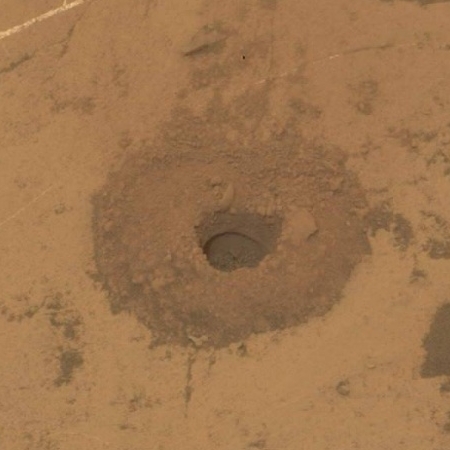
Perseverance's first core sample drill location
Click for full image.

The first attempt by the Mars rover Perseverance to obtain a core sample has apparently failed.

The failure does not appear to be technical. All the hardware appears to have worked. When they inspected the interior of the hollow core drill however no sample was seen inside.

“The sampling process is autonomous from beginning to end,” said Jessica Samuels, the surface mission manager for Perseverance at NASA’s Jet Propulsion Laboratory in Southern California. “One of the steps that occurs after placing a probe into the collection tube is to measure the volume of the sample. The probe did not encounter the expected resistance that would be there if a sample were inside the tube.”

…”The initial thinking is that the empty tube is more likely a result of the rock target not reacting the way we expected during coring, and less likely a hardware issue with the Sampling and Caching System,” said Jennifer Trosper, project manager for Perseverance at JPL. “Over the next few days, the team will be spending more time analyzing the data we have, and also acquiring some additional diagnostic data to support understanding the root cause for the empty tube.” [emphasis mine]

Do the highlighted words remind you of anything? They do for me. The first thing I thought of when I read this was the drilling mole for InSight’s heat sensor. It failed in its effort to drill into the Martian surface because the nature of the Martian soil was different than expected. It was too structurally weak, and would break up into soft dust rather than hold together to hold the mole in place.

In the case of Perseverance, it appears right now (though this is not confirmed) that the drill successfully drilled into the ground, with its core filling with material, but when the core was retracted, that material simply fell out, as if it was too structurally weak to maintain itself inside the core.

The photo above of the drill hole and its thick pile of dust appears to support this hypothesis. Even though they drilled into what looked like bedrock the act of drilling fragmented that bedrock apart.

I am speculating based on limited information, so I am likely wrong. For example, the drill certainly has sensors to detect the density and structural strength of the rock it is drilling into. The engineers will check those numbers during drilling. If the rock doesn’t appear dense enough or structurally strong enough for a core sample, I would expect them to pick a different spot.

If true however it means that obtaining core samples at many locations in Jezero Crater will simply not be possible. This does not mean no samples will be obtained, because there are definitely places on Mars where the ground’s structure is solid enough for this method to work. Curiosity definitely found this to be true, when if found several places on Vera Rubin Ridge where its drill didn’t have the strength to penetrate the rock.

8 comments

Zhurong travels another 700 feet on Mars

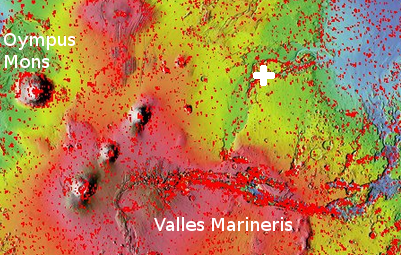
Zhurong's location

According to a new update from China’s state-run press today, since the last update of its Zhurong Mars rover on July 31st, the rover has traveled just over 700 feet, for a total travel distance of about 2,624 feet, just under a half mile.

As of August 6, 2021, the rover has worked on the surface of Mars for 82 Martian days and the orbiter has been in orbit for 379 days. The two are in good condition and functioning properly.

The report provides no other real information.. I have indicated on the map to the right the range in which this travel distance could have taken Zhurong. Hopefully they will release more information soon.

The nominal mission was originally planned for 90 days. Right now it looks like the rover will easily exceed that.

0 comments
1 90 91 92 93 94 212