Perseverance’s upcoming targets: sand ripples, rocks, and a lot of dust

Ingenuity's view during 12th flight

Cool image time! The photo to the right was one of ten color images taken by Ingenuity on its twelfth flight on August 15, 2021. This photo is one of two images looking the same area from slightly different positions in order to create a stereoscopic view, with the other image found here.

The ground the helicopter was scouting, dubbed South Seitah, is an area that the Perseverance team hopes to send the rover. Ingenuity’s images from this flight will not only tell them whether the terrain is safe to traverse, it will allow them to map out a route that will avoid problems while effectively targeting the most interesting rocks.

The photo shows a lot of Martian dust, with a good portion forming small sand dune ripples. The rocks appear to be bedrock pavement stones, which because these are on the floor of the crater and the lowest elevation, likely hold the oldest geology that Perseverance will see on its journey in Jezero Crater. For this reason the science team is spending a lot of time studying that floor, and will make probably several drilling attempts to obtain samples.

The terrain in general looks entirely safe for the rover to travel. I expect the science team will thus continue north, crossing to North Seitah, rather than backtrack and travel over already traversed ground. Initially they had decided to avoid this ground because they feared it might be too rough for the rover. I suspect they were just being overly cautious at the start of the mission, and will now work past that fear.

1 comment

Wind-blown dark material on Mars

Dark wind-blown material on Mars
Click for full image.

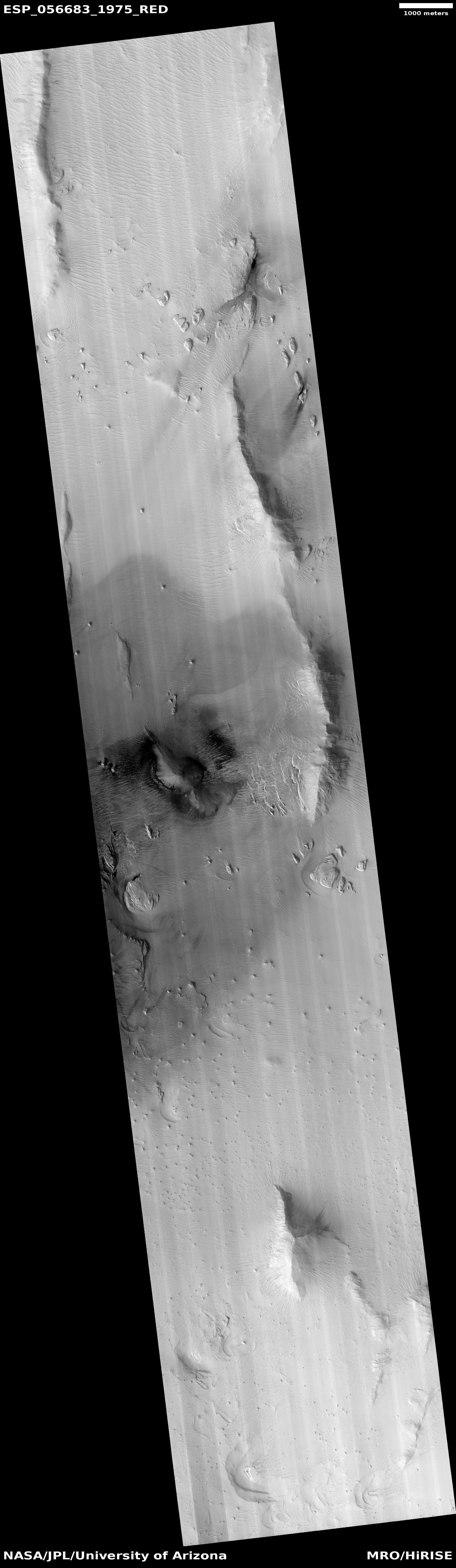
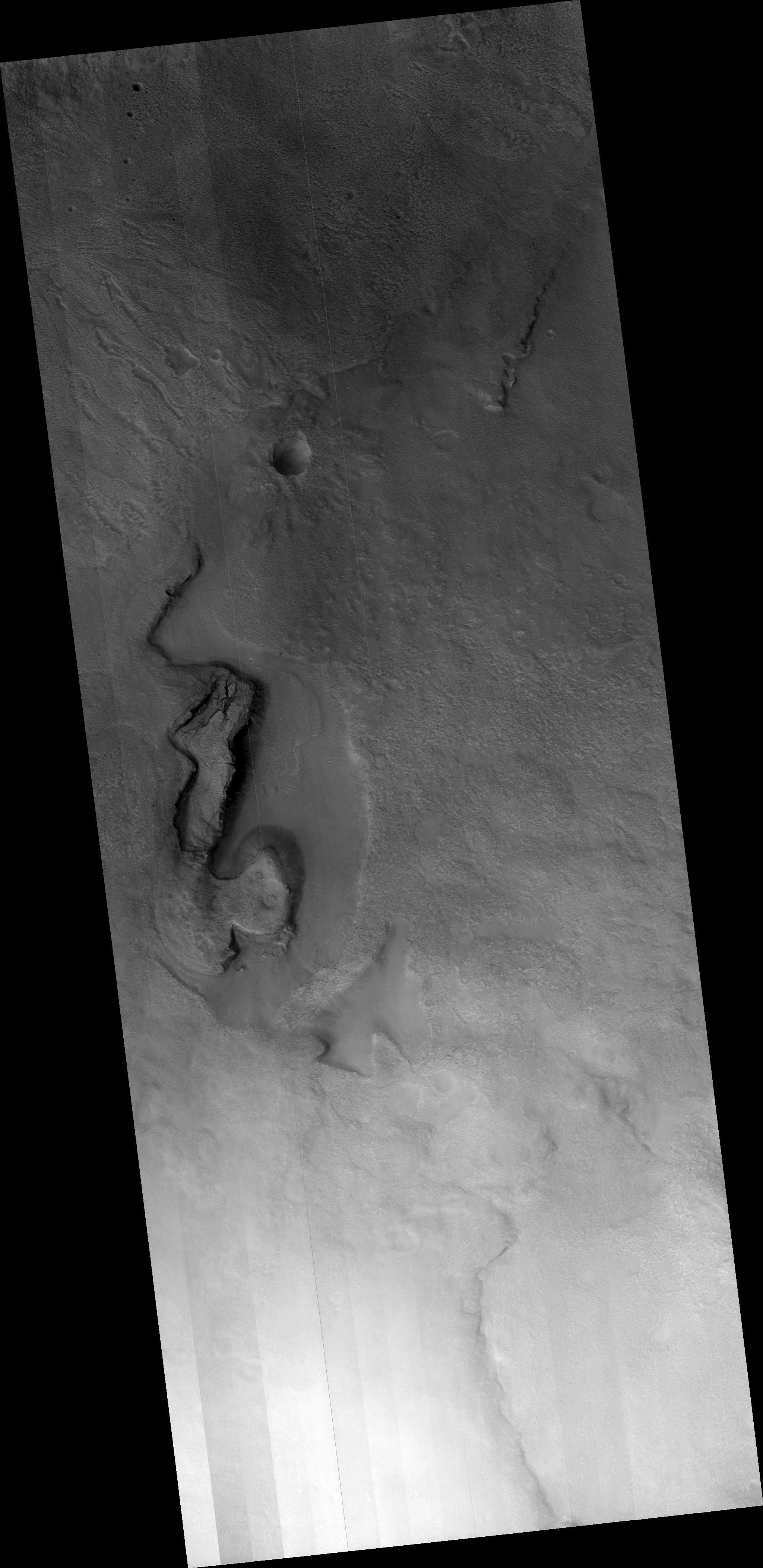
Cool image time! The photo to the right, cropped and reduced to post here, was taken on May 13, 2021 by the high resolution camera on Mars Reconnaissance Orbiter (MRO). It shows a cluster of small depressions from which has blown dark material across the ground to the south. The full image also shows two craters north and south of this cluster that have similar dark material blown from their interiors.

When I first looked at this image, I wondered if the dark material and these depressions signaled a recently active volcanic vent where magma had spewed upward to stain the nearby ground. See for example this recent post about what some scientists believe might the most recent volcanic event so far found on Mars. I emailed several scientists for their thoughts, all of whom said this appears to not be active volcanism but merely windblown dark material.

Kim Seelos, science operations lead for MRO’s visible-near infrared spectrometer, put it simply. “My own reading of this image is that the dark areas here are likely akin to wind streaks.” Instead of the dark material being thrown from the depressions by a volcanic event, it was swept to the south by the prevailing winds.

How that dark material got into the depressions, and why it was so comparably darker than the surrounding terrain, remains unclear. David Horvath of the Planetary Science Institute in Arizona speculated that the low hills just north of the dark patch might be a factor.
» Read more

2 comments

Two smallsat orbiters to launch in ’24 to study Martian upper atmosphere

NASA has picked a twin orbiter mission being built by a partnership of the University of California-Berkeley and the private rocket company Rocket Lab to place two smallsats in orbit around Mars to study how the harsh environment of space might be causing the red planet to lose its atmosphere.

The entire project is dubbed ESCAPADE (an insanely contrived acronym) but the two smallsats have been dubbed “Blue” and “Gold.”

The mission builds on decades of experience at SSL in building satellite instruments and fleets of spacecraft to explore regions around Earth, the moon and Mars, specializing in magnetic field interactions with the wind of particles from the sun. Each of the two satellites, named after UC Berkeley’s school colors, will carry instruments built at SSL to measure the flow of high energy electrons and ionized oxygen and carbon dioxide molecules escaping from Mars, magnetic field detectors built at UCLA and a probe to measure slower or thermal ions built at Embry-Riddle Aeronautical University in Daytona Beach, Florida.

With twin satellites, it is possible to measure conditions simultaneously at two places around the planet, Lillis said, allowing scientists to connect plasma conditions at one site to the escaping ion flux at another. Over the course of the mission, the two satellites will change positions to map the upper atmosphere and magnetosphere of nearly the entire planet from an altitude of between 150 and 10,000 kilometers.

Maybe the most important aspect of this mission however is not what it will learn at Mars, but how it is being financed and built. NASA is only paying about $80 million, a tiny amount compared to most past unmanned planetary probes. The university in turn is buying Rocket Lab’s Photon satellite structure rather than building the satellites from scratch. It will configure the instruments to fit into that ready made satellite body, thus saving time and money.

By doing it this way NASA and the planetary science community is increasingly relying on private companies to provide them their planetary probes, rather than building such things by hand themselves, at much greater cost. The result is a growing and thriving private commercial sector that owns and builds its own planetary probes, for profit.

0 comments

Curiosity’s coming mountainous target

Curiosity's upcoming mountainous target
Click for full image.

Overview map


Click for interactive map.

Cool image time! The photo above, taken on August 22, 2021 by Curiosity’s left navigation camera and reduced to post here, looks ahead at the rover’s upcoming mountainous goals. The overview map to the right shows the area covered by this image by the yellow lines. The dotted red line indicates the rover’s original planned route, with the white dotted line its actual path of travel.

The cliff ahead is about 400-500 feet away. The top of this cliff is the Greenheugh Pediment, its blocky top geological layer visible as the dark cap at the top of the cliff face. Back in March 2020 Curiosity had climbed up to view across this pediment, from a point to the northwest and off the overview map to the left. (Go to this link to see what the view was like from there.) Since then the science team has had the rover travel quite a distance, to circle around to now approach the pediment from the east.

The white box marks the area covered by a close-up high resolution mast camera image, shown below.
» Read more

0 comments

New cracks across old Martian lava flows

New cracks across an old lava flow
Click for full image.

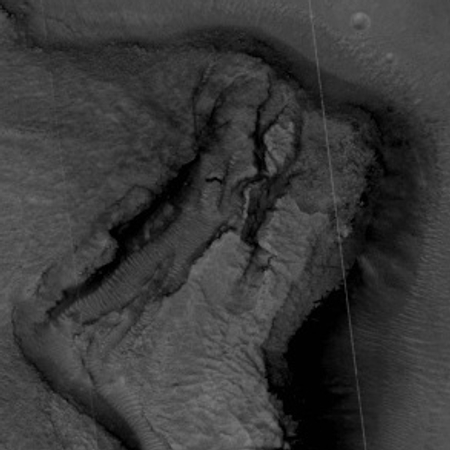
Cool image time! The photo to the right, cropped and reduced to post here, was taken on June 4, 2021 by the high resolution camera on Mars Reconnaissance Orbiter (MRO). It captures one of the many deep straight fissure canyons that make up the feature dubbed Cerberus Fossae in the center of Mars’ volcano country.

The crack is called a graben, and happens when the ground is either stretched from pressure from below, or when two adjacent large blocks of material move sideways relative to each other.

What makes this particular graben interesting are two features. First, the overlapping break suggests something complex took place at this spot when the crack separated. Second, the crack cut across the foot of an older frozen lava flow, meaning it has to be younger than that flow.

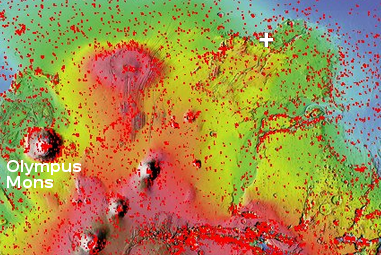
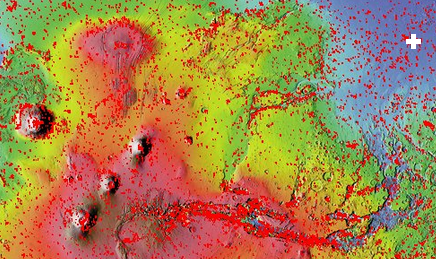
The overview map below provides a clue when that lava flow might have occurred, while also suggesting this crack in Cerberus Fossae might be much younger than expected.
» Read more

6 comments

Perseverance’s next drill attempt

Perseverance short term planned route
Click for full image.

The Perseverance science team today announced its near-future plans for where it will send the rover, but also when and how it will attempt its next core sample drilling.

The map to the right, cropped and reduced to post here, shows the rover’s future route. The red dot indicates its present location. The blue dot indicates where next they will attempt to drill. The route shows that they have decided to also make a short side trip south, an target that until now was considered optional.

As for what they plan to do in that next drill attempt:

We will first abrade the selected rock and use the science instruments to confirm (to the best of our ability) that the new target is likely to result in a core after the sampling process.

If we choose to sample the rock, Perseverance will perform a set of activities very close to what was done on the prior coring target. The main difference will be, after coring, we’ve added a “ground in the loop” session to review the images of the tube in the bit and confirm a sample was collected. Then, the tube will be transferred into the rover for processing.

If post-coring imagery shows no sample in the tube, we may elect to try again, using an alternate geometry (e.g. more horizontal) for the coring activity. Another option, if the targeted rock doesn’t allow for a change in geometry, is to look for a different rock in this region that is more easily cored horizontally.

They really want to get a sample of this particular bedrock on the floor of Jezero Crater. Their problem is that the first core sample failed because the bedrock was too structurally weak, crumbled into powder during drilling, and thus poured out of the drillbit once retracted from the ground. It could be that this will be a consistent issue with any sample attempts in this bedrock. This is why they are also considering drilling sideways, in order to hold any material they grab.

I suspect that the short side trip south might be to an outcrop that the rover could drill sideways into. Thus, if they are successful in getting a sample at the blue dot they might still cancel that side trip.

0 comments

Japan to attempt sample return mission to Martian moon

Japan’s space agency JAXA today announced that it will launch in ’24 an unmanned probe to the Martian moon Phobos that will return a sample to Earth in ’29.

The plan is to bring back about 10 grams of material.

If launched as planned, Japan will beat everyone in getting the first samples back from Martian space. China says it hopes to grab samples from Mars itself by 2030, while the U.S. and Europe hope to launch a mission to return the Perseverance cached samples sometime in the 2030s.

3 comments

A weak avalanche season on Mars?

The north pole scarp
Click for full image.

Today’s cool image from Mars is cool both for what is visible in the photo and for what is not, the latter of which might turn out to be a discovery of importance.

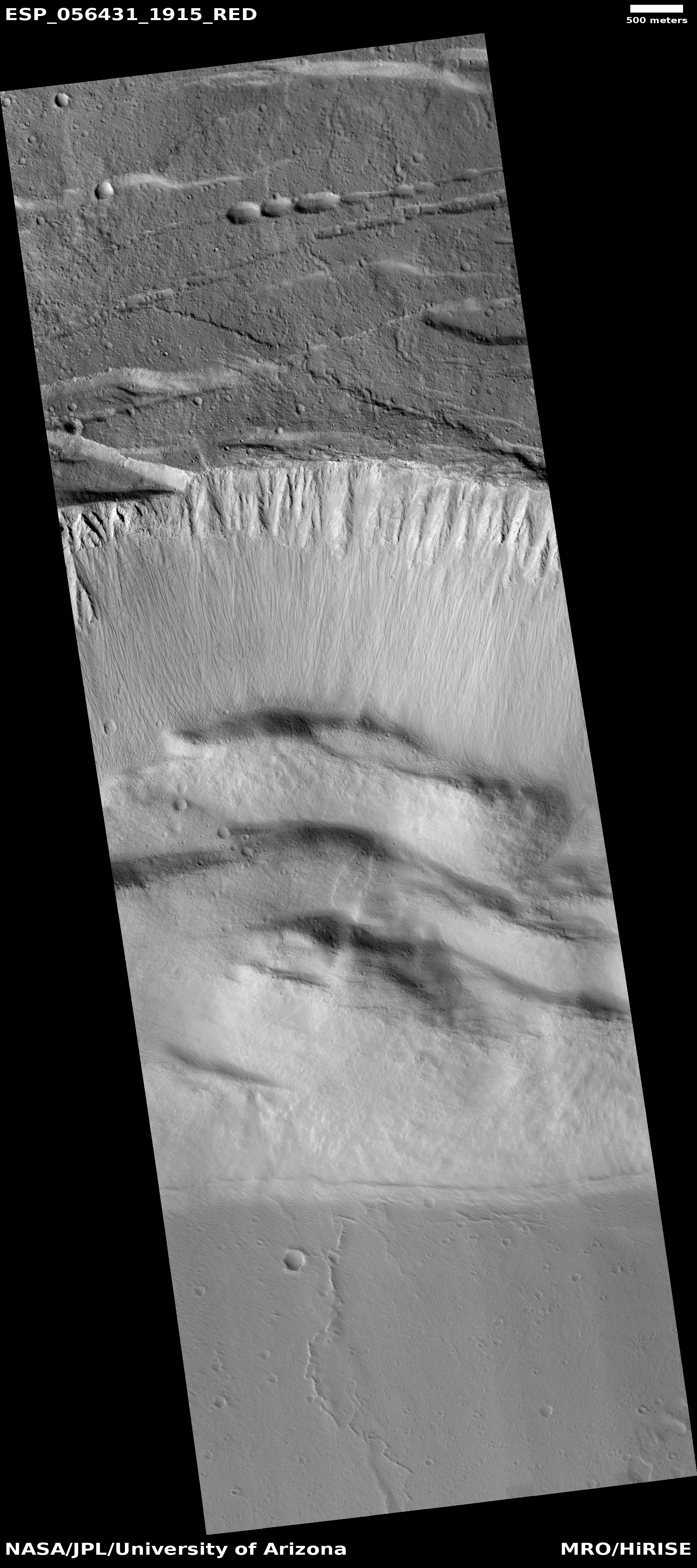
The photo to the right, cropped and reduced to post here, was taken on June 24, 2021 by the high resolution camera on Mars Reconnaissance Orbiter (MRO). It shows a section of the edge of Mars’ north polar ice cap, with north at the top.

This scarp is probably more than 2,000 feet high, though that height drops to the south as the upper layers disappear one by one from either long term erosion or sublimation. Those layers represent the visible information in the photo that is cool. They give us tantalizing clues about the geological and climatic history of Mars. Each layer probably represents a climate period when the north icecap was growing because the tilt of the planet’s rotation was even less than the 25 degrees it is now. When that tilt is small, as small as 11 degrees, the poles of Mars are very cold, and water ice migrates from the mid-latitudes to the poles, adding thickness to the icecaps. When the tilt grows, to as much as 55 degrees, the mid-latitudes are colder than the poles, and the water ice migrates back to the mid-latitudes.

What is not visible in this picture, however, might be far more significant.
» Read more

0 comments

A dry bedrock Martian crater floor?

A dry bedrock crater floor?
Click for full image.

Cool image time! The photo to the right, cropped and reduced to post here, was taken on June 21, 2021 by the high resolution camera on Mars Reconnaissance Orbiter (MRO). The location is a very eroded crater at about 26 degrees north latitude. The image shows the crater’s crater floor, with a variety of bedrock-type features, sharp ridges, abrupt scarps, and flat smooth plateaus, with a hint of lobate glacial flows in the image’s southeast quadrant.

At 26 north latitude, it is unlikely that anything here is icy, unless it is very well protected by debris. Most of these features are almost certainly bedrock, though their formation could very well have been shaped by ice in past eons when this location was more amenable to water ice.

The wider MRO context camera image of the entire crater, plus the overview map, give a larger picture, and raise some interesting questions.
» Read more

2 comments

Curiosity produces new 360 degree hi-res panorama

360 degree hi-res panorama from Curiosity
Click for full resolution image.

The Curiosity science team has used the rover’s high resolution camera to produce a new 360 degree panorama, with the center of the image looking directly up at Navarro Mountain.

To get a really good idea of what this panorama shows, I have embedded below a video the scientists have produced giving a tour of the image, which reveals two especially interesting details. First, their future route will go between Navarro Mountain (the highest visible peak) and the 80-foot-high dark butte to its right. This is as planned, as indicated by the red dotted line on the overview map show in this July 8, 2021 post.

Second, the air was very clear when this panorama was taken, and so the rim of Gale Crater can be distinctly seen, 20 miles away.

» Read more

2 comments

Zhurong completes its planned 90-day mission on Mars

China’s state-run press announced today that its Mars rover Zhurong has successfully completed its planned 90-day mission, is operating without issues, and will continue its exploration of the Red Planet.

The rover has traveled 889 meters as of Aug. 15, and its scientific payloads have collected about 10 Gb of raw data. Now the rover runs stably and operates in good condition with sufficient energy. The CNSA added that the rover will continue to move to the boundary zone between the ancient sea and the ancient land in the southern part of Utopia Planitia and will carry out additional tasks.

According to the administration, Zhurong operated with a cycle of seven days during its exploration and detection. Its navigation terrain camera obtained topographic data along the way to support the rover’s path planning and detection target selection.

Zhurong’s subsurface detection radar acquired the data of the layered structure below the Martian surface, which analyzes the shallow surface structure and explores the possible underground water and ice. [emphasis mine]

This announcement reveals two tantalizing details. First, they are extending the mission, and plan to continue traveling to the south, with a very long term fantasy goal of reaching the transition zone between the northern lowland plains that Zhurong landed in and the southern cratered highlands. That fantasy goal is about 250 miles away. At the pace Zhurong is traveling, about 1,000 feet per month, it will take about a 100 years to cover that ground. Even so, as they move south they are slowly going up hill, and have the chance of seeing some change in the geology along the way.

The second tantalizing detail is indicated by the highlighted last sentence, and is probably the most important data obtained by Zhurong. It suggests they obtained good data from the rover’s ground penetrating radar, and it indicated the existence of underground layers. Whether those layers contain ice however is not clear. From the story it appears the data has not yet been analyzed enough to say.

0 comments

Lacy patterns in the high north of Mars

lacy patterns in the high north of Mars

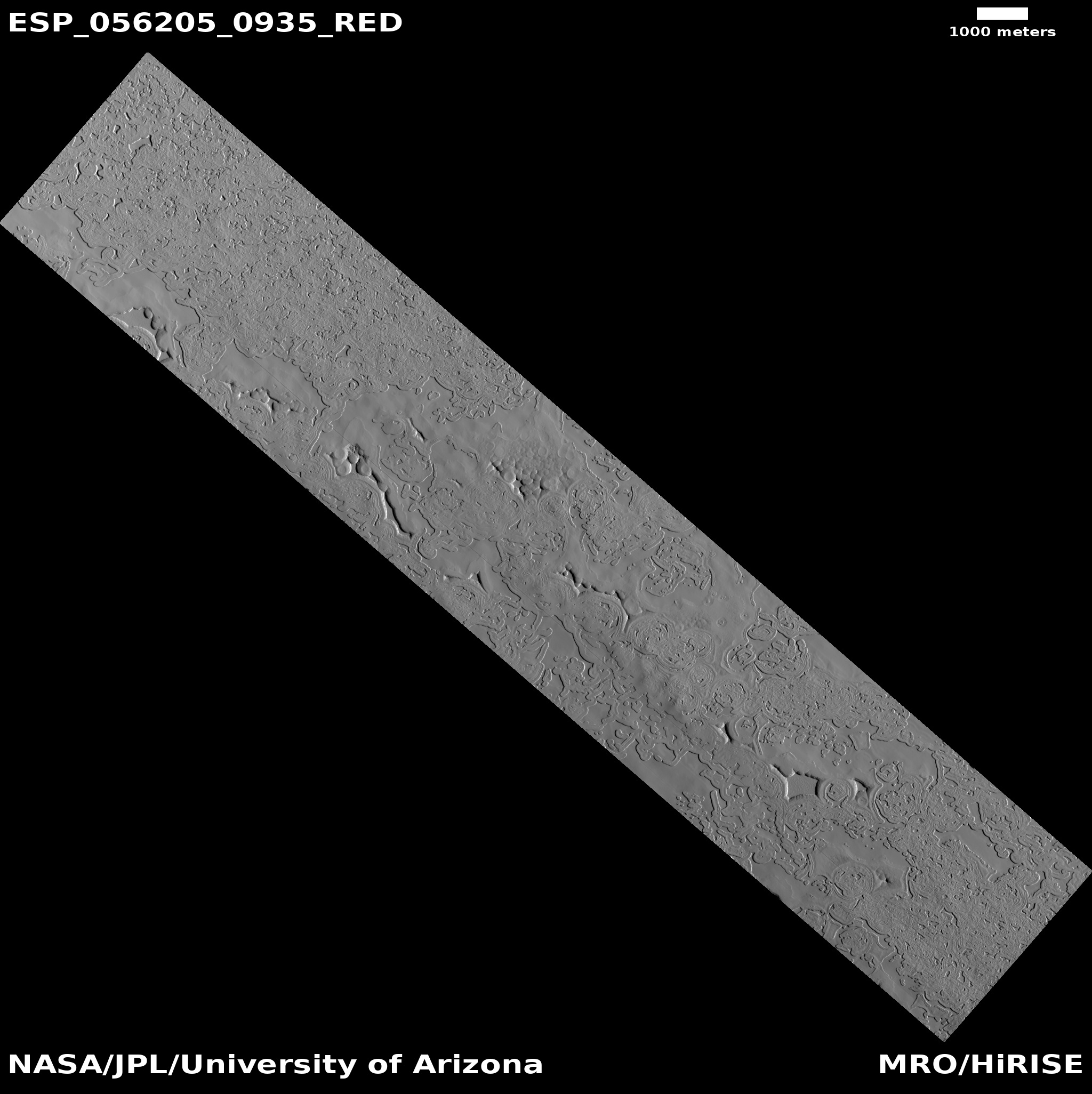
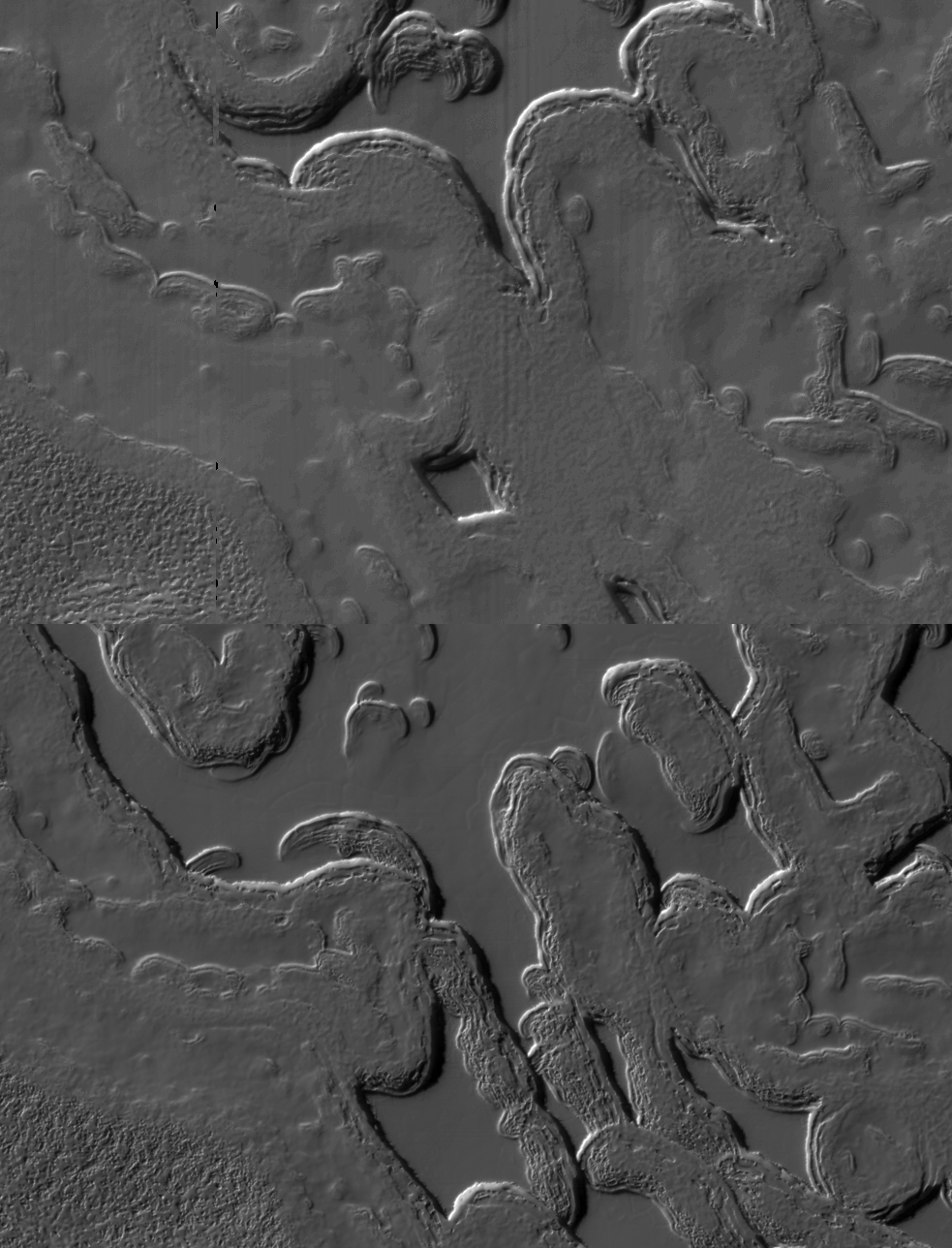
Cool image time! The photo to the right, cropped, reduced, and rotated so that north is up, was taken on May 12, 2021 by the high resolution camera on Mars Reconnaissance Orbiter (MRO). It shows the strange lacy patterns seen routinely in the very high northern latitudes surrounding the Martian north pole.

Located in a region of the vast northern lowland plains dubbed Scandia Tholi, such features are apparently common here. From a 2011 geology paper of the region’s geological history:

We find that Scandia Tholi display concentric ridges, rugged peaks, irregular depressions, and moats that suggest uplift and tilting of layered plains material by diapirs and extrusion, erosion, and deflation of viscous, sedimentary slurries as previously suggested. These appear to be long-lived features that both pre-date and post-date impact craters.

The small circular feature near the bottom of the picture appears to be a mesa, and might be a pedestal crater, so old that the surrounding terrain has worn away and left the hardened-by-impact crater as a butte. To its right is a larger circular mesa with its scarp well eroded into hollows. This might also be a pedestal crater, or not.

The white lacy patterns could be frost, either water ice or dry ice. That the white lace tends to favor the north-facing slopes lends support to this guess. The photo was taken in the early spring, so the thin mantle of carbon dioxide that falls to cover the polar region south to sixty degrees latitude is only beginning to sublimate away.

0 comments
1 89 90 91 92 93 212